TCS Researchers Celebrate Their O(n^72649 lg^72(n)) Polynomial Triumph
Why is this CS Fundamentals meme funny?
Level 1: Technically a Winner
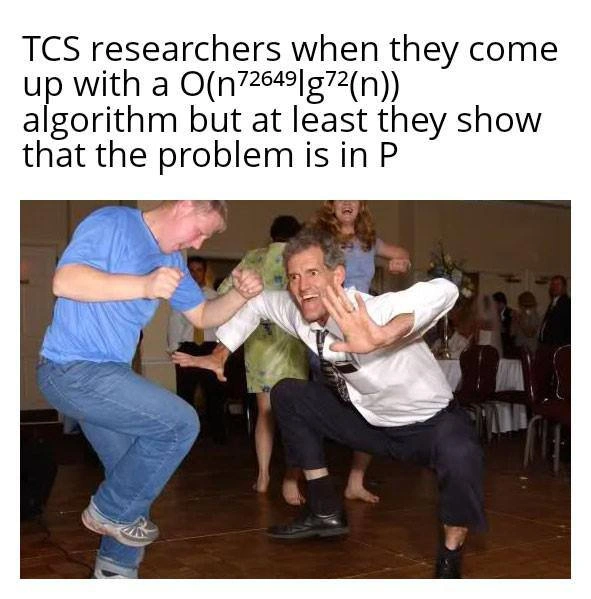
Imagine someone bragging they found a way to walk to the moon — and they can prove the path exists, every step of it. Sure, the walk would take longer than anyone could ever live, but the path is real, and that's what they were trying to prove! The picture shows them celebrating with the world's most embarrassing dad-dance while everyone else stares. It's funny because they're genuinely thrilled about something completely useless in everyday life — like winning a trophy for the world's slowest race — and they're dancing like they just saved the day.
Level 2: P, Big-O, and Why Anyone Dances
- Big-O notation describes how an algorithm's running time grows with input size
n. $O(n^2)$ means doubling the input roughly quadruples the work. - P is the class of problems solvable in polynomial time — $O(n^k)$ for some constant
k. It's the formal stand-in for "efficiently solvable," contrasted with problems believed to need exponential time (the famous P vs NP question lives here). - The catch: the definition doesn't care how big
kis. $O(n^2)$ and $O(n^{72649})$ are both "polynomial," but only one finishes before your laptop dies. - A galactic algorithm is one whose theoretical superiority only kicks in for inputs larger than anything in this galaxy — a real, semi-affectionate term in the field.
If you've taken a data structures course, you learned to flinch at $O(n^2)$ sorting. This meme is what happens seventy-two thousand exponents past that flinch, with the authors high-fiving anyway — because in their world, the category matters more than the clock.
Level 3: The Exponent Is Doing Cartwheels
The image choice is the real comedic engineering. It's the classic banquet-hall photo of a middle-aged man in a white shirt and tie doing a deep-crouch, jazz-hands dance move next to a younger guy in a blue t-shirt mid-flail — the canonical awkward dad dancing meme. The man's expression is pure unguarded triumph, completely uncalibrated to how he looks. That's the joke's load-bearing beam: theoretical computer scientists celebrating a result that, to any practitioner watching from the buffet table, looks exactly this ridiculous.
The meme captures a real cultural fault line between theory and practice. To a TCS researcher, moving a problem from "no known polynomial algorithm" into P is a structural victory — it kills certain hardness conjectures, opens reduction pathways, and earns a STOC/FOCS slot. To a working engineer profiling a hot loop, an exponent of 72,649 is indistinguishable from "doesn't exist." Both are right, and neither fully respects why the other is right. Industry quietly returns the insult, too: production systems happily run worst-case-exponential algorithms (SAT solvers, type inference, regex backtracking) because real-world instances are friendly — the exact inverse of celebrating a useless polynomial. The mutual incomprehension is the banquet hall: everyone's at the same party, dancing to different music.
There's also a sly nod in lg^72(n) — the polylog factor. Stacking seventy-two logarithm factors onto an $n^{72649}$ term is like detailing the cupholders on a car with no engine: rigorous, lovingly analyzed, and cosmically irrelevant. Yet that's exactly the kind of term that gets fought over in the final revision of the paper.
Level 4: Cobham's Thesis Hits the Dance Floor
The caption — "TCS researchers when they come up with a O(n^72649 lg^72(n)) algorithm but at least they show that the problem is in P" — is a precision strike on the philosophical foundation of complexity theory: the Cobham–Edmonds thesis, which declares a problem "efficiently solvable" if and only if it admits a polynomial-time algorithm. The thesis is what makes P the celebrity complexity class. But it's an asymptotic statement, deliberately blind to constants and exponents. $O(n^{72649} \log^{72} n)$ is, formally, polynomial — it sits inside P with the same legal standing as binary search — while being so far beyond physical computability that even $n = 2$ would exceed the operations the observable universe could perform before heat death.
This isn't a strawman; the field genuinely produces such results. They're called galactic algorithms — correct, asymptotically superior, never runnable. The AKS primality test landed primality in P with an exponent (~12 in its original form) too fat for practice; fast matrix multiplication's exponent improvements below 2.373 hide constants so monstrous that everyone still ships Strassen or plain $O(n^3)$. The 2017 deterministic graph-isomorphism progress and various flow/matching breakthroughs follow the same pattern: the classification is the result. The exponent is a confession. The deep reason this is still celebrated is structural: membership in P is robust under composition and machine models, and historically, first polynomial algorithms tend to get their exponents beaten down over subsequent decades (linear programming went from ellipsoid-method "technically polynomial" to genuinely practical interior-point methods). The dance is for the door being opened, not the room behind it.
Description
A classic meme using the 'awkward dad dancing at a party' photo: a middle-aged man in white shirt and tie doing an exaggerated crouching dance move next to a younger man in a blue t-shirt and jeans dancing energetically, in a banquet-hall setting. The caption reads: 'TCS researchers when they come up with a O(n^72649 lg^72(n)) algorithm but at least they show that the problem is in P.' The joke targets theoretical computer science, where proving a problem is in P (polynomial time) is a celebrated complexity-class result even when the polynomial exponent is so astronomically large the algorithm is utterly useless in practice - galactic algorithms in their purest form
Comments
2Comment deleted
It's polynomial, so technically it's tractable - for inputs of size one, before the heat death of the universe
don't we solve such problems with parallelism? Comment deleted