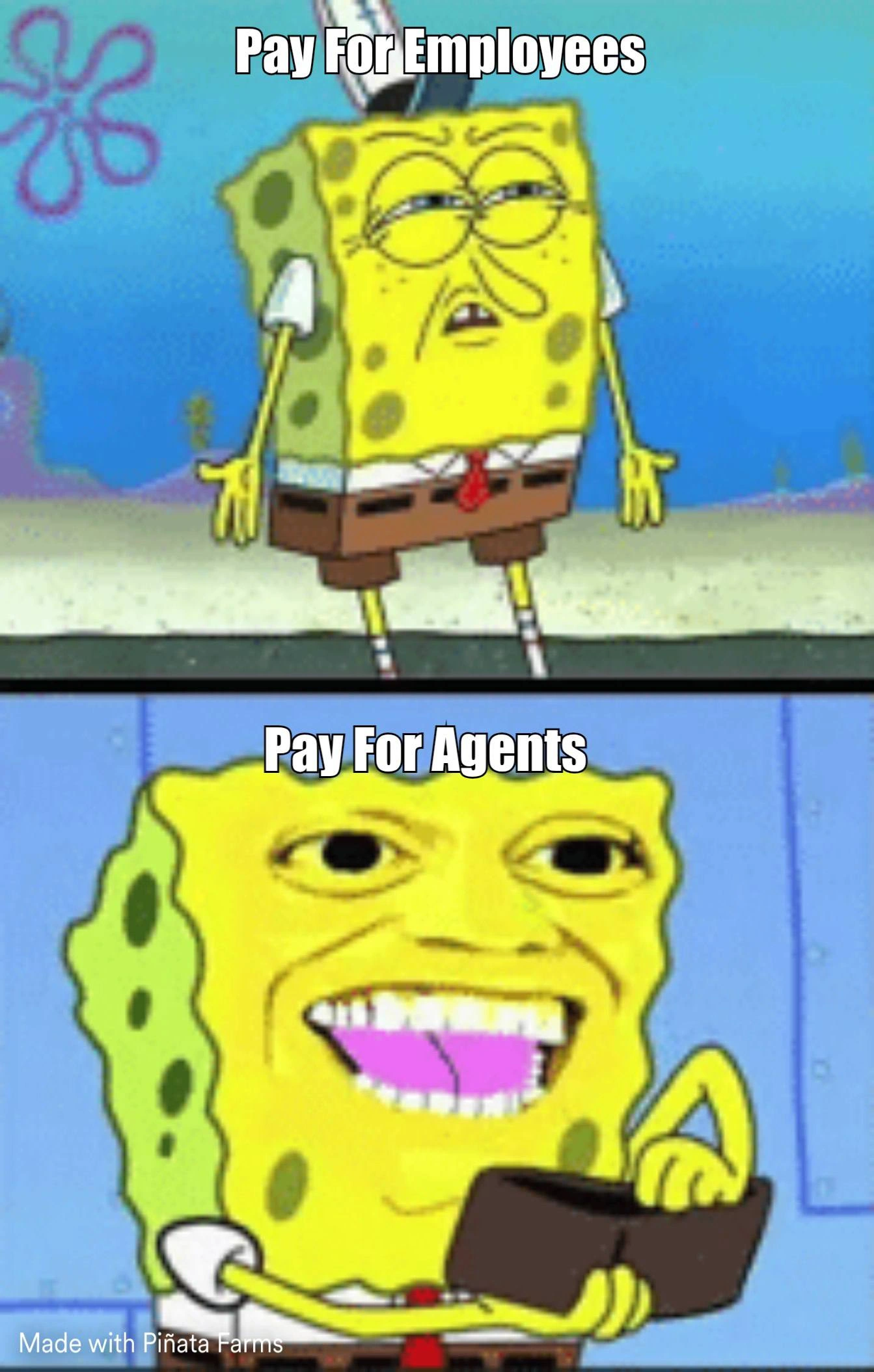
SpongeBob Wallet Meme: Reluctant Payroll, Gleeful AI Agent Spend
Why is this AI ML meme funny?
Level 1: The Allowance Problem
Imagine a kid who groans and drags his feet every time he has to share his snacks with his little brother — but happily empties his entire piggy bank to buy a robot toy that promises it can do his chores. The joke is in the faces: the same person looks miserable paying for something real and helpful, then absolutely thrilled paying for the shiny new thing. It's funny because we all know the robot toy's batteries cost extra, and the little brother still ends up doing the chores.
Level 2: The Vocabulary of the Wallet
- AI agents: LLM-powered systems that don't just answer questions but take multi-step actions — writing code, filing tickets, browsing, calling APIs. Vendors sell them explicitly as "digital workers," which is why the comparison to employees isn't subtext; it's the marketing.
- Headcount: corporate-speak for the number of human employees a team is allowed to hire. Getting headcount approved is famously slow and political; getting a SaaS subscription approved often takes one manager's credit card.
- Token-based billing: agents are billed by usage — every word in and out costs fractions of a cent that compound at scale. Unlike a salary, the monthly total is a surprise.
- The meme template: the bottom panel is the classic "SpongeBob gleefully reaching for his wallet" frame, used for decades to mark irrationally eager spending. Pairing it with the deflated top-panel SpongeBob creates the two-panel contrast format: same subject, opposite enthusiasm.
If you've ever watched a company freeze hiring "for budget reasons" the same quarter it announced a seven-figure AI initiative, this image is just that earnings call drawn in yellow.
Level 3: OpEx Doesn't Have Feelings
Two panels of SpongeBob, one budget meeting's worth of corporate psychology. Top panel, captioned "Pay For Employees": SpongeBob slumped, eyes squinted into resentful slits, arms dangling like a CFO reading a benefits renewal. Bottom panel, "Pay For Agents": the immortal manic-grin-with-wallet-open shot, pupils dilated, billfold already extended toward the nearest API pricing page. (The Made with Piñata Farms watermark confirms this was assembled in roughly the time it takes an enterprise to approve one headcount requisition.)
The meme nails a genuine accounting asymmetry that drives the AI agent spending boom. An employee is the most encumbered line item in corporate finance: salary plus payroll taxes, health insurance, equity, onboarding lag, management overhead, performance review machinery, legal exposure, and — worst of all from the spreadsheet's perspective — the ability to quit, unionize, or ask for a raise. An agent subscription is none of that. It's clean OpEx: a per-seat or per-token charge that scales down as easily as up, requires no 1:1s, and can be terminated with a billing-page click instead of a severance package and an awkward all-hands. Executives aren't just excited about capability; they're excited about commitment-free capacity. The wallet opens gleefully because nothing in that wallet ever comes with an HR ticket attached.
The satire cuts in the gap between the fantasy and the invoice. Anyone running agents in production knows the bottom panel's euphoria has a hangover: token costs are stochastic and usage-correlated in ways salaries never are. An agent that gets stuck in a retry loop, or "thinks harder" on a hard problem, can quietly 10x its burn overnight — there's no labor law capping an agent's overtime because the overtime is the billing model. Meanwhile the work the agents produce still needs humans to review, integrate, and own the blast radius when it's wrong. The companies cutting the top panel to fund the bottom panel often discover they've converted predictable payroll into unpredictable cloud spend, plus a skeleton crew of remaining engineers doing workforce-replacement cleanup duty. The grin is real; so is the bill that arrives after it.
There's also a darker organizational note: the meme's humor depends on both panels being the same guy. It's not two companies — it's one decision-maker whose enthusiasm flips entirely based on whether the spend has a face.
Description
A two-panel SpongeBob SquarePants meme with a 'Made with Pinata Farms' watermark. Top panel, captioned 'Pay For Employees': SpongeBob stands with a sour, squinting, reluctant face, arms hanging dejectedly. Bottom panel, captioned 'Pay For Agents': the classic 'SpongeBob gleefully opening his wallet' shot - manic wide grin, eager eyes, wallet out and ready to pay. The meme skewers 2025-2026 corporate budgeting: executives who grumble about headcount and salaries while enthusiastically throwing money at AI agent subscriptions and token bills
Comments
5Comment deleted
Agents don't ask for raises - they just silently 10x their token consumption and call it 'extended thinking.'
Admin be like: Comment deleted
Third world labor >>>>>>>>>>>>> ANY AI (Coming from a third worlder btw) Comment deleted
I agree (coming from a first worlder) Comment deleted
If the result is absolutely the same, that makes perfect sense in business terms (no management or HR costs, no employee benefits, nothin’ — like paying for a conveyor belt instead of human carriers). However, that’s a very big, I’d say HUGE ‘if’ (the analogy is false 95%+ of time ‘cause the result is not the same, and it’s usually not a conveyor belt vs human carriers but a buggy printer vs an artist) Comment deleted