A Tale of Two Protocols: TCP's Orderly Process vs. UDP's Casual Data Handling
Why is this Networking meme funny?
Level 1: The Careful Messenger vs. The Casual Messenger
Imagine you want to send a bunch of messages to a friend across town. You have two different messengers you can use:
Messenger 1: The Careful Messenger. This person is very careful and a bit strict. If you give them ten messages labeled #1 through #10, they will deliver them one by one in exact order. After delivering message #1, they won’t hand over #2 until they’re absolutely sure your friend got #1. In fact, they’ll wait at your friend’s door until your friend gives a thumbs-up or a receipt for message #1. Only then do they go back to get #2 and deliver that. If along the way a message gets lost, this messenger will notice (“Hmm, I haven’t gotten a thumbs-up for #3, maybe it didn’t arrive.”) and they’ll go back and resend that missing message before moving on. They might take longer to finish the job, but in the end, your friend will get all the messages in the right order. It’s like a very reliable mailman who knocks on the door for each delivery and doesn’t leave until someone answers and signs for the package.
Messenger 2: The Casual Messenger. This person is super laid-back. If you give them the same ten messages, they just grab the whole stack and run to your friend’s place, tossing messages over the fence as they go without even checking if anyone is picking them up. They do not wait for any thumbs-up or receipt. Message #7 might arrive before message #3, but this messenger doesn’t care – they’re not even keeping track of the numbers. If a couple of messages get lost in the wind during the delivery, oh well, that’s just how it goes. They’re done with the job as soon as they’ve thrown all the messages out there. It’s like a newspaper delivery person who just flings the newspapers in the general direction of the houses and moves on to the next street, assuming most of them will land okay. It’s much faster, but there’s a chance some messages never reach or arrive jumbled.
Now, the funny comic is making an analogy with these two messengers. In the comic, TCP is like the Careful Messenger and UDP is like the Casual Messenger:
- In the first picture, the TCP character is freaking out because he found message #2 where #1 was expected. That’s exactly what our careful messenger would do – panic a bit if things are out of order and rush to correct it (in the comic, TCP says he’ll send a note about #1 immediately, which is like our messenger resending a lost message).
- In the second picture, the UDP character is totally chill, letting everything through without checking. He basically says, “Looks like we’re sending data, cool.” That’s our casual messenger who just doesn’t verify anything and keeps going.
This is funny even without knowing computers because it’s a classic cartoon scenario: one character is obsessive about doing things right, and the other is totally easygoing and careless. It’s like a strict teacher who must grade homework in order versus a classmate who just passes your notes around without even looking at them. We often find such exaggerated opposites amusing.
So, in very simple terms:
- TCP is the rule-following, careful delivery guy – he makes sure everything arrives safely and in sequence, even if he has to slow down and double-check things.
- UDP is the carefree, fast delivery guy – he just sends stuff out quickly, but some things might get lost or arrive out of order because he’s not checking.
When people who work with computers see this comic, they laugh because they know their “messengers” (the protocols) behave exactly like that. If you absolutely need something to get there intact, you’d use the TCP approach. If you’re okay with a bit of loss but want speed, you’d use the UDP approach. It’s a bit like choosing between sending a package with guaranteed delivery vs. just tossing a message in a bottle and hoping it arrives. The comic just personifies those two choices in a fun, memorable way. The careful TCP and the casual UDP make a funny duo, and it helps us remember why we have two different methods to send our data.
Level 2: TCP vs UDP Basics
Let’s break down what’s going on in simpler terms. The comic is about two important network protocols that computers use to send data: TCP (Transmission Control Protocol) and UDP (User Datagram Protocol). Both of these live in the transport layer of networking (the part that takes data from one computer and helps get it to another over the internet), but they have very different styles, almost like two different personalities. The joke is showing those personalities in a funny way.
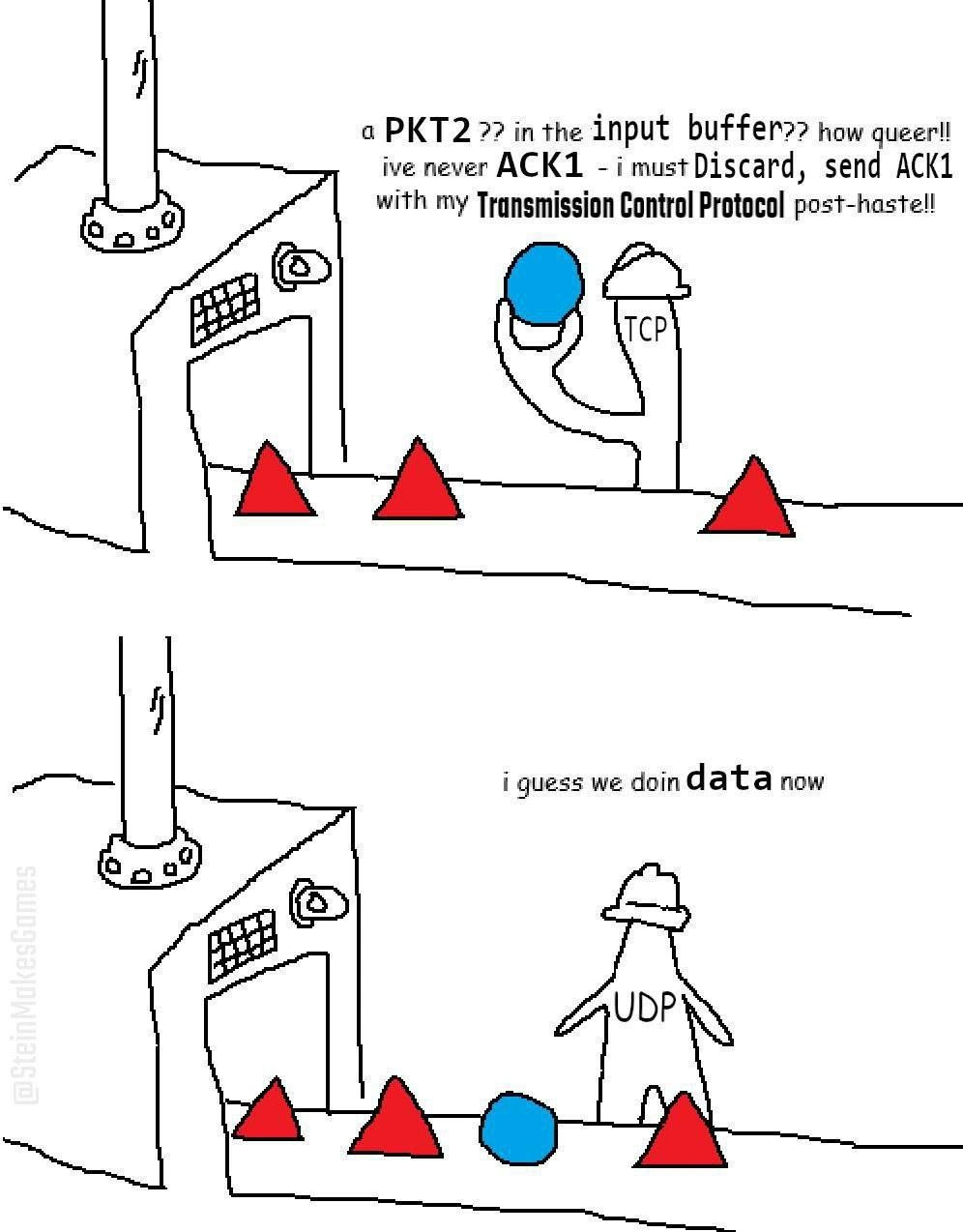
In the first panel (the top image), the character “TCP” is like a factory worker doing quality control on a conveyor belt of packages. The packages on the belt (red triangles and one blue circle) represent data packets coming in. TCP is holding a blue sphere (think of it as one data packet) and freaking out because it’s not what he expected at that moment. He says something overly technical and formal: “I’ve never ACK1 – I must discard, send ACK1 with my Transmission Control Protocol post-haste!!” Don’t worry about the exact wording – it’s deliberately silly – but let’s unpack the terms he’s using and what they mean:
- Packet: When data is sent over a network, it’s broken into small chunks called packets. It’s like if you have a big book, and you mail it page by page in separate envelopes. Each envelope is one packet. In the comic, each of those shapes on the conveyor belt is a packet carrying part of the data.
- Sequence & Order: TCP numbers packets (or the bytes in them) in sequence, like giving each page of that mailed book a page number. It expects to receive them in order: 1, then 2, then 3, etc. In the meme,
PKT2means “Packet 2.” The TCP character findsPKT2in the input buffer when he hasn't yet seen packet 1. That’s like getting page 2 in the mail but page 1 hasn’t arrived yet. He’s thinking “How odd! I haven’t even acknowledged packet 1 yet, and here’s packet 2.” In the comic he says “how queer!!” which in this old-fashioned usage means “how strange!!”. So, TCP is very concerned that things are out of order. - ACK (Acknowledgment): In TCP, whenever the receiver (the computer getting the data) gets a packet, it sends back an ACK to the sender. An ACK is like a little postcard that says “I got your packet number X.” If packet 1 arrives safely, the receiver sends ACK1 to confirm. If packet 2 arrives but packet 1 was missing, the receiver will typically send another ACK1 (essentially saying “I’m still waiting for packet 1”). In the text, when TCP says “I’ve never ACK1 – I must send ACK1!”, it’s reflecting that: TCP is realizing it never got to send an ACK for packet 1 (since it never got packet 1), so it’s going to send an ACK1 now (essentially a reminder or duplicate acknowledgment for packet 1) to tell the sender “Hey, I need packet 1!”.
- Discarding Out-of-Order Data: TCP is shown discarding that unexpected packet (the blue sphere, packet 2). In real life, TCP might either drop it or put it aside until the missing piece arrives, but importantly, TCP will not deliver packet 2’s data to the application until packet 1 is also received. It’s as if our careful mailman got page 2 but not page 1 of the book, and refuses to hand page 2 to you until he has page 1 to give you first – because he wants you to read it in the correct order. So in the comic, TCP removing the blue sphere from the belt is him saying “Nope, not going to process this yet. This isn’t the packet I expected next. First, I’m going to ask for the missing one.”
So, in summary for the top panel: TCP is portrayed as a very strict, by-the-book process. He checks every packet, makes sure they’re in the right order, and if anything’s off, he stops and tries to fix it (by requesting the missing packet). This is why, in real networks, TCP is reliable: it makes sure all the data gets through in the correct order, but that can involve some waiting and re-sending behind the scenes.
Now, the bottom panel shows the “UDP” character. This guy is just standing by the conveyor belt with a more relaxed posture. The packets (the red triangles and blue circle) just flow past him, and he doesn’t stop them or pick them up. He says, “I guess we doin data now,” in a very casual, whatever-happens-happens way. This represents how UDP works, which is almost the opposite of TCP in approach:
- No Connection, No Ordering: UDP is often described as “connectionless” and it doesn’t sequence packets like TCP does. There’s no continuous conversation or checking between the sender and receiver. So, if we go back to our mailing analogy, using UDP is like dropping a bunch of postcards in the mailbox to send a story, without numbering them at all. If they arrive out of order to your friend, they’ll just have to deal with it, and if some never arrive, you (the sender) might never even know.
- No ACKs: The UDP receiver (the computer getting UDP packets) does not send back acknowledgments for each packet. In the comic, notice UDP doesn’t talk about ACKs or missing packets at all. He just says “we doin data now,” implying he’s just letting whatever data arrives pass through. So if packet 1 didn’t show up and packet 2 did, UDP isn’t going to send any “ACK1” or ask for anything. It will either deliver packet 2 to the application immediately (out of order) or just drop packet 2 if the application can’t handle out-of-order data. The key point: UDP itself won’t try to recover or even report a lost packet.
- Best-Effort (Unreliable) Delivery: UDP is often called a best-effort protocol. It will do the basic job of getting a packet from A to B, but with no guarantees. It’s like our casual messenger who throws all the letters over the fence and leaves – maybe all the letters arrive, maybe one gets lost in a bush. He’s not checking. In many cases, surprisingly, that’s okay! For example, when you stream music or video, it’s often okay if one small packet of data doesn’t arrive; you’d rather have the music continue with a tiny glitch than stop everything to recover that one packet. UDP is used for that kind of scenario. In contrast, you wouldn’t use UDP for, say, downloading a file, because you’d end up with holes in your data if packets got lost.
This comic is funny to people who know about networking because it exaggerates these behaviors. But even without deep knowledge, you can grasp the basic comedic contrast:
- TCP is like a super careful person who follows every rule and double-checks everything (ensuring reliability and order).
- UDP is like a carefree person who just goes with the flow and doesn’t worry about details (allowing some data to be lost or messy).
To give an everyday life analogy:
- Using TCP is like sending a series of important packages with tracking and requiring a signature for each one. You send package #1, and you wait to get a confirmation receipt that it was delivered before you send package #2, and so on. If a package gets lost, you notice and resend it. It’s safe and organized, but a bit slow and requires effort.
- Using UDP is like dropping a bunch of postcards in the mail to different people all at once. You’re not checking if they arrive. If one gets lost, you might not even know unless someone tells you they didn’t get it. It’s fast and easy, but there’s a risk some postcards won’t make it or will arrive jumbled.
In the meme, TCP’s speech and behavior shows the “careful package” approach, and UDP’s one-liner shows the “postcard, whatever happens” approach. It’s a humorous illustration, but it’s actually a decent memory aid for these concepts. After seeing this, you might remember: TCP is the one fussing over order and acknowledgments, UDP is the one that just doesn’t bother. And that’s exactly the main difference.
One more thing: neither TCP nor UDP is “bad” or “good” universally – they each have their uses. The comic jokes about TCP being slow or overly strict and UDP being lazy, but really, it’s about choosing the right tool:
- If you need all your data perfect and in order (like loading a webpage, transferring money, sending an email), you use something like TCP.
- If you need speed and can tolerate a bit of mess (like a live video call, online game updates, or a quick lookup of an address), you might use UDP and design your app to handle the occasional dropped packet.
So, the comic strip is a fun way to remember the difference: it’s like having two co-workers handle your data – one is an eagle-eyed inspector (TCP) and the other is a laid-back mover (UDP). Seeing them side by side makes it clear why we have both methods. And it gives you a little chuckle because of how extremely those personalities are drawn!
Level 3: Packet Perfectionist & Data Slacker
What makes this comic especially hilarious to seasoned developers is the way it personifies these protocols with opposite personalities. We have two stick-figure workers on an assembly line of data packets – a classic metaphor in developer humor for data moving through a system. The figure labeled TCP is the ultimate packet perfectionist: he’s checking every item on the conveyor belt, making sure nothing is out of sequence, much like a senior engineer double-checking every step of a deployment. The text above his head is over-the-top formal (using phrases like “how queer!” and “post-haste!”) to caricature TCP as an overly pedantic protocol butler.
TCP: "a PKT2 ?? in the input buffer?? how queer!! I’ve never ACK1 – I must Discard, send ACK1 with my Transmission Control Protocol post-haste!!"
If you’ve spent time in networking, you know TCP does have that butler-like thoroughness – it won’t even deliver data to an application until everything that came before is in perfect order and confirmed. The comic nails this by showing TCP literally plucking a packet off the line because it arrived “out of place” and triggering a flurry of protocol actions (discarding it and sending a duplicate ACK for the missing packet 1). Experienced engineers reading this can nod knowingly because they’ve seen similar scenarios in real life. For example, when debugging a sluggish connection, you might capture packets and notice that one lost packet caused a chain reaction of duplicate ACKs and retransmissions – exactly the sort of overreaction our TCP character is comically acting out. It’s “too real” how one missing segment can make TCP momentarily freak out and pause the stream, much like our hard-hat TCP figure halting the conveyor belt in dismay.
Now look at the UDP character in the second panel – he’s the epitome of the data slacker, a totally chill worker on the line. He doesn’t check anything; he just watches packets go by with a relaxed stance. He even delivers a single, shrugging line that perfectly captures UDP’s philosophy:
UDP: "i guess we doin data now"
That one casual sentence tells you everything: UDP’s attitude is basically “Whatever comes, comes. I’m just here to move data along.” This is exactly how UDP feels from a developer’s perspective. There’s no handshaking or double-checking; UDP doesn’t even know if the other side got the message. It’s the networking equivalent of a YOLO approach (“You Only Live Once”): send it and forget it. The humor here thrives on the personification – one protocol is a neurotic stickler for order (think of an OCD librarian or an overzealous QA engineer), and the other is a carefree messenger (think of a guy in shorts and flip-flops delivering mail, whistling a tune, not caring if a letter or two blows away). For anyone who knows the udp_vs_tcp trade-offs, this contrast is instantly recognizable and funny. It’s basically a buddy-cop comedy dynamic applied to network protocols: TCP is the strict by-the-book veteran detective, UDP is the rookie who “goes with the flow.”
The reason developers find this so amusing is because it reflects real-world design choices and the sometimes comical extremes of those choices. In system design discussions, it’s common to joke about TCP and UDP in exactly this way. For instance, say you’re building a multiplayer game or a live video streaming app. Someone on the team might quip, “We need this to be fast, let’s use UDP and just hope for the best,” essentially channeling the UDP character’s vibe. Then someone else (with TCP’s mindset) might respond, “But what if packets get lost? Are we just gonna shrug? Maybe we should use TCP or at least implement some checks.” This is a classic debate in protocol design: do you choose reliable_transport with all its safety nets (and overhead), or do you choose raw speed and simplicity and handle any fallout yourself? The meme simplifies that debate into a funny visual: one guy rigorously enforcing reliability (TCP), the other blissfully ignoring it (UDP).
Think of scenarios many devs have faced:
- You’re watching a video on a flaky Wi-Fi connection. If the streaming is using TCP (say, an older protocol), a brief dropout might make the video pause (buffering) because TCP is waiting to fill in the missing pieces – just like TCP in the comic stopping the line for the missing packet. Frustrating, right? Now, many modern streaming services use UDP-based protocols under the hood so that if a packet is lost, they skip it and keep playing, which might cause a momentary drop in quality but no full pause – that’s UDP’s style, akin to the comic’s UDP who keeps the line moving regardless.
- Or consider online gaming: Many real-time games use UDP for sending positions and actions. If one update gets lost, oh well, another is coming shortly. The game doesn’t freeze; maybe your character teleports slightly or a shot doesn’t register, but play continues. If those games used TCP for every little update, one lost packet could freeze the action while the game engine waits for the missing data. Gamers and developers alike joke that “UDP is the way to go for games, unless you enjoy lag spikes caused by TCP’s obsessive need to recover every lost packet.”
The conveyor belt and factory_packet_flow imagery in the meme also resonate with engineers because we often visualize data moving through systems in such ways. The TCP character even mentions an “input buffer.” In reality, TCP sockets do use buffers to hold incoming data. The depiction of TCP saying it will discard a packet because it arrived out of order (and then sending an ACK for the earlier one) is a spot-on dramatization of how packet_ordering is maintained. It’s a bit exaggerated (modern TCP might not literally throw the data away, it could just hold it until the missing part arrives), but the effect is the same: TCP will not deliver that blue sphere (packet 2) to the application until it gets the missing red triangle (packet 1) that was supposed to come first. By contrast, UDP has no such buffer or mechanism — if a blue packet comes after a red packet, it just delivers both as separate messages in whatever order they arrived, or drops one, who knows. The UDP figure’s indifferent stance – just letting everything slide by – is the perfect visual punchline to drive home that lack of checks.
There’s also an element of tech nostalgia and inside-joke here. Notice how the TCP figure’s speech is written in a flowery, somewhat antiquated style (“how queer!! … post-haste!!”). This is a playful nod to TCP’s age and formality. TCP emerged from the 1970s era of the ARPANET and has been the bedrock of internet protocols for decades – it’s battle-tested and somewhat old-school. By giving TCP an old-timey gentleman’s voice, the meme hints at this history, as if TCP is a veteran engineer wearing a monocle. UDP, while also an old protocol, is portrayed in a modern, colloquial way (“we doin data now” feels like something a chill millennial or Gen-Z might say casually). This contrast in language adds another layer to the joke: it’s like the stodgy old professor vs. the easygoing student – a trope that works in humor and fits the actual characteristics of these protocols.
For those in the know, there’s even more humor in imagining the consequences: the TCP person would be sending frantic messages back upstream (ACKs for the missing packet) and probably writing a stern log entry about this anomaly, whereas the UDP person would, at most, just shrug and maybe drop a note saying “some data might’ve been lost, oh well” (if even that!). In countless bug discussions or war stories, engineers have personified systems in exactly this way. For example, “The load balancer was like UDP – it didn’t care that half the requests never got a response.” or “Our transaction system is as strict as TCP; it will roll back everything if one tiny thing is out of place.” So the meme is not only explaining a technical difference, it’s riffing on a broader cultural habit in tech of giving human traits to abstract systems to explain their behavior.
In summary, the combination of the strict packet perfectionist (TCP) and the carefree data slacker (UDP) on a conveyor belt hits a sweet spot of engineer humor. It visualizes a dry concept (packet delivery semantics) in a relatable way. Seasoned developers laugh because they see a reflection of real computing behaviors exaggerated as a workplace comedy. And indeed, once you’ve debugged networking or had to choose between TCP and UDP for a project, you can’t help but imagine, just as this comic does, TCP as an overworked clerk meticulously stamping “APPROVED” on each packet in order, and UDP as the guy who rubber-stamps a whole stack of packets at once without looking. It’s a memorable and educational joke, one that you might even show a junior colleague who asks “Why would I ever use one protocol over the other?” because in two panels, it captures the essence of that answer with a laugh.
Level 4: Precise Packet Policing
In the meme’s first panel, the stick figure labeled TCP is effectively performing the duties of a reliable transport protocol’s receiver state machine. The text “a PKT2 ?? in the input buffer?? how queer!!…” humorously depicts an out-of-order packet (packet number 2 arrived when packet 1 hasn’t been seen or acknowledged yet). This is a direct reference to TCP’s handling of sequence numbers and acknowledgments. According to the Transmission Control Protocol (TCP) specification, the receiver expects data in a strict order; if it receives a segment with a sequence number higher than the next expected one, it does not immediately accept it as in-order data. Instead, classic TCP behavior (especially in older implementations or simplified depictions) is to either buffer the out-of-order segment or drop it, and then send a duplicate ACK for the last contiguous byte it received (which in this case would be an ACK for packet 1, often denoted ACK1). This duplicate ACK is a signal to the sender that something is missing – essentially “I’m still expecting packet 1, please resend it.” The meme exaggerates this with the TCP figure exclaiming in a posh, old-fashioned tone about never having “ACK1” (acknowledged packet 1) and deciding to discard PKT2 and urgently re-send an acknowledgment for packet 1 “post-haste.” This dramatization is poking fun at how meticulous and strict TCP’s delivery guarantees are: it polices packet order rigorously, ensuring nothing is out of place before moving on.
What’s being referenced here is the fundamental mechanism of ARQ (Automatic Repeat reQuest) algorithms that TCP employs under the hood. Specifically, TCP’s reliable delivery is often compared to protocols like Go-Back-N or Selective Repeat. (Modern TCP with selective acknowledgments can buffer out-of-order packets, but early illustrations treat it akin to Go-Back-N for simplicity – out-of-order packets trigger fast retransmission by duplicate ACKs). The meme uses anthropomorphism to make this advanced concept relatable: the TCP worker behaves like a finite state machine sticking to the protocol – he has an internal counter of the “next expected packet” and is alarmed when he sees something beyond that. In formal terms, TCP assigns each byte (or packet) a sequence number. The receiver tracks the next sequence number it wants. If it gets data with the right sequence number, great – it passes it up to the application and moves the window forward (sending an ACK for that number). If it gets a higher sequence number (meaning a gap), classical TCP will send an ACK for the last correct sequence (essentially saying “I’m still at sequence 1, waiting for it”), and it might store the new data temporarily. The excessively proper language (like “how queer!” and “post-haste!”) satirically emphasizes how protocol-pedantic TCP is about following its rules to the letter.
Conversely, in the second panel, the figure labeled UDP stands back, uttering “i guess we doin data now” as the mixed shapes just flow by. This captures User Datagram Protocol (UDP)’s philosophy of “send and forget”. UDP is a connectionless protocol – it doesn’t establish a session or maintain a sequence. There’s no concept of an “expected next packet” built into UDP. Each UDP datagram is independent; the protocol will forward whatever comes down the line directly to the application, with minimal fuss. If one datagram is lost or arrives out of order relative to another, UDP itself remains blissfully unaware – it neither reorders data nor asks for missing pieces. The UDP figure’s nonchalant attitude (“we doin data now”) is a perfect caricature of UDP’s simplicity – as if to say, “Whatever I got, I deliver, no questions asked.” This highlights that best-effort delivery nature: UDP provides no guarantees of reliability or ordering, trading those off for low overhead and latency.
From a protocol design perspective, the meme humorously contrasts key design goals of these two core network protocols. TCP is designed for reliable, ordered transport over the inherently unreliable IP network. It achieves reliability through checksums, acknowledgments, retransmissions, and timers. There’s a known theoretical constraint in distributed networking: to guarantee delivery, some form of acknowledgment and retry is necessary (a concept stemming from the "Two Generals Problem" and formalized in protocols via ARQ). TCP’s creators (circa RFC 793 in 1981) implemented a solution that ensures data integrity and in-order arrival at the cost of complexity and overhead. This includes mechanisms like the three-way handshake to establish a connection, sequence numbers to order bytes, ACKs to confirm receipt, and even congestion control algorithms to avoid flooding the network. That strictness is a hallmark of TCP – it treats data like a conveyor belt that must be quality-checked and serialized exactly as sent.
UDP, defined in RFC 768, was intentionally kept minimal – essentially just a thin wrapper over IP with ports and a checksum. Why? Because not all applications need the heavy machinery of TCP. Some applications prefer to implement their own logic on top of a simpler substrate, especially for use cases where speed or continuous flow matters more than absolute reliability. For example, real-time applications (voice calls, video streaming, online games) often use UDP to avoid the latency that TCP’s careful handshaking introduces. They tolerate or handle occasional data loss themselves (e.g., a lost video frame or voice packet might just result in a brief glitch rather than halting the entire stream). In a sense, if TCP is a strict librarian ensuring every book is in order, UDP is a casual messenger who just delivers whatever arrives and moves on – if something didn’t show up, oh well, maybe it wasn’t vital.
To seasoned engineers in networking, this stark contrast is both very familiar and a rich source of tech humor. The meme’s factory conveyor belt is a classic metaphor in network humor for a data pipeline. The TCP worker acts like an overzealous quality control inspector stopping the line for any anomaly (enforcing packet ordering and correctness), whereas the UDP worker is like an easygoing colleague who lets everything through, embodying best-effort service. It’s funny because it’s fundamentally true: anyone who has dealt with sockets and protocols knows that using TCP vs UDP is a decision between guaranteeing delivery or embracing uncertainty for the sake of simplicity and speed.
To put the difference in a concise form:
| TCP (Reliable Transport) | UDP (Best-Effort Datagram) |
|---|---|
| Connection-oriented: a handshake establishes a session between sender and receiver. | Connectionless: no setup – it just starts sending. |
Ensures in-order delivery of bytes. If data arrives out of order, it waits or requests retransmission (as humorously shown by ACK1). |
No order guarantees; datagrams may arrive in any order or not at all. The protocol doesn’t mind (the UDP figure just “doin data now” with whatever comes). |
| Reliable: lost packets are detected (missing sequence causes duplicate ACKs or timeouts) and retransmitted until acknowledged. It will try hard so that data eventually gets delivered. | Unreliable: if a packet is lost, UDP itself won’t resend it. There’s no feedback to the sender about loss at the protocol level. |
| Has flow control and congestion control (adjusts rate to network conditions). | No inherent flow or congestion control (the application must handle any such logic if needed). |
| Larger header (20 bytes + options) and more processing due to sequencing, ACKs, etc. More overhead per packet. | Very small header (8 bytes) with just port, length, checksum. Minimal overhead – faster, but leaves reliability to the app if required. |
This table underscores why the TCP character in the comic is so alarmed by a missing piece, while the UDP character is unfazed. It’s a humorous illustration of each protocol’s core algorithmic behavior: one is like a rigorous accountant cross-checking every transaction, the other like a free spirit who just delivers messages and moves on. In essence, the meme distills a bit of networking theory into a visual gag, and to those well-versed in NetworkProtocols, it’s immediately recognizable why TCP would be freaking out about an unexpected PKT2 and why UDP just couldn’t care less.
Description
A two-panel, minimalist comic strip drawn in a simple black-and-white line style, comparing the TCP and UDP networking protocols. A watermark on the left side reads '@SteinMakesGames'. In the top panel, a factory-like machine has a conveyor belt with red triangular packets and one blue circular packet. A character labeled 'TCP', depicted as a cautious figure, holds up the blue packet and says, 'a PKT2 ?? in the input buffer?? how queer!! ive never ACK1 - i must Discard, send ACK1 with my Transmission Control Protocol post-haste!!'. This illustrates TCP's strict, in-order, and reliable nature, where packets received out of sequence are discarded until the expected packet is acknowledged. In the bottom panel, the scene is similar, but a new character labeled 'UDP', drawn as a laid-back figure in a hard hat, stands casually amongst the packets on the conveyor belt, simply stating, 'i guess we doin data now'. This humorously captures the essence of UDP as a 'fire-and-forget' protocol that does not guarantee order or delivery, prioritizing speed over reliability. The meme is a classic personification of fundamental computer science concepts
Comments
8Comment deleted
TCP is that senior engineer who insists on a full JIRA ticket, peer review, and sign-off for a one-line config change. UDP just pushes straight to main on a Friday afternoon
TCP is the architect who blocks the release until every review comment gets an ACK; UDP is the intern who slaps “LGTM,” hits merge, and calls it “eventual delivery.”
After 20 years of debugging distributed systems, I've realized TCP and UDP perfectly represent the two types of senior engineers: those who triple-check every deployment with rollback plans and monitoring alerts, and those who push straight to prod on Friday because 'the tests passed locally and besides, we have good observability now.'
This perfectly captures the existential difference between TCP and UDP: TCP is that senior engineer who's seen every edge case, maintains a 47-step checklist for deploying a single packet, and will retry indefinitely until they get that ACK - even if it means the user's video call has already ended. UDP is the pragmatic architect who knows that for real-time systems, a dropped frame beats a 3-second buffering delay, and sometimes 'good enough now' beats 'perfect eventually.' The real joke is that after 20 years in the industry, you realize both are right - it just depends on whether you're building a banking system or a multiplayer game. Though let's be honest, we've all shipped that UDP-based feature that should've been TCP because 'the network is reliable, right?'
TCP: full audit on every packet. UDP: 'It'll get there or it won't - retransmit in userland if you care.'
TCP sends a dup-ACK and kicks off fast retransmit; UDP read the SLO as “best effort” and promoted the packet straight to prod
TCP refuses PKT2 without ACK1 - classic head‑of‑line blocking; UDP: “Stateless means never having to say you’re sorry.”
for those who wonder Comment deleted