Skip to content
DevMeme
717 of 7435
Imaginary Loop Variables
CS Fundamentals Post #813, on Nov 14, 2019 in TG

Imaginary Loop Variables

Why is this CS Fundamentals meme funny?

Level 1: It’s Always “i”

Imagine you have a big stack of 10 identical boxes and you want to label them in order. You could come up with unique names like “Alice, Bob, Charlie…” but that’s a lot of work for plain boxes. The easy way? Just call them “Box 1, Box 2, Box 3, … Box 10.” Simple, right? In the same way, when programmers have to count things or go through a list in a program, they use a super simple name for the counter: they just call it i. It’s like calling the first box “Box 1” – i is basically programmer for “first thing, second thing, third thing…” We all use it because it’s quick and everyone else knows what it means. The meme is funny because it points out this common habit. Instead of coming up with a creative name each time, developers almost always pick i. It’s our little default name for any loop, just like always naming your first pet goldfish “Goldie.” Everyone in on the joke sees √–1, remembers that equals i in math, and laughs because they know it’s true: when in doubt, just use i!

Level 2: Naming Loops 101

Let’s break this down more simply. In programming, a loop is a way to repeat a set of instructions multiple times. You often use a loop variable to keep track of the iteration count or to access each element in a list one by one. For example, consider a basic loop in Python:

# Loop from 0 up to 4 and print each number
for i in range(5):
    print("Loop iteration number:", i)

Here, i is our loop variable (also called a counter or index). On the first iteration, i = 0; next time, i = 1; then 2, 3, and so on. The loop stops when i reaches 4. We used print to show the value of i each time, so this code would output:

Loop iteration number: 0  
Loop iteration number: 1  
Loop iteration number: 2  
Loop iteration number: 3  
Loop iteration number: 4  

Now, the meme is specifically about what name developers choose for that loop variable. We could name our loop variable almost anything (within the rules of the language). For instance, we might call it counter, index, num, or even banana if we felt silly. But by far the most common choice in practice is just the single letter i.

Why i? In this context, think of i as short for index. It’s also the first letter of words like iterator or integer, which fit the idea that i is an integer counting something. But honestly, the real reason is convention: everybody uses i because, well, everybody uses i. It’s a habit taught from the very beginning. If you open any programming textbook or tutorial, when they show how to write a loop, the code will almost always use i as in for i in range(...): or for (int i = ...; ...; i++). So new programmers naturally follow that pattern. It’s like how in algebra class, the teacher might say “let i be the counter in this sum from 1 to N.” We carry that same idea into code.

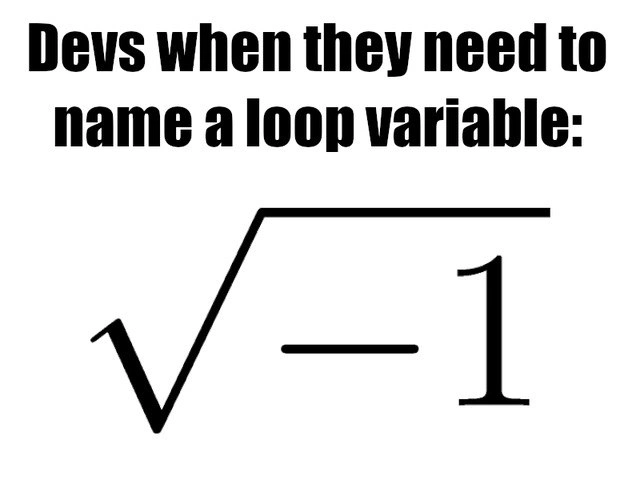
The top text of the meme, “Devs when they need to name a loop variable:”, sets up the scenario: a programmer is sitting there thinking, hmm what should I call this loop counter?. And the image below provides the punchline answer by showing √–1. If you’ve had some math, you’ll recall √–1 is a special number. There’s no “real” number that squares to -1, so mathematicians defined a new number i (called the imaginary unit) to be √–1. It’s a cornerstone of complex numbers in math. So basically, the image is a sly way of saying “the answer is i.” The meme assumes viewers know that little math fact, so they’ll translate √–1 to the letter i in their head.

So putting it together: the meme is joking that when devs have to decide on a name for a loop variable, their brain just pops out “i” (as if by some mathematical instinct). It’s humorously suggesting that we don’t even consider other names; we just conjure this one-letter name out of nowhere, much like pulling the imaginary number out of thin air.

Now, outside of jokes, there is a bit of a reasoned approach here. In code, single-letter variables are usually avoided because they can be confusing — if you just see x or y in code, you might wonder “what is that?”. But loop indices are a well-known exception. Using i in a small loop is so standard that it doesn’t confuse people; in fact, many would find i clearer than a longer name in that context. It’s universally understood to mean “this is just a simple counter”. If we had multiple loops, we’d use j for the second loop, and maybe k for the third, following alphabetical order. This convention comes straight from mathematics and old-school programming practices.

For someone new to coding, the key takeaway is: i is the go-to name for a loop counter. It doesn’t stand for anything fancy — you can pretend it stands for “index” — but really it’s just tradition. Every programmer will know what you mean. If you saw code like:

for (int index = 0; index < 10; index++) { ... }

that works fine, but if you saw

for (int i = 0; i < 10; i++) { ... }

you’d understand it just as easily. In fact, most people reading the code mentally pronounce i as “index” anyway. It’s so ingrained that many coding style guides explicitly say “it’s okay to use i, j, k for loop counters.” They might discourage one-letter names elsewhere, but i in a loop gets a thumbs-up because it’s been the inside joke and standard for ages.

Also, remember that if the loop is iterating over something more concrete — say, a list of names — then we often use a meaningful name. For example, for name in names_list: is clearer than for i in names_list: because in that case i wouldn’t convey what it represents (is i an index? an item?). But when you just need a number to count iterations or access by index, i is perfectly convenient.

In summary, this meme is taking a lighthearted jab at how programmers default to the letter i whenever they set up a loop. The mathematical symbol √–1 is a nerdy way to say “i”, so it’s illustrating that thought process in a creative way. It’s funny to us because it’s so true — almost every developer, no matter what language they use, has written loops with an i counter. It’s like a little universal quirk of programming culture.

Level 3: Imaginary Unit, Real Convention

Now step into the shoes of a seasoned developer reading this meme. The header says “Devs when they need to name a loop variable:” and below it is the radical sign with –1. Immediately, an experienced engineer smirks, recognizing that √–1 is the mathematician’s hint for the imaginary number i. The joke is that when faced with the oh-so-difficult task of naming a simple loop counter, developers almost always choose i. It pokes fun at our own habits: after all the complex architecture decisions and fancy design patterns, we still default to the simplest one-letter variable name for something as routine as a loop.

This touches on a famous running gag in software development: naming things is hard. There’s an oft-quoted saying:

“There are only two hard things in Computer Science: cache invalidation and naming things.”
(…plus the inevitable off-by-one error, making it three!)

We constantly emphasize good naming for code clarity, yet here we are, reusing the same tiny name over and over. The meme highlights that paradox. We agonize over descriptive, meaningful identifiers for most variables, but the humble loop index is the exception — we all just name it i without a second thought. It’s a decades-old inside joke in programming.

So why i in the first place? In this context, i stands for index (or some say iterator). It’s the classic loop variable in C-style languages and beyond. Ever since the early days of C programming, tutorials and books have featured loops like:

for (int i = 0; i < n; ++i) {
    // 'i' is the loop index, counting from 0 up to n-1
}

When you see code like that, you instantly know i is just a number that goes 0,1,2,… up to n-1, typically used to access array elements array[i] or repeat something n times. The practice was so prevalent that anyone reading C (or Java, C++, C#...) learns by osmosis that for (int i ... ) means a loop with i as a counter. This convention is reinforced from your very first programming class or tutorial. If you learned Python first, you undoubtedly saw examples like for i in range(10):. If you learned JavaScript, it was for (let i = 0; i < 10; i++). It’s language-agnostic: i is the loop variable nearly everywhere.

And it doesn’t stop at i. If you need a nested loop (a loop inside a loop), the time-honored pattern is to use j for the inner loop, and if you go one level deeper, k for the next. It’s i, j, k — like x, y, z of looping. For example, iterating over a matrix (2D array) might look like: for (int i=0; i<rows; i++) and inside it for (int j=0; j<cols; j++). Every C/Java developer instantly recognizes that i is the row index and j is the column index in this context, without needing a comment. These letters are ingrained as our generic counter names. It’s almost an unwritten rule or a piece of tribal knowledge passed down through generations of devs.

Here’s where CodeQuality and modern practices enter the discussion. Today, clean code guidelines usually advise against single-letter variable names, because in most cases x or y doesn’t tell you much about what the variable holds. We strive for self-documenting code like:

total_price = 0
for item in shopping_cart:
    total_price += item.price

In that example, item is nicely descriptive. But consider a simpler task: summing numbers 1 to N. A loop like for num in range(1, N+1): total += num would be fine, yet many of us would just write for i in range(1, N+1): total += i. And everyone reading it is okay with that. Why? Because in the tradition vs. readability tug-of-war, i has achieved a special status: it’s so traditional that it is readable. In the very specific context of a loop counter, a single-letter name actually doesn’t reduce clarity at all — every programmer knows i means a simple index. In fact, some style guides explicitly call out that short names like i, j, k are acceptable (even preferable) for loop indices, precisely because any longer name would be redundant. Naming a loop counter loopCounterIndexNumber would just prompt seasoned devs to roll their eyes (and maybe offer you a gently sarcastic “Wow, that’s... descriptive”).

This meme strikes a chord with senior engineers because it’s a shared experience. We’ve all gone through code reviews or team discussions about naming, where someone will insist on clearer naming for almost everything except the loop variable. That one gets a free pass. VariableNaming in other cases might spark debate, but nobody argues when you use i in a for loop. In fact, if you broke convention and used x or counter in a trivial loop, some folks might jokingly ask, “Why not just i? Did the classic i offend you or something?” It’s that ubiquitous.

There’s also a bit of historical practicality behind this. In the early days, short variable names weren’t just convenient, they were economical. Older languages and compilers had limits on name lengths, and memory was scarce. Why use 10 characters when 1 will do? Of course, nowadays those limitations are gone, and we could name everything super explicitly. But habits persist, especially when they’re harmless and handy. Using i is quick to type, universally understood, and unlikely to conflict with any other name in your code. It’s a tiny act of coding convenience that’s survived through generations of evolving languages and programming paradigms.

For a senior dev, the humor also carries a touch of nostalgia. Seeing √–1 instantly evokes that high-school algebra moment of learning i, and then it collides with decades of muscle memory typing for (int i = 0; ... ). It’s a reminder that as much as technology changes, some things stay the same. We chuckle because we’ve all been there: opening a blank loop and the fingers just auto-complete “i” before the brain even engages. The meme is basically saying: “When a dev has to think of a loop variable name, they summon the imaginary number i out of thin air” — as if we pretend to be all creative but end up using the same old letter every time. It’s self-deprecating humor for the coding crowd. We know it’s a trivial cliché, and that’s exactly why it’s funny. Everyone from a grizzled low-level C hacker to a modern Python enthusiast can relate and think, “Ha, guilty as charged — we do always reach for i.”

Level 4: Algebraic Notation in Code

In the realm of computer science and mathematics, a single letter often carries significant meaning. The meme cleverly uses the √–1 notation — as any mathematician or CS student knows, this denotes the imaginary unit usually represented by the letter i. This single letter is more than just a placeholder; it reflects an algebraic notation tradition that programming inherited from math. For example, mathematicians have long used letters like i, j, k as generic indices in summations or arrays (e.g. ∑i=1N to sum something N times). Early computer science simply carried this forward. In formal algorithm pseudo-code, one often writes for i = 1 to N to indicate a loop — mirroring math’s use of i as a running index.

Historically, this convention even shaped language design. FORTRAN (one of the first high-level languages, in the 1950s) had a rule that any variable name starting with I, J, K, L, M, or N was implicitly an integer unless declared otherwise. This was no coincidence — those letters were traditionally used for integer counters in math (I for “integer” or “index”). In other words, i literally had a built-in role as a loop counter in the language’s design! So from the very beginning, code and math agreed: if you need a stand-in symbol to count things, start with i.

This highlights a deeper concept: programming, at its core, is a form of symbolic mathematics. We use concise symbols (often single letters) to represent varying quantities. Just as x is the unknown in equations and i is the imaginary unit satisfying i² = –1, in code i became the de facto symbol for a loop index that iterates through values. It’s a direct borrowing of algebraic shorthand into software. And speaking of i² = –1: the letter chosen to represent the loop index is the same letter representing an imaginary number in math. In complex number theory, i is a cornerstone of the complex plane (Euler’s famous identity $e^{i\pi} + 1 = 0$ showcases i’s almost mystical mathematical significance). In everyday programming, however, i is usually far less exotic — it might just take on the values 0, 1, 2, 3… up to N-1, stepping through array indices one by one.

Interestingly, different fields use different symbols for √–1. Electrical engineers, for instance, use j to denote $\sqrt{-1}$ because i is commonly used for electric current. Coincidentally, in programming when we nest loops, if i is taken for the outer loop, we use j for the inner loop (and then k for the next). It’s a funny cross-disciplinary parallel: in math and coding, when i is busy, j is the next helper symbol in line. This meme riffs on that shared symbolic legacy. The use of √–1 to hint at “i” operates on a very nerdy level — it’s acknowledging that deep down, a lot of our coding patterns come straight from algebra class. We’re seeing an imaginary math concept repurposed as a very real coding convention. In short, the meme’s punchline exploits the rich connection between mathematical notation and programming practice. It reminds us that a seemingly trivial naming habit has roots in the fundamental language of mathematics.

Description

A simple meme with black text on a white background. The top text reads, "Devs when they need to name a loop variable:". Below this, there is a large mathematical symbol for the square root of negative one (√-1). This is a clever mathematical pun. The square root of -1 is an imaginary number, represented by the symbol 'i'. In many programming languages, 'i' is the conventional and most common variable name used for the index or counter in a loop (e.g., `for (int i = 0; i < n; i++)`). The meme humorously equates this standard programming practice to a fundamental concept in mathematics

Comments

7
Anonymous ★ Top Pick Why do programmers prefer 'i' for loops? Because 'j' is just 'i' after it's been through a gnarly code review and had to be completely refactored
  1. Anonymous ★ Top Pick

    Why do programmers prefer 'i' for loops? Because 'j' is just 'i' after it's been through a gnarly code review and had to be completely refactored

  2. Anonymous

    Euler unintentionally became our style-guide author - 200 years later every for-loop still ships with his single-letter API surface

  3. Anonymous

    Twenty years in, still using 'i' for loops while enforcing strict naming conventions in code reviews that would make Uncle Bob weep with joy

  4. Anonymous

    The real reason we use 'i' for loop variables isn't laziness - it's because after debugging nested loops with i, j, k, l, m, n, we've all entered an imaginary dimension where variable names lose all meaning. At least mathematicians had the decency to stop at 'i'; we keep going until we're using Greek letters and contemplating our life choices at 2 AM

  5. Anonymous

    Architects mandate 'loopIndex' for readability, but every prod codebase secretly increments the imaginary 'i'

  6. Anonymous

    Twenty years of style guides and code reviews, and the only global standard we actually follow is that loop counters start at the imaginary unit - then increment straight into off-by-one hell

  7. Anonymous

    Name it i because readability is imaginary - then j and k show up and Big O starts standing for ‘oh no’

Use J and K for navigation