Skip to content
DevMeme
5174 of 7435
The Linux Community's Consensus on the 'systemd Sucks' Debate
OperatingSystems Post #5667, on Nov 17, 2023 in TG

The Linux Community's Consensus on the 'systemd Sucks' Debate

Why is this OperatingSystems meme funny?

Level 1: We Still Like You

Imagine you and a bunch of friends are all part of the same team, and the team decided everyone has to wear the same jersey. You really don’t like this new jersey and you even shout, “This jersey is the worst!!” But instead of getting upset with you, all your friends just smile and give you a big group hug. They’re all wearing that jersey, and guess what – you’re wearing it too, because you’re on the team. They know you don’t love it, but you’re still one of them, and you’re going to play together anyway. It’s funny because you complained really loudly, but nothing changes – you’re still stuck with the jersey like everyone else, and they still include you with a thumbs-up. In other words, you can yell that you hate what everyone’s doing, but all the big friends around you will just shrug, hug you, and keep doing it. They still like you, no matter what. That’s the warm joke here: even if you grumble about the rules everyone agreed on, you’re still part of the family and they’ll treat you kindly.

Level 2: One Big Linux Family

Let’s break down what’s happening in this comic for those newer to Linux and open source culture. The cartoon is about Linux distributions (different versions of the Linux operating system, like Ubuntu, Fedora, openSUSE, Arch Linux, etc.) and a piece of software called systemd. First, know that when a Linux computer starts up, there’s a special first program, often called init, that launches all the other processes. Systemd is one modern type of init system – basically the startup manager for Linux. A few years back, not all Linux systems used systemd; there were other init systems (for example, “SysV init” which used old-style scripts, or Ubuntu’s former choice called Upstart). But systemd came along with a new approach to managing startup and services, and over time it became the default choice in almost every big Linux distro.

Now, what does “systemd sucks” mean? This is something you’d hear in Linux forums or geeky chats. Some people felt systemd was too complex or too controlling. They were used to the old ways and didn’t like that systemd kind of took over many tasks (it handles starting programs, but also logging, scheduling tasks, etc., all in one). They would say “systemd sucks” to express frustration or preference for the old minimalist approach. It became a bit of a meme or running joke in the Linux world – kind of like a catchphrase for folks resisting change.

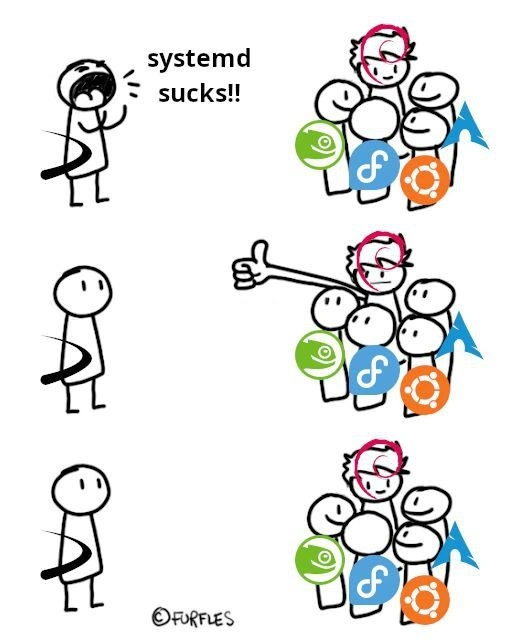
In the comic’s first panel, the stick figure on the left yelling “systemd sucks!!” represents one of these critics or unhappy users. On the right side, the group of six stick figures huddled together each represents a major Linux distro (short for distribution). We can tell who they are by their logos drawn on them:

  • The green spiral with a chameleon is the logo of openSUSE (a popular Linux distro from the SUSE community).
  • The blue circle with an “f” is Fedora (a cutting-edge distro backed by Red Hat).
  • The orange circle with three little shapes is Ubuntu (one of the most popular user-friendly Linux distros).
  • The blue pointed shape is the Arch Linux logo (a lightweight, do-it-yourself style distro for advanced users).
  • The top figure has a pink swirl on its head – that likely hints at Debian (Debian’s logo is a pinkish red swirl). Debian is a classic community distro that Ubuntu is based on.
  • There might be another figure representing something like CentOS/Red Hat or others, but the idea is simply “all the big Linux families” are there together.

So basically, every major flavor of Linux is in that crowd. And importantly, all those distros use systemd now as their init system. They might have had different approaches in the past, but today they’ve all converged on systemd.

In panel 2 of the comic, the yelling figure has gone quiet (maybe surprised), and one member of the distro crowd (the one outlined in pink) reaches out with an ridiculously long arm giving a thumbs-up right in front of the complainer’s face. This is a funny, exaggerated way to show the response of the Linux community. Instead of arguing back or getting angry at the “systemd sucks” shout, the distros collectively respond with a friendly thumbs-up – basically saying “It’s okay, we hear you.” It’s like they’re reassuring the critic or just cheerfully acknowledging them. The long arm and thumbs-up is cartoon humor signaling an almost goofy level of friendliness or unity. Panel 3 shows that arm pulled back and the distro group unchanged, still together, and the lone figure just standing there, probably a bit disarmed (no pun intended) because their shout didn’t cause a fight; they actually got a kind of hug instead.

The caption “Shout ‘systemd sucks’ and every major distro still hugs you anyway” sums it up: even if someone yells that they hate systemd, all the main Linux communities will still “hug” them – meaning the person is still part of the family. In real terms, if you use Linux (be it Ubuntu, Fedora, Arch, etc.), you’re pretty much using systemd under the hood whether you like it or not. The Linux community isn’t going to kick you out for complaining; in fact, they’ve largely moved on. They treat the “systemd sucks” thing as an old joke or just an opinion you’re allowed to have. It also implies a bit of “we’ve all adopted systemd, and we’re okay – you will be too”. It’s a wholesome twist: rather than an angry flame war, the community responds with a group hug.

For a newcomer, the meme highlights a piece of open source culture: big debates happen (like over systemd), but at the end of the day, the community stays together. OpenSourceCulture generally is inclusive – people might argue about tools and technologies, but they still collaborate on projects and use each other’s work. Here, all these different distros (which sometimes compete or pride themselves on differences) actually stand united on a core component (they all use systemd now). The lone stick figure could be any Linux user voicing a frustration. The friendly thumbs-up from Fedora, Ubuntu, openSUSE, Arch, Debian (and others) shows that “we’re all on the same side, it’s all good.” Everyone’s still friends even if they disagree on that technical point. It’s a little bit of tech humor and an inside joke for those who know about the systemd controversy. The message to a junior developer or Linux beginner is: Linux has a bunch of different versions, but nowadays they share a lot of the same core stuff (like systemd). If you hear someone say “systemd sucks,” know it’s a long-running joke from when that was a hot topic. Don’t worry – whichever Linux you’re on, it likely uses systemd, and that’s normal. And the community will welcome you, playful teasing and all.

Level 3: Post-Init War Group Hug

At the senior engineer level, this meme hits on a too-real slice of open source community history. It humorously portrays the aftermath of the init system wars – a period when Linux users and maintainers fiercely debated whether systemd should replace traditional init systems. In the first panel, a lone figure yelling “systemd sucks!!” represents those vocal critics (sysadmins, old-school Unix users, or die-hard minimalists) who resisted this sweeping change. Opposite them is a huddle of six stick figures wearing badges of major Linux distributions: we see the green chameleon swirl of openSUSE, the blue Fedora “f”, Ubuntu’s orange “circle of friends”, Arch Linux’s blue arch, and likely Debian (the pink circled head could be a nod to Debian’s swirl logo). Essentially, this crowd is “every major distro.” The humor is that despite the lone shouter’s outrage, the collective response from the distros is a friendly thumbs-up – even a hug. In panel 2, one distro character extends an absurdly long arm to give a big thumbs-up right next to the complainer. By panel 3 the arm snaps back, and the distros remain huddled together as if nothing happened, while the complainer is left standing there, embraced (whether they like it or not).

This is poking fun at how the Linux DevCommunities handled the systemd controversy: with a sort of resigned unity. Years ago, saying “systemd sucks” on forums or mailing lists could spark flame wars spanning hundreds of messages. It was a polarizing topic about OperatingSystems design philosophy and control. Detractors treated systemd as an unwelcome encroachment – some likened it to Windows-like bloat creeping into Linux, or an attack on the “do one thing well” ethos. There were even forked projects like Devuan (a Debian fork without systemd) born from this backlash. Yet, fast-forward to today, and virtually all mainstream Linux distributions have adopted systemd as their default init. Fedora led the charge (being upstream for Red Hat), openSUSE followed, Arch switched relatively early (despite Arch’s ultra-minimalist userbase, they recognized the practical benefits), Ubuntu eventually conceded (after Debian did, Ubuntu dropped its own Upstart to align with the crowd), and Debian itself – after intense internal governance debates in 2014 – settled on systemd. The war of words simmered down because the battle was essentially over: systemd won. The phrase “every major distro” in the title is no exaggeration; from enterprise servers to popular desktops, systemd became the common denominator.

So the comic’s joke is that no matter how loudly you decry “systemd sucks,” you’re still part of the club. The major distro communities aren’t kicking you out or fighting you anymore – instead, they give a figurative hug. It’s a group hug born of inevitability: “We hear you, we know some of you aren’t fans, but hey, we’re all running systemd anyway. Welcome aboard.” This reflects a kind of camaraderie in the OpenSource world. Linux folks might argue ferociously about tech decisions, but at the end of the day, they’re one big ecosystem. There’s an inside joke here that even the most outspoken haters often end up using systemd-powered distros (sometimes grudgingly). The meme captures that irony visually: the solitary critic is basically embraced by the very thing they’re railing against because there’s nowhere else to go in the mainstream.

For experienced developers who lived through this, the panels deliver a knowing chuckle. We’ve seen such scenarios where controversial changes eventually become standard: think of Python 3 adoption (after all the “Python 3 sucks, we refuse to upgrade” drama, everyone uses it now), or Git replacing other VCS tools (resistance was futile, it’s everywhere). The Linux distro unity depicted with logos hugging it out shows that even after something akin to a civil war in the community, there’s a collective we’ll move forward together resolution. The long thumb gesture is especially funny to insiders – it exaggerates how far the community will go to acknowledge dissent but still give a thumbs-up, as if to say “It’s all good, friend.” It’s almost patronizing in a playful way: the distros pat you on the back like, “Aw, you don’t like systemd? That’s cute. We’re using it anyway, and we still embrace you as a user.”

Furthermore, this meme touches on CommunityAndCulture in tech: open source projects often have loud debates (because people are passionate), but they also have a way of absorbing dissent once a decision is made. Systemd’s rollout was contentious, yet here we are – the FOSS community is largely united, and even those who grumble stick around contributing to forums, wikis, and bug reports. There’s an unwritten understanding that disagreements don’t banish you from the community. In fact, complaining about systemd has almost become a nerd humor trope itself – a bit of ritual theater carried on tongue-in-cheek at conferences or on Reddit. Seasoned devs nod knowingly at such jokes because it recalls the intense blog posts and heated chats of the past. Now it’s mostly resolved, so we can laugh about it. The HumorInTech here comes from that collective memory: once divisive, now practically universal and almost trivial to new users. The meme’s message is basically: Shout all you want, we’ll still be here hugging you (and running systemd on your machine). It’s a gentle roast of the stubborn holdouts and a celebration of the fact that the Linux world, with all its internal squabbles, remains a family.

Level 4: One PID to Rule Them All

In the realm of Linux operating systems, the init process (Process ID 1) is like the single ring that binds the entire system’s startup. Systemd emerged as a unifying init system aiming to rule them all – replacing older init schemes across distributions. This was a radical shift at the OS internals level. Traditional SysV init relied on numbered scripts running sequentially (think runlevel scripts in /etc/rc.d); by contrast, systemd introduces a parallel, dependency-driven model. It uses unit files (declarative configs) and aggressively parallelizes service startup, harnessing modern multi-core hardware to boot faster. Under the hood, systemd leverages advanced kernel features: cgroups (control groups) to sandbox and track services, socket activation to launch daemons on-demand, and an event-driven model via dbus for system-wide coordination. The design is comprehensive – some say monolithic – bundling an init system with log management (journald), timed tasks (systemd-timers), network config (systemd-networkd), and more. Critics argue it violates the classic Unix philosophy (“do one thing well”) by doing too many things in one umbrella. Yet from a systems theory perspective, this integration addresses fundamental complexity: modern Linux systems have dozens of services, dynamic hardware events, and concurrent demands at boot. A collection of ad-hoc scripts struggled with these realities, often leading to race conditions or tedious manual ordering. Systemd’s event-loop architecture and unified approach bring deterministic order to the chaos of startup, much like a conductor synchronizing a large orchestra versus an unmanaged cacophony of individual musicians. It’s a case of engineering pragmatism winning over purity – akin to how the monolithic Linux kernel itself triumphed over microkernel ideals for performance reasons. In academic terms, systemd optimized the OS initialization problem by treating it as a dependency graph to be resolved and executed concurrently (reducing boot time from what was often $O(n)$ sequential steps to a more parallel process graph). All major Linux distros gradually accepted this technical merit, even if it meant abandoning decades of POSIX init scripts and dealing with binary logs instead of plain text. The meme’s absurdly long thumbs-up arm can even be read as a metaphor for systemd’s far-reaching control across the system: from PID 1 it extends into every major distro, touching everything – an init singularity at the core of the Linux world. In summary, the init system wars had deep technical roots: systemd solved real, hard problems in OS initialization and service management, which is why, despite the cries of “systemd sucks!”, it became the standardized OperatingSystems component. All the fundamental constraints (boot concurrency, service supervision, unified configuration) naturally led to one dominant solution – and that’s how PID 1 prevailed to unify the Linux startup universe.

# Example: Starting a service the old way vs new way
# SysV init script (legacy style)
$ sudo /etc/init.d/networking restart

# Modern systemd (used by almost all Linux distros now)
$ sudo systemctl restart networking
Init System Aspect SysV Init (Old) systemd (New)
Startup order Manual runlevels, serial Dependency graph, parallel
Service config Shell scripts in /etc/init.d Unit files (*.service units)
Dependency handling Implicit via naming (e.g. S90foo starts after S89bar) Explicit (After= and Requires= in units)
Process supervision Basic (PID 1 reaps or respawns some daemons) Advanced (uses cgroups to track and control all child processes)
Logging Separate text logs per daemon Unified binary log (journald with structured entries)
Philosophy Modular, many small tools Integrated, many features in one suite

Why does this matter? The table highlights why systemd was both powerful and polarizing. It shows how Linux distros moved from a loose collection of scripts to a tightly integrated init system. Systemd’s “one PID to rule them all” design brought technical consistency across DevCommunities – at the cost of upsetting some Unix traditionalists. From an engineering lens, this deep dive reveals that the meme isn’t just poking fun at community drama; it’s grounded in the OpenSourceCulture of heated debates over core design philosophies. Yet, as the dust settled, every major distro aligning on systemd became an industry in-joke: a once contentious innovation turning into the default that everyone (willingly or grudgingly) runs. The meme captures this irony at the most granular level: even if systemd’s init system dominance was forged in controversy, it’s now the beating heart embraced by the entire Linux family.

Description

A three-panel stick figure comic illustrating a social interaction within the Linux community. In the first panel, a lone stick figure yells 'systemd sucks!!' towards a small crowd of other figures. Several members of the crowd are branded with the logos of popular Linux distributions that use systemd: openSUSE (green chameleon), Fedora (blue 'f'), Ubuntu (orange circle of friends), and Arch Linux (blue stylized 'A'). In the second panel, the lone figure is now silent, and a character from the crowd extends an absurdly long arm to give them a condescending thumbs-up, as if to placate them. In the final panel, the crowd retracts its arm and goes back to ignoring the lone figure, who is left standing alone. The comic, watermarked '©FURfLES', humorously captures the fatigue surrounding the long-running 'init wars' debate. It suggests that while the criticism of systemd is a well-known opinion, the vast majority of the community and major distributions have moved on, and the argument is now met with patronizing dismissal rather than engagement

Comments

23
Anonymous ★ Top Pick We get it, you prefer a loosely-coupled collection of shell scripts for an init system. The rest of us have accepted our fate and are too busy trying to debug a failed service with `journalctl -xe` to argue
  1. Anonymous ★ Top Pick

    We get it, you prefer a loosely-coupled collection of shell scripts for an init system. The rest of us have accepted our fate and are too busy trying to debug a failed service with `journalctl -xe` to argue

  2. Anonymous

    Complaining about systemd in 2025 is the new ‘tabs vs spaces’ - the thread is long, the outcome identical, and everyone’s build still boots with PID 1

  3. Anonymous

    Complaining about systemd while running it on every production server is like criticizing Kubernetes complexity while your entire infrastructure depends on it - we've all become experts at hating the things we can't live without

  4. Anonymous

    The systemd debate perfectly encapsulates the eternal struggle between Unix philosophy purists and pragmatic modernists - one side mourns the death of 'do one thing well' while the other enjoys sub-second boot times and declarative service management. The real irony? Both camps spend more time arguing about init systems than actually writing init scripts, and the thumbs-up gesture here represents the ultimate power move: responding to technical criticism with corporate-backed inevitability and a smile

  5. Anonymous

    Yelling 'systemd sucks' is a transient unit; the distros already set WantedBy=reality.target, and PID 1 just keeps reaping your argument with socket activation

  6. Anonymous

    Yell “systemd sucks” and every distro returns exit status 0 and keeps booting to default.target - the flamewar.service has been masked for years

  7. Anonymous

    Systemd scope creep to Gentoo USE flags: trading binary convenience for compile-time purgatory - pick your architectural masochism

  8. @mxkrsv 2y

    Based

  9. @Bitals 2y

    And shortly after OpenSuSE banned everyone.

    1. @SamsonovAnton 2y

      What?

      1. @Bitals 2y

        They recently declared everyone not left enough politically to be rotten flesh, banning users, members and contributors left and right.

        1. @maximilionus 2y

          Looks like an absolutely based opinion. Change my mind.

  10. @Alienatick 2y

    Well, Devuan's not the only one, there's Artix, Void, etc. Which are really good distros without systemd

  11. dev_meme 2y

    I mean, it sucks but the alternatives suck more 🤷‍♂️

  12. @Araalith 2y

    Init.d forever!

  13. @samorosnie 2y

    Does systemd has any documentation really, btw? Because i find it absurdally hard to find something. Manpages are basic, and there's nothing advanced besides arch wiki

    1. @SamsonovAnton 2y

      "Source code is the best documentation". © "Source code, mf, do you read it?" 🔫😡

      1. @samorosnie 2y

        I'm paid per task, not per wasted time

        1. @RiedleroD 2y

          sounds like a bad deal

    2. @Bitals 2y

      In my experience systemd is very well documented both officially and by community. What is it you are unable to find?

      1. @twisted_by_design 2y

        True. Look at the amount of pages here: https://www.freedesktop.org/software/systemd/man/latest/index.html

      2. @samorosnie 2y

        I had few issues but don't remember all. One of them was systemd-nspawn containers. I've received those containers from my predecessor. The only source that was decent was arch wiki

        1. @chupasaurus 2y

          nspawn has a problem of being constructed so well you need mind-alteration drugs to understand it

Use J and K for navigation