Skip to content
DevMeme
6680 of 7435
Junior SRE at 2am Choosing kubectl Edit in Prod Over GitOps Pipeline
DevOps SRE Post #7322, on Oct 23, 2025 in TG

Junior SRE at 2am Choosing kubectl Edit in Prod Over GitOps Pipeline

Why is this DevOps SRE meme funny?

Level 1: Late-Night Quick Fix

Imagine you’re supposed to clean up your toys by neatly putting them on the shelf (that’s the “proper” way). But it’s very late and you’re so tired you can barely keep your eyes open. Instead of doing it the right way, you quickly shove all your toys under the bed in one go so you can just go back to sleep. You know you’re supposed to tidy up properly, but you’re exhausted and just want the problem (the messy room) to disappear right now. It might cause a bit of confusion or mess in the morning (“Hey, where did all the toys go?!”), but in that sleepy moment, you simply don’t care. It’s funny because we all understand that feeling: when you’re super tired, you might take a naughty shortcut even if you know better. In the meme, the Junior SRE at 2am is like that sleepy kid, and pressing the red button to edit things directly in production is like shoving the toys under the bed — a quick fix to make the immediate problem go away, even though it’s not the ideal or honest solution. That’s the joke: being so sleepy and desperate that you choose the easy, naughty option and hope it’ll be okay until morning.

Level 2: Pipeline vs. Quick Patch

Let’s break down the scenario for a newer developer or junior engineer. This meme is about deployment choices during a production emergency, especially in a Kubernetes environment (Kubernetes is a system for running and managing containers, basically the engine behind modern cloud apps). There are two ways shown to deploy a fix to a live application:

  • GitOps pipeline deployment (Green Button): GitOps means using Git (a code repository) as the single source of truth for all deployments. If you want to change something in the production cluster, you’re supposed to do it by editing a configuration file (for example, a Kubernetes YAML manifest) in the Git repository and then letting an automated CI/CD pipeline apply that change. A CI/CD (Continuous Integration/Continuous Deployment) pipeline is like an automated assembly line that takes your code or config changes from Git and rolls them out to your servers or cluster in a controlled way. This process is audited (everyone can see what was changed via Git commit history), and it’s repeatable. It’s the disciplined approach: kind of like following a recipe step-by-step. The “GitOps button” implies there might even be a nice interface or one-click deployment mechanism tied to this pipeline. Press it, and your change goes through tests, checks, and then deploys if everything is okay.

  • kubectl edit in prod (Red Button): kubectl is the command-line tool to control Kubernetes clusters. It lets you do anything on the cluster directly, including live editing of running configurations. kubectl edit specifically will open up the current configuration of a resource (like a Deployment) in your text editor so you can change it on the fly. Doing this “in prod” (in production) means you’re directly modifying the live system that real users are using. It’s the opposite of the GitOps approach — it’s manual and not recorded in any Git history. It’s fast and immediate, more like quickly patching a hole with duct tape rather than following a thorough repair manual. Engineers call these hotfixes or manual patches. They solve the problem right now, but because they bypass the usual process, they can cause something called “configuration drift” — where the config running in production no longer matches what’s in the Git repo.

Now, why would a Junior SRE (Site Reliability Engineer) choose the red button? An SRE is someone responsible for keeping services running smoothly. They carry a pager or phone and get alerts whenever something breaks (this is being on-call). If it’s 2 AM, that means the on-call SRE was woken up by an alert – something in production is on fire (figuratively). Maybe a service is down, maybe a new deployment failed, or there’s a severe bug impacting users. At that hour, stress is high and sleepiness is real. The “proper” GitOps way (left button) would have the engineer: wake up fully, open the Git repo, write a proper fix or rollback, push the code, wait for the CI/CD pipeline to run tests/deployment. That could take many steps and precious minutes. The “Edit deployment using kubectl in prod” (right button) is the tempting shortcut: just log into the cluster and patch the issue directly — for example, change an image tag to a previous working version, or increase a memory limit, or disable a problematic feature flag. It’s instant gratification: within seconds, the change is live and hopefully stops the alert storm.

Here’s a comparison in pseudo-steps, to illustrate:

# The GitOps way (automated and tracked):
git pull                      # get latest config
vim k8s/deployments/app.yaml  # edit the YAML file for the app's Deployment
# (make the needed change, e.g., replicas: 4 instead of 3)
git commit -am "Temporary increase replicas to handle load"
git push                      # triggers CI/CD pipeline which deploys to cluster

# The 2 AM way (manual and quick):
kubectl edit deployment my-app -n production
# (this opens an editor directly on the live Deployment object;
#  you change replicas from 3 to 4 and save, deploying immediately)

In the first method, everything is logged and goes through proper channels (others can see the commit “Temporary increase replicas…” next day). In the second, only the person who did it and the cluster itself know about the change — it’s outside the usual log/audit trail. That’s why it’s generally discouraged and even considered dangerous. It’s easy to forget what you did at 2 AM and then the GitOps controller (if one is running) might later say “Hey, the config in Git still says 3 replicas, so I’ll set it back to 3,” effectively undoing the sleepy SRE’s fix. This battle between automated desired state and manual emergency change is exactly the conflict the meme highlights (and one of the context tags calls gitops_vs_manual_patch).

For a junior engineer, this meme is also a bit of a cautionary tale and a rite-of-passage joke. Early in your career, you learn about best practices: “Don’t hack in prod, use the pipeline, keep everything under version control.” You might imagine everyone always follows those rules. Then you either hear war stories or experience your own late-night incident where the fancy deployment pipeline failed or was too slow, and someone says, “Alright, I’m just gonna kubectl edit this real quick.” It’s shocking the first time — “Wait, we can do that?! Isn’t that against the rules?” Yes, it is, and that’s the point. This is often referred to as a “break glass” emergency fix (like breaking the glass on a fire alarm). You’re only supposed to do it when things are dire. The meme’s humor comes from the Junior SRE deliberately choosing to break the glass, like an exhausted person who sees no other way out. The image of the two giant buttons is based on a popular scene format (here referencing Squid Game, which dramatizes high-pressure choices). One button is clearly the right choice in terms of DevOps process (green = good), and the other is the easy choice that every official guide tells you not to do (red X = bad). The Junior SRE’s hand going for red means, “I know I shouldn’t, but I can’t resist.” And the label “Junior SRE at 2am” over the weary old man’s face just underlines how drained that person is — so drained they’ll do something risky just to get the problem resolved quickly.

In simpler terms, this meme is about OnCallDuty reality versus DevOps ideals. It’s poking fun at containerized deployment practices: we containerize applications and set up pipelines to make deployments smooth and reproducible (Containerization and GitOps are modern best practices). Yet, when you’re the one getting paged in the dead of night, those best practices might be ignored for a quick fix. The meme resonates with anyone who’s been part of incident response after midnight. It’s both funny and a bit uncomfortable because it’s true: even in a world of fancy tools and DevOpsCulture of “automate everything”, sometimes a human with kubectl just brute-forces a solution. And ironically, it’s often the junior folks on call who face this decision, learning the hard way why manual patches are risky. The next day, more experienced team members might gently scold, “You did what in prod last night?!” — but they’re likely hiding a smile because, well, they did the same thing years ago.

Level 3: The Red Button Temptation

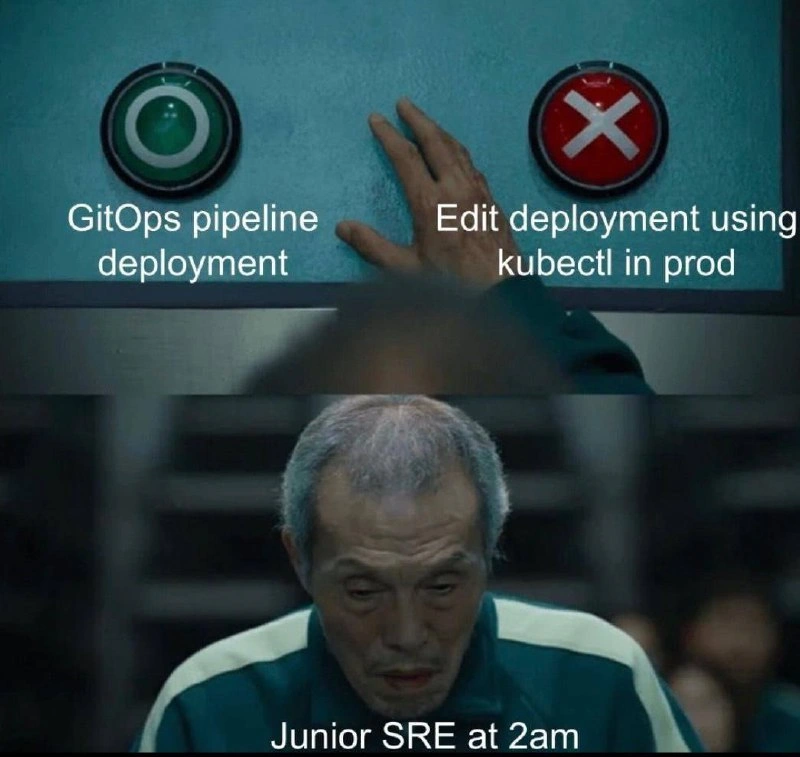
At 2 AM, all those polished DevOps principles tend to fly right out the window. This meme captures that midnight moment when a tired on-call engineer knowingly breaks the rules. On the left, we have the glowing green GitOps pipeline deployment button — the proper, audited, infrastructure-as-code way to deploy changes. On the right, there’s the ominous red “kubectl edit in prod” button — essentially a manual override in the dark of night. In true Squid Game fashion, the Junior SRE (Site Reliability Engineer) is depicted as an exhausted contestant facing a life-or-death decision. And surprise, surprise: he’s lunging for the red X button, the one clearly labeled “Do Not Push (Unless 2 AM).”

Why is this funny to seasoned engineers? Because we’ve all been there. The humor digs into a core DevOps dilemma: we preach using automated CI/CD pipelines and GitOps for deployments (so everything is version-controlled and traceable), yet when an incident wakes us up after midnight, the temptation for a quick kubectl fix is overwhelming. This is the immutable infrastructure irony at play. In theory, nothing in production should be manually altered (servers are cattle, not pets, etc.), but in practice a sleepy SRE with pager alarms blaring will become decidedly mutable. The meme’s hand slamming that red button screams, “I know I’m not supposed to, but I just want this alert to stop!” It’s a darkly comic reminder that even the best DevOpsCulture can crumble during an after-midnight incident response.

From a senior perspective, the image also pokes fun at GitOps vs. manual patch warfare. In a true GitOps setup, an automated controller (like Argo CD or Flux) continuously applies what’s in Git to the cluster. If our drowsy hero does a kubectl edit directly on the Kubernetes cluster, a GitOps system will likely undo his change moments later, re-syncing to what Git says. It’s like fighting a self-healing robot: the system tries to correct the drift that the junior just introduced. This friction is well-known to SREs — if you don’t also commit that hotfix to Git, the “single source of truth” will overwrite your live tweak. So pressing that red button might only solve things for a hot minute (or spawn a bigger 2:05 AM problem). The meme exaggerates it as a giant Squid Game choice because it feels that dramatic: follow the proper DeploymentPipeline (safe, but possibly slow and frustrating under pressure) or go cowboy with kubectl edit (fast relief, but at the cost of breaking protocol). Seasoned engineers chuckle (or cringe) because they recall their own 2 AM cowboy moments, followed by next-day “Who manually changed this?!” meetings. It’s a shared trauma in OnCall_ProductionIssues circles — we design robust processes, yet OnCallDuty reality sometimes forces our hand onto that forbidden red button.

Even the casting in the meme is a joke: the “Junior SRE at 2am” is represented by the elderly contestant Oh Il-nam from Squid Game. He looks battle-weary and drained — which is exactly how a junior on-call engineer feels by the time they’re desperate enough to bypass Git. It’s a wry nod that a single chaotic night in prod can age you prematurely in this field. The irony is thick: the junior (supposedly inexperienced) is making a veteran move here — a risky manual hotfix only a desperate or very confident engineer would attempt. In the SRE world, you often hear cynical veterans joke about “releasing on a Friday” or “it’s always DNS.” Here, the equivalent gallows humor is “temporary hotfix at 2 AM” — a frowned-upon move that everyone ends up doing at least once. This meme gets knowing nods from senior DevOps and SRE folks because it highlights that gap between the ideal (GitOps governance) and the real (just fix it now). It’s funny and painful in equal measure: the green button represents everything we say we value (control, auditability, sleep), while the red represents what we actually do when the system is on fire. And let’s face it, at 2 AM the only green most of us care about is the glow of the power button on the coffee machine.

Description

A meme using the Squid Game button-pressing scene showing an elderly contestant (labeled 'Junior SRE at 2am') reaching past a green button labeled 'GitOps pipeline deployment' to press a red X-marked button labeled 'Edit deployment using kubectl in prod'. The meme captures the universal SRE anti-pattern where a panicked junior engineer bypasses proper GitOps workflows and directly edits production Kubernetes deployments via kubectl during late-night incidents, choosing the quick-and-dangerous path over the safe one

Comments

7
Anonymous ★ Top Pick kubectl edit deployment/production at 2am: because nothing screams 'I've learned from my mistakes' like making a brand new one that won't show up in git blame
  1. Anonymous ★ Top Pick

    kubectl edit deployment/production at 2am: because nothing screams 'I've learned from my mistakes' like making a brand new one that won't show up in git blame

  2. Anonymous

    A senior SRE has two buttons: 'Trigger GitOps pipeline' and 'Go back to sleep because the automated rollback already handled it.' The junior SRE's second button is 'Update resume.'

  3. Anonymous

    Nothing says ‘declarative infra’ like live-patching deployments while half-asleep on pager duty

  4. Anonymous

    The real game of death isn't choosing red or green light - it's explaining to your principal engineer why the git history doesn't match prod after your 2am 'quick fix'

  5. Anonymous

    The real test isn't whether you know GitOps - it's whether you still follow it at 2am when the CEO is breathing down your neck and the pipeline takes 15 minutes

  6. Anonymous

    At 2am, “kubectl edit” feels like MTTR optimization - until GitOps reconciles it back and you’re debugging your own hotfix

  7. Anonymous

    GitOps: reproducible deploys. Kubectl in prod: artisanal outages, handcrafted at 2AM

Use J and K for navigation