Skip to content
DevMeme
3110 of 7435
Turn Your Mac Into a Space Heater with Two Lines of Swift
Languages Post #3428, on Jul 17, 2021 in TG

Turn Your Mac Into a Space Heater with Two Lines of Swift

Why is this Languages meme funny?

Level 1: Running in Circles to Keep Warm

Imagine you have two robots named A and B. Robot A only listens to Robot B, and Robot B only listens to Robot A. Now, you give Robot A a task, but it says, “Okay, I’ll do it after B does his part.” And B says, “Sure, I’ll start as soon as A starts his part.” Uh-oh – A is waiting for B and B is waiting for A. They get stuck waiting for each other forever in a loop! Neither robot ever actually does the task because each one thinks the other should go first. But here’s the funny part: even though they’re stuck, they’re both working really hard waiting and checking on each other. It’s like having two people each insisting “You go first!” endlessly – they’re not accomplishing anything, but they’re getting tired and sweaty from all the arguing.

Now replace those robots with your computer’s brain. If you give the computer a puzzle with no solution (like those two classes that inherit from each other in a circle), it will keep working furiously trying to figure it out. The computer’s brain doesn’t know how to stop on its own – it just gets hotter and hotter as it works. Your laptop has little fans (like tiny ventilators) to cool it down, but even then you might feel it warm up. It’s exactly like making someone run around in circles really fast: they won’t get anywhere, but their body will heat up from all the effort. So the joke in this meme is saying, “Hey, if you’re feeling cold, just make your computer do this super hard, never-ending task. It will get hot like a heater and warm you up!” Of course, that’s a silly solution – you wouldn’t really want to do that to your poor computer. But it’s a funny way to show how a computer doing a lot of useless work can literally spread warmth, just like a little space heater would.

Level 2: Infinite Loop, Finite Patience

Let’s break down what’s happening in this Swift meme in simple terms. Swift is a programming language made by Apple, used to build apps for iPhones, iPads, and Macs. Developers write Swift code in a program called Xcode (that’s Apple’s integrated development environment, basically a fancy text editor that can also build and run your code). In the meme, a well-known Swift educator (Paul Hudson) shared a funny two-line code snippet:

class A: B {}
class B: A {}

These two lines define two classes, A and B. In many programming languages including Swift, one class can inherit from another. Inheritance means class A can say “I want to have all the features of class B, plus some of my own.” It’s a way to reuse code and establish relationships like “a Car is a type of Vehicle.” But here, class A says it inherits from B, and class B says it inherits from A. This is a circular dependency – A points to B as its parent, and B points to A as its parent. It’s like two friends each saying “I’m the boss because my friend said so.” If you try to make a chain of command or hierarchy out of that, you just go round and round in circles with no real base case (no actual independent starting class).

Now, normally the Swift compiler (the tool that turns Swift code into an actual app) should catch this and say, “Error: You can’t have class A inherit from B and B inherit from A. That doesn’t make sense!” In fact, most languages explicitly forbid circular inheritance for this very reason. However, the joke here is that at one point the Swift compiler didn’t immediately stop or throw a clear error for this scenario. Instead, it got confused and ended up working really hard trying to figure these classes out. The two classes create an infinite loop of logic during compile time. The compiler essentially goes: “To build A, I need to know about B. Let me build B… but to build B, I need A… which needs B…” and on and on. It’s as if you’re looking up a word in the dictionary that references another word, which references back the first word – you’d flip pages forever!

What happens when the compiler is stuck in this loop? Your computer’s CPU (the central processing unit, basically the “brain” of the computer) goes into overdrive. It’s doing millions (actually billions) of operations per second trying to resolve this puzzle. CPU utilization shoots up to 100%, meaning the CPU is fully busy with this task. And when a CPU is busy, it draws a lot of electrical power and gets hot – really hot. If you’ve ever played a heavy 3D game or had a bunch of apps running and heard your laptop’s fans start whirring, that’s the computer cooling the CPU down. Here, Xcode is effectively stressing the CPU so much with just those two lines that the Mac’s cooling system has to work overtime. The tweet jokes that this will “heat up your room in no time,” and that’s not an exaggeration – a working CPU consumes energy and outputs heat, just like a little heater. A MacBook Pro under full load can get its chassis warm to the touch and blast warm air out of its vents. Thermal throttling might kick in too, which is when the computer slows down the CPU to prevent it from overheating. All of this is a very physical reaction to a logical error in code!

For a new developer or someone not familiar with Swift, the key points are: (1) This code is a quirky bug example – it’s not something you’d normally write on purpose. (2) It exposes a weakness in the Swift compiler back in 2019, where it didn’t handle a circular definition well. (3) When compilers or programs get stuck in an infinite loop, they keep the computer’s processor busy non-stop, which uses a lot of energy and creates heat. So the joke is suggesting, “If you’re cold, you can use this weird bug as a free heater,” because your Mac will get warm trying (and failing) to compile the code. Of course, in reality, this isn’t a recommended solution (poor computer!). It’s just a funny way to point out how crazy it is that two silly lines of code can make a powerful laptop struggle. For Apple developers, it’s a lighthearted poke at the tools we use – acknowledging they’re not perfect. And for anyone who’s ever felt their laptop get hot, it’s a relatable chuckle about how our devices literally convert computing power into heat. In short, the meme is both a technical curiosity (a compiler edge-case) and a techie joke: “Don’t have a heater? No worries, just run some bad code on your Mac!”

Level 3: Mutual Recursion Meltdown

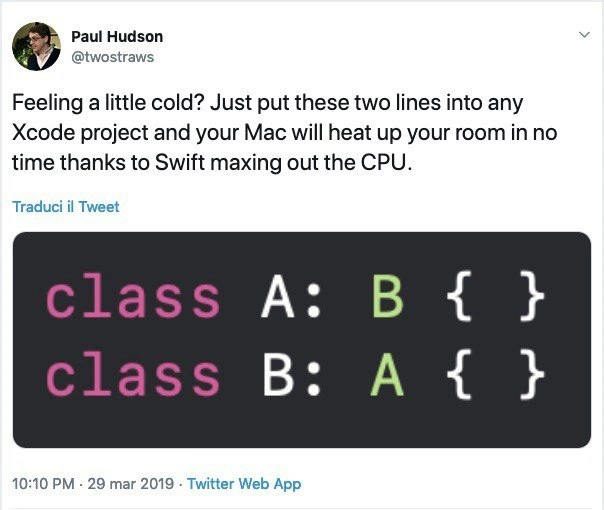
“Feeling a little cold? Just put these two lines into any Xcode project and your Mac will heat up your room in no time thanks to Swift maxing out the CPU.”
— Paul Hudson (@twostraws), March 2019

Seasoned developers couldn’t help but smirk at this tweet. It humorously suggests using a bug in Apple’s developer tools as a feature – essentially repurposing your expensive MacBook into an unwitting radiator. The code snippet is a pair of mutually referential class definitions in Swift. Class A inherits from B, and class B inherits from A. For experienced folks, this immediately screams “compiler error!” or more ominously “infinite loop!”. The meme plays on the shared pain of iOS/macOS developers: Xcode (Apple’s official IDE) sometimes hits edge cases that make it work insanely hard. We’ve all experienced those moments when a build stalls and your laptop’s fans kick into jet-engine mode. Here, the tweet suggests one silver lining: at least your MacBook can keep your hands (or room) toasty while Xcode is losing its mind. 😂

The humor works on several levels. First, there’s the absurdity of the solution: cold in your office? Just run some bad code! It’s a perfect tech parody of a life-hack. Instead of turning on a real heater, you intentionally max out the CPU. The phrase “Swift maxing out the CPU” is something developers have joked about, especially with early Swift versions. Swift is a powerful, modern language, but in its early years it was notorious for making processors sweat during compilation. Complex expressions or generic type puzzles could send compile times through the roof. Many senior devs have stories of a seemingly harmless code change causing Xcode to beachball for minutes. This two-line example is the ultimate pathological case – a compiler bug where a simple mistake (circular class inheritance) doesn’t produce a quick error as it ideally should. Instead, it kicks the compiler into an endless spin. It’s the software equivalent of a car stuck in mud, wheels spinning endlessly and going nowhere, while the engine revs at full throttle. Except here, the “engine” is your laptop’s CPU, and those spinning wheels are the compiler’s type-checker trying and retrying to resolve an impossible relationship between class A and class B.

For veteran Apple developers, the meme also satirizes the Apple ecosystem quirks. Xcode is beloved for many things, but performance issues and cryptic compiler errors are a running gag. Seeing a prominent community member like Paul Hudson poke fun at it gave everyone permission to laugh at a frustration we typically just groan about. It’s a bit of communal tech therapy: “Yes, Xcode can sometimes turn my MacBook Pro into a hand-warmer. No, it’s not just you – the struggle is real!” The tags like PerformanceIssues and CompilerErrors hit home; we’ve debugged slow build times and scratched our heads at stuck processes. And who hasn’t quipped about their laptop doubling as a space heater during a long coding session? Modern laptops, especially Intel-based MacBooks of that era, ran hot under load – so much that thermal throttling (where the CPU slows down to avoid overheating) could kick in. Some devs used to joke: “I know my code is inefficient when I can feel the heat through the keyboard.” This meme just takes that to a comical extreme by implying we could warm up a whole room with a particularly nasty bit of code.

The deeper industry commentary is about how even elegant systems like Swift/LLVM have rough edges. Compilers are programs too, and they can have bugs. Here a missing check for cyclic_inheritance or a flaw in infinite_type_resolution logic turned into a 100% CPU trap. Fixing an issue like this isn’t always trivial – it lives in the weeds of the compiler’s logic. Until it’s fixed, the onus is on developers to avoid such pitfalls (which, granted, you’d rarely write intentionally unless you’re being mischievous or accidentally create a complex generic cycle). In the meantime, we cope with dark humor: if life gives you an overheating Mac, at least you won’t need a separate heater! Senior devs recognize this coping mechanism all too well: turning misery into a joke to stay sane. The tweet’s popularity within the community shows how relatable the scenario was. It’s a gentle reminder that even cutting-edge technology can sometimes feel like it’s held together by duct tape and prayer – or that we’re all beta testers for the tools we use. Yet, we laugh, share the meme, maybe upgrade to the next Xcode hoping for a fix, and carry on coding (perhaps with a fan pointed at our MacBook in the meantime).

Level 4: Ouroboros Inheritance

In the rarified air of compiler theory, Swift's two-line space heater is a case of a cyclic inheritance causing an internal meltdown. The code:

class A: B {}  // Class A tries to inherit from B
class B: A {}  // Class B tries to inherit from A

At first glance, these class definitions form an impossible loop – each class claims the other as its parent. In a well-behaved compiler, the class inheritance graph must remain a Directed Acyclic Graph (DAG). Here we've introduced a cycle (an Ouroboros eating its tail), violating that acyclic rule. The Swift compiler’s type-checker likely enters a recursive descent trying to resolve A’s parent B, which in turn requires resolving B’s parent A, which again depends on B, and so on ad infinitum. Without a proper cycle detection mechanism or termination condition, the compiler’s algorithm gets stuck in an endless loop (technically an infinite type resolution process). This is akin to solving a set of equations with no solution – the compiler is effectively trying to find a class layout or parent chain that can never be satisfied.

Under the hood, the Swift compiler (built on LLVM) typically would construct an abstract syntax tree (AST) or some intermediate representation of these classes and attempt to validate their relationships. A circular inheritance might confuse the symbol table or the inheritance hierarchy builder. Ideally, a semantic analysis pass should yell “circular dependency!” and error out. If that check fails (as it did in this scenario circa 2019), the compiler might tailspin: an inescapable recursion in the compiler’s own code. This bears a resemblance to the classical halting problem in miniature – the compiler cannot decide to halt because it’s waiting for a resolution that will never arrive. We’ve created a tiny paradox inside the compiler: each class definition defers to the other, so the poor compiler never finds a solid ground to stand on (no ultimate base class).

The result? CPU Utilization skyrockets as the compile process churns away, chasing its tail. All those billions of CPU cycles have to go somewhere, and by the laws of thermodynamics, they turn into heat. Modern CPUs, like the Intel chips common in Macs of that era, will happily consume maximum power trying to solve this impossible puzzle, dumping energy as heat through the logic board and chassis. The longer the compiler runs in this infinite loop, the more your MacBook resembles a MacBook cookbook, dispersing warmth. In effect, we’ve turned a compiler bug into a makeshift thermal demo: an unintended showcase of how a purely logical problem (infinite compile time) translates into a very physical consequence (your laptop doubling as a space heater). It’s a fascinating intersection of theoretical computer science and real-world hardware behavior — a literal example of how computational complexity can spill over into thermal complexity. If there’s an academic paper on “Using NP-hard problems for home heating,” this Swift compiler edge-case might warrant a footnote.

Description

A screenshot of a tweet from Paul Hudson (@twostraws). The tweet humorously suggests that adding two lines of Swift code to an Xcode project can heat up a room. The code snippet shows two classes, A and B, inheriting from each other (`class A: B {}` and `class B: A {}`), creating a circular inheritance dependency. This is a classic computer science joke that plays on the idea of causing a compiler or runtime to get stuck in an infinite loop, consuming maximum CPU resources and generating significant heat. The joke is particularly relevant to developers working with compiled languages like Swift, who understand that the compiler's attempt to resolve this logical impossibility will lead to a system freeze or crash, effectively turning the CPU into a heating element


Comments

21
Anonymous ★ Top Pick This is the most elegant way to trigger thermal throttling I've ever seen. It's not a bug, it's a feature for cold winter mornings during sprint planning
  1. Anonymous ★ Top Pick

    This is the most elegant way to trigger thermal throttling I've ever seen. It's not a bug, it's a feature for cold winter mornings during sprint planning

  2. Anonymous

    Facilities cut the heating budget, so I spun up a Swift project with `class A: B` and `class B: A`. Nothing warms the room faster than a type checker stuck topologically sorting a graph that isn’t a DAG

  3. Anonymous

    The real genius of Swift's type system: it doubles as a distributed heating solution for open-plan offices. Just deploy this pattern across your CI/CD pipeline during winter months and watch your AWS bill compete with your heating costs

  4. Anonymous

    Ah yes, the classic 'turn your MacBook Pro into a space heater' optimization technique. This circular generic constraint is essentially a type-checker DoS attack - the Swift compiler enters an infinite loop trying to resolve whether A inherits from B or B inherits from A, maxing out CPU cores while your laptop's fans achieve liftoff velocity. It's the compiler equivalent of 'this statement is false,' except instead of a philosophical paradox, you get thermal throttling and a $3000 hand warmer. Senior engineers know this is why we have compilation time budgets and why that innocent-looking two-line 'refactor' can turn your build time from 30 seconds to 'heat death of the universe.'

  5. Anonymous

    Swift type checker: proving circular dependencies scale perfectly - to 100% CPU and room-temp nirvana

  6. Anonymous

    Mutual inheritance: the design pattern that converts reference cycles into thermal cycles - Swift’s type checker goes O(heater) while your architecture goes O(facepalm)

  7. Anonymous

    Pro tip: declare class A: B and class B: A in Swift; the type checker will hunt for a least fixed point while your Mac demonstrates the Space Heater pattern

  8. @fuutea 4y

    damn

    1. @VladislavSmolyanoy 4y

      same

    2. @rostopiradv 4y

      This post is 2 years old, so it has already been fixed

      1. @NiKryukov 4y

        So no more free heating, so sad

        1. @ZgGPuo8dZef58K6hxxGVj3Z2 4y

          Trick the compiler

        2. @walkersubterra 4y

          Just take an old version to use this heating

        3. @DTSHNICK 4y

          +

      2. @bekzat_karayev 4y

        yeah that's true

  9. @pyproman 4y

    Or bruh:for(;;){goto bruh;}

  10. @Jeffeek 4y

    Circular dependency, it's impossible

  11. @Vlasoov 4y

    error: B is not declared in this scope 😎

  12. @bekzat_karayev 4y

    I used to do that, now I just turn on couple of dozens gpus to mine dogecoin 24/7

  13. @bekzat_karayev 4y

    my room is hotter than outside in july😂

  14. @ozalexo 4y

    Too old. 2019

Use J and K for navigation