Microsoft's Digital Assistant: A Scooby-Doo Unmasking
Why is this Microsoft meme funny?
Level 1: New Toy, Old Friend
Imagine you get a cool new robot helper for your birthday. It talks in a shiny high-tech voice and seems super fancy. But when you take off its helmet, you discover it’s actually your old buddy dressed up as a robot! 😄 It’s funny because the “new” helper turned out to be the same old friend in disguise. This meme is just like that: everyone thought Cortana was a brand new high-tech helper, but surprise — it was really the old friendly paperclip (Clippy) all along, just wearing a new costume.
Level 2: From Clippy to Cortana
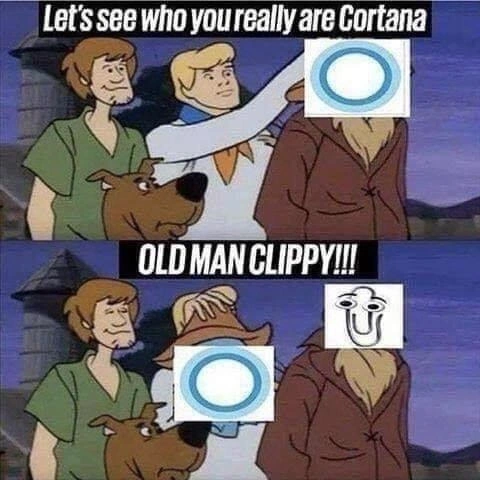
This meme is referencing two generations of Microsoft helpers – one old-school and one modern – by using a funny Scooby-Doo cartoon scene. In the top panel, the Scooby-Doo characters are about to reveal the true identity of a villain disguised as the circular blue Cortana logo. The text says, “Let’s see who you really are, Cortana.” In the bottom panel, they’ve taken off the “mask” (the Cortana icon) to uncover Clippy, the classic Microsoft Office paperclip character. The caption shouts “OLD MAN CLIPPY!!!” mimicking the Scooby-Doo formula where the monster turns out to be just some old guy in a costume.
To understand the joke, you need to know who these two characters are:
- Clippy was a famous (or infamous) animated paperclip assistant in Microsoft Office around the late 1990s. He’d pop up in your Word document with googly eyes and say things like, “It looks like you’re writing a letter. Can I help?” Clippy’s goal was to help users by offering tips or shortcuts. Unfortunately, Clippy often showed up when you didn’t want him and became annoying. Many users (and developers writing documents or code) found him more distracting than helpful. Eventually, Microsoft removed Clippy in newer Office versions because of the negative feedback.
- Cortana is a much later creation (first introduced in 2014) and is a digital assistant built into Windows 10 (and originally Windows Phone). Instead of a cartoon, Cortana is basically software you can talk to. Represented by a swirling blue circle logo, Cortana can answer your questions (like “What’s the weather?”), set reminders, open apps, and generally help you use your computer via voice commands or text queries. Cortana uses artificial intelligence and internet connectivity to understand what you ask and give useful responses – similar to Apple’s Siri or Amazon’s Alexa, but made by Microsoft. The name “Cortana” actually comes from an AI character in a popular Xbox video game (Halo), which gave it a bit of geek appeal.
Now, the meme jokingly suggests that these two are actually the same in spirit. By “unmasking” Cortana and finding Clippy, it’s saying: Microsoft’s fancy new AI assistant is really just their old assistant idea dressed up differently. This is funny to people in tech because Clippy was a well-known quirky part of tech history, and seeing him “behind” Cortana pokes fun at Microsoft’s habit of reinventing its old ideas. It triggers tech nostalgia for those who remember Clippy. Even if you’re a newer developer who never used Clippy, you’ve probably seen him referenced in tech jokes as that goofy paperclip who annoyed everyone. So the meme is both a nostalgic reference and a playful critique.
In simpler terms, think of it this way: Clippy was an early attempt to make computers user-friendly by having a helpful character give suggestions. Cortana is a modern attempt to make computers user-friendly by letting you speak to an assistant. The form is different (paperclip vs. voice AI), but the purpose is similar. The Scooby-Doo meme format exaggerates this likeness for comedic effect. It’s as if the gang is saying to Microsoft, “Aha! Caught you reusing that old idea!” And the reveal “Old Man Clippy” hits home because in Scooby-Doo, it was often some familiar character (like an old man from the town) pretending to be a scary monster. Here, Clippy is the familiar old “man” behind the high-tech mask of Cortana. For a junior dev or someone new to tech, the takeaway is that tech companies often bring back old concepts in new forms — and the developers who’ve been around will immediately recognize it and have a laugh.
Level 3: Return of the Paperclip
In classic Scooby-Doo fashion, this meme shows the young sleuths unmasking Microsoft Cortana—the modern AI voice assistant—only to reveal Clippy, the infamous Office paperclip from the 90s, underneath. Seasoned developers chuckle at this mask reveal trope because it humorously suggests that nothing really changes at Microsoft: old tech ideas just get new faces. The joke lands on a technical-historical level. Clippy first appeared in Office 97 as an animated paperclip assistant (officially named "Clippit") that would pop up and say things like, “It looks like you’re writing a letter. Need help?” whenever it detected a user typing something like a formal letter. It was an early attempt at a digital assistant inside desktop software, long before we had cloud-powered AI assistants. But instead of winning hearts, Clippy became a symbol of intrusive UX and unwanted help—practically a meme before memes were a thing.
Fast forward to the 2010s: Microsoft introduces Cortana as a built-in voice assistant for Windows 10 (after debuting on Windows Phone in 2014). Cortana was named after a beloved AI character in Microsoft’s own Halo video game series, giving it a cool, futuristic persona. She’s represented by a sleek blue circular logo (the “halo” ring), and she can respond to voice commands, set reminders, search the web, and tell you the weather. Under the hood, Cortana leverages cloud services, speech recognition, and natural language processing—tech far more advanced than Clippy’s simple pop-up heuristics. On paper, Cortana is a completely different, next-gen product. Yet, experienced devs immediately saw a familiar pattern. Microsoft was once again trying to put a “friendly assistant” on our computers. The meme nails this irony: Cortana is just Clippy with a fresh coat of AI paint.
From an industry perspective, this is about the cyclical nature of tech ideas and branding. Microsoft has a history of reviving concepts: Microsoft Bob in 1995 tried to make a user-friendly GUI with cartoon guides (that flopped spectacularly), then Clippy brought the cartoon helper idea into Office, and decades later Cortana resurrected the personal assistant concept for the AI era. Each attempt had new technology and a new name, but the core idea — “let’s proactively help users!” — keeps coming back like a ghost in the machine. It’s like the classic Scooby-Doo scene where the monster turns out to be someone we’ve seen before: “Old Man Clippy!?” We all shake our heads and laugh because we recognize the villain immediately.
This meme resonates with veteran developers’ shared memory. Many of us vividly recall hurriedly disabling Clippy each time we installed Office because it would bounce into action at the worst times (“I see you’re debugging, need help?” Nope, go away!). Cortana, while more sophisticated, triggered similar feelings for some — a nifty idea that could become annoying or feel forced. In Windows 10’s early days, having Cortana always there (listening for “Hey Cortana”) felt eerily similar to Clippy always lurking in the corner of Word. The meme’s punchline “OLD MAN CLIPPY!!” captures that I-knew-it moment. It’s a satirical way to say: maybe our fancy AI assistant is just the return of an old gimmick. In other words, even with cutting-edge AI, Microsoft is still that company trying to offer us helpful paperclips.
To break down the evolution and why this unmasking gag is spot-on, consider a comparison of the two assistants:
| Clippy (1997) 💾 Classic Office Assistant | Cortana (2014) 🤖 Modern AI Assistant |
|---|---|
| Cartoon paperclip character inside Microsoft Office apps (Word, Excel). | Disembodied AI persona built into Windows OS (and Windows Phone). |
| Triggered by simple cues in your typing (e.g. typing "Dear" might prompt letter template help). | Activated by voice command ("Hey Cortana") or a click, uses speech recognition and cloud AI to interpret requests. |
| Responses were scripted tips and trick balloons. No real understanding of context beyond basic patterns. | Uses natural language processing to answer questions, set calendar events, fetch information from the web, and more. |
| Popped up uninvited and frequently annoyed users. (Everyone learned how to disable Clippy quickly.) | Stays dormant until invoked, but some users still found it unnecessary or turned it off for privacy/performance. |
| Became a pop-culture joke about bad UX; Microsoft retired Clippy by Office 2007 due to backlash. | Part of the wave of voice assistants (like Siri/Alexa). Had initial hype, but later got de-emphasized in Windows as usage fell short of expectations. |
Despite the vast differences in technology, both are essentially productivity assistants trying to anticipate user needs. The meme distills this whole history into a single comedic aha!: behind the futuristic AI mask, it’s the same old idea from decades ago. It’s funny because it’s a bit true — Microsoft can’t escape its own tech history. As a tongue-in-cheek example, even Microsoft officials have jokingly acknowledged Clippy’s legacy (at one point Clippy almost made a comeback as an Office emoji/sticker 😜). The Scooby-Doo format is perfect here: it’s as if the gang has caught Microsoft red-handed rebranding Clippy as Cortana, and a gruff Clippy might grouse, “And I would’ve helped users efficiently too, if it weren’t for you meddling kids!”
Description
This is a two-panel meme using the classic Scooby-Doo unmasking format. In the top panel, Fred is shown pulling a mask off a villain, with Shaggy and Scooby looking on. The mask is the circular blue logo of Microsoft's Cortana. The caption reads, 'Let's see who you really are Cortana'. In the bottom panel, the villain is unmasked to reveal the face of 'Clippy', the infamous paperclip assistant from older versions of Microsoft Office. The caption exclaims, 'OLD MAN CLIPPY!!!'. The meme humorously suggests that the modern AI assistant Cortana is just a new iteration of the widely disliked and intrusive Clippy, tapping into a long-standing skepticism among tech veterans about recycled ideas and the actual helpfulness of AI assistants
Comments
11Comment deleted
The only difference between Cortana and Clippy is that Cortana's suggestions are now cloud-powered and backed by a machine learning model that's still 99% certain you're writing a letter
Ah, Cortana was just Clippy the whole time - classic Microsoft move: take a ’90s COM object, expose it as a cognitive service, and hope nobody notices the paperclip in the call stack
After 20 years in the industry, I've learned that every 'revolutionary AI assistant' is just Clippy with better marketing and a cloud subscription. At least Clippy didn't need an internet connection to annoyingly suggest you're writing a letter
Ah yes, Cortana - Microsoft's ambitious attempt to rebrand their most beloved (read: universally despised) assistant. Turns out slapping a Halo reference and some Azure ML on top of Clippy's DNA doesn't change the fundamental truth: we still don't want unsolicited help while we're trying to work. At least Clippy had the decency to be obviously annoying; Cortana tried to hide it behind Bing search results and calendar integrations. Same energy, different epoch - proof that some architectural decisions haunt you across generations, no matter how many times you refactor the UI
Under the hood, Cortana is just Clippy with a GPU budget, OAuth, and a telemetry pipeline
Under the hood, Cortana is just Clippy with OAuth and a telemetry pipeline - same interrupt-driven UX, bigger cloud bill
Cortana unmasked: Clippy, the singleton Microsoft can't garbage collect
I wish Comment deleted
Clippy was offline Comment deleted
clippy didnt need online Comment deleted
Clippy didn't spy us :( Comment deleted