Skip to content
DevMeme
5056 of 7435
Gearing Up for the Legacy Codebase Colonoscopy
LegacySystems Post #5536, on Sep 29, 2023 in TG

Gearing Up for the Legacy Codebase Colonoscopy

Why is this LegacySystems meme funny?

Level 1: A Dirty Job

Imagine you have to clean up a really messy room that hasn’t been tidied in ages. There are toys, old food wrappers, and maybe something sticky on the floor. Yuck! Before you start, you might put on some big rubber gloves and even pinch your nose – because you just know it’s going to be gross. You carefully step in, ready for unpleasant surprises (like “What’s that smell?!” or “Oops, I didn’t mean to knock over that pile of gunk”).

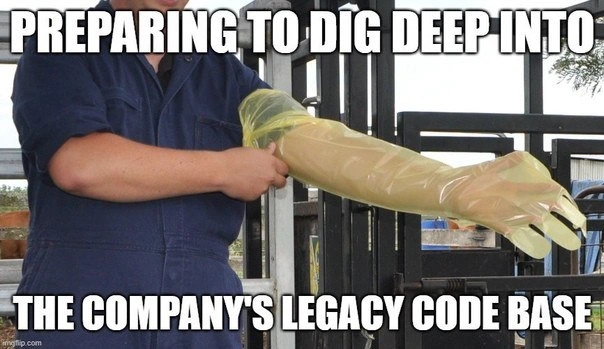
This meme is joking that working on an old computer program (the company’s legacy code base) feels just like that messy clean-up job. The person in the picture is pulling on a huge glove that goes up to their shoulder. That’s the kind of glove someone might use when doing something really icky, like cleaning a dirty aquarium or helping an animal on a farm. The top words say “PREPARING TO DIG DEEP INTO” and the bottom says “THE COMPANY’S LEGACY CODE BASE.” It’s a funny way of saying: “I’m about to stick my arm into something nasty – in this case, a big pile of old computer code!”

Even though coding isn’t physical work, programmers sometimes talk about code being “clean” or “dirty.” Clean code is easy to read and nice to work with. Dirty (or messy) code is confusing and hard to change. When code has been around a long time, with many people changing it, it can become a giant mess – like that untidy room or a muddy puddle. So, the developer in the meme is gearing up like someone would for a dirty chore. They’re not literally getting dirty, but they expect the task to be tough, unpredictable, and maybe a bit gross in a metaphorical way. The joke works because we don’t normally think of programming as needing protective gear, but here the code is imagined to be so messy that you’d want a full hazmat suit!

So, the simple idea is: fixing old code is a dirty job, and this picture makes us laugh by showing a programmer as if they’re about to do something extremely yucky. It’s funny and relatable – anyone who’s had to deal with a big mess (whether it’s spilled juice or spaghetti all over the kitchen) knows the feeling. You take a deep breath, put on your gloves, and dive in to clean it up. Developers feel the same way about old code: here goes nothing, let’s clean up this mess!

Level 2: Tech Debt Trek

So, why is everyone laughing (and cringing) at this image of a person pulling on a long glove? In the programming world, legacy code refers to old code that a team has inherited over time – usually written by other people (sometimes years or decades ago) – which is still in use and often hard to understand or change. It’s the code equivalent of an old haunted mansion: creaky, unpredictable, and a bit scary to walk through. When the meme says “preparing to dig deep into the company's legacy code base,” it’s highlighting that feeling of venturing into a mysterious, messy codebase that might be full of surprises (mostly unpleasant ones!).

The big yellow shoulder-length glove is something you’d use for a very dirty job (like a vet helping a cow give birth or examining something really gross). The joke compares that to a developer getting ready to deal with messy old code. In other words, the code has gotten so dirty (in a figurative sense) over time that the developer mentally suits up as if handling toxic waste. Why would code be “dirty”? Over years, many quick fixes and changes build up, creating what we call technical debt. Technical debt is a metaphor: imagine you take a shortcut to solve a problem now, but it’s not a clean solution – later on, that shortcut might cause trouble, and you “pay interest” on it by having to fix an even bigger mess. A legacy codebase is usually full of such shortcuts and patched holes – a bit like a wall with dozens of band-aids covering cracks.

A junior developer often first encounters this when they’re assigned a bug fix in an older part of the system. You open the file and see hundreds of lines of convoluted code, maybe with comments from 2005 and functions named DoStuff() or Calculate2() that give no clue what they do. This tangled, confusing structure is fondly nicknamed spaghetti code in developer slang – because the logic is twisted and entangled like a bowl of spaghetti. There’s no clear start or end; everything loops and jumps in confusing ways. Changing one piece of spaghetti code can unexpectedly tug on another piece. For example, you might adjust a function to fix a bug, only to discover that function was secretly used by some other part of the system for a totally different purpose. Oops!

Let’s say you have an old function that processes user orders. In clean code, it would do just that one thing. But in a legacy system, processOrder() might also update global settings, send an email, calculate a discount, and check the weather (why? Who knows!). Such a function is doing too much – that’s poor code quality – and if you touch it, you have to be super careful not to break any of those hidden side tasks. A junior dev quickly learns that in a legacy codebase, debugging (finding what’s wrong) and troubleshooting (fixing it) can be really hard because the code isn’t organized logically. It’s like solving a puzzle where pieces have been randomly glued together.

When the meme shows “gearing up with shoulder-length gloves,” it humorously advises developers to prepare thoroughly before making changes to an old system. In practice, this preparation might include: reading whatever (outdated) documentation exists, talking to teammates who have been around longer for any tribal knowledge (“Ah, yes, that module was written by Alice, who left in 2016, and only works if the date is a weekday.”), writing small tests to understand current behavior, and backing up everything. It’s the software equivalent of wearing protective gear. You wouldn’t stick your hand in an unknown dark hole without gloves, and likewise, you shouldn’t stick your hands in a chaotic legacy code without safeguards.

To illustrate, here’s a tiny snippet of what messy legacy code might look like, along with issues a junior should notice:

// Legacy code snippet with side effects and odd conditions
var GlobalState = { count: 0 };  // A global variable used all over the app

function addUser(user) {
    GlobalState.count += 1;       // Side effect: updates global state
    user.role = "customer";       // Modifying input data directly (could be problematic)
    legacyInitUser(user);         // Call to an old, mysterious setup function
    // ... (imagine hundreds of lines of old code here) ...
    if (new Date().getDay() === 5) {
        launchFridayProtocol();   // Weird behavior: do something special, but only on Fridays
    }
}

In this contrived example, the function addUser changes a global state variable, modifies the user object passed in, calls some undefined legacy initialization, and even has a quirky rule that triggers only on Fridays. 😅 A new developer might look at this and go “Why on earth…?” It’s a bit humorous, but real legacy code often has similar oddities that accumulated over time (“Oh that Friday thing? That was a quick fix for a demo years ago, but nobody removed it.”).

Refactoring is the term for cleaning up such code — reorganizing and simplifying it without changing what it actually does (like tidying a messy room without throwing away any important items). Everyone agrees refactoring legacy code is needed, but it’s also risky. If you don’t fully grasp what the code is doing (and with spaghetti code, nobody fully does), you might break something unintentionally. That’s why developers joke about needing “gloves” and caution: you treat the code as if it’s fragile or even dangerous. One strategy is to cover the code with new tests before changing it, like laying down drop-cloths before painting a dusty old room. Another is the “if it ain’t broke, don’t fix it” mantra – meaning, sometimes we prefer not to touch legacy code at all unless absolutely necessary, because it’s so easy to introduce new bugs.

The meme is relatable to developers at all levels because it captures a real feeling: wariness and preparation. Even as a junior, you quickly learn that not all code is nice and neat. Some of it is ancient, and working with it feels like exploring a dank cave – you go slow, shine a flashlight (debugger) around, and try not to disturb any sleeping bats (bugs). The humor here is in exaggeration: coding is usually a clean activity (you’re just typing on a keyboard), so the idea of wearing a literal shoulder-length glove to “dive into code” is silly. Yet, emotionally and mentally, that’s exactly what it feels like! You brace yourself in a similar way. This mix of something so serious (protective gear) with something normally mundane (reading code) makes it funny and oh-so-true for those in the know.

In short, this meme teaches newcomers about the concept of legacy code dread in a memorable way. It says: old code can be scary and messy, so be prepared! As a junior developer, don’t be surprised if one day you see a senior developer take a deep breath, maybe jokingly crack their knuckles, and say “Alright, time to put on the long gloves and dig into this code.” That’s your cue that an adventure in the codebase (or rather, a rescue mission) is about to begin. And yes, they’re speaking figuratively – no actual farm animals involved, just a gnarly code module or two. 🐄💻

Level 3: Shoulder-Deep Debugging

Digging into a legacy codebase can feel like wading through a swamp at midnight – you go in fully armed (with protective gear and plenty of tests) because you know it's messy and dangerous in there. The meme’s top text “PREPARING TO DIG DEEP INTO” and bottom text “THE COMPANY'S LEGACY CODE BASE” frame an image of a person pulling on a shoulder-length veterinary glove. This over-the-top protective measure is a perfect metaphor for approaching an old, crusty codebase laden with technical debt. It screams: "This is gonna get unpleasant, brace yourself!"

For seasoned engineers, the humor cuts deep (almost as deep as that glove): a longtime LegacySystem often accumulates bizarre quirks, quick-fixes, and downright spaghetti code over the years. Just like a vet reaching somewhere unsavory, a dev venturing into decades-old code takes on significant risk. One wrong move in a legacy module and you might unleash foul side-effects elsewhere in the system. It's not just code – it's historical baggage. The meme hits on that shared PTSD of maintaining code that’s older than the framework it runs on (and possibly older than some colleagues!). The CodeQuality in these parts of the system is usually so poor that touching it feels like sticking your hand in something slimy: you do it gingerly, wearing proverbial gloves, because who knows what gross surprises (bugs, crashes, NULL pointer exceptions, you name it) are lurking inside.

We laugh because it’s true: maintaining legacy code feels like a dirty job. On-call engineers have stories of late-night debugging sessions where a “simple fix” in legacy code caused a cascade of new bugs – a bit like poking a sleeping monster. No one wants to disturb the beast unless absolutely necessary. Hence the hazmat-grade glove in the image: it's a nod to extreme caution. The bold Impact font text style is classic meme branding, but here it also mimics the dramatic internal monologue of a dev psyching themselves up: "Alright, let's do this..." before diving into the unknown. The whole setup satirizes how refactoring or even reading such a codebase often requires a full mental armor.

In real life, of course, you don’t wear actual rubber gloves to read code – your protection is a careful mindset and plenty of safeguards (think code backups, tests, and a lot of coffee). The meme exaggerates it visually, which is why it’s funny: it captures the relatable developer experience of legacy code spelunking in one snapshot. Every senior developer recognizes that “suiting up” feeling – maybe you don’t literally put on a glove, but you do prepare by cracking your knuckles, opening three monitoring consoles, summoning that one veteran co-worker who remembers the 2008 rewrite, and perhaps whispering a small prayer to the coding gods. The protective gear represents defensive programming to the extreme: double-checking every change, expecting the worst, and treating the code as if it might fight back.

Underneath the humor, there’s a bitter reality: companies often allow critical systems to age without proper cleanup, resulting in fragile maintenance pain. The longer this goes on, the more every function in that tangle becomes like an unstable Jenga tower – everyone’s afraid to pull out the wrong block. You can almost hear a cynical veteran dev mutter, “I’m going in... cover me,” as they deploy the code on a staging server with every logging tool known to man watching for explosions. The meme’s brilliance is how it equates a programmer’s cautious approach to nasty old code with a veterinarian’s approach to a, uh, particularly unglamorous farm task. In both cases, there’s a real chance you’ll end up knee-deep (or shoulder-deep) in crap if you’re not careful. And trust me, no amount of hand sanitizer (or code comments) can fully wash away the stench of truly bad legacy code.

To really appreciate this, consider some classic legacy-code horrors that justify suiting up:

  • Unpredictable Side Effects: Changing one line in Module A inexplicably breaks Feature X in Module B. Why? Perhaps there's a hidden global variable or a copy-paste coding sin from years ago. It's the software equivalent of stepping in something nasty you didn’t see coming.
  • Historic Hacks: Comments like “// TEMP HOTFIX, REMOVE BY 2014” still linger in 2023. These ancient hacks are practically fossils now, but the business logic may secretly depend on them. Removing one is like pulling on a thread that could unravel the whole system.
  • Lack of Tests & Documentation: The old code has zero unit tests and the original authors have long since left the company. There’s no map for this territory. You proceed fully expecting to get lost, and you wear your metaphorical gloves by sandboxing changes and running diff tools like your life depends on it.

In summary, at the senior engineer level this meme hits home because it’s satirically accurate. Working with crusty legacy code really does require caution, patience, and often a gallows humor to survive the experience. The shoulder-length glove is a perfect comedic exaggeration of that brace-yourself moment. We laugh to keep from crying, because we’ve all been that poor soul gearing up to do something we wish we didn’t have to do – namely, dig into the company’s old, tangled, possibly cursed codebase.

Description

A meme that visually equates working on old software with an unpleasant veterinary procedure. The image shows a person in blue overalls putting on a long, yellow, shoulder-length plastic glove, the kind typically used by veterinarians for examining large animals. The overlaid text in a bold, white, impact font reads: 'PREPARING TO DIG DEEP INTO THE COMPANY'S LEGACY CODE BASE'. The humor lies in the powerful and relatable metaphor: diving into a legacy codebase is often a messy, unpleasant, and deep-probing task that requires special preparation for the 'dirty work' ahead. It perfectly captures the feeling of dread and resignation many senior developers experience when faced with maintaining or debugging old, poorly documented systems

Comments

7
Anonymous ★ Top Pick The only difference between this and debugging a legacy monolith is that the cow has a simpler architecture and is less likely to have undocumented dependencies on a server in a closet
  1. Anonymous ★ Top Pick

    The only difference between this and debugging a legacy monolith is that the cow has a simpler architecture and is less likely to have undocumented dependencies on a server in a closet

  2. Anonymous

    Strapping on the shoulder-length diff gloves - git blame ends at the CVS import, the service still runs on NT4, and every brace you move toggles SOX compliance

  3. Anonymous

    The real protection you need is a therapist on standby for when you discover the original architect hard-coded database credentials in 47 different places because "environment variables were too complicated."

  4. Anonymous

    Every senior engineer knows that moment when you're assigned to 'just add a small feature' to the legacy system that's been running in production for 15 years, has zero documentation, was written by developers who left the company a decade ago, and somehow processes $10M in transactions daily. The length of those gloves? That's proportional to the number of nested if-statements you'll find in the first file you open. Pro tip: The gloves should actually be longer - you haven't seen the stored procedures yet

  5. Anonymous

    Putting on the shoulder-length glove before touching the legacy monolith - the side effects outlive the call stack, and one tug on a “util” singleton can deliver a full prod outage

  6. Anonymous

    Monolith rule: if you need shoulder‑length PPE before git pull, it’s not a refactor - it’s hazardous‑waste remediation on shared mutable state; bring a feature freeze, backups, and a one‑command rollback

  7. Anonymous

    Legacy codebases: where even gdb needs elbow-length gloves to probe without contaminating the call stack

Use J and K for navigation