Skip to content
DevMeme
7285 of 7435
Linear's 'Difficult Decision' to Increase Workforce: Layoff Memo Parody Inverted
CorporateCulture Post #7985, on May 10, 2026 in TG

Linear's 'Difficult Decision' to Increase Workforce: Layoff Memo Parody Inverted

Why is this CorporateCulture meme funny?

Level 1: Sad Voice, Happy News

Imagine the school principal coming on the loudspeaker with the slow, serious voice everyone dreads — the one used for canceled field trips and broken vending machines — and saying: "Children, I have very hard news. We have made the difficult decision... to give everyone extra recess. We're so sorry." Everyone laughs because the sad voice and the happy news don't match. The joke is that big companies use the exact same gloomy speech every time they let people go, so this person used that speech to say the opposite — we're giving people jobs — and apologized for it, like a doctor gravely informing you that you're perfectly healthy.

Level 2: Decoding the Corporate Dialect

If you haven't been through a layoff cycle yet, here's the glossary this parody depends on:

  • "Difficult decision" — standard opener for layoff announcements. The difficulty is asserted, never demonstrated.
  • "Not a reflection of anyone's performance" — legally careful phrasing meant to soften terminations (and reduce wrongful-dismissal exposure). It also tells survivors: this could be you next, regardless of how well you work.
  • "Reimagining roles for the AI era" — the modern justification clause. Companies cite agentic AI — AI systems that act autonomously, like coding agents or workflow bots — as the reason headcount is changing.
  • Linear — a popular project-management / issue-tracking tool beloved by startups; its co-founder is the one posting.
  • X.com screenshot — the meme's delivery format: a real post, screenshotted and circulated, which is how most tech humor travels between platforms.

The comedy mechanism is inversion: take a text everyone has read a dozen dreadful times, flip the single word that matters (increase instead of the expected reduce), and keep everything else intact. The mismatch between the funeral tone and the happy content is the entire joke. Early in your career, the first real layoff email you receive will feel eerily familiar — because you've already read it here, backwards.

Level 3: The Memo Template Compiles in Reverse

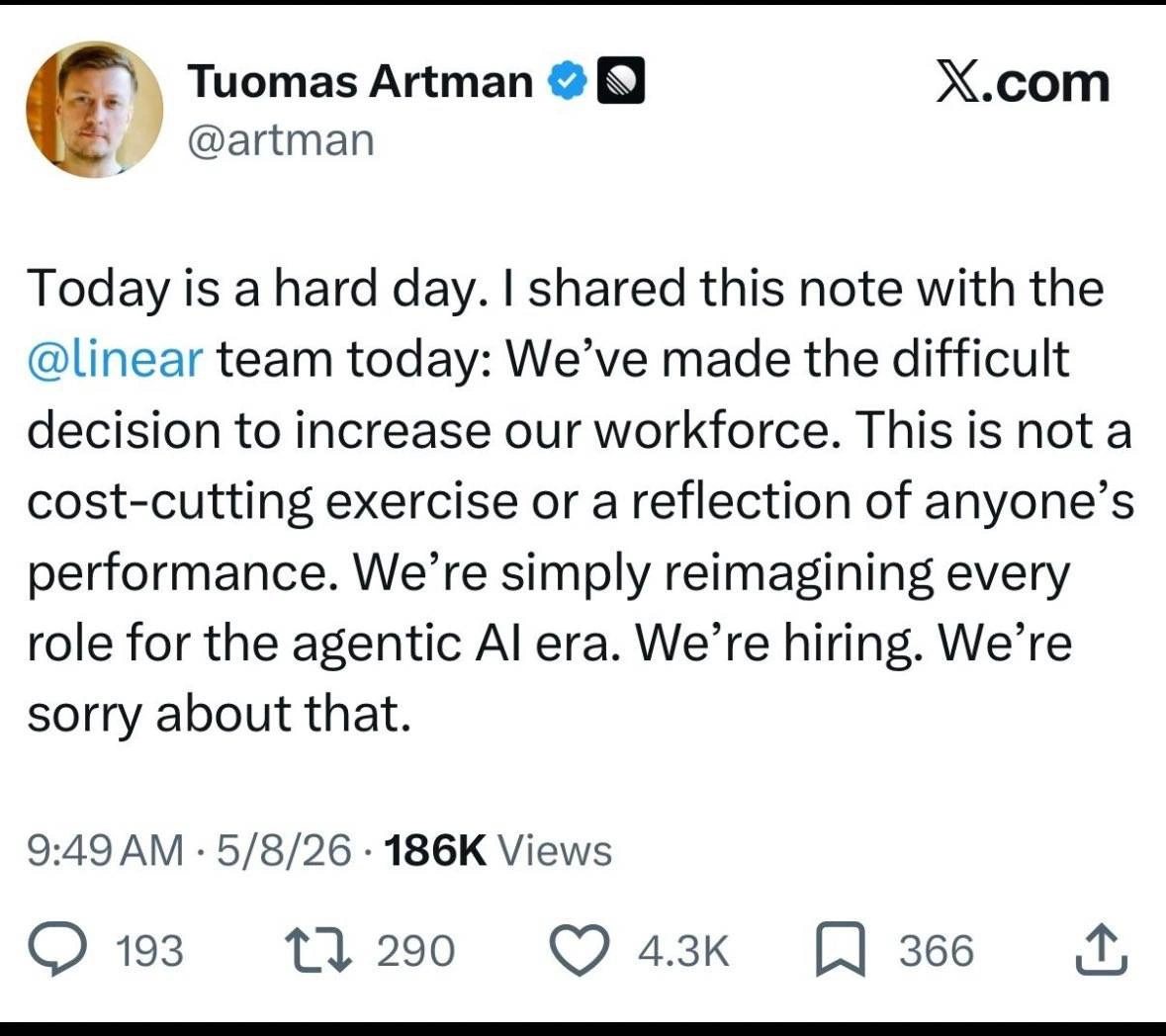
What's on screen is a verified X post from Tuomas Artman (@artman), co-founder of Linear, and it executes a perfect string substitution attack on the corporate layoff memo. Every clause is lifted verbatim from the genre: "Today is a hard day," "We've made the difficult decision," "This is not a cost-cutting exercise or a reflection of anyone's performance," "reimagining every role for the agentic AI era." Then the payload lands:

We're hiring. We're sorry about that.

The joke works because the layoff memo has become so standardized that it functions like a template with one mutable field. Swap decrease for increase and the surrounding boilerplate doesn't even flinch — which quietly proves the boilerplate never carried information in the first place. Anyone who has survived a reorg knows these phrases are load-bearing in the legal sense and hollow in every other one: "not a reflection of performance" exists to preempt lawsuits, "difficult decision" exists to launder agency ("decisions were made," passive voice doing its finest work), and "the AI era" is the current-generation justification string, hot-swapped in where "macroeconomic headwinds" and "right-sizing" used to live.

The sharper edge is the AI-layoffs narrative itself. By 2026, "we're restructuring for agentic AI" had become the default cover story for cuts — sometimes true, often a convenient repaint of an ordinary budget decision, because "AI efficiency" reads better to investors than "we over-hired." Artman's inversion is a founder publicly mocking that script while doing the opposite — a recruiting flex disguised as satire. It's also impeccable startup marketing: Linear gets 186K views' worth of "we're growing while everyone else is cutting" signaling, wrapped in plausible deniability. The apology at the end — sorry for hiring — is the final twist of the knife: the memo format is so fused with bad news that even good news delivered through it must end in contrition. The template has only one emotional register, and it's HR-grade remorse.

And yes, the engagement stats visible in the screenshot (193 replies, 290 reposts, 4.3K likes) confirm the eternal law: nothing performs better on tech Twitter than dunking on HR-speak using HR-speak.

Description

A screenshot of an X.com (Twitter) post by verified user Tuomas Artman (@artman), co-founder of Linear, timestamped 9:49 AM, 5/8/26 with 186K views, 193 replies, 290 reposts, 4.3K likes, and 366 bookmarks. The tweet reads: 'Today is a hard day. I shared this note with the @linear team today: We've made the difficult decision to increase our workforce. This is not a cost-cutting exercise or a reflection of anyone's performance. We're simply reimagining every role for the agentic AI era. We're hiring. We're sorry about that.' The post is a deadpan parody that inverts the boilerplate language of corporate layoff announcements - 'difficult decision', 'not a reflection of performance', 'reimagining roles for the AI era' - to announce hiring instead, mocking how AI is routinely used as a euphemistic justification for workforce cuts
Comments

6
Anonymous ★ Top Pick The layoff memo template is so battle-tested that even the inverse operation compiles: 'We're hiring. We're sorry about that.'
  1. Anonymous ★ Top Pick

    The layoff memo template is so battle-tested that even the inverse operation compiles: 'We're hiring. We're sorry about that.'

  2. @deimossos 2mo

    We've come full circle to hiring people again?

  3. @NickNirus 2mo

    kinda late for april fools

  4. Егор 2mo

    «reimagining» usually means hiring lower grade H1B to fire higher grade employees

    1. @ferriego 2mo

      They are like: slop generators + AI turbocharger > nerd seniors

  5. @ferriego 2mo

    Why every manager at every company fails to understand this

Use J and K for navigation