Agile Estimation: From a Simple 3-Pointer to a 50-Point Boulder Run
Why is this Agile meme funny?
Level 1: Little Plan, Big Surprise
Imagine you tell your parents you’ll clean your room and you think it will only take 5 minutes. You start cleaning, and at first it seems easy. In fact, you get optimistic and think, “Maybe it’ll just take 3 minutes if I hurry!” But as you pick up a toy, you accidentally knock over a big hidden box of LEGO pieces from under the bed. Suddenly, hundreds of tiny bricks scatter everywhere – oh no! What you thought was a quick, simple chore turns into a huge mess that takes an hour to fix. You run around trying to gather all the pieces as fast as you can, totally surprised by how big the job became.
In the meme’s story, the explorer thought the task (grabbing the golden idol) would be simple and quick. He even hoped it was easier than it looked. But the moment he lifted the idol, a giant boulder came rolling after him – a big surprise and a lot more trouble than expected. This is funny because we’ve all had moments like that: a small job suddenly becoming a giant problem. It’s like thinking you had a tiny puppy to take care of, but when you turn around it’s grown into a huge, playful dog that is knocking things over. The meme uses that silly exaggeration to make us laugh and remind us that sometimes, we underestimate how hard something will be. It starts calm and easy, but ends up as a wild, unexpected chase. The explorer running from the boulder is just like anyone who’s said “I got this, no problem,” and then yelled “Wait, wait, this is way more than I thought!” when things got out of hand. It’s a fun way to say: even a little plan can hide a big surprise!
Level 2: Hidden Complexity
Let’s break down what’s happening for those new to Agile and story point estimation. In Agile software development (especially in frameworks like Scrum), teams plan their work in short cycles called sprints (often 1-2 weeks long). Instead of assigning hours or exact days to tasks, Agile teams use story points to estimate how much effort or complexity a task (often called a user story) will involve. Story points are an abstract, relative measure – for example, a 1-point story is trivial, a 5-point story might be medium complexity, and an 8 or 13 could be quite complex. Teams often use a rough scale (sometimes Fibonacci numbers like 1, 2, 3, 5, 8, 13, 21, …) to indicate that as tasks grow in size, the uncertainty and effort grow non-linearly.
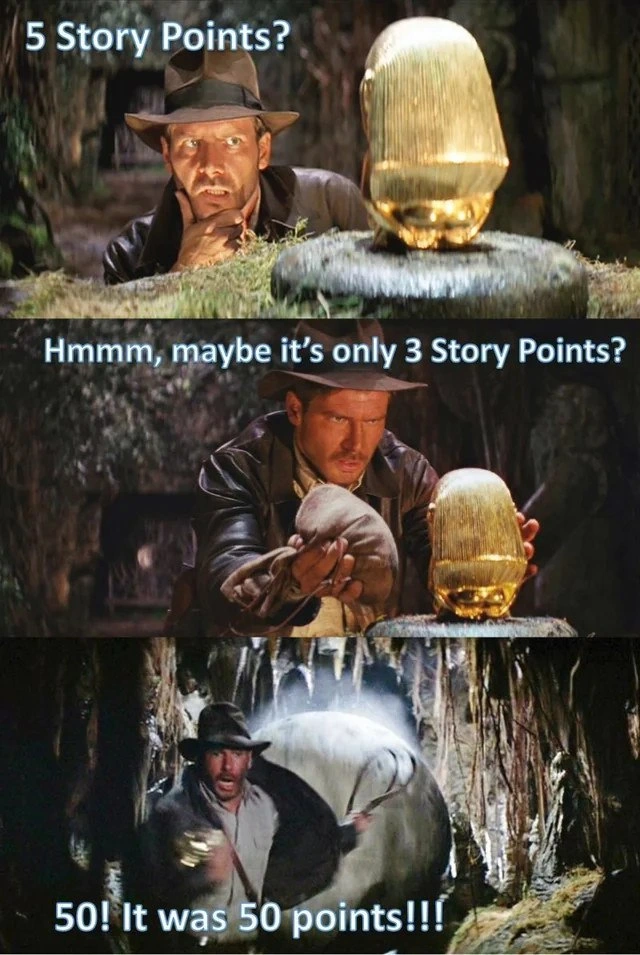
Now, the meme shows a famous scene from Indiana Jones and the Raiders of the Lost Ark. Indiana Jones (the explorer in the fedora) is our developer, and the golden idol he’s eyeballing is the task at hand, initially thought to be 5 story points. In Agile terms, a 5-point task is something of moderate size the team thinks it can handle in one sprint without much trouble. The text “5 Story Points?” over Indy’s face in panel 1 shows he’s considering the effort: is this feature worth 5 points? He’s cautious but interested – the idol (task) looks shiny and do-able.
In panel 2, Indy swaps the idol with a bag of sand while the text says, “Hmmm, maybe it’s only 3 Story Points?” This is a visual metaphor for re-estimating or underestimating the task. Perhaps the developer (or the team) rethinks: “Actually, this might not be that hard, maybe we can do it faster than we thought.” This often happens in Sprint Planning meetings: there’s discussion and sometimes people argue the story point value down, thinking they can lighten the load – just like Indy gently replacing the heavy idol with a lighter bag. A 3 story point task is considered small-ish. Maybe the team feels they’ve done similar tasks before or there’s existing code to reuse, so they lower the estimate. That’s the calm moment of optimism: the plan feels under control and everyone is happier because a 3-point task leaves more room in the sprint for other work.
Now, panel 3 is where things go haywire. The scene shows a giant stone boulder chasing Indiana Jones as he runs for his life, and the caption reads “50! It was 50 points!!!” In Agile terms, a 50-point story is massive – far beyond what anyone would normally put into a single sprint (most teams would break such a huge task into smaller pieces). The meme exaggerates to make the point: once Indy lifted that golden idol (started the task), he triggered a hidden trap in the temple. In the same way, once a developer actually starts working on a seemingly small task, they might discover it’s much more complicated. Perhaps the codebase is more tangled than expected, or the feature has a lot of unexpected requirements. It’s like finding out that what you thought was a tiny statue is actually holding up the roof of a temple – remove it, and everything starts collapsing! The “boulder” symbolizes all those unseen complications and extra work tumbling out and threatening to crush your carefully laid plan.
So the meme is showing, in a humorous way, a common situation in software development and project management: underestimation. At first, everyone thinks the task will be quick and easy (5 points, or even 3 points – which might correspond to, say, a day or two of work in rough terms). But once you dig in, you realize it’s enormous (maybe it would take many weeks – hence 50 points). The developer (like poor Indy in the third panel) ends up scrambling to deal with the fallout. In a real project, this might mean working late, pushing the task to another sprint, or calling for help because the task blew past its original scope. The emotion behind that “50! It was 50 points!!!” text is shock and panic – something juniors might not have experienced yet, but eventually do when a “simple bug fix” turns out to require debugging half the system.
Some key terms and concepts here:
- Story Points: A unit of measure for effort in Agile. Instead of time, we use points to say “relative size”. It’s a bit fuzzy – not an exact science – and meant to account for complexity, unknowns, and effort collectively.
- Sprint Planning: A meeting at the start of a sprint where the team decides what to work on and estimates the effort for each backlog item (user story). That’s where you’d hear conversations like “Is this 5 points or 8 points? Could it be just 3 points if we keep it simple?” The meme’s first two panels are basically that conversation in pictorial form.
- Underestimation: When you think a task will take less effort than it actually needs. New developers often trust initial impressions of a problem, but as you gain experience, you learn there are often hidden complexities – parts of the task that aren’t obvious until you’re in the thick of it. This meme exaggerates underestimation to the extreme (from a small number to a gigantic one) to get a laugh.
- Hidden Complexity: This means aspects of a problem that are not visible until you start working. For example, you might plan to add a simple form on a website (sounds easy), but once you start, you realize the form needs to integrate with a legacy system, handle multiple languages, and comply with some security rules – none of which were apparent at first. Suddenly a “small” task grows in all directions. That’s the boulder rolling at you!
For someone new to Agile, the meme is a funny demonstration that estimating software work is tricky. Even experienced teams get it wrong. A story that was estimated as a 3 could indeed end up being way bigger. In practice, teams try to avoid this by discussing acceptance criteria, breaking tasks into smaller pieces, and sometimes doing spikes (time-boxed research) on risky stories before sizing them. But despite all that, surprises happen. The meme uses an adventure film metaphor to make it dramatic and humorous – the calm planning (Indy eyeing the idol) and the sudden chaos (Indy running from a boulder) feel surprisingly similar to a quiet planning session versus the frantic scramble when things go wrong later in the sprint.
So the main takeaway for a junior developer: estimating software tasks is hard, and we often underestimate without realizing it. This meme is basically warning (in a lighthearted way): “Be careful with those low story point estimates – you never know what’s lurking in the code!” If you’ve ever confidently said “Oh, I can do that in an afternoon” and then found yourself still debugging it two days later, you’ve lived a mini version of this meme. In Agile teams, it’s a shared joke that points can suddenly jump once the real work starts, so don’t feel too bad – it happens to everyone. Just remember, when grabbing that next shiny task, keep an eye out for rolling boulders!
Level 3: Booby-Trapped Backlog
In the depths of Agile project caves, even seasoned developers still trigger ancient traps of underestimation. The meme riffs on the iconic Indiana Jones idol swap scene – and every senior dev feels Indy’s pain here. The golden idol labeled 5 Story Points represents a shiny new feature or task initially estimated at a 5 (a moderate effort). Indy (our developer avatar in a fedora) eyes it warily. In panel 2, he daringly swaps the idol with a sandbag as the text changes to “Hmmm, maybe it’s only 3 Story Points?” – an optimistic re-estimate to a 3 that any project manager would cheer. This is the moment in Sprint Planning when the team, under pressure to fit work into a two-week sprint, convinces themselves “Actually, it’s simpler than we thought.” It’s the classic setup: a backlog item that looks straightforward if we just adjust a few assumptions (swap the idol for a lighter bag of sand).
But then comes panel 3: reality’s giant boulder thundering toward a wide-eyed, fleeing Indy with the caption “50! It was 50 points!!!” This is the punch line every senior engineer knows too well. That innocuous task wasn’t a quick win at all – it was a booby trap of hidden complexity. The “boulder” is all the unexpected work and scope creep crashing down once implementation starts: unanticipated edge cases, integration hell, legacy code nightmares, dev environment issues – you name it. A story that was estimated as a 3-pointer explodes into something ten times larger, maybe a full 50-point epic (an absurdly high number outside the usual Fibonacci-like scale many teams use for story points, underscoring just how off the estimate was). The humor lands because we’ve all lived this: that sinking feeling when a “small” task mushrooms into a monumental grind, jeopardizing the sprint and sending developers into full-on escape mode trying not to get flattened by unrealistic deadlines and mounting pressure.
This meme brilliantly captures an AgilePainPoint: story point estimation gone horribly wrong. Teams adopt story points in Agile to abstract away time and focus on relative effort, but here the abstraction itself is comically undercut. The initial calm of a low estimate lulls everyone into a false sense of security – until implementation triggers the trap. It’s darkly funny to experienced devs because it’s so relatable. We’ve sat in planning meetings confidently declaring a task “should be about a 5” based on best-case assumptions. Sometimes someone even argues it down to a 3 (the sandbag swap – less weight, right?). Then once coding starts, it’s like opening a cursed tomb: the straightforward fix requires a refactor of a core module, the one-line change breaks five downstream systems, QA finds dozens of edge cases, and suddenly that user story devours the entire sprint (or five). Hofstadter’s Law kicks in: “It always takes longer than you expect, even when you take into account Hofstadter’s Law.” In other words, no matter how cautious you are, software tasks often hide unknown unknowns that blow up any rational estimate. Senior devs chuckle (or rather, groan) at the meme because it’s basically a snapshot of trauma: the time a “tiny” feature turned into a week-long firefight, or when a quick bugfix ended up unraveling half the codebase at 3 AM. It highlights the disparity between plan and reality in Agile. The agile process preaches adaptability to change – and here that adaptability is tested to the max as the whole plan is uprooted by the runaway boulder of new discoveries.
On a systems level, this speaks to the planning fallacy and how teams often fall into it. Even with Agile’s relative sizing and velocity tracking, human optimism and pressure can lead to chronic underestimation. The meme’s dramatic jump from 5 to 50 points satirizes how a calm estimate meeting can give way to a shocking sprint review when the task isn’t done. It’s the gap between the map and the terrain in software development – a gentle reminder (with a laugh) that in coding adventures, you should always expect some giant boulders along the way. The truth is, that golden idol of an easy task might just be resting on a pressure plate of technical debt and tangled requirements. And once you lift it – boom! – the Boulder of Reality is rolling after you. For veteran devs, the meme is hilariously cathartic: it’s a nod that estimations are hard, Agile or not, and sometimes you don’t find out a task’s real size until you’re sprinting to escape its consequences.
- Why it’s so funny to us: Because we’ve been Indiana Jones in the code temple, sprinting for our lives when a tiny estimate went oh-so wrong. It’s a wry commentary on project management promises vs. the chaotic reality of software projects. In short, “5 points? Sure… oh wait… 50!? Run!” is basically the unofficial motto of that ill-fated sprint every experienced dev can recount.
Description
A three-panel meme that uses the iconic golden idol scene from the movie 'Raiders of the Lost Ark' to satirize software development estimation. In the first panel, Indiana Jones eyes the idol with the caption, '5 Story Points?'. In the second panel, he carefully attempts to swap the idol with a bag of sand, and the text reads, 'Hmmm, maybe it's only 3 Story Points?'. The final panel shows him frantically running from the giant boulder, clutching the idol, with the panicked caption, '50! It was 50 points!!!'. The meme perfectly captures the all-too-common scenario in Agile development where a task is initially assessed, then confidently underestimated, only for the team to discover a massive trove of unforeseen complexity (the boulder) once they begin working on it. It humorously illustrates the pain of poor estimation and the sudden, chaotic realization that a seemingly simple task is, in fact, a massive undertaking
Comments
15Comment deleted
That's the face of a dev who just realized the 'simple API change' requires a full database migration and touches three microservices owned by a team that was laid off last quarter
That moment the PO talks your 5-pointer down to a “quick 3,” you deploy, wake a 2004 cron job, and the legacy boulder reminds everyone Fibonacci secretly jumps straight to 50
The only thing more dangerous than swapping out a golden idol is confidently declaring 'it's just a simple CRUD operation' during sprint planning - both trigger ancient mechanisms designed to crush the overconfident
Every senior engineer knows this moment intimately: you confidently estimate a 'simple refactoring' at 3 points during planning, only to discover it's actually a 50-point archaeological expedition through a temple of legacy code, complete with booby traps in the form of undocumented dependencies, circular references, and that one critical service nobody remembers writing. The real treasure isn't the idol - it's making it out alive before the sprint ends and explaining to the PM why 'just updating a few files' somehow triggered a complete system redesign. At least Indiana Jones only had to outrun a boulder; we have to outrun the retrospective
Planning poker: it’s a 3… until the idol hides legacy Oracle + vendor SOAP + SAML + CAB approvals, and suddenly the boulder reads “50”
Planning poker needs a boulder card; once SSO, compliance, and cross‑team dependencies arrive, that 3 quietly promotes itself to 50
Story points measure not the work, but the hubris of the estimator - until the boulder hits
Story points - one of the greatest shits that does not work in tech Comment deleted
It works At least it works much better than attempts to make precise estimation trying to guess exact amount of hours Comment deleted
Erm, but the solving of the problem of when this or that is going to be delivered is not limited to time-bound and relative estimations. Relative estimation is better-suited for tech than time-bound but it does not mean that we should be limited by relative estimation. There is more. Try no-estimates approach. Cheers Comment deleted
It helps devs improving estimates over time and ideally can be used to estimate time. The (managerial) fallacy is that story points in one team cannot be compared to those of another team. Comment deleted
The story points concept helps generate estimates, not bring accurrate time lines for the business. And generally estimations are not the best way to understand when something is going to happen. The forecast is much more accurate. Look up the difference. Guess why story points cannot be compared between different teams? - Because they are relative. It means that they are related to the context of a specific team, therefore, if the context is different, the old measurements become useless. You need a new set of estimations. Last time one of the genius managers tried to combine story points from different teams, it ended disastrously. Comment deleted
What is story points Comment deleted
after a google search what I get is when you estimate the time that your team can complete certain parts of a project Comment deleted
I propose measuring project budget in storydollars. Comment deleted