Startup life: the ride that never stops, and crying isn’t an emergency
Why is this Startup meme funny?
Level 1: Crying Won’t Stop the Ride
Imagine you’re on a merry-go-round or roller coaster at a carnival that just keeps going and going without stopping. The only time the ride will stop is if something very bad or dangerous is happening – like if the ride broke down or someone got hurt (that’s what we’d call an “emergency”). Now, suppose you’re on this ride and you start crying because you’re scared or you don’t feel good. The operator sees you crying, but instead of stopping the ride, they just shrug and say, “Sorry, crying isn’t a good enough reason to stop!” That sounds a bit mean and crazy, right? But it’s also kind of silly-funny because it’s so over-the-top.
This meme is saying that building a startup (a new company) is just like that never-stopping ride. When you work at a startup, the work just keeps coming and rarely pauses. Even if people feel upset or exhausted (so upset they might cry), the project won’t pause just for that. It will only pause for something really huge, like a big disaster. The phrase “crying is not an emergency” is a funny way to say “we’re not going to stop just because we’re unhappy or tired.” It’s humorous in a dark way because usually if someone is crying, you’d think it’s time to take a break and help them. But the joke here is that in the crazy world of a startup, they treat crying as no big deal – the work goes on.
So the big idea is: working at a startup can feel like being on a wild ride that never stops. It’s exciting and fast, but also a little scary and exhausting. The meme makes us laugh because it compares something serious (being overwhelmed at work) to a simple theme park rule. It’s saying, “Hang on tight, because we’re not stopping for anything – not even tears!” This kind of funny-but-true comparison makes people who have experienced it smile and nod, even if it’s a bit absurd. It highlights how relentless (never-ending) startup life can be, in a way that anyone who’s ever been on a ride can understand. Plus, the picture has a cartoon character (Goofy) shrugging, which adds to the jokey tone. In the end, the meme is both joking and hinting at a real feeling: at a startup, you’ve got to be ready for a nonstop adventure, so don’t expect the ride to slow down just because you’re tired or feeling emotional. It’s a playful warning about how intense that world can be.
Level 2: Startup Rollercoaster
If you’re a newer developer or just starting out, this meme compares working at a startup to being on a wild rollercoaster that never stops. A startup is a small new company (often in tech) where everyone is working crazy hard to make an idea successful. People often say “working at a startup is a rollercoaster” because there are constant ups and downs – thrilling successes, sudden drops, and lots of surprises. Unlike a big established company with stable routines, a startup’s situation can change every week. You might release a new feature on Monday, fix critical bugs on Tuesday, pivot the whole product on Wednesday, and scramble to prepare a demo by Friday. It’s exciting, but also exhausting. There’s a common term StartupLife (often seen with a hashtag like #StartupLife) that sums up this intense, all-consuming lifestyle many startup employees experience.
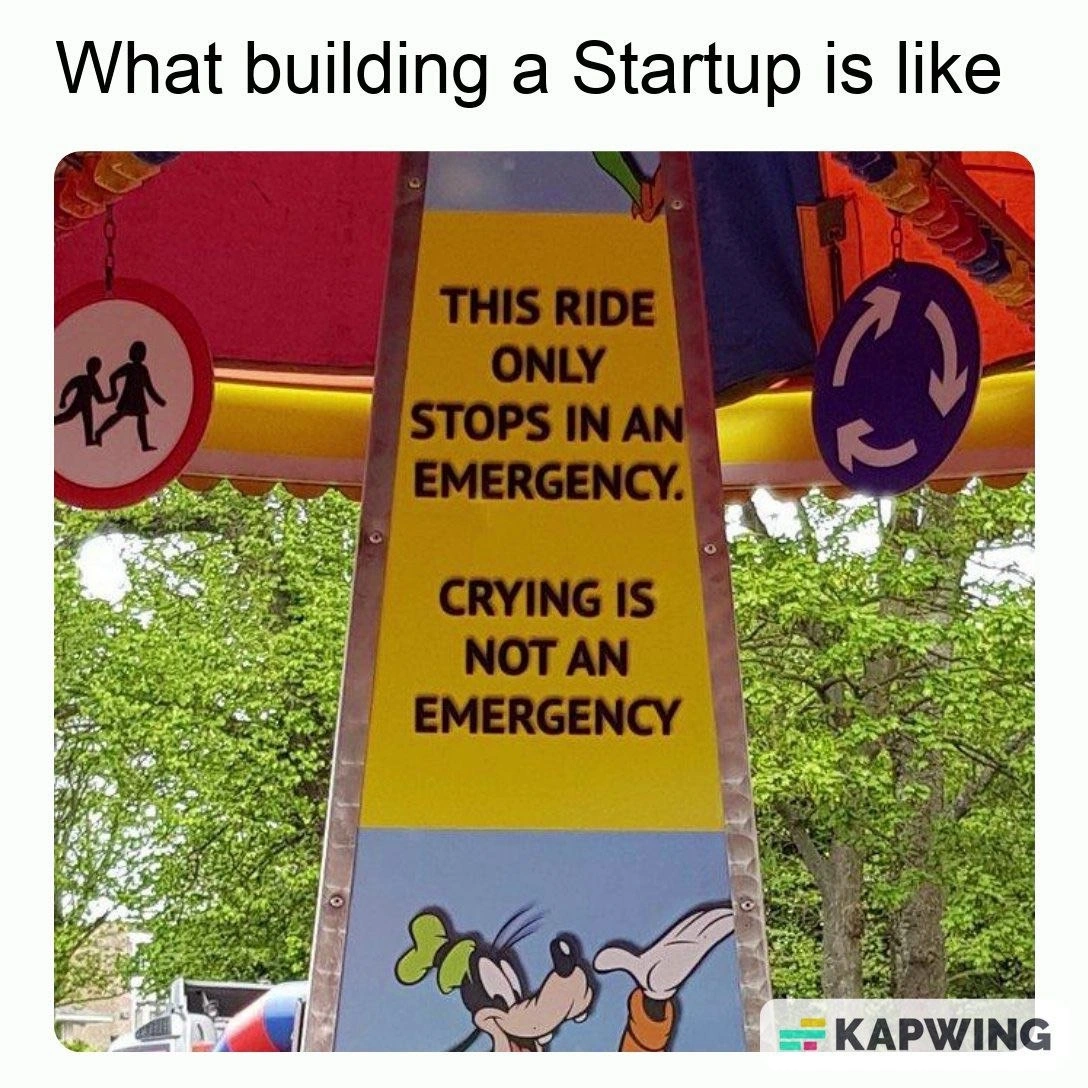
Now, the text on the meme’s image says: “THIS RIDE ONLY STOPS IN AN EMERGENCY. CRYING IS NOT AN EMERGENCY.” This is presented on a bright, fun-looking amusement park ride sign (with Disney’s Goofy character shrugging at the bottom). In a literal sense, a carnival ride won’t stop just because a child on it starts crying; it only stops for something really serious (an emergency, like if the ride malfunctions or a safety issue happens). The meme is using this as an analogy for startup culture: in a tough startup, the work doesn’t slow down or pause just because the team is tired or stressed (that’s the “crying” part). It only pauses for huge emergencies – for example, if the website or app completely breaks down, or a major deadline is missed in a big way. In other words, normal stress or fatigue isn’t considered a reason to stop pushing forward.
Let’s break down some terms and ideas here:
- CrunchTime: This is a period when everyone is working extra hard, for extra long hours, to meet a very tight deadline. Think of when a project is due tomorrow and the team stays up all night – that’s crunch time. In startups, CrunchTime can feel like it’s all the time. There’s always another investor meeting or product launch coming up fast, leading to DeadlinePressure (intense stress because a due date is looming).
- DeadlinePressure: In jobs (and especially startups) a deadline is when something is due. Deadline pressure means you’re close to that due date and there’s a lot left to do, so you feel pressure (stress) to hurry. In a startup, often deadlines are very tight or even unrealistic deadlines (dates that are almost impossible to meet, but you’re told to try anyway). This pressure cooker environment means developers often work late nights and weekends to try to deliver on time.
- DeveloperBurnout: Burnout is what happens when someone has been under extreme stress for too long and basically becomes exhausted, both mentally and physically. A developer (software engineer) experiencing burnout might feel extremely tired, lose motivation, and even feel cynical or depressed. Developer burnout is unfortunately common in environments with constant crunch and no rest, like some startups. It’s like if you never get off that rollercoaster ride, eventually you run out of energy and feel sick.
- SleepDeprivation: This means not getting enough sleep. If someone is pulling consecutive all-nighters or repeatedly working until 3 AM and then coming back to work at 8 AM, they are sleep-deprived. In startups, during intense periods, team members often skimp on sleep to cram in more coding hours. Over time, sleep deprivation makes people less productive, more error-prone, and frankly miserable. It’s another factor that can lead to burnout.
So, the meme’s sign “crying is not an emergency” humorously implies that feeling overwhelmed (to the point of tears) is treated as business as usual in some startup cultures. It points to an expectation of emotional resilience – meaning the ability to handle stress and keep functioning. In a healthy workplace, if someone is crying from stress, that’s a serious red flag that the team is overworked or something is wrong. But in a toxic startup environment, the sad joke is that management might say, “Well, unless the servers are literally on fire, keep working.” They treat the situation as if only a literal emergency – like the app going completely offline (often called a production outage in tech terms) – would justify stopping work or changing plans.
For example, imagine you’re a junior developer at a small startup. Your team has promised a new feature to an important client by the end of the week. It’s Thursday night, and things are not working; there are a lot of bugs. Everyone is still in the office (or on Slack at home) at midnight trying to fix everything. You’re exhausted and on your third cup of coffee. One of your teammates is so frustrated and tired they actually start crying from stress. Now, a sensible response might be: “Whoa, we all need a break, let’s pause and rest and come back with clear heads.” But instead, the startup attitude – as the meme jokes – is more like: “We can’t stop now, this has to be delivered! Wipe away the tears and keep coding unless this whole system is crashing down.” The only thing that would make the bosses hit the brakes is if, say, the main database suddenly crashed – that would be considered an actual emergency. Feeling overwhelmed isn’t considered a valid reason to stop; it’s almost seen as normal.
The continuous arrows in the meme image (the circular blue sign with arrows) emphasize that the ride goes round and round without end. In a startup, this represents how the cycle of work just keeps going. After one deadline is met, there’s always another on the horizon. After one crisis is resolved, the product might pivot or new features are needed immediately, and you’re back in crunch mode. It can truly feel like a startup rollercoaster – exciting and terrifying at the same time. You have wins (like reaching a milestone or getting user growth – that’s the exhilarating uphill part of the coaster), and you have drops (like bugs, outages, or angry clients – the stomach-dropping failures). Importantly, you don’t get off the ride because you’re tired or stressed; you hang on until a real stop occurs (like maybe the company runs out of money, which is the ultimate emergency stop for any startup).
In simpler terms, this meme is highlighting the relentless pace of startup work. It’s poking fun at the idea that in some startup environments, working until you’re miserable is just part of the job. Crying from stress is viewed as something you might do at your desk, then you compose yourself and join the next meeting as if nothing happened. It’s a form of dark humor that many developers understand, especially those who’ve been through “crunch time” at a startup or game development studio. The joke reminds everyone that this kind of work culture is over the top – it shouldn’t be normal, but often it is.
The categories “Startup” and “Deadlines” and “MentalHealth” all come into play here:
- Startup & Deadlines: Startups often have tight deadlines because they’re racing against competitors or trying to impress investors. That leads to a culture of working non-stop, which the meme illustrates by saying the ride only stops for real emergencies.
- Mental Health: The phrase “crying is not an emergency” touches on mental health because crying is a sign of emotional distress. The meme is shedding light (through humor) on a serious issue: many startup employees feel immense pressure and can become overwhelmed or burnt out. Yet, in a toxic work culture, those feelings might be brushed aside. This meme resonates as a coping joke – developers share it to say “yeah, this environment is crazy, we know it, we’ve lived it.”
So, for a junior developer, the takeaway is: this meme jokingly warns about the no-stop mentality in some startups. It’s saying: Working at a startup can be like being stuck on a ride that just won’t stop. Even if you’re freaking out or completely drained, you’re expected to carry on. It’s a critique of that lifestyle, wrapped in humor. And if you ever find yourself in a job where it feels like this description – constantly in crunch, no breaks for personal well-being – it might be a sign to speak up or reconsider, because crying shouldn’t have to be normal at any job. The meme is funny to developers because it’s a bit too real, capturing an extreme that many have experienced or at least seen in the tech industry.
Level 3: Infinite Crunch Loop
At a startup, work can feel like an infinite loop that never breaks out. This meme nails it with that carnival sign: “This ride only stops in an emergency. Crying is not an emergency.” It’s a perfect metaphor for StartupCulture. In a fast-paced startup, there’s no pause button – the team keeps coding, deploying, and firefighting without real breaks. The only time everything halts is when something truly catastrophic happens (think a production server catching fire or a major outage taking down your app). Regular human needs? Those get ignored deferred. Crying from stress or exhaustion won’t trigger any outage alarms or all-hands war room calls. Seasoned engineers chuckle (probably a bit bitterly) at this because we’ve all been there: deploying a hotfix at 3 AM, eyes bleary, maybe a tear or two, but you keep going since “crying is not an emergency.”
The humor here comes from how relentless the startup ride is. The sign’s cheery theme-park setting (bright colors, Goofy shrugging) contrasts with its harsh message. It’s as if management plastered a friendly cartoon on the wall to say, “Keep smiling through the pain!” Startups often present themselves as fun, high-energy environments – free snacks, bean bag chairs, casual vibe – but behind that is a brutal workload and constant CrunchTime. The meme exaggerates it to dark comedy: a Disney-esque ride where even if you’re screaming (or sobbing) to get off, the ride operator just shrugs like Goofy and says “Not unless it’s an emergency, pal.” That shrug is the startup CTO when you tell them you’re burnt out: they’ll sympathize for half a second, then ask if the new feature is deployed yet.
Why is this so relatable for senior devs? Because startup life feels like a rollercoaster that never stops. There’s perpetual motion – new features to ship, investor demos, scaling challenges, maybe a pivot of the whole product – and hardly any scheduled downtime. In a healthy world, you'd plan maintenance breaks or recovery time, but in many startups the culture is "go, go, go." Did the site stay up this week? Great, then no time to rest, onward with the next release! The ride doesn’t stop; you just hold on tighter. If a developer has a meltdown (tears, stress, DeveloperBurnout), it’s unfortunately often treated as their problem, not a project-stopping issue. But if the production database melts down, then it's all sirens and everyone-panics – the equivalent of an amusement ride’s emergency stop. It’s a bleak joke: code could be literally on fire and that is an emergency, but a coder on the verge of collapse is expected to just “work through it.”
Let’s break down the unwritten definitions at many crunch-heavy startups:
- Emergency (Valid Reason to Stop): The live site is down, data is corrupted, a major client is screaming, or something’s on fire (hopefully metaphorically). All hands on deck! Everything stops except fixing that issue.
- Not an Emergency (Keep Going): You haven’t slept in 36 hours and are crying into your keyboard at 2 AM. Production is technically still running, so the timeline marches on. Grab another energy drink.
- Emergency: A critical deadline slipped and investors might pull funding. Full panic, instant war-room meeting.
- Not an Emergency: Half the dev team is burned out or quietly crying in the bathroom. Management pats them on the back and says “Hang in there, we’ll push through.”
It’s funny because it’s painfully true. The meme’s sign could be hung in the office of a startup with a wink: “THIS PROJECT ONLY STOPS IN AN EMERGENCY. BURNOUT OR TEARS DO NOT COUNT.” The CrunchTime mentality is so ingrained that taking a break for mental health can feel like asking to stop a rollercoaster mid-loop – it just doesn’t happen unless things have fully derailed. Experienced developers have learned to recognize this absurd pattern. We joke about it now (with a dash of sarcasm), but it highlights a real problem: the “always on” startup ethos that treats normal human limits as an afterthought.
To a battle-hardened coder, there’s also an ironic nod to system design here: a robust system is supposed to keep running unless a failure triggers a shutdown. Startups treat their teams the same way – keep producing code non-stop, and only a severe “failure” (like a production outage or someone quitting on the spot) forces a pause. We’ve turned people into highly available services, expected to have 99.999% uptime. It’s a twisted form of engineering reliability applied to human beings. So, the meme gets a laugh and a wince from veteran developers. We laugh because we’ve survived that endless ride, and we wince because we remember how exhausting it was.
// Pseudo-code depicting the startup ride logic
while (startup.isRunning()) {
workHard(); // continuous work, feature development, firefighting
if (systemEmergency()) {
break; // The only condition that stops the ride
}
if (developer.isCrying()) {
developer.wipeTears(); // crying is not considered a stopping condition
// (Keep going... no emergency here)
}
}
deployToProduction();
In the above tongue-in-cheek code, systemEmergency() is the only thing that breaks out of the loop. If developer.isCrying() returns true, the program just calls wipeTears() and continues – exactly like the sign says. It’s a dark joke about how startups often operate: the process won't break for your burnout. The code even ends with deployToProduction(); – because of course it does! The deployment (launching new code to users) goes on, tears or not. This resonates with developers who have written code late into the night despite being at the brink of collapse.
Ultimately, the meme is cathartic humor for those of us who’ve done tours of duty in startup land. It calls out the unspoken truth: StartupLife is a wild ride that rarely ever stops, so hold on tight. It’s making us laugh at the absurdity that in some tech cultures, being human (tired, stressed, even crying) isn’t seen as a good enough reason to hit the brakes. Only a true emergency – the kind that threatens the startup’s survival – will get everyone to finally pause. Everything else? Just part of the ride. Welcome aboard!
Description
The meme has a white border with the headline text, “What building a Startup is like,” centered in bold black letters at the top. Below, a photo shows the inside pillar of a colorful amusement-park ride; bright yellow signage on the pillar reads, “THIS RIDE ONLY STOPS IN AN EMERGENCY. CRYING IS NOT AN EMERGENCY,” with Disney’s Goofy shrugging at the bottom of the sign. Circular instruction icons for children and a circular blue arrows-in-a-circle sign hang on either side, emphasizing continuous motion. Trees and equipment are visible in the background, and a small “KAPWING” watermark sits in the lower-right corner. Technically, the meme equates startup engineering to an uncontrollable production environment: no true downtime, only catastrophic outages warrant a stop, and ordinary emotional fatigue (crying) doesn’t qualify - echoing the relentless, all-hands-on-deck culture, constant deadlines, and burnout risks familiar to experienced developers

Comments
6Comment deleted
Startup runbook: “Engineer crying in stand-up” is a Sev-3 - we only stop the ride when the Kubernetes deployment hits CrashLoopBackoff and the burn-rate graph resembles a hockey stick
The only difference between a startup and a roller coaster is that roller coasters have safety inspections, defined maintenance windows, and someone actually tested them before letting customers on
Startup founders debug their code with a linter, but debug their emotions with this sign. The ride's SLA guarantees 99.9% uptime regardless of your mental state - tears are considered a non-blocking warning, not a critical exception. Remember: your production incidents get a war room and PagerDuty alerts, but your emotional incidents get a yellow sign and a cartoon dog. At least the ride has better error handling than your MVP's exception logging
Startup incident policy: the roadmap pauses only for Sev-1; tears are P4 and the Jira bot auto-closes them unless they affect MRR
Startup SRE policy: stop the ride only for SEV‑0 - data loss or runway at zero; CEO tears are within the error budget. Keep deploying
Like a Kubernetes cluster with zero-downtime deploys: the pods keep spinning, but founder tears aren't a valid disruption budget