Git Push Sponsored by Raid Shadow Legends -- The Future Is Now
Why is this VersionControl meme funny?
Level 1: Ads Everywhere
Imagine you’re quietly doing your homework with a pencil, and all of a sudden the pencil shouts out, “This homework was brought to you by a video game! Use code HOMEWORK20 to get a discount!” That would be pretty weird, right? This meme is laughing at a similar kind of weirdness. In the picture, a programmer is using a very normal tool to save their work (kind of like pressing save on a document), and suddenly a big advertisement pops up saying it’s sponsored by a game. It’s funny because we don’t expect ads to show up in our personal tools – just like you wouldn’t expect your toothbrush to play an ad while you’re brushing your teeth. The joke is showing a silly “what if” future where even our basic work tools have commercials. The feeling it gives is a mix of surprise and “oh no, not here too!”. In simple terms: it’s making fun of how it seems like ads are everywhere these days, by imagining them in a place that should absolutely be ad-free. Even if you’re not a coder, you know how annoying ads can be – this meme gets a laugh by pretending that even coding (which is usually just text on a screen) could get interrupted by a cheesy game advertisement. It’s like saying, “wow, nothing is safe from ads now, not even the nerdy stuff!”
Level 2: Ads in the Terminal
For junior developers or those new to the scene, let’s unpack what’s going on and why it’s funny (and scary at the same time). First, Git is a widely-used version control tool. It keeps track of changes in code and allows multiple developers to collaborate. Typically, you interact with Git through a command-line interface (CLI) by typing commands in a terminal (a text-based window for entering commands). A command like git push origin main means “send my latest commits (changes) to the remote repository named ‘origin’, specifically to the main branch.” After you run this, Git usually prints some standard messages about what it’s doing – things like counting objects, compressing data, and confirming that the update to the remote repository was successful. For example, a normal session might look like:
$ git push origin main
Enumerating objects: 5, done.
Counting objects: 100% (5/5), done.
Compressing objects: 100% (2/2), done.
Writing objects: 100% (3/3), 240 bytes, done.
Total 3 (delta 1), reused 0 (delta 0)
To github.com:yourrepo/project.git
71e6e17..7df6ae5 main -> main
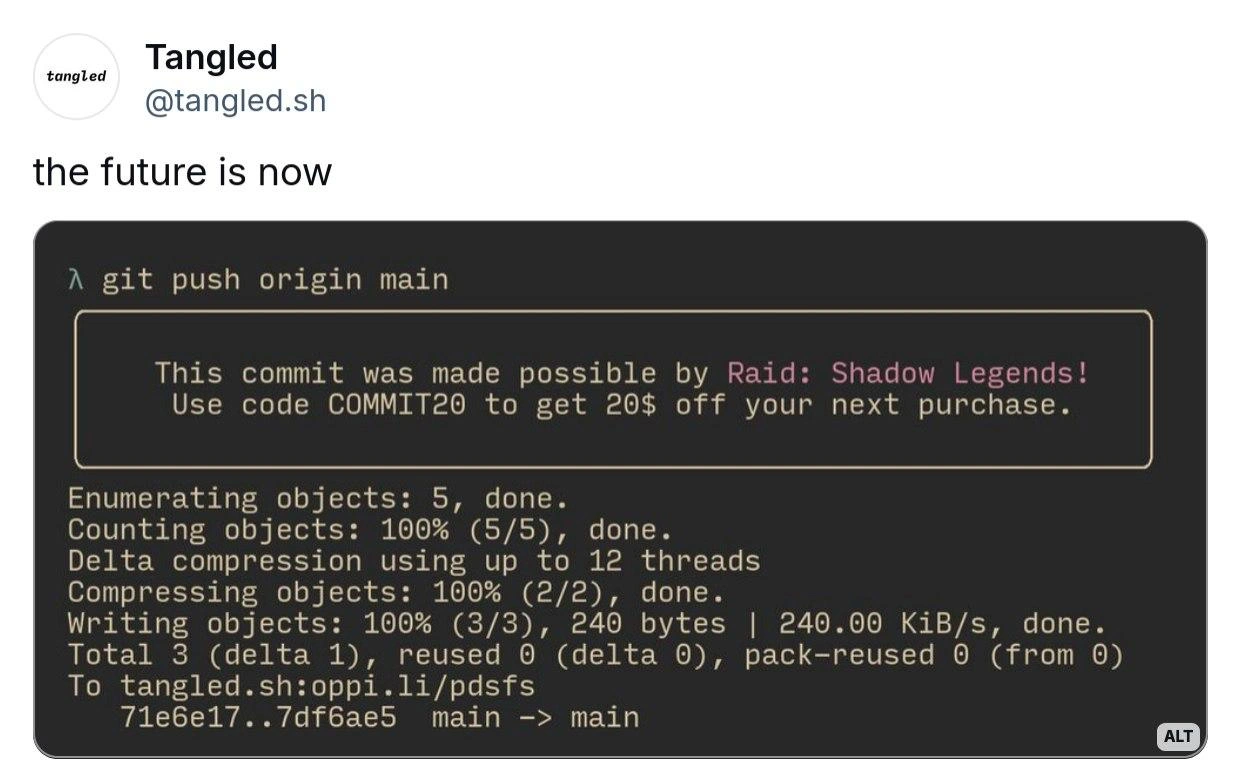
All of that is typical technical output from Git, showing it processed your request and updated the code on the server. Now, in the meme’s screenshot, something extra is in there that does NOT normally happen: a big boxed message in pastel yellow text appears right after the command is run. It says, “This commit was made possible by Raid: Shadow Legends! Use code COMMIT20 to get $20 off your next purchase.” This is basically an advertisement or sponsorship message, very similar to what you’d see a YouTuber say at the start of a video: “This video is sponsored by… [some product]. Use my code to get a discount.”
Why is that funny in this context? Because developer tools like Git have never had ads. The command-line is usually a very no-nonsense environment. You tell the computer what to do with short commands, and it spits back purely the info you need. There’s no concept of pop-ups or sponsored content in a terminal – that’s stuff we expect on free mobile apps or websites, not in our serious coding workflow. So the meme is showing a ridiculous what-if scenario: Imagine if pushing code to GitHub triggered a commercial! It’s the clash between a DeveloperExperience (which is normally focused, efficient, and ad-free) and the world of monetization (where everything is brought to you by a sponsor these days).
The mention of Raid: Shadow Legends is no accident either. If you’re not familiar, Raid is a mobile game infamous for advertising seemingly everywhere online. If you watch gaming videos or tech content on YouTube, you’ve probably heard the almost cliché line: “This video is sponsored by Raid: Shadow Legends…” It’s become a bit of a running joke in internet culture, because that game sponsors so many people that it’s basically shorthand for “annoying sponsor ad.” By choosing this particular sponsor, the meme instantly communicates: this is a cheesy, intrusive ad. Even the phrasing “Use code COMMIT20 to get $20 off” parodies typical promo codes : they often combine some theme of the content (in this case, “COMMIT” is a Git term, repurposed as a coupon code) with a discount offer. It’s a perfect storm of context clash: a Git commit being linked to a purchase code for a game.
For a newer developer, it’s worth pointing out that currently, Git (the tool itself) is open-source and free, maintained by the community (originally created by Linus Torvalds, who also created Linux). It doesn’t have any kind of advertising or sponsorship built into it. In fact, most command-line tools don’t; the terminal is considered a professional space. Seeing an ad there would be like finding a commercial jingle in the middle of a serious news broadcast – it just doesn’t belong. That’s why the meme’s image caption says “the future is now.” It’s implying a kind of sci-fi or dystopian future where even our coding tools have ads. A junior dev might not have experienced it, but many of us have seen a progression: software that used to be one-time purchase or free has moved to subscription models, apps have added ads or “premium” tiers, and even development tools (like certain IDEs or cloud services) now push in-app promotions or marketplace items. There’s a growing concern about monetization_of_dev_tools, meaning the trend of turning developer software into revenue-generating platforms.
The categories and tags listed (like ToolingFrustration, DeveloperHumor, cli_ads_injection) reflect what this meme is poking fun at:
- Developer Humor: It’s a joke that developers would particularly find funny (or cringe-y) because it twists their daily experience (using Git). If you’ve ever used Git, you know how outlandish it would be to have an ad show up in it. It’s humor born from the contrast between expectation and reality.
- VersionControlHumor: This specifically targets version control systems (Git being the most popular one). There are many jokes about Git (like how confusing
git rebasecan be, or the classic “works on my machine”), but this one is about the tool itself being corrupted by corporate influence. - Tooling Frustration: Developers often feel frustration when tools don’t work as expected or add unwanted features. An ad in the CLI would be a prime example of an unwanted “feature” causing frustration. The meme exaggerates it for comedic effect.
- Open source sponsorship: In the real world, open source projects do seek sponsorship or funding (because developers maintaining big projects often do it for free and need support). Typically that might be done through GitHub Sponsors, Patreon, or a message in the README, etc. This meme makes a joke that instead of politely asking for sponsorship, the tool itself might just directly show a sponsor’s ad. It’s a tongue-in-cheek commentary: “What if open source took sponsorship to the extreme by literally plastering ads on the console output?”
- CLI ads injection: CLI stands for Command-Line Interface; “ads injection” means inserting advertisements into a place they normally wouldn’t be. The meme imagines someone injected an ad into the CLI output of Git. That’s like a prank or a malicious modification. It’s not something that happens in normal operation! But thinking about it makes us laugh and cringe because we realize how much we take for granted that our tools won’t do that.
- Sponsored commits: A commit is a saved change in your version control history. We usually think of commits as purely technical – just code and messages like “Fixed bug” or “Add feature X”. The idea of a “sponsored commit” flips that, suggesting each commit could have a sponsor. Picture if every time you made a commit, you had to thank a sponsor or it was “brought to you by” someone. That concept is so absurd it becomes a joke. It’s basically what the meme is showing visually. No one would literally sponsor individual commits… right? (Let’s hope not!)
Another reason this scenario rings alarm bells (in a funny way) for developers is the notion of focus and concentration. Many programmers prefer working in a minimalist environment. That’s one reason the terminal is beloved — it’s just text, no distractions, no pop-ups. When you’re debugging or deploying code, you don’t want anything diverting your attention. The pastel yellow ad box is specifically designed to catch your eye. It’s like a spotlight in your peripheral vision while you’re trying to drive. So the meme also jokes about how a DeveloperExperience_DX can be ruined by something like this: imagine you’re in “the zone” pushing out important bug fixes, and suddenly your flow is broken by “USE CODE COMMIT20 FOR $20 OFF!” blinking in your console. You’d probably do a double-take, maybe utter some choice words at your screen, and wonder if you got hacked or if the world’s gone crazy. This emotional response (surprise, annoyance) is exactly what the meme is tapping into and exaggerating for comedic effect.
Lastly, consider the context of industry trends. We live in a time where companies are always looking for new surfaces to display ads or do branding. It’s not entirely unthinkable that at some point a company might try to “skinover” a popular open source tool with some form of sponsorship – maybe an officially branded version of Git that shows tips or ads, or a plugin that does it. For now, that hasn’t really happened (the community would likely reject it), but because software moves fast, the joke resonates: it’s a cautionary “imagine if”. It’s funny, but it also reflects a tiny fear: as everything becomes monetized, maybe even our beloved command-line tools could be next.
In summary, at this level, you just need to know:
- Git push: a command to send your code changes to the cloud (like saving your work to GitHub or another Git server).
- Ad banner in output: absolutely not a normal thing. The meme-maker added that as a joke. If you ever see something like that in real life, it’s either a prank or something is very wrong!
- Raid: Shadow Legends code: a reference to a popular meme about excessive sponsorship; it’s intentionally chosen to represent the most stereotypical ad one might see.
- Why it’s funny: It’s the contrast. It’s like a monk at a silent monastery suddenly blasting a commercial on a loudspeaker – the last place you’d expect it. Developers treasure an uncluttered workflow, so the idea of a “sponsored commit” is both amusing and alarming.
Level 3: Push, Pull, Profit
On the surface, this meme is a sardonic mash-up of version control and shameless monetization. We see a developer's terminal where they run git push origin main – a routine command to upload code changes to a remote repository on the main branch. But instead of the usual quiet professionalism of Git, the terminal output includes a garish sponsorship banner:
"This commit was made possible by Raid: Shadow Legends! Use code COMMIT20 to get $20 off your next purchase."
This absurd message mimics the style of influencer sponsorships and ad reads usually found on YouTube videos or podcasts, not in a developer’s command-line. The humor lands because it’s a tech satire of an “ad-supported Git.” It imagines our sacred developer tooling turning into a billboard, with a free-to-play monetization model invading the austere world of text-based workflows. Seasoned developers have historically trusted tools like Git (the de facto VersionControl system) to be mercifully free of corporate noise. Seeing a Raid: Shadow Legends promo (the quintessential meme-worthy mobile game sponsor) wedged between git push output lines is hilariously horrifying. It’s the kind of dystopian twist that makes senior engineers both chuckle and shudder: What if even our CLI isn’t safe from ads?
This scenario underscores real industry anxieties about monetization_of_dev_tools. In the past few years, we’ve watched many developer products chase revenue streams in surprising ways. DeveloperExperience (DX) has become a battleground for profit: flashy GUIs, cloud IDEs, and plugin marketplaces all vying for attention (and dollars). But the command-line has remained a last bastion of focus and minimalism. The meme jokes that even git push – a simple, ubiquitous dev action – could succumb to ads_in_git. It’s like a nightmare inversion of “it’s always DNS”: here it’s “it’s always ads”. The tweet caption "the future is now" drips with irony, implying we’ve slid into a timeline where this shameless sponsorship is actually a thing. It’s funny because it feels just plausible enough in our hype-driven industry. After all, we already have subtle forms of this: some open-source CLI tools print open_source_sponsorship messages after installation (npm install often shows post-install donation pleas). The meme simply cranks that to 11, showing a full-on cli_ads_injection for a completely unrelated product.
From a senior perspective, it also satirizes how IndustryTrends_Hype can corrupt even Tooling. We’ve joked about “what’s next, ads in my ls command?” – and this meme runs with that joke. It’s highlighting ToolingFrustration: the frustration of developers if core tools were to prioritize revenue over user experience. We invest effort in mastering our tools; in return we expect them to remain stable, predictable, and focused on functionality, not pushing promo codes for fantasy RPG games. The banner “This commit was made possible by…” evokes the tone of corporate sponsorship announcements, hinting at a dystopia where each commit needs a financial backer like a NASCAR race or a PBS broadcast (“This push is brought to you by Raid: Shadow Legends, and viewers like you!”). It’s an exaggeration that pokes fun at real trends, such as big tech companies inserting themselves into open-source projects or the question of how maintainers get paid.
Let’s break down the mechanics of how this could even happen (in theory), since experienced devs might wonder if it’s technically feasible or just visual Photoshop humor. Git itself is an open source tool primarily used via command-line, and by default it doesn’t show ads. For this meme’s scenario to occur, someone would have to modify the Git client or use a custom Git hook that injects the ad. For example, a malicious or playful addition to the pre-push hook could print a message:
# .git/hooks/pre-push (hypothetical ad injection)
echo "This commit was made possible by Raid: Shadow Legends!"
echo "Use code COMMIT20 for $20 off your next purchase."
This script would run every time you push, spitting out the sponsor message before the usual Git output. In reality, no mainstream Git distribution does this — developers would riot. But the joke lands because it’s just plausible enough that an underhanded tool misuse or a desperate service might try sneaking in a “harmless message” for revenue. We’ve seen analogous attempts: remember when some libraries started printing sponsored_commits messages or funding URLs in build logs? It sparked community debate about what’s acceptable. The meme magnifies that debate to a ridiculous extreme.
The CynicalVeteran viewpoint here would note that nothing is truly sacred when monetization creeps in. If free mobile apps bombard us with ads, why wouldn’t a free dev tool be tempted to do the same? It’s a cheeky way to say “we live in a timeline where even our development workflow might get monetized.” The post text “We surely have a timeline where this is real” voices a resigned sigh — a feeling shared by long-time devs who’ve seen once-open platforms get locked down or filled with IndustryTrends_Hype (looking at you, Electron apps with paid plugins 🙄). The meme resonates with anyone who’s warily watched tech companies insert ads into email clients, file explorers, and yes, even command-line programs (Microsoft, for instance, flirted with putting ads in the Windows terminal via PowerShell help commands linking to docs with ads, which caused an uproar).
In summary, at the senior level this image is a dark joke about DeveloperExperience_DX being sold to the highest bidder. It’s funny because it’s horrifying: mixing the purity of a git push with the cringe of a sponsored shout-out. It hits on real concerns about the future of developer tools:
- Trust Erosion: If tomorrow your package manager or VCS started showing ads, the trust in those tools would plummet. Devs choose open source partly to escape such nonsense. This meme visualizes that betrayal of trust in a single screenshot.
- Ad Fatigue Comes to DevOps: We all suffer ad fatigue on the web and in apps; imagining it in DevOps pipelines or Git commands is both comical and maddening. It’s as if Git went “freemium” or adopted a Raid: Shadow Legends style marketing strategy – something completely at odds with how a low-level tool should behave.
- Community Backlash: The shared laughter is also a shared understanding: “If this ever actually happened, we’d fork Git so fast or write patches to remove it.” In other words, the meme is a pressure-release valve. We joke about it precisely because we don’t ever want to see it become real. (Remember how quickly devs removed the “Npm package adds political protest messages” or any time a tool oversteps boundaries, the community reacts swiftly.)
To seasoned engineers, the image is absurd but uncomfortably on-the-nose. GitCommands are supposed to be boring and utilitarian. The encroachment of a flashy Raid: Shadow Legends ad – complete with a promo code COMMIT20 – is a perfect parody of corporate culture invading hacker culture. The code-like format of the ad (“COMMIT20”) even parodies how marketers try to speak our language, turning a sacred word like “commit” into a coupon. It’s a wink to those who’ve seen sponsors shoehorn their brand into every context (”Use code DEBUG for 20% off!” – sound familiar?).
In essence, DeveloperHumor like this thrives on shared frustration: it’s mocking the idea of ads_in_git because we all innately feel that would be a line crossed. The meme exaggerates reality just enough: it isn’t randomly showing a Coke or Pepsi ad – it specifically picks a notorious online game ad that many devs are sick of hearing about. This specificity gives the joke bite: out of all things, that game has infiltrated our terminal?! It’s as if the last pop-up-free zone got stormed by the most cliché sponsor. The senior dev outlook chuckles at the witty execution but also whispers a little prayer: please, never let this actually happen.
| Normal CLI Experience 🛠️ | Sponsored CLI Nightmare 🎮💰 |
|---|---|
Developer runs git push – output shows only relevant version control info. |
Developer runs git push – output is preceded by a bright ad banner for a mobile game. |
| The terminal remains a serious, distraction-free zone focused on code. | The terminal feels like a YouTube video with an intrusive sponsorship segment. |
| Tooling behaves predictably (no surprises, just git doing git things). | Tooling behaves like ad-supported software, mixing work with marketing fluff. |
| Trust in the tool is intact – it’s doing exactly what it should do. | Trust is shaken – is my tool serving me or some advertiser’s interest? 🤨 |
In a world where every app and service seems eager to upsell or advertise, this meme strikes a chord. It’s a senior engineer’s daymare: running a basic command and getting terminal_hijinks courtesy of a marketing department. It jokingly warns: beware the slippery slope of monetization; today it’s free and open, tomorrow you might need to click “Skip Ad” to push your code. And as over-the-top as it is, anyone who’s been around the industry long enough has that tiny nagging thought – “let’s hope this stays just a joke, and not a Jira ticket on some PM’s backlog.”
Description
A tweet by Tangled (@tangled.sh) with caption 'the future is now'. Below is a terminal screenshot showing: 'git push origin main' followed by a boxed message: 'This commit was made possible by Raid: Shadow Legends! Use code COMMIT20 to get 20$ off your next purchase.' Then the standard git push output: 'Enumerating objects: 5, done. Counting objects: 100% (5/5), done. Delta compression using up to 12 threads. Compressing objects: 100% (2/2), done. Writing objects: 100% (3/3), 240 bytes | 240.00 KiB/s, done. Total 3 (delta 1), reused 0 (delta 0), pack-reused 0 (from 0). To tangled.sh:oppi.li/pdsfs 71e6e17..7df6ae5 main -> main'. The meme imagines a dystopian future where even git operations have sponsored advertisements
Comments
12Comment deleted
In 2030: 'git commit' now requires watching a 30-second ad. Premium subscribers get 'git commit --no-ads' for $9.99/month. Enterprise plan includes 'git blame --skip-product-placement'
They're rolling out `git push --premium` next quarter. It removes the ads and supposedly has a 5% higher chance of passing CI on the first try
Brace yourselves - next quarter the merge-conflict resolver will whisper, “Sponsored by Oracle Cloud, please accept the new terms before rebasing.”
After 20 years of arguing about whether to monetize with ads or subscriptions, we finally found the perfect solution: sponsored git commits. Next up: merge conflicts brought to you by NordVPN, and CI/CD pipelines that mine crypto between builds
Finally, a sustainable funding model for open source: every git push comes with a 30-second unskippable ad. Next up: 'This merge conflict resolution brought to you by NordVPN - because your branches need protection too.' At least the commit messages will be more entertaining than the actual code changes
Delta compression using 12 threads? Nah, Raid's COMMIT20 squeezes your wallet harder
Sponsored git outputs are how you know we’ve exhausted monetization - next up: unskippable pre-commit hooks and paywalled fast‑forward merges
Postmortem 2030: pre-receive hook couldn’t fetch the sponsor banner - adblock returned NXDOMAIN, so nobody could push the hotfix
why this is so accurate! Comment deleted
inevitable... Comment deleted
I wish I had control of the git MOTD like that. :D Comment deleted
... get $20 off your next commit. 👌 Comment deleted