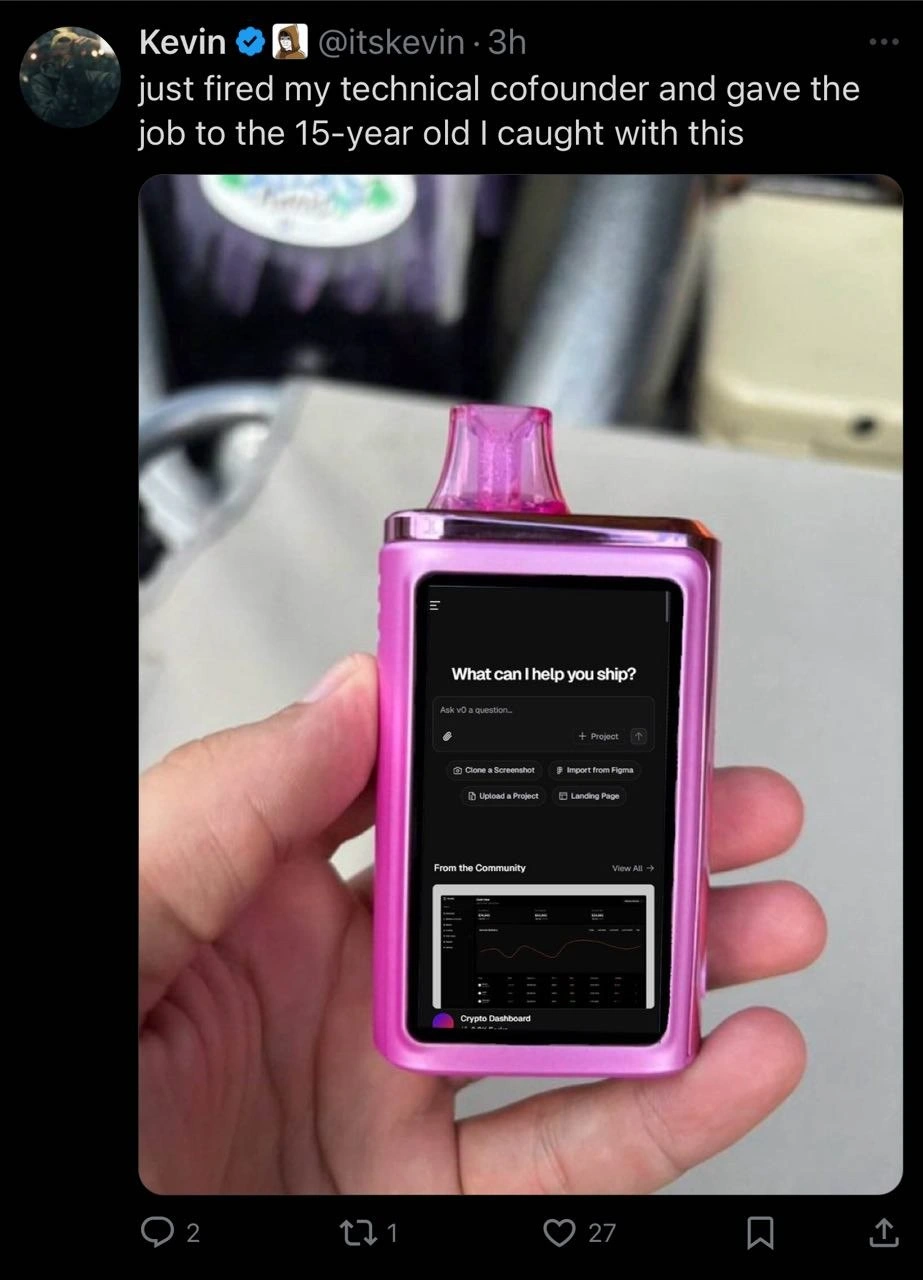
Firing the CTO after seeing a teenager's vape running an AI code generator
Why is this AI ML meme funny?
Level 1: Firing the Chef for a Microwave
Imagine a famous chef in a restaurant – someone who knows all the recipes and how to run the kitchen. Now picture the restaurant owner sees a kid come in with a magic cooking gadget, say a microwave that, with one button, can cook any dish perfectly. In a silly twist, the owner says, “You know what, Chef? You’re fired. I’ve got this kid with his fancy microwave to do the job now!” That sounds crazy, right? We all know a microwave (no matter how high-tech) can’t truly replace a skilled chef who understands flavors, presentation, and how to handle a busy kitchen. The joke here is just like that, but with computers and AI.
In the meme’s story, the “chef” is the CTO, the experienced tech person, and the “magic microwave” is a tiny device that supposedly can create software by itself (thanks to some powerful AI inside it). And the kid with the device is just a random teenager who knows how to push this magic button. It’s funny because it’s an exaggeration: it takes the idea that “new technology can do amazing things” to such an extreme that it becomes laughable. In real life, you wouldn’t actually fire someone who’s crucial to your team just because you found a cool new tool. You’d maybe let the chef use the microwave to save time on heating soup, but you still need the chef to plan the menu and ensure everything tastes good.
So the emotional core of this meme is the silliness of believing a gadget can instantly replace expertise. It makes us laugh because it’s a bit like a cartoon scenario – you can almost see the shocked face of the CTO (or the chef in our analogy) and the overly excited grin of the founder (or restaurant owner) who thinks they found a shortcut to success. It’s poking fun at how sometimes people get so hyped about a new thing (be it an AI, a microwave, or anything “smart”) that they momentarily forget the value of real human skill and experience. Even a kid can see the humor: if your friend said “I don’t need to study anymore because I got a fancy app that does all my homework,” you’d probably roll your eyes. Sure, the app might help answer questions, but it can’t truly learn or think for you. In the same way, this meme jokingly reminds us that no matter how awesome our tools get, we still need the people who know what they’re doing – otherwise, who’s going to fix things when the “magic microwave” inevitably breaks or cooks something weird?
Level 2: When AI Writes the Code
Let’s break down what’s happening here in simpler terms. The meme shows a tweet where someone claims they fired their CTO (Chief Technology Officer, the person in charge of all the tech stuff at a startup) and replaced them with a 15-year-old kid who has a special gadget. That gadget looks like a pink vape (an e-cigarette device) but instead of just puffing smoke, it has a tiny screen running what appears to be an AI code generator. In other words, it’s joking that this small device can do the job of a seasoned software expert, as long as a teenager is there to hold it. This is a tongue-in-cheek take on AI hype – the widespread excitement that AI can do anything, even write all our code for us.
The interface on the device’s screen is labeled “v0” and asks “What can I help you ship?” with a prompt bar that says “Ask v0 a question…”. Here “ship” means finish and deliver a software project. So the device is presenting itself like an AI assistant for developers. It’s as if you could ask, “Hey, build me a website that does X,” and it would generate the code for you. The options shown – Clone a Screenshot, Import from Figma, Upload a Project, Landing Page – are all things related to building software:
Clone a Screenshot: If you click that, presumably you’d give the AI a picture of a website or app design, and it would try to create real code that looks like that picture. For a junior developer, this sounds amazing because turning designs into actual code (HTML, CSS, etc.) is a big part of web development. Usually you’d do that by hand, which takes time and skill. The meme is suggesting the AI can do it automatically.
Import from Figma: Figma is a popular design tool where designers make mock-ups of websites/apps. Importing from Figma would mean the AI reads the designer’s file directly and builds the app’s frontend from it. It’s like skipping the coding part by having the AI interpret the design file and produce working software components. This is another task new developers often have to do (take a design and implement it), so having a button for it sounds both exciting and a bit suspicious – can it really capture all the details correctly?
Upload a Project: This likely means you can give the AI an existing codebase or project files, and the AI might help continue the work or fix/improve it. Think of it like having an AI code reviewer or collaborator that can understand your project and add features or debug it when you upload it.
Landing Page: In the startup world, a “landing page” is usually a simple one-page website that describes your product or service – basically marketing material to have an online presence. The option here implies the AI can generate a quick landing page for you, probably based on minimal input. It’s a common need for new startups to whip up a landing page without much development effort. For a beginner, it’s helpful to know that there are template-based tools for this, but an AI doing it custom is next level.
Now, why is it a teenage kid with a vape? The vape is funny because it’s the last device you’d expect to run an app builder. Vapes are for inhaling flavored vapor (often nicotine) – they are not known to run software except maybe a tiny firmware to control the heating element. So seeing a full app interface on a vape is absurd. It’s mixing a bit of youth culture (teens and their gadgets) with tech culture (startup founders and AI tools). The teenager angle plays on the idea that young people often pick up new tech really fast. There’s a stereotype (with some truth) that the younger generation adapts to new digital tools quicker than the older folks. So here, a 15-year-old is shown outsmarting or out-tooling an experienced CTO simply by using this new AI gizmo. It’s a humorous exaggeration of how developer experience (DX) could evolve – maybe you don’t even need formal programming knowledge; you just need to know how to prompt an AI. The “caught with this” phrasing in the tweet implies the teen wasn’t even supposed to have such a powerful tool; like he was sneaking a vape and accidentally revealed he had an AI supercomputer in his pocket. The founder sees that and jokingly goes, “You’re hired! Sorry CTO, you’re out.”
Some important terms in case they’re unfamiliar:
CTO (Chief Technology Officer): In a startup, this is the person who leads the technical side of things. If it’s a tech startup, often the CTO is a co-founder who architects the system, chooses the tech stack, and sometimes manages the engineering team. Firing your CTO is a huge deal – it’d be like a soccer team firing their coach mid-season. It’s not done lightly, and if the CTO was also a co-founder, you’d have serious fallout (legal and practical). So saying you fired your technical co-founder is both dramatic and, in this context, clearly meant as a joke.
Generative AI: This refers to AI systems that generate content. ChatGPT, for example, generates text (including code) based on prompts. An AI code generator is a generative AI specialized for programming. It learns from lots of example code and can produce new code when you ask it something. GitHub Copilot is a real example that many junior devs might have heard of or used; it suggests code as you type, using AI. The meme is referencing an even more advanced tool that could generate entire projects or features on command.
No-code / Low-code: These are platforms or tools that let people build software with minimal hand-written code. They often use visual interfaces – like dragging and dropping elements – or configuration settings. The idea is to empower non-programmers to create simple apps or websites. A lot of startups try them, but they have limitations, and usually for complex apps you eventually need real code. In this meme, the AI tool is like the ultimate no-code assistant: you literally don’t code; you just ask the AI or give it designs and it does the coding part for you.
Developer Experience (DX): This is a term that refers to how smooth or convenient it is for developers to build, test, and ship software. Good DX means tools and processes are easy to use, so developers can focus on creativity rather than fiddling with setup or fighting errors. In the image, the AI’s prompt “What can I help you ship?” and those one-click options are all about improving DX – it’s making the complex parts of coding feel straightforward. It’s like having a super helpful assistant who takes care of the boilerplate so you can be more productive (or in the joke’s case, so you don’t need the expert at all).
Startup culture and humor: Startups are known for moving fast and sometimes being a bit over-optimistic with new tech. It’s not unheard of for startups to pivot or change direction when they find a new hot technology. The tweet is a caricature of that mindset: a founder instantly changing their approach (even their staffing) upon discovering a fancy new tool. It’s sarcastic – real companies (hopefully) wouldn’t fire someone just because a gadget seemed cool for an hour. But it captures that kernel of truth about chasing trends.
So for a junior developer or someone new to this: the meme is funny because it’s ridiculously suggesting that a kid with an AI gadget can replace a seasoned pro. It exaggerates how powerful AI developer tools are becoming, to the point of absurdity. If you’ve ever used something like ChatGPT or seen it produce code, you might have been both impressed and concerned – “Wow, it wrote that function for me… could it take my job someday?” This meme takes that concern and satirizes it. It’s saying, “Haha, yeah, the AI is so good even a vape can run it and replace you.” In reality, tools like these are helpers, not full replacements (at least not yet!). They can boost your productivity – maybe you’ll finish your project faster with an AI buddy – but they don’t have the human judgment or deep understanding of your specific problem domain. A 15-year-old with an AI can generate a lot of code, sure, but would that code be secure, scalable, and exactly what the product needs? That’s where experienced developers still shine. The meme is a light-hearted reminder not to believe all the hype. It’s great to explore AI tools (even as a beginner, they can teach you patterns), but software development is more than just churning out lines of code.
In summary, at Level 2 we see clearly: this is a joke about a startup founder who thinks a new AI gadget (so easy a teenager can use it) is enough to replace an expert programmer. It mixes techie references with everyday concepts: firing someone important, a teenager’s vaping device, and an AI that can “magically” build apps. Understanding those pieces, we get why it’s funny: it’s like saying a new shortcut has made the long route obsolete overnight, which almost never happens so cleanly in real life. It’s a playful caution not to take tech fads too seriously – even as we enjoy dreaming about them.
Level 3: No Code, No Cofounder
On the surface, this meme reads like classic StartupHumor: a founder bragging they just replaced their highly-paid technical cofounder (CTO) with a teenager and an AI-powered gadget. It’s poking fun at the current AI hype in startup culture. In recent years, every founder has been asking, “Can we use AI for this?” and here the answer was apparently, “Yes, so much that we don’t even need our CTO!” The tweet format itself – “just fired my technical cofounder and gave the job to the 15-year-old I caught with this” – is so absurd that any seasoned developer immediately spits out their coffee. It’s a perfect storm of DeveloperHumor and StartupLife satire: it combines the trope of the non-technical founder who doesn’t quite appreciate what a CTO does, the shiny promise of a new AITool, and the shock factor of a kid with a neon pink vape somehow out-coding a veteran engineer.
Why is this funny to those of us with scars from real projects? Because we’ve seen AI tools and “no-code” platforms come and go, each promising to make engineers obsolete, yet here we still are – late nights and all. The meme exaggerates a scenario many devs secretly fear (or mock): the boss thinking “Hey, with ChatGPT and its cousins, coding is easy now, anyone can do it. Why keep expensive engineers or cofounders?” It’s the “just use GPT” mindset taken to a comical extreme. No-code platforms (and their buzzwordy sibling, low-code) have been around for ages claiming “you don’t need programmers, just drag and drop!”. From Microsoft FrontPage in the 90s, to Dreamweaver, to modern Wix and Bubble, every few years we hear “this will let you build apps without developers.” Now with AI, the promise sounds even cooler: “Describe what you want, and the AI will build it.” In a pitch meeting, it sounds like magic – why give equity to a CTO if a ChatGPT-style generator can spit out your MVP (Minimum Viable Product)? The meme nails this naivety by literally putting that power in a teenager’s hands (and not just any teen, one who’s sneaking a vape, which adds a rebellious LOL factor). It’s a riff on the idea that the next generation is so at home with tech that they can do in minutes what old pros do in weeks – a classic “kids these days” moment for veteran developers.
The visual of the pink vape with a screen saying “What can I help you ship?” is loaded with inside jokes. For one, “ship” in developer lingo means to deploy or release a product. An on-device assistant cheerily asking how it can help you ship software plays into the fantasy of extremely streamlined DeveloperExperience (DX) – as if deploying a new feature could be as easy as asking Siri. The UI has options like “Clone a Screenshot”, “Import from Figma”, “Upload a Project”, and “Landing Page”. These are all tasks that normally require a developer’s time:
Clone a Screenshot: This implies the AI can take a picture of an app or webpage and generate the code for it automatically. Seasoned devs know that turning a pixel-perfect design into working front-end code is non-trivial. Hearing a one-click button for it triggers equal parts intrigue and skepticism. Could an AI really do all the CSS, HTML, and logic just from a screenshot? It’s a real research pursuit (we’ve seen early attempts where you sketch a layout and ML produces code), but any front-end engineer will tell you there’s a ton of nuance – responsiveness, state management, accessibility – that a naive generator might miss. Seeing that on a vape’s tiny screen is hilariously implausible, and that’s the point.
Import from Figma: Figma is a popular design tool where UI/UX designers craft the look of applications. Importing from Figma suggests the AI will take the designer’s files and automatically turn them into a live application. In real life, we do have plugins and tools that help generate snippets of code from Figma designs, but it’s never as simple as pressing a button. There’s usually a lot of wiring up and fine-tuning needed. The meme’s device implies “Nah, I got this, I’ll do it end-to-end.” It’s compressing what might be days of coding into an instamatic task. If you’ve ever been the junior dev handed a Figma file and told “make it look like this in code,” you know it’s a meticulous process. The meme assumes an AI can do it instantly, which is both amazing and ridiculous.
Upload a Project and Landing Page: These suggest the AI can take existing code or content and modify or deploy it, and even scaffold a generic landing page for your product. Startups churn out landing pages for marketing, often using templates or boilerplate. A one-tap “Landing Page” generator fits the Startup move-fast mentality: why hire a web developer for a marketing site when an AI can draft one in seconds? “Upload a Project” hints the AI might refactor or continue development on code you give it – like, “Here’s my half-built app, please finish it.” That’s a scenario junior devs might fantasize about during crunch time.
The From the Community section with a “Crypto Dashboard” thumbnail is another wink. It showcases how any hyped technology (in one screenshot we got Crypto, now it’s AI) tends to gather a community sharing templates and use-cases. Crypto was the big hype a couple years ago in startups – everyone and their dog was launching a coin or a dashboard. Now AI is the new crypto: every startup pitch includes “...and we’re adding AI to do X”. The meme slyly implies that an AI builder app would have a community where users share pre-built projects (like a crypto dashboard) that others can clone. It’s actually a plausible feature – a template marketplace – but framing it on a vape device just makes it comically surreal. It’s blending a developer experience UI with the aesthetic of something a high schooler would have in their pocket. The contrast is gold: one part of your brain says “hey, that UI looks like a cool new Vercel product (codenamed v0 perhaps)”, and the other part screams “wait, why is it on a vape!?” It’s a classic meme non-sequitur that heightens the absurdity.
Now, beneath the humor there’s a grain of truth that senior devs will appreciate. AI-powered code generation has made impressive strides. We have GitHub Copilot writing whole functions by interpreting comments, and ChatGPT answering programming questions or scaffolding simple apps. A 15-year-old today could indeed accomplish tasks with these tools that might have taken a team of coders a decade ago. That’s real and exciting. The meme simply exaggerates it to a fanciful extreme: the kid doesn’t even need a laptop – just a pimped-out vape mod that runs the latest AI tool – and boom, they’re the new CTO. It lampoons the anxiety and thrill of developers witnessing this change. Experienced engineers nod knowingly because we’ve all read hot takes on Twitter like, “I built an entire app with GPT-4 in one weekend” or seen junior devs skyrocketing in productivity by leaning on AI suggestions. The meme is basically the “hold my beer” of those stories: “We replaced our whole engineering leadership with a device that, until yesterday, was mainly used to inhale cotton-candy-flavored nicotine.” It’s the ultimate hype-man statement for AI in dev work.
Of course, real-world startups don’t run on code alone. A CTO isn’t just writing JavaScript or Python; they’re designing architecture, ensuring scalability, mentoring the team, making build-or-buy decisions, and firefighting production issues at 3 AM. The idea that a gadget plus a teenager could take on all that responsibility is intentionally ludicrous. It jabs at how some founders misunderstand the role – thinking it’s just cranking out code. The developer humor hits home because many of us have faced a boss or client who genuinely thought coding was the “easy part” now that stack overflow and AI exist. We laugh (perhaps a bit nervously) because we’ve had to explain, “It’s not quite that simple…”
In sum, Level 3 exposes the satirical take: AIHype gone wild in a startup context. It’s a cautionary chuckle at the idea that you can fire your experts because a new tech toy came along. It resonates especially with senior devs and CTOs who’ve weathered multiple “this will change everything” waves. Today it’s AITools, yesterday it was some new JavaScript framework or cloud service – there’s always something that’s supposedly the CTO replacement. And yet, here we remain employed (for now!). The meme’s brilliance is packaging that whole concept into a single image that’s equal parts ridiculous and topical. It says: Welcome to 2025, where even the vapes are shipping code and the real engineers are left wondering if they should retrain as teenage device hackers.
Level 4: LLM in a Little Box
At the cutting edge of AI/ML, we have gargantuan neural networks doing tasks that once required entire teams of developers. Imagine stuffing one of these Large Language Models (LLMs) – the kind that powers tools like OpenAI's ChatGPT or Codex – into something the size of a pink vape. In theory, an AI code generator on a vape means running a model with billions of parameters on a device smaller than a smartphone. That’s like trying to fit a data center’s brain into a keychain. Under the hood, such generative AI systems use the Transformer architecture, crunching enormous amounts of data to predict code that might fulfill your request. Running that on real vape hardware is science fiction: you’d need extreme chip miniaturization or, more realistically, edge computing where the heavy model lives in the cloud and the vape is just a fancy remote terminal. In essence, the teen’s device is probably a thin client connecting to some beefy GPU servers puffing away out of sight – the vapor here is doing double duty as a joke about vaporware.
From a theoretical perspective, turning a design or prompt into working code is an AI-hard problem that mixes computer vision, natural language understanding, and programming synthesis. For example, that “Clone a Screenshot” feature implies an AI can take a UI image and infer the corresponding HTML/CSS/React code. Academically, this involves convolutional vision models to parse the screenshot, then an LLM to generate code – an active research area. We have papers and tools (like pix2code, Uizard, etc.) that attempt this, but they often struggle with edge cases and complex layouts. Import from Figma similarly suggests parsing design files and translating them into components automatically. These tasks highlight the dream of Software 2.0: instead of humans writing code, the machine writes code based on high-level intent. It’s a powerful idea, but it bumps into fundamental challenges. Coding isn’t just mapping inputs to outputs; it requires reasoning about state, edge conditions, and the end-user. Current AI models, no matter how large, are essentially pattern predictors – they don’t truly understand the project’s intent like a human technical cofounder would. They’ll happily generate an authentication system if asked, but they might also blissfully introduce a security hole or performance bottleneck because the prompt didn’t specify otherwise. There’s no formal verification step in these AI pipelines yet – they produce what looks right more than what is right.
This is where reality diverges from the hype of AI tools. A seasoned CTO brings architecture vision, prioritization, and the wisdom of past failures – things an AI, which lacks true comprehension or long-term planning, can’t replicate simply by regurgitating training data. The meme pushes the scenario to an absurd extreme: a 15-year-old wielding a gizmo that harnesses AI to do the work of an entire engineering leader. It’s a playful nod to Clarke’s adage that “any sufficiently advanced technology is indistinguishable from magic.” Here the “magic” is an AI code generator so advanced and miniaturized that it overturns traditional roles. But in practice, we know that cramming a generative AI into a pocket-sized gadget doesn’t circumvent the laws of computation or the need for human judgment. The vape might be glossy and pink, but it would need to conjure some serious silicon sorcery (or a 6G internet connection) to replace a real CTO. We’re talking about an AI tool that would require massive parallel processing, memory, and energy – things a nicotine vape was definitely not designed to provide. Until quantum computers come in watermelon-pink and fit in your hand, this scenario remains a tongue-in-cheek AI humor piece rather than a startup playbook. It’s highlighting the gap between AI hype and technical reality: amazing progress in AI-generated content (like code) still has constraints, and those constraints are exactly what make this meme so hilariously far-fetched.
Description
A screenshot of a tweet from the account “Kevin @itskevin · 3h” reads: “just fired my technical cofounder and gave the job to the 15-year old I caught with this”. Below the tweet, a hand holds a glossy pink vape whose front face has been photoshopped into a tiny smartphone-style display. The black UI on the device shows the headline “What can I help you ship?” with a search bar labelled “Ask v0 a question…”, buttons for “Clone a Screenshot”, “Import from Figma”, “Upload a Project”, and “Landing Page”, plus a community section featuring a thumbnail titled “Crypto Dashboard”. The absurd visual joke implies that a generative-AI design/code tool (Vercel’s v0) is so powerful that even a teenager with a vape-sized device can replace a technical cofounder, poking fun at AI hype, startup culture, and the shifting definition of developer experience

Comments
11Comment deleted
Thought we’d reached peak edge computing until a teenage intern showed up running v0 on a bubble-gum vape - turns out the future of DevOps is literally fog deployment
Nothing says 'technical due diligence' quite like discovering your next CTO is running a full-stack development environment on nicotine delivery hardware - though to be fair, both vaping and using AI to generate production code provide similar levels of long-term architectural damage
When your technical cofounder's equity vesting schedule becomes more expensive than a lifetime supply of nicotine-infused AI prompts, suddenly that Series A runway looks a lot longer. The real disruption isn't the technology - it's realizing your entire engineering org can be replaced by a device that also satisfies oral fixation and ships landing pages faster than your sprint velocity
We finally achieved edge compute - the CTO is a vape running v0; wake me when it handles zero‑downtime migrations and explains our SLOs to the board
True edge computing: the kid ships with v0 from a vape - DX is perfect, latency’s great, and SOC 2 immediately reassigned our platform team to Legal
The only cofounder with true zero-downtime shipping: instant deploys, no CI/CD required
wait what is this Comment deleted
What's the meaning of this? I mean, it is not allowed at school either way Comment deleted
"allowed" rules just make students hide whatever they're doing lol Comment deleted
It should've been something like cheating tool disguised as a regular pen, but disguising a mobile phone as a vape is like stuffing crack into hand grenade Comment deleted
Ah, the classic case of "When the teacher entered the classroom, I had to switch to smoking device, because it was easier to explain". 🧠 Comment deleted