Bing Maps’ double-named Gulf pokes fun at Microsoft’s duplicate apps problem
Why is this Bugs meme funny?
Level 1: Seeing Double
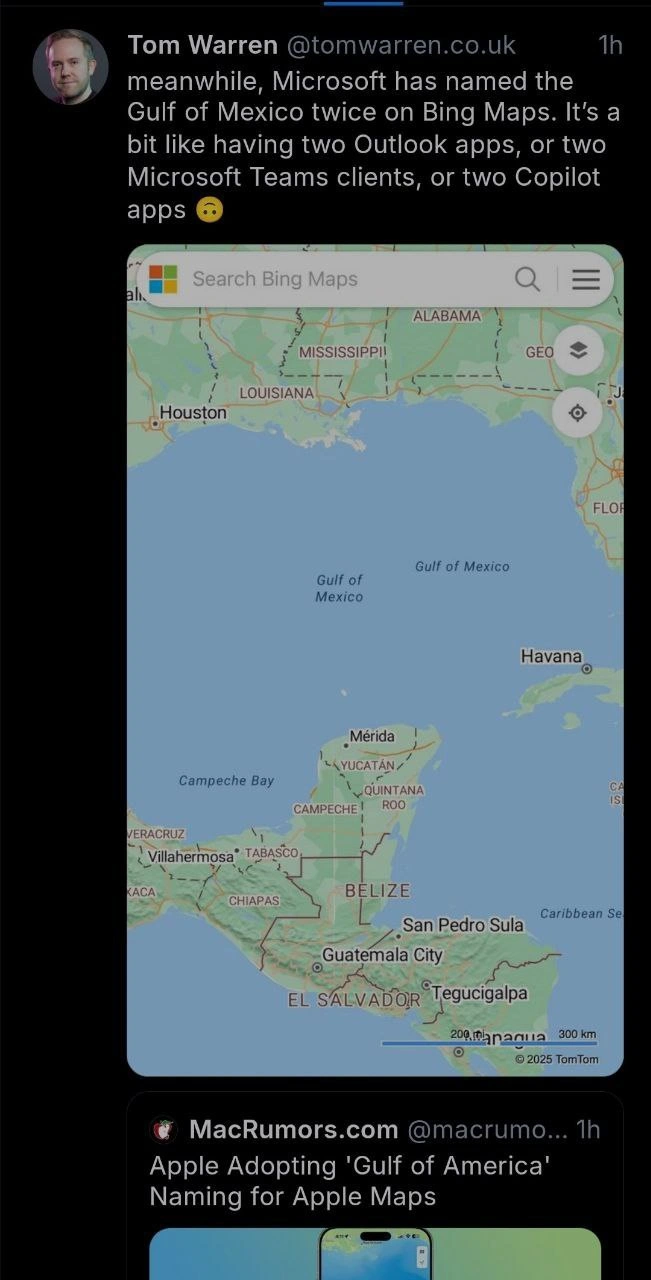
Imagine looking at a map and seeing the name of the same place written twice – for example, a big ocean labeled “Gulf of Mexico” two times. You’d probably do a double-take and chuckle, thinking, “That can’t be right, it’s just one gulf!” This meme is funny in a similar way. It’s showing that even a huge company like Microsoft can make a silly mistake, like accidentally putting two identical labels on one ocean in their map. It’s like if you had a globe or atlas at home and it printed the name of the ocean twice – it just looks goofy and obviously wrong.
Now, the joke goes a step further by saying this mistake is just like Microsoft having two of the same app on your computer. Think about turning on a new phone and finding two weather apps that do the exact same thing. You’d be confused, right? You might laugh and say, “Why on earth did they give me two?” That’s what people notice with Microsoft sometimes: they’ll have, say, two different programs both called “Outlook” that are meant for email, or two versions of their Teams chat app. It’s a bit like a store accidentally selling you two identical shirts when you only wanted one – it’s not harmful, but it’s kind of silly and unnecessary.
So, the meme is comparing the double-named gulf (clearly a mistake on the map) to Microsoft’s habit of having duplicate apps (which feels like a planning mistake in real life). It makes us laugh because it’s pointing out something obvious and absurd. Basically, even big tech companies can mess up in simple ways, and that’s oddly comforting and funny. It’s as if the map itself got confused and thought, “Hey, let’s label this big Gulf twice just to be sure people see it!” We all know one label was enough. The humor is playful: seeing double where you shouldn’t be. It reminds us that everyone makes mistakes – even a giant company – and sometimes those mistakes are just plain funny when you spot them.
Level 2: Two of Everything
So, what’s going on here? The meme shows a Bing Maps screenshot where the Gulf of Mexico is labeled twice. That’s clearly a mistake – normally, an ocean or gulf should have just one name label on the map. This kind of error is a bug in the software or the map’s data. It might be that the map had duplicate data entries for the Gulf, or the program drawing the map didn’t filter out the second label. Essentially, the map is seeing double. For users, it’s a visible UX (user experience) blunder: it looks sloppy and could be confusing if you thought maybe there are “two Gulfs of Mexico” (there aren’t – it’s just one big gulf!). A UX failure like this usually means the quality checks or QA (Quality Assurance) testing didn’t catch an obvious issue before the map update went live. Developers and testers aim to catch these things, but sometimes a bug slips through – perhaps the glitch only appears at a certain zoom level or after a data update, and no one noticed in time.
Now, the text from Tom Warren (a tech journalist known for Microsoft coverage) jokes that this double-name bug is “a bit like having two Outlook apps, or two Microsoft Teams clients, or two Copilot apps”. He’s comparing the map’s duplicate labels to something Microsoft does with its software. And indeed, Microsoft has a reputation for sometimes having two of everything in its product line, which many find both funny and frustrating. For example:
- Outlook: Microsoft has had two Outlooks at once – the classic Outlook program (part of Office) and another mail app in Windows also branded Outlook (formerly just Mail/Calendar). For a while, users saw two different apps named “Outlook” on their PC, which was confusing.
- Teams: Microsoft Teams (the workplace chat app) is going through a rebuild. There’s the original Teams app and a new faster Teams client. During the transition, some people ended up with both versions installed side by side. In some cases, one might be for work and another for personal use – two Teams clients on one machine.
- Copilot: “Copilot” is a name Microsoft uses for its new AI helper features. But they’ve used it in multiple places – there’s GitHub Copilot (to help write code), Microsoft 365 Copilot (to help in Office apps like Word/Excel), and Windows Copilot (built into Windows 11). They all have similar names — “Copilot” — even though they’re separate. So you could say there are multiple Copilot apps (or features) floating around with the same branding, which, again, can confuse users.
Tom’s joking that Microsoft tends to release overlapping or duplicate solutions instead of one clear product. This is something people in tech often tease Microsoft about. It’s like the company’s left hand and right hand each made a version of an app and rather than pick one, Microsoft ships both! This leads to weird situations like two apps with the same or similar names installed on your system. It’s a known quirk of Microsoft’s ecosystem – think of times when Windows had two web browsers (old Internet Explorer and the new Edge) or two control panels (the new Settings app and the classic Control Panel). Each is an example of redundancy that regular users notice and joke about.
So, when we see Bing Maps accidentally putting two identical labels (“Gulf of Mexico”) on one ocean, it amusingly mirrors that duplicate mentality. It’s as if even the map is following Microsoft’s habit of doubling up! The meme basically says: “Look, Microsoft named this place twice… just like they tend to give us two of every app!” For developers and tech-savvy folks, this comparison is humorous because it blends a simple software bug with a well-known industry observation about Microsoft. It’s a form of tech humor that combines a real bug in software (the map error) with a bit of truth about how big tech companies operate.
The second part of the meme (the MacRumors post) adds an extra punchline: “Apple Adopting ‘Gulf of America’ Naming for Apple Maps.” This isn’t a real news story; it’s a satirical jab. It implies that Apple, seeing Microsoft’s goof, might intentionally call the Gulf something completely different (as a playful twist). There’s a history to this joke: when Apple Maps first launched, it had many mapping errors and odd names, to the point it became a joke itself. The phrase “Gulf of America” sounds like Apple deciding to rename the Gulf of Mexico with a more “Apple-esque” or US-focused name – which is deliberately absurd. It’s poking fun at how companies sometimes have inconsistencies or national biases in their mapping data. In reality, Apple isn’t renaming the Gulf, but the joke makes the meme even funnier to those who remember Apple Maps’ early troubles or the rivalry between Apple and Microsoft.
In summary, this meme is pointing out a pretty obvious mistake (duplicate map labels) and cleverly linking it to a pattern in Microsoft’s world (duplicate apps). It falls under DeveloperHumor and UXFailures because it highlights how even big tech products can have silly bugs, and it lightly ribs Microsoft for its sometimes confusing product lineup. If you’ve ever scratched your head over having two similar apps on your phone or computer that came from the same company, you’ll get why this is funny. It’s a reminder that tech giants, with all their resources, still have very human slip-ups – naming an ocean twice on a map, or maintaining two versions of the “same” app – that make the rest of us both laugh and groan.
Level 3: Double Label, Double Trouble
On a technical level, this meme highlights a surprising data quality glitch in Bing Maps' front-end. The screenshot shows the Gulf of Mexico labeled twice on the map – a clear duplicate UI label issue. For seasoned developers, this smacks of a backend data inconsistency or a rendering bug in the map tiling engine. Bing Maps likely pulls geographic names from a dataset (or multiple datasets). If there's a duplicate entry for a feature (say, the Gulf of Mexico polygon appears twice in the data source, perhaps from merging two map layers), the map could naively render both labels. Ideally, a mapping system has logic to deduplicate labels – e.g., merging identical names or preventing overlapping text. Here, that logic evidently failed or wasn’t applied for large water bodies. The result? The Gulf gets two name tags, as if one wasn’t enough. In code, it’s as if someone did:
water_bodies = ["Gulf of Mexico", "Gulf of Mexico"] # Data glitch: duplicate entry
for name in water_bodies:
map.draw_label(name) # Draws "Gulf of Mexico" twice... oops!
From a QA (Quality Assurance) perspective, this is a facepalm-worthy oversight. It’s the kind of bug that sneaks in when automated tests focus on data correctness but maybe not on visual UX continuity – or when multiple teams each assume the other will handle label overlap rules. This mapping QA failure suggests nobody looked at that region at the right zoom level before shipping, or they relied too much on the data pipeline to self-correct duplicates. Seasoned devs have all experienced that scenario where a minor change (like ingesting a new map data source) has unintended UI side-effects. The meme hits home because it’s a trivially obvious bug that somehow made it to production – something any dev dreads happening under their watch.
Now, Tom Warren’s tweet cheekily connects this bug to a long-standing Microsoft quirk: having duplicate or overlapping products in their ecosystem. He jokes it's “a bit like having two Outlook apps, or two Microsoft Teams clients, or two Copilot apps” – and for those in the know, that analogy is spot on. Microsoft has a notorious habit of rolling out new versions or variants of products alongside (not replacing) old ones, causing a Noah’s Ark of apps (two of each!). Outlook is a prime example: for a while, Windows had the built-in Mail/Calendar app (later renamed Outlook for Windows) and the classic Outlook desktop app (part of Office). Users literally saw two Outlooks installed – with different icons and features, yet both official. Similarly, Microsoft has been transitioning Teams to a new architecture; during that period, many had both the old Teams client (Electron-based, heavier) and the new Preview Teams client (WebView2-based, lighter) on their machines – effectively two Teams apps coexisting (and sometimes confusingly both auto-starting 🙄). And when Tom mentions “two Copilot apps”, he’s poking at Microsoft’s buzzword Copilot being applied to multiple offerings: e.g., GitHub Copilot for coding, Microsoft 365 Copilot for Office, and even Windows Copilot built into Windows 11 – separate implementations all branded “Copilot.” It’s as if each team said “We’ll have our own Copilot,” leaving users with a swarm of similarly named assistants rather than one unified experience. In short, Microsoft’s house is a bit cluttered with duplicate rooms. Developers who have worked in big orgs recognize this pattern: different teams racing to ship their version, old and new coexisting due to backward compatibility or organizational silos, and a general reluctance to kill off legacy versions – the breeding ground for redundancy.
The humor here comes from how perfectly the double-named gulf visual fits Microsoft’s duplicate-app syndrome. It’s a literal UX failure on the map reflecting a metaphorical UX inconsistency in Microsoft’s product line. It’s as if Bing Maps itself caught the “two of everything” bug that plagues its parent company’s product strategy. To an experienced dev, it’s a chef’s kiss of irony: the MicrosoftProducts ecosystem that gave us two of each app has now given us two names on one ocean. Of course, beyond the joke lies a reminder: even polished products can have silly oversights. It’s a lighthearted example of BugsInSoftware that can slip past layers of review in a large organization. In big systems, one team might own the map data ingestion, another owns rendering, and a third does UI polish – and the gaps between responsibilities are where things like a duplicate “Gulf of Mexico” label sneak in. The cost of fixing it is trivial (probably deleting one entry or adding a check), but the cost to Microsoft’s reputation is a little ding of embarrassment – and fodder for tech humor on Twitter.
Even Apple got dragged in via the second screenshot: MacRumors jokingly tweeted “Apple Adopting ‘Gulf of America’ Naming for Apple Maps”. This is a tongue-in-cheek jab referencing Apple’s own mapping quirks. (Remember, Apple Maps had a rough start with data bugs, once sending people to the wrong location or renaming landmarks – a proverbial UXFailure in Cupertino’s history.) The “Gulf of America” joke exaggerates the situation: implying that rather than accidentally duplicating a name, Apple would intentionally use a completely different (and ultra-US-centric) name 😅. It’s satirizing the idea that Apple might one-up Microsoft’s mistake with an absurd alternative label. For veteran tech folks, it recalls the rivalry and the unique bugs each platform has had.
All combined, this meme pack is a compact lesson in why DeveloperHumor thrives: it takes a real bug (duplicate map labels), ties it to a well-known tech trope (Microsoft’s duplicate apps), and delivers an absurd hypothetical (Apple’s goofy rename) – creating a scenario that’s ridiculous yet rooted in truth. Seasoned devs laugh because they’ve lived through similar data quality snafus and corporate missteps. They know that behind every silly UI bug, there’s probably an issue tracker item like “#4721 – dedupe Gulf of Mexico label” filed by a weary engineer after a Twitter call-out. And behind every duplicate app, there’s a tale of internal teams not quite in sync. This is humor with a knowing nod: we’ve all seen this movie before, and oh look, it’s happening again – twice.
Description
Dark-mode screenshot of two X/Twitter posts. The first, from Tom Warren, reads: “meanwhile, Microsoft has named the Gulf of Mexico twice on Bing Maps. It’s a bit like having two Outlook apps, or two Microsoft Teams clients, or two Copilot apps 😔”. Below it sits a Bing Maps capture: a teal search bar at the top, a zoom-control circle on the right, and the Gulf of Mexico ocean area labeled “Gulf of Mexico” twice - center-left and center-right - surrounded by Houston, Havana, Mérida, and other place names. A second post from MacRumors.com says: “Apple Adopting ‘Gulf of America’ Naming for Apple Maps” with the edge of an iPhone screenshot visible. The humor exposes a front-end data-quality bug (duplicate map labels) while referencing Microsoft’s notorious ecosystem redundancy, illustrating real-world UX QA failures familiar to developers
Comments
13Comment deleted
Bing Maps duplicating “Gulf of Mexico” is what happens when both instances of the label service think they won leader election - now the ocean’s in active-active, just like the two Outlook executables haunting my Start menu
Microsoft's duplicate naming bug is actually a feature - they're implementing eventual consistency across their map labels, just waiting for the CAP theorem to resolve which Gulf of Mexico wins the consensus algorithm
Microsoft's approach to the Gulf of Mexico is the same as their approach to enterprise software: if one instance works, ship two and let the users figure out which one to use. At least with Bing Maps, the duplicate is in the same application - that's actually progress for Microsoft's product strategy. Next up: three different ways to view the same body of water, each requiring a separate Azure subscription
Bing Maps labeling the Gulf of Mexico twice is just distributed cartography: non-idempotent label writes plus a split-brain tile cache. Apple's fix? Rename the entity to "Gulf of America" - when dedupe fails, ship branding
Looks like the label service runs with at-least-once semantics and no idempotency key - hence two Gulfs of Mexico. Same architecture that shipped two Teams and two Outlooks
POI database merges product catalog with geography: 'Gulf of Mexico' rebranded to 'Gulf of Apple' overnight
Big charts may be quilted from smaller ones, each one having its own piece of large natural object, such as land or sea. Comment deleted
...or desktop MS Office Outlook Comment deleted
TIL that Microsoft has a map application… Comment deleted
or as I've recently taken to calling it, mex+merican bay Comment deleted
Please, use English around dev meme 🙏 Comment deleted
two note Comment deleted