Skip to content
DevMeme
4971 of 7435
A Satirical Attack on Python's Simplicity
Languages Post #5438, on Sep 13, 2023 in TG

A Satirical Attack on Python's Simplicity

Why is this Languages meme funny?

Level 1: If It’s Easy, It’s Bad

Imagine a kid on the playground shouting, “Stop using training wheels on your bike! Biking was not supposed to be easy! Only babies use training wheels. Real big kids ride unicycles on a tightrope!” Sounds silly, right? This meme is joking in the same way. It shows someone essentially throwing a tantrum because a popular programming language (Python) is easy to use, and they claim that’s a bad thing. They even say something as outrageous as, “real programmers should use a crazy hard language with only eight commands” – kind of like saying “you should do math using ancient Roman numerals instead of modern numbers because it’s tougher.” The humor comes from how ridiculous this gatekeeping is. It’s funny because the person is acting as if making things harder or more complicated automatically makes you more professional or grown-up. That’s like insisting you carve your homework into a stone tablet with a chisel instead of writing with a pencil, just to prove you’re serious. In real life, of course, we prefer good tools that make our work easier. So the meme is making fun of the idea that using an easy, friendly tool (like Python) is wrong. It exaggerates that attitude to the point of absurdity – which is why it makes people who know about programming laugh. In short, the meme is a big, goofy joke saying: don’t be that person who thinks “easy = bad”. Using a simpler way to do something smart is nothing to be ashamed of!

Level 2: Python vs Brainfuck 101

Let’s break down this meme’s references in more straightforward terms. It’s comparing two programming languages in a joking way: Python and Brainfuck. The big text “STOP USING PYTHON” sets the stage – the meme pretends to be someone ranting that people should quit Python entirely. This is immediately funny to developers because Python is actually one of the most popular and useful programming languages today, widely loved for its clarity and power. To understand the joke, we should know a bit about each language and the concepts mentioned:

  • Python: Python is a high-level programming language created in the early 1990s (1991 by Guido van Rossum). When we say "high-level," we mean it’s closer to human language and abstracts away a lot of computer hardware details. It’s designed to be easy to read and write – often touted as beginner-friendly because its syntax (the way code is written) is very clear. For example, Python uses actual English words and whitespace (indentation) to structure code, instead of lots of punctuation or obscure symbols. A simple Python example is:

    name = input("What's your name? ")
    print("Hello,", name)
    

    This would prompt a user for their name and then greet them. Python is used in tons of real-world applications (despite the meme’s claim to the contrary). Companies like Google, Netflix, and Facebook utilize Python. It’s used in web development (frameworks like Django and Flask), data science and machine learning (libraries like Pandas, NumPy, TensorFlow), scientific research, automation scripts, and even in some parts of operating systems or games. In short, Python is definitely used in serious, real projects – from small scripts that automate boring tasks to large codebases running on servers. So when the meme says “Python has NEVER been used for ANY real world application,” it’s being sarcastic. Every junior developer should know that Python is actually a go-to language for many professionals. In fact, it’s often recommended as the first language to learn because of its simple syntax and huge community support. The meme’s stance is the opposite of reality, and that contrast is what makes it comedic.

  • Brainfuck: Despite its shocking name, Brainfuck (often censored as Brainf**k in writing) is indeed the official name of a programming language. It was created in 1993 by Urban Müller as a kind of puzzle or joke language (what we call an esoteric programming language – “esoteric” meaning unusual or intended for a specialized interest rather than practical use). Brainfuck is extremely minimalistic. It has only eight commands or operations, each represented by a single character. To a beginner, a Brainfuck program looks like a random string of symbols. Here are the eight Brainfuck commands and what they do:

    • > : Move the "pointer" one position to the right. (Think of the program having an array of memory cells, and a pointer that selects one cell at a time. > means go to the next cell on the right.)
    • < : Move the pointer one position to the left (go back to the previous cell).
    • + : Increase the value in the current memory cell by 1 (like adding 1 to a number stored at that cell).
    • - : Decrease the value in the current cell by 1 (subtracting 1).
    • . : Output the character corresponding to the value in the current cell (if the cell’s value is 65, for example, this would output the character 'A' in ASCII encoding). In simple terms, this prints a character to the screen.
    • , : Input a character and store its value in the current cell. This means it takes one character of user input (like one keystroke) and puts its numeric code into the memory at the pointer.
    • [ : If the value in the current cell is zero, jump the instruction pointer to the command after the matching ]. These brackets together [...] create a loop. [ means “start loop” and will skip to the loop’s end if the current cell is 0 (meaning no need to loop).
    • ] : If the value in the current cell is not zero, jump back to the matching [ (loop beginning). This means “end of loop, go back if we’re not done”.

    That’s it – only those eight. There are no commands for things like multiplying numbers directly, or printing whole strings easily, or reading full words. To do anything useful, a Brainfuck programmer has to combine these very basic operations in clever ways. For example, to print “Hello”, you have to get the ASCII code for 'H' (72) into a cell, then output it, then get 'e' (101), output it, and so on. Since you only have + and -, it might involve pressing + 72 times (or using loops to add in larger chunks) – it’s a lot of work compared to a high-level language where you can just write print("Hello"). Brainfuck was never meant for practical programming; it’s more of a programming challenge or a nerdy amusement. People implement Brainfuck interpreters or try writing small programs in it as a test of skill or for fun, not for building real applications. Because Brainfuck is so minimal, it’s often cited in discussions about the theoretical limits of programming languages – it proves that as long as a language is designed carefully (Turing-complete), even a handful of commands can do anything, but it also demonstrates how impractical that can be for humans.

  • Language Gatekeeping: This term “gatekeeping” means setting an unwelcome high barrier to entry – basically telling newcomers or outsiders that they don’t belong unless they meet arbitrary tough standards. In programming communities, language gatekeeping is when people say things like “You’re not a real programmer unless you use language X (usually a low-level or “hard” language) or do things the hard way.” The meme portrays an extreme gatekeeper who insists that using an easy language like Python is wrong and only a super-hard language (Brainfuck) is acceptable. This is a comedic exaggeration of real attitudes. Some experienced developers do have strong language preferences and might tease others – e.g., a C++ developer might joke that JavaScript is a “toy,” or someone might say “if you didn’t suffer through pointer arithmetic in C, you haven’t truly programmed.” Those attitudes exist, but almost no one goes as far as the meme’s character who basically says anything easy is invalid. By taking it to such an extreme (preferring Brainfuck), the meme is clearly lampooning that mindset. The message is: gatekeeping is silly. Programming being accessible (even to children or beginners) is a good thing, not a bad thing.

  • “Real world application”: When the ranter says Python has never been used for any real world application, he’s questioning Python’s practical use. In simple terms, a "real world application" means software that is used by real people or businesses in day-to-day life or operations – not just a toy example or a demo. We already touched on it, but to be crystal clear: Python is absolutely used for real-world applications. For example, the website Reddit is largely written in Python. Many of the tools scientists use to analyze data (like Jupyter notebooks or libraries for statistics) are Python-based. Even parts of the iRobot vacuum cleaner’s software and YouTube’s back-end were Python (YouTube was originally largely Python). So the rant is plainly wrong on this point. It would be like saying "Cars have never been used for real transportation" – an obviously false claim meant to sound angry but coming off as ignorant. The meme expects the reader to know or find out that Python is used everywhere, and thus see the rant as a joke.

  • Python “steals” libraries: The rant accuses Python of stealing libraries that others have made, which sounds odd. In truth, programming languages don’t “steal” libraries – rather, programmers often share code in the form of libraries or packages. A library is a collection of pre-written code that provides useful functionality so you don’t have to write it all yourself. For example, Python didn’t originally have a fancy chart plotting module built-in, but you can install matplotlib library (written by other developers) to get that capability. This isn’t theft; those developers created matplotlib for others to use. Open-source languages like Python thrive on community contributions. The ranting character frames this as if Python is somehow plagiarizing or has no capabilities of its own, which is misleading. In reality, Python’s design encourages using libraries – it's considered a good thing to reuse code. The phrase might also be referencing that Python is often a glue language; it can interoperate with C/C++ libraries (for speed) and wrap them for Python users. But again, that’s a deliberate design choice and a strength, not something shameful. The meme uses this weird complaint to mimic a clueless argument someone might make when they’re scraping the bottom of the barrel to criticize a language.

  • “Hundreds of thousands of commands”: This is hyperbole. In programming, we usually talk about keywords or functions, not "commands", but let’s assume the rant means functions or things you have to learn. Python actually has a very small set of core keywords (like for, while, if, def, etc.). It also has a large standard library of modules (for handling different tasks), and beyond that, an even larger universe of third-party libraries. No one expects a single person to know all of them! A real junior programmer learns the basics and then learns additional libraries or functions as needed for their project. The meme’s character acting like you must memorize “hundreds of thousands” of things in Python is part of the joke – it’s an obviously exaggerated complaint. It’s like someone saying, “English has hundreds of thousands of words, so it’s a terrible language,” whereas in practice you only use a subset in daily life and look up fancy words when you need them. Python actually has a reputation for letting you do a lot with just a little knowledge. You can start by knowing just a dozen or so concepts and write useful programs. Over time you pick up more. The rant pretending Python overwhelms users with countless commands is just for comedic effect, painting the language as unnecessarily convoluted right after calling it simplistic – a contradictory stance that shows the rant isn’t logically serious.

  • Misinterpreting basic code (input, while, print): The meme gives three little code examples and the rant’s response to each, to showcase how the ranter is either very ignorant or just joking nonsensically:

    • myAge = input() – In Python, input() is a function that waits for the user to type something and hit enter, and then returns that text. Typically programmers pass a prompt string into input(), like input("Enter your age: "), to ask the user for info. The meme caption "Why does it want your PERSONAL INFORMATION?" pretends that just because the code is named myAge = input(), Python is somehow prying into your private data. In reality, the programmer chose to ask for your age in this hypothetical code. Python itself isn’t demanding anything; it could have been favorite_color = input() or anything. The rant is making a joke as if Python is an invasive app asking personal questions, which is silly. This exaggeration plays on a newbie confusion: someone might see input() and think it’s a fixed command that always asks something personal, when actually it’s totally up to what prompt you give it. It’s a bit like misunderstanding a tool’s purpose – for example, seeing a button labeled "Submit" and joking "Submit to what? World domination?" It's humor from misconstruing a normal term.
    • while b < 10: – This is a programming construct: a while loop that continues as long as the condition b < 10 is true. If you were learning Python, you’d know b is presumably a variable (maybe a number that starts at 0 and goes up), and 10 is just the number ten. The rant’s response "TEN WHAT? APPLES? ORANGES?" treats the 10 as if it were an unspecified quantity in everyday language. In normal English, if someone says "I have 10," you’d indeed ask "10 what?" because the unit or item isn’t stated. But in code, while b < 10: doesn’t need a unit – it’s purely mathematical/logical. This joke is highlighting a fundamental difference between code and natural language. A beginner might momentarily wonder "10 of what?" if they haven’t grasped that b is likely just a number counting something abstractly. The meme uses this to show how the ranting person is clueless about even basic loops or is intentionally acting dumb to mock Python. Seasoned devs find it funny because it’s like watching someone take a completely reasonable line of code and act as if it’s nonsensical by applying the wrong context. If a junior dev saw this meme and got confused, the takeaway is: in code, 10 means the numeric value 10, and you don’t have to specify apples or oranges – b might represent a count of anything, but in the loop logic, only the number matters.
    • print('Hello world!') – This is perhaps the oldest, most classic line of code in programming examples. “Hello, World!” programs are the first thing taught in many languages as a simple output example. In Python, print() is a function that displays whatever you give it (here the text 'Hello world!') on the screen/console. The meme’s quip "WHAT IF YOU DON’T HAVE A PRINTER?" is the kind of jokey question a non-programmer might ask if they took the word print too literally. Historically, the term “print” in programming comes from the days when output actually often went to a printer or teletype, but for decades now, print just means "show text output" (on your monitor, typically). The rant pretends that the code is trying to use an actual printer device, which is nonsense for a Python print call. This indicates how absurd the ranter’s criticisms are – they’re grasping at straws to find faults, even to the point of intentionally misunderstanding a basic function. For a new coder, it’s good to clarify: print() in Python doesn’t require you to have a printer connected; it will simply display the message on the screen (for example, in an output window or terminal). The meme expects readers to know this and thus laugh at how off-base the "printer" comment is. It’s an edge case gag just to be funny – no one in reality complains about print() like that.
  • Brainfuck’s “eight commands” vs Python’s many features: The concluding statement claims Brainfuck is superior because you only have to learn eight commands. This is ironic. It’s true Brainfuck has 8 commands (which we listed above), and Python has many more keywords and thousands of functions available. But having fewer commands doesn’t make Brainfuck easier or more useful! In fact, it’s the opposite in practical terms: because those commands are so low-level, doing anything meaningful requires a huge combination of them and a deep understanding of how to manipulate them to achieve a result. Python, on the other hand, gives you high-level commands (and plenty of built-in tools) that directly accomplish common tasks. It’s the difference between having a toolbox with only a tiny screwdriver vs. having a fully stocked toolkit. Sure, it’s fewer tools to remember, but good luck building a house with just a screwdriver. The meme takes the stance of an exaggerated purist who equates “learning fewer commands” with “being better.” For a junior developer, it’s useful to see why that doesn’t hold true. Ease of learning isn't just about the raw count of commands; it's about what those commands can express and how naturally they map to problems you’re solving. Python’s vocabulary is larger because it has words for many concepts (like for loops, classes, list comprehensions, etc.), whereas Brainfuck’s tiny vocabulary means you have to express everything in terms of moving a pointer and adjusting numbers one by one. It’s a bit like the difference between a language with a rich dictionary and one with only a few words that you have to combine in convoluted ways to say anything. The claim that Brainfuck is better for serious work is pure sarcasm – no engineer would choose Brainfuck for a real project with deadlines and maintenance! It’s just a comedic way to highlight how absurd the gatekeeping argument is: effectively, “if you think easy languages aren’t real programming, then why not use the hardest, weirdest language possible?” It’s important to note that Brainfuck, despite its minimal commands, can do everything any other language can in theory. It’s what we call Turing-complete, just like Python, C, Java, etc. But theory aside, practically it’s like coding with one hand tied behind your back and a blindfold on. Thus, the meme’s final line is a tongue-in-cheek punchline, revealing that the whole rant was an intentionally ridiculous position.

In summary, at this level we can see the meme is a sarcastic anti-Python rant that deliberately uses flawed logic and wild claims to mimic and mock real instances of language gatekeeping. It contrasts a very user-friendly language (Python) with an extremely unfriendly one (Brainfuck) to make its point. For a new developer encountering this meme, the key context is:

  • Python is widely used and respected, not actually a “baby” language – it’s beginner-friendly and powerful enough for advanced projects.
  • Brainfuck is an extreme example of a programming language made to be hard on purpose – it's a fun reference among coders but not something you’d use for a job.
  • People sometimes argue over programming languages (often playfully, sometimes seriously), and this meme is poking fun at those arguments by taking them to a comical extreme.

Understanding these points helps you appreciate why the meme is funny: it’s basically a tech inside-joke turned up to 11. The rant is so wrong that it signals it’s not to be taken at face value. Instead, it’s ridiculing the idea that “harder is automatically better” in programming. Developers often use this kind of humor to remind ourselves not to be snobs about tools – what matters is getting things done and writing code you (and others) can understand, not intentionally making things hard just to feel superior.

Level 3: Real Programmers Use Brainfuck?

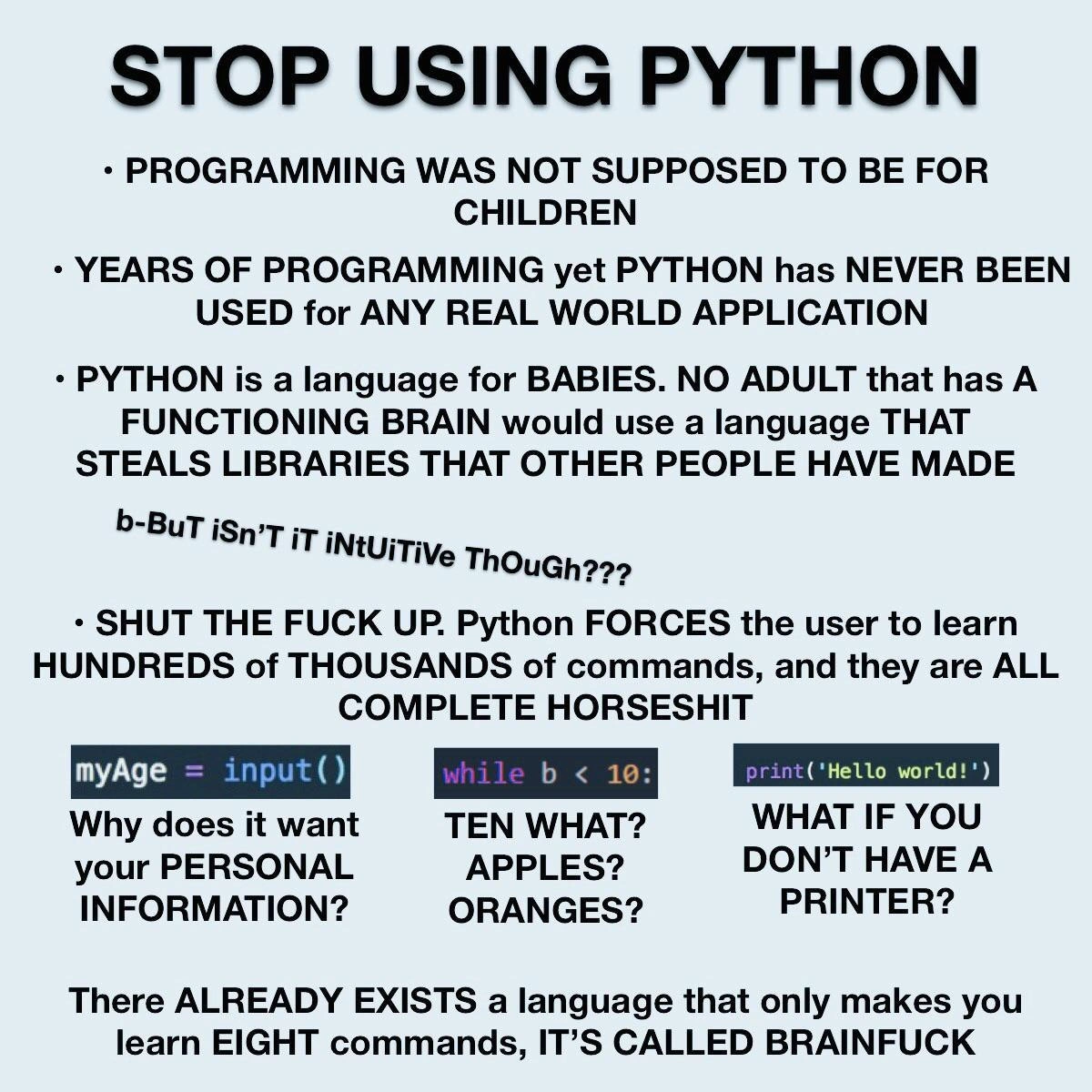
This meme is a sharp satire of language gatekeeping in developer culture. In all-caps fury, it parodies a certain holier-than-thou attitude where an old-school or elitist programmer declares a popular modern language (here, Python) to be "for babies" and praises an absurdly difficult alternative (Brainfuck) as the only true tool for serious work. Experienced developers will instantly recognize the ridiculous exaggeration as a send-up of real arguments they've seen in forums and comment threads during language wars. The combination of elements here – an angry rant filled with logical fallacies, cherry-picked code examples, and a punchline endorsement of an unusable esoteric language – creates humor by pushing gatekeeping to the brink of absurdity.

Let's unpack the specific jabs:

  • "STOP USING PYTHON. PROGRAMMING WAS NOT SUPPOSED TO BE FOR CHILDREN" – This opener mocks the gatekeeper belief that programming should remain an exclusive, difficult craft. Seasoned devs recall times when some veterans grumbled that newer languages or tools "dumb down" programming. The meme exaggerates this stance: implying that if a language is beginner-friendly or taught to kids, it's automatically illegitimate. In reality, Python’s accessibility is one of its greatest strengths – it invites newcomers, including children, to learn coding (think of initiatives like Raspberry Pi or Code.org using Python to teach). By claiming “programming was not supposed to be for children,” the ranter sounds like a curmudgeonly character who resents the democratization of coding knowledge. This is tech satire at its finest, because modern developer culture generally celebrates making programming easier and more inclusive, not gatekeeping it behind needless difficulty.

  • “Python has NEVER BEEN USED for ANY REAL WORLD APPLICATION” – Any experienced developer reading this will smirk, knowing how patently false that statement is. It’s a sarcastic inversion of reality: Python is actually everywhere in real-world applications. It powers major portions of the internet and industry – from web applications (YouTube, Instagram, Reddit use Python or its frameworks) to scientific computing (NumPy, SciPy, and countless machine learning projects) to automation scripts and infrastructure (even parts of AWS and OpenStack are written in Python). The meme deliberately ignores these facts to parody the way haters dismiss evidence. There’s an undercurrent of sarcasm in calling Python unused in production, because most developers have at some point either written a production script in Python or used a Python-based tool. By making such an outrageous claim, the meme signals that the speaker is not to be taken seriously. It’s riffing on that “no true Scotsman” mentality where a gatekeeper might say, “Sure, people use Python, but not for real work” – a sentiment we know is bogus. So, senior devs get the laugh: the statement is so over-the-top wrong that it lampoons the whole idea of language snobbery.

  • “PYTHON is a language for BABIES. NO ADULT with a FUNCTIONING BRAIN would use a language THAT STEALS LIBRARIES OTHER PEOPLE HAVE MADE.” This line piles on the insults and introduces a sly jab at Python’s rich ecosystem. Calling Python “a language for BABIES” echoes the kind of immature insult one might see in a flame war – it’s deliberately juvenile language to ironically accuse others of being childish. The mention of “stealing libraries that other people have made” is a comical misunderstanding (or misrepresentation) of how code reuse and open source work. In reality, Python’s vast array of libraries (via PyPI) is a huge asset; developers routinely share and import libraries to avoid reinventing the wheel. Far from “stealing,” using libraries is collaborating and standing on the shoulders of giants – a normal, smart practice in software development. The meme’s rant makes it sound as if leveraging community-made modules is a shameful shortcut, which pokes fun at a certain purist mindset. Experienced devs know one of Python’s slogans is “batteries included,” meaning it comes with a strong standard library, and the community has created libraries for just about everything. By framing that as a negative, the meme highlights the absurdity of gatekeeping: the ranter essentially suggests every “real” programmer should build everything from scratch (an attitude that leads to not-invented-here syndrome and lots of unnecessary work). This bullet point resonates as satire because many of us have encountered someone who oddly prides themselves on not using frameworks or libraries out of a misguided sense of purity. We’re nodding along at the joke: avoiding good libraries isn’t a virtue, it’s masochism – about as logical as refusing to use electric tools in construction because “real builders only use hand tools.”

  • “b-BuT iSn’T iT iNtUiTiVe ThOuGh???” – Here the meme mocks the common defense of Python: that it’s intuitive and easy to read. The text alternates case to mimic a sarcastic, mocking tone (like one might see on the internet to ridicule someone’s argument). The gatekeeper character is derisively imitating a newbie saying “But isn’t it intuitive though?”, only to sneer at it. This touches on a real cultural moment: Python is often praised for having a straightforward syntax (even non-programmers can often guess what Python code does, which is a huge plus). Gatekeepers sometimes dismiss “intuitive” or beginner-friendly as a negative, equating “intuitive” with “not powerful.” Seasoned developers recognize this as a false dichotomy – a language can be both easy to start with and powerful in production (Python is evidence). The meme uses the mocking tone to highlight how unreasonable the gatekeeper is: they won’t even entertain the notion that intuitiveness is a good thing. This exaggerated sarcasm is something many devs have seen in heated online debates, making it instantly familiar and funny in context.

  • “SHUT THE FK UP. Python FORCES the user to learn HUNDREDS of THOUSANDS of commands, and they are ALL COMPLETE HORSESHIT.”** This is the rant hitting fever pitch with profanity and hyperbole. The gatekeeper character has basically lost it – telling the imaginary Python defender to shut up, then spouting a blatantly nonsensical claim. The phrase “hundreds of thousands of commands” is a huge exaggeration (and the vulgar “complete horseshit” cements how unhinged this rant is). Experienced programmers know Python’s syntax is actually quite small and elegant – it has a limited number of keywords (around 35 or so in Python 3) and a relatively gentle learning curve for basics. Nobody is memorizing "hundreds of thousands" of anything; in fact, one big appeal of Python is that you can be productive with just a few core concepts and then learn more features as you need them. By claiming Python forces you to learn an impossible number of commands, the meme satirizes how detractors paint a wildly inaccurate picture of a language they dislike. It also subtly references Python’s extensive standard library and available modules – indeed, there are tens of thousands of modules out there, but you only import what you need. No Python coder is sitting down to rote-learn every function in every library; that notion is absurd. This bullet point is essentially the meme screaming "Python is too complicated!" right after complaining it’s for babies – a humorous contradiction that senior readers will catch. It caricatures the inconsistency in some arguments against popular languages: critics will say Python is too simple and too generic, then also claim it’s bloated or too much to learn. The over-the-top anger and name-calling (calling all those commands “horse****”) mirror the kind of meltdown one might see from an internet troll who’s run out of rational points. It’s the meme’s way of signaling: “Yes, this viewpoint is irrational, and we’re laughing at how extreme it can get.”

  • Code snippet jokes: The meme then illustrates the gatekeeper’s technical ignorance (or willful misinterpretation) by showing simple Python code examples and the ranting responses to them. This is one of the funniest parts for developers:

    • myAge = input() – In Python, this line prompts the user for input (commonly used to ask for things like the user’s age, hence the variable name myAge). The meme’s caption: “Why does it want your PERSONAL INFORMATION?” is a facepalm-inducing quip. The ranter treats the code as if Python itself is nosy or violating privacy by asking for your age. Of course, any programmer knows input() simply reads whatever the user types; it’s not secretly reporting data to some server or demanding private info unless you, the programmer, specifically ask for it. The humor here plays on the absurd literal interpretation – it’s like someone completely misunderstanding a basic function. Seasoned devs find it amusing because it reads like a joke about a paranoid newbie or a non-technical person encountering code: they see input() asking for something and freak out. It exaggerates the gatekeeper’s ignorance: he’s ranting about Python, but he doesn’t even understand how an input() function works. This aligns with an underlying trope in developer cynicism: the loudest critics sometimes have the weakest grasp of the thing they’re criticizing.
    • while b < 10: – This is a simple while loop header that means "loop as long as the variable b is less than 10". The meme’s caption mocks it with: “TEN WHAT? APPLES? ORANGES?” This joke highlights that the ranter either doesn’t understand context or is being deliberately obtuse. In code, 10 is just a numeric literal (ten, the number). We usually know what it represents by variable names or comments. For instance, b might be a counter or an index. No programmer would ever think "10 what?" – that’s a question you ask in natural language if someone says "I have 10" without saying 10 of what. In code, we don’t attach units like that; 10 is just 10. By applying everyday literal interpretation to a code snippet, the meme lampoons how out-of-depth the gatekeeper is. It’s a playful jab at people who critique code without understanding basic programming constructs. Experienced devs also recall humorous scenarios where non-tech folks read code and get confused by the lack of explicit context (e.g., a joke about someone thinking the if statement is asking a philosophical question because "if" in English is conditional). The “apples? oranges?” gag is exactly this kind of misunderstanding. It reinforces that the ranting character is a caricature – he’s supposed to be a veteran programmer complaining, yet he’s making a rookie mistake in comprehension. That contradiction makes the situation comically absurd.
    • print('Hello world!') – One of the simplest, most iconic lines of code in any language, typically the first thing beginners learn to do: print "Hello, world!" to the screen. The meme’s caption: “WHAT IF YOU DON’T HAVE A PRINTER?” slays developers because it’s such a ludicrous misinterpretation. Here the gatekeeper reads the word print and thinks of a physical printer device, as if Python is trying to use a printer to say hello. In reality, print() in Python just outputs text to the console (the screen/terminal). The joke plays on the double meaning of "print" in English. Yes, in everyday language, to print often means to put ink on paper. But in programming, print has long meant "display text". The rant deliberately conflates the two meanings, as though the language expects you to have a printer hooked up! This is a classic newbie confusion (somebody completely new might indeed ask, “Do I need a printer to use the print statement?”), but coming from the mouth of a supposed hardcore programmer, it’s comical. It’s the meme saying: this gatekeeper is so out of touch, he doesn’t even grasp the most elementary functions. For veterans, it also tickles the funny bone because we remember writing print("Hello World") in various languages as a trivial test – nobody took it to mean paper printing, it’s just tradition. The gatekeeper’s interpretation is as far-fetched as possible. It reminds us of a common pattern in heated tech debates: one side will sometimes deliberately misinterpret the other side's tools or arguments in the most bizarre way to make them look bad. Here, the extreme straw man is that Python’s print function is a flaw because "what if you have no printer?" – an obviously nonsensical concern. Developers share a knowing laugh at how the meme exaggerates this bad-faith style of argument.
  • “There ALREADY EXISTS a language that only makes you learn EIGHT commands, IT’S CALLED BRAINFUCK.” This is the punchline of the whole rant, and it’s delivered in bold, dramatic fashion at the bottom. After all the ranting about Python being too easy or having too many features, the gatekeeper ‘hero’ of the meme reveals his ideal language: Brainfuck — a famously impractical and esoteric language. For those in the know, this is hilariously incongruent with the idea of “serious work,” and that’s exactly the point. Brainfuck is essentially a joke language; it was created in 1993 by Urban Müller mostly for amusement and to challenge programmers (its very name is a crude hint that it will "mess with your brain"). No one in a professional environment would seriously propose Brainfuck for a production system; it’s used for fun, puzzles, or as an exercise in minimalism. By championing Brainfuck, the meme’s gatekeeper character completely jumps the shark, revealing the absurd extremity of his viewpoint. This is where even a mildly experienced programmer realizes the entire rant has been a parody. The contrast is stark and comical: Python (a language known for being readable, productive, and heavily used in the real world) is being denounced, while Brainfuck (a language known for being nearly unreadable and used only as a novelty) is held up as the gold standard. It’s satire aimed at the “real programmer” myth – the notion some people have that if you’re not suffering, you’re not doing real work. The meme exaggerates this to “Only the most masochistic, convoluted tool (Brainfuck) is worthy of respect,” which seasoned devs recognize as utterly laughable.

In essence, Level 3 reveals the industry in-joke: this meme humorously skewers the over-the-top critique and elitism that sometimes pops up in programming communities. It combines developer humor with tech satire by taking common anti-Python arguments to a ludicrous extreme. The emotional core for a veteran developer is a mix of cathartic laughter and a bit of eye-rolling: we laugh because we’ve met smaller-scale versions of this attitude before (the Java veteran who scoffs at JavaScript, or the C++ guru who calls Python a toy), and it’s satisfying to see those attitudes lampooned. The meme’s format (bold headlines, all-caps ranting, and even a mocking “b-but” reply) mimics the style of unhinged forum posts or sarcastic copypasta, which is a part of meme culture. It’s a cultural reference to how heated and absurd language debates can become. For a seasoned developer, the message is clear: gatekeeping and elitism in tech can reach comical levels of nonsense, so we shouldn’t take those rants too seriously – better to chuckle at them and continue happily using the right tool for the job (even if it’s Python, kids allowed!).

Level 4: Eight Commands, Infinite Complexity

At the theoretical extreme of the language wars, this meme invokes a concept from computer science: minimalism in programming languages. Brainfuck is a notorious esoteric language that has only eight commands. Despite its tiny instruction set, Brainfuck is Turing-complete, meaning it can compute anything that languages like Python can (in theory, given unlimited time and memory). This absurd endorsement of Brainfuck over Python pokes fun at gatekeepers by dragging the argument into the realm of computational theory. Brainfuck's design is fundamentally similar to a Turing machine model – it manipulates a tape of memory cells with a pointer using just > (move pointer right), < (move pointer left), + (increment cell), - (decrement cell), . (output a byte/character), , (input a byte), [ (jump past matching ] if current cell is zero), and ] (jump back to matching [ if current cell is non-zero). These eight symbols form a complete "machine code" for an imaginary ultra-simple computer. The meme’s rant facetiously claims this minimalism is superior for "serious" work, which is a tongue-in-cheek inversion of reality – fewer commands does not make a language more powerful in practice, it just shifts complexity onto the programmer. In fact, Brainfuck exemplifies the Turing tar pit: a system that is theoretically capable of anything but in which nothing practical can be done easily.

From a computer science perspective, Python and Brainfuck are both equally powerful in the sense of computability (both can implement any algorithm given enough resources), but they occupy opposite ends of the abstraction spectrum. Python is a high-level, human-friendly language that abstracts away details like memory management, providing rich built-in functions and libraries. Brainfuck, by contrast, operates at a near-machine level of abstraction – each command corresponds to a tiny operation on memory. Writing a simple program in Brainfuck can require hundreds or thousands of these operations explicitly spelled out. For example, printing "Hello World" in Brainfuck is famously convoluted: it involves incrementing memory cells to specific ASCII values with + and moving the pointer with </> for each letter – a task that results in a sprawling line of symbols almost impossible to decipher by human eyes. This highlights an important principle in programming language design: abstraction and readability are features, not flaws. The meme’s extreme stance implies that making the programmer juggle minute details (like manually managing each byte with Brainfuck’s eight commands) is somehow more "adult" or "serious." In truth, high-level languages like Python exist precisely to take care of those low-level details, freeing developers to focus on complex real-world logic. The humor at this deep level comes from recognizing that insisting on Brainfuck’s minimalist purity is as absurd as suggesting we all program with raw machine code – it’s a knowing wink to those familiar with computability theory and the folly of ignoring programmer productivity. Ultimately, the eight-command minimalism brag is a parody of misunderstanding what simplicity means: Python is simple for humans, whereas Brainfuck is simple for a machine. The meme flips this on its head to expose how ludicrous the gatekeeping argument is when taken to its logical (or illogical) conclusion.

Description

A text-heavy meme on a light blue background with a bold, black title: "STOP USING PYTHON". Below the title, a series of bullet points in all-caps text aggressively attack the Python language with exaggerated and nonsensical claims, such as it being for children and never used in real-world applications. The meme includes three small code snippets of basic Python commands (`myAge = input()`, `while b < 10:`, `print('Hello world!')`) and provides absurd, literal interpretations questioning their purpose (e.g., asking why `input()` wants personal information). The final line reveals the punchline, advocating for the esoteric programming language "BRAINFUCK" as a superior alternative with only eight commands. This meme satirizes the "language wars" prevalent in tech communities by taking criticism of Python to a comical extreme. The humor derives from the stark contrast between the irrational hatred for a user-friendly, popular language and the ironic promotion of one of the most notoriously difficult and impractical languages ever created. It's a classic piece of developer-centric shitposting


Comments

37
Anonymous ★ Top Pick This meme perfectly captures the energy of a C++ developer who just spent two weeks debugging a memory leak caused by a misplaced semicolon and now considers Python's GIL to be a personal attack
  1. Anonymous ★ Top Pick

    This meme perfectly captures the energy of a C++ developer who just spent two weeks debugging a memory leak caused by a misplaced semicolon and now considers Python's GIL to be a personal attack

  2. Anonymous

    Nothing screams enterprise-ready like deploying Brainfuck to prod - just tell compliance the audit trail is ‘obfuscated for security.’

  3. Anonymous

    The best part about this rant is that it's probably written by someone whose entire ML pipeline runs on Python, deployed via a Python-based framework, monitored with Python scripts, and automated with... you guessed it, more Python. But hey, at least their Brainfuck implementation of gradient descent only uses eight commands!

  4. Anonymous

    This reads like someone discovered Brainfuck after a particularly frustrating pip dependency resolution and decided to channel their rage into the world's worst programming language review. The 'print needs a printer' argument is peak literal-minded pedantry - by that logic, we should rename malloc() to 'please_give_me_memory_mr_kernel()' for clarity. Though I'll admit, after debugging a third-party package's undocumented breaking change at 2 AM, 'STEALS LIBRARIES THAT OTHER PEOPLE HAVE MADE' hits differently than intended

  5. Anonymous

    If print() needed a printer, our Kubernetes cluster would be out of toner every deploy; instead, the only thing it prints is another five‑figure CloudWatch bill

  6. Anonymous

    Python's 'intuitiveness' shines in hello-world fruits, but try scaling that while loop to petabyte clusters - Brainfuck at least admits it's unmaintainable from byte one

  7. Anonymous

    Production reality: readability scales better than '+-<>[].,'; if your stack ever shipped with eight Brainfuck opcodes, your pager would need a ninth just to apologize

  8. @dp229 2y

    use mojo instead

    1. Deleted Account 2y

      I mean no joke it could be awsome if you could use mojo to create programs and not AI

      1. @dp229 2y

        Yea you absolutely could use it to create programs

        1. Deleted Account 2y

          Its insane then

  9. @hannybu 2y

    brainfuck doesn't know god's thoughts

  10. @dhaysalih 2y

    POST ONE FOR JAVASCRIPT

  11. @AguaMineralDelMonte 2y

    I want one but in C

    1. @SomeWhereIBelong 2y

      Its not possible

      1. @AguaMineralDelMonte 2y

        Why not you stupid bastard?

  12. Deleted Account 2y

    so fucking zased

  13. @SmirnGreg 2y

    This one is not funny

    1. dev_meme 2y

      Did you read the meme till the end?

  14. @yehorson 2y

    Btw i am 13 and i use Python

  15. @yehorson 2y

    And i run Arch, Btw

    1. @vladyslav_google 2y

      No one cares🤓🤓🤓

    2. @Odinmylord 2y

      That is an amazing programming language

  16. @Araalith 2y

    Stop blaming Python. It's a nice modern language that helps individuals with mental challenges feel like real developers.

  17. Егор 2y

    it’s possible to create monstrous non-supportable constructs in Python though

    1. @endisn16h 2y

      read as moisture first time lmao

    2. Alexander Berdnikow 2y

      Isn't this a sign of a mature programming language?

      1. Егор 2y

        no? can’t do the same in c/c++

    3. @theodolu 2y

      You can break an entire server with one line of C.

      1. @RiedleroD 2y

        you can write an entire program in one line of C… if you just put all the statements on one line.

        1. @SamsonovAnton 2y

          Simply putting multiple statements on single line separated by semicolon is boring. But what if you write a program consisting of nested blocks only (not necessarily on single line) so that no semicolons are used, except in for clauses and other special cases, — so that it can be considered a one-liner? 🤪

  18. @JManray 2y

    I need one for java

  19. @Diotost 2y

    We need this meme about file access rights

  20. @Vlasoov 2y

    Still being a meme, there are productions in Python

  21. @anilakar 2y

    There are much better arguments against Python such as lack of tail call optimization combined with nonexistent stack space, lack of proper dependency version handling in the package manager and the fact that half of the English dictionary are reserved words.

  22. @dp229 2y

    But for now only in linux

  23. @dp229 2y

    Windows & Mac support later

Use J and K for navigation