The Leaky Reality Behind a Startup's Product-Market Fit Announcement
Why is this Startup meme funny?
Level 1: Broken but Celebrating
Imagine you tell your family you’ve fixed the leaky sink, and you’re really proud. But instead of the water going neatly down the pipe, it’s pouring out onto the floor because two pipes aren’t connected right. You cut a hole in the pipe below to catch some water, and now you’re saying “See, it flows fine!” while the kitchen is getting wet. 😅 This is funny because the person is celebrating too early. It’s like throwing a party for finishing a big project, even though you used tape and glue and things are still falling apart. The picture with the misaligned pipes is a silly way to show someone claiming success while everyone else can see the job isn’t done properly. In short, the boss of the startup is cheering that they finally made something people want, but the way it’s built is so clumsy that it’s leaking like a broken pipe. Even if you’re not a tech person, you get the joke: they’re acting like everything is perfect, when clearly it’s still a big mess.
Level 2: Duct Tape Solutions
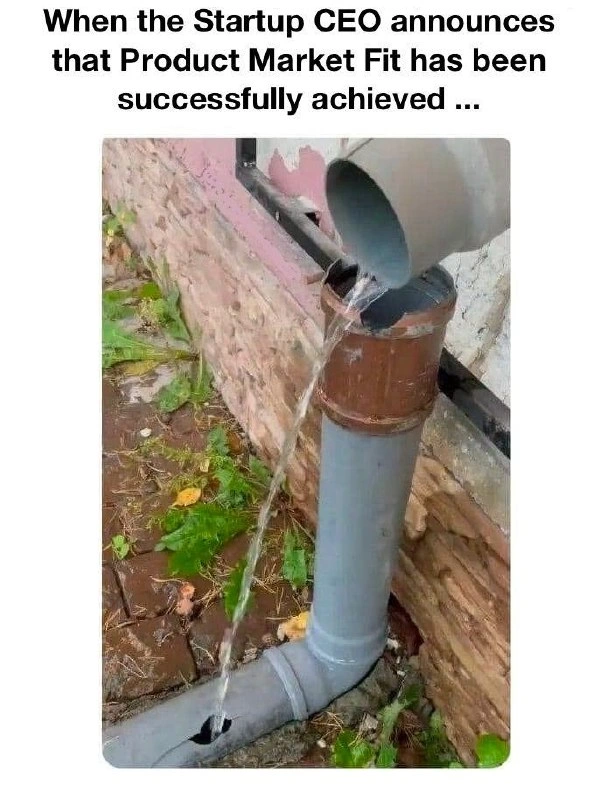
Let’s break down the joke in simpler terms. In startup lingo, Product Market Fit is when a company’s product finally matches what customers want – a big milestone that often leads to celebration. It’s like finally finding a key that fits a lock: the business feels it can open big doors now. The meme’s caption says the CEO announced they hit this sweet spot. But the image underneath tells another story: the “plumbing” of the product is a mess. We see two grey plastic pipes that don’t line up properly, almost like two puzzle pieces forced together incorrectly. Water is supposed to flow from the top pipe into the bottom pipe neatly, but instead it’s gushing outside the connection. Someone even cut a crude hole in the lower pipe to eventually catch some of that water, after a bunch has already splashed out. In real terms, this is a botched job – the kind of quick, sloppy fix you’d do if you were in a hurry or didn’t have the right parts.
Now think of a software startup’s product as the system of pipes and water as the data or value flowing through. Integration in software means connecting different pieces so they work together, kind of how pipes are connected so water flows through a whole drainage system. Here we have a leaky_integration: the pieces integrated so poorly that stuff (water/data) is spilling through the cracks. When engineers talk about mismatched_interfaces, they mean one part’s output isn’t in the form the next part expects as input – like if one pipe is supposed to fit into another but is aimed wrong. In code, an interface mismatch could be, for example, one function expecting data in meters and another giving it in feet, so things don’t align until someone hacks a converter in between. The photo’s misaligned pipes physically show what a bad interface connection looks like.
This relates to TechnicalDebt – a term for the cost of quick-and-dirty design decisions we make in code. Think of technical debt like taking shortcuts on a school project: you skip some steps to finish faster, but later you (or someone else) will have to fix the mess, which is extra work – that’s “paying back” the debt. Startups often accumulate a lot of tech debt because they’re racing to build a MVP (Minimum Viable Product). An MVP is the simplest version of the product that still kinda works, made to test the market quickly. In this meme, the plumbing is basically an MVP of a drainage system: it technically moves water from top to bottom, but just barely and very messily. We call these kinds of fixes “duct tape solutions.” Imagine using actual duct tape to patch a broken pipe: it might hold for a while but it’s not a proper fix. Software teams do similar things under pressure – maybe hardcoding values, or writing a quick script to transfer data instead of building a robust pipeline. These are design trade-offs: sacrificing cleanliness or future-proofing for speed and convenience now.
The tags StartupLife and StartupHumor are on point because anyone who’s worked at a new startup has likely seen something like this. For example, a junior developer might write some quick glue code (throwaway code to connect two systems) to get a demo working, intending to replace it later. But if that demo leads to real customers, suddenly that glue code is in production, warts and all. The CEO, much like in the meme, is excited: customers are happy, money might be coming in – “Hooray, our idea is validated!” Meanwhile, the developers are nervously eyeing that fragile code which they know could fail at any moment. This gap between the MisalignedExpectations of the CEO (who expects things are great now) and the engineering team (who knows there’s a leak in the system) creates the humor and pain.
The wet bricks and leaves in the photo give a sense that this system has been leaking for a while – similarly, the codebase might be showing signs of strain (slow performance, weird bugs, error logs flooding) even though leadership tries to ignore those as “minor issues.” The phrase “leaks value like a broken pipe leaks water” from the description is key: value (like user trust, data integrity, performance) can be lost when systems don’t integrate cleanly. If an app is clunky or data gets lost because of these quick fixes, users might get frustrated, which is like the water that never makes it to the end of the pipe.
In simpler terms, the meme is a funny caution: just because a startup finds a market for their product doesn’t mean their product’s construction is solid. That CEO announcement is a bit premature, like saying “the house is finished!” when the roof is still held up by sticks. Engineers, especially those new in startups, learn quickly that “achieved product-market fit” can sometimes translate to “we barely got it working and people want it – now we have to frantically patch it up to keep up!”. The image of the misaligned pipes exaggerates this in a way anyone can see: the contraption is obviously flawed. So even a junior developer or someone just learning about these concepts can chuckle and think, “Yep, that looks like my spaghetti code solution in physical form.” It’s a humorous reminder that making something work is only step one – making it work well (without leaks) is a whole other challenge that every fast-moving startup eventually faces.
Level 3: Minimum Viable Plumbing
When a startup CEO triumphantly declares Product Market Fit has been “successfully achieved” while the system is held together by hacks, seasoned engineers can't help but smirk. This meme hits on a classic StartupCulture gag: the founder_optimism that celebrates a big milestone even as the product’s underbelly is a makeshift mess. In the image, we see a jury-rigged outdoor plumbing job – misaligned PVC downspouts where an upper elbow pipe pours water past its intended connector. The water free-falls in open air, then vanishes through a jagged hole farther down into the vertical pipe. It's a hilariously apt visual_metaphor for a software architecture full of gaps and ad-hoc patches.
For senior engineers, this broken gutter is like looking at a hastily-built system architecture diagram after a year of “move fast and break things” development. Each pipe joint is an interface between components, and here those interfaces are mismatched – data (water) is not flowing through proper connectors but leaking out, much as critical information or efficiency leaks away in a poorly integrated system. The CEO’s exuberance about having reached product_market_fit (meaning customers really want the product) contrasts with engineering reality: behind the scenes, the codebase is effectively a duct tape and glue solution. We’ve got microservices (or maybe just modules) practically spitting data onto the floor because their APIs don’t align, akin to that upper pipe spewing water outside the funnel.
This meme resonates because it captures the MisalignedExpectations between leadership and engineering. The illusion_of_success is that the product works and market demand is met, but the actual implementation is fragile and held together by quick fixes. In real startups, hitting product-market fit is like a green light to scale up users and features; however, if the underlying system is a shoddy prototype, things will break spectacularly under increased load. It’s like declaring your MVP (Minimum Viable Product) a victory without realizing it’s also a minimum viable plumbing job. Experienced devs have seen this play out: the team took on massive TechnicalDebt to rush a feature to market, and now that debt “leaks” all over their roadmap.
Consider a real-world scenario: an early product needed to integrate two services quickly, so an engineer wrote a quick script to dump data from Service A to a file every minute, which Service B then reads – a total hack, but it worked just enough for the demo. That hack is equivalent to cutting a hole in the pipe to catch the water: it’s the kind of leaky_integration you swear you'll replace next sprint. But if the startup hits success, suddenly that hack is in production, scaled to thousands of users. Cue the 3 A.M. pager alerts: “System Down – water everywhere!”. The CEO, oblivious to the brittle internals, is busy tweeting about their amazing growth, while the on-call dev is literally writing hot_fix_v2.py at dawn to patch the next hole. The humor here is darkly relatable: we laugh because we’ve lived through that dissonance between shiny StartupLife announcements and the dirty reality of architectural_tradeoffs.
In a robust design, pipes (modules) would align perfectly, no leaks, using proper connectors and sealed joints – think well-defined API contracts and data flows. But early on, startups often prioritize speed over elegance. DesignTradeoffs are made: “We can either ship this week with a hack, or delay for a month to do it right.” Guess which one wins when investors are watching? 😅 Over time, these shortcuts accumulate into a labyrinth of tech debt. Each quick-fix patch (that jagged hole, that misaligned elbow) becomes harder to replace because the business has come to depend on it. Eventually, someone in engineering will grimly mutter, “we need to re-architect this entire thing,” often right after the CEO proclaims everything is awesome.
This image also pokes fun at MisalignedExpectations in communication. The CEO sees the output (water coming out somewhere, so it must be fine, right?) and concludes success. The engineers see how it’s coming out (spraying everywhere) and cringe. There’s an implicit commentary on startup illusion_of_success: a product might appear successful externally (users signing up, revenue coming in) while internally it’s chaos – broken tests, memory leaks, spaghetti code, and failing integrations lurking under the hood. The humor is heightened by the physical absurdity of the plumbing: it’s such a bad job that even a non-engineer can tell it’s wrong. It screams TechnicalDebt in a way anyone who’s done home repairs can understand: you can see the leak and misalignment.
In essence, the meme uses a plumbing_meme scenario to say: “Sure, the startup found market demand, but the system built to deliver it is so crude and misaligned that value is literally leaking away.” It’s a cautionary chuckle for senior devs: we know that feeling when leadership is popping champagne while we’re praying the brittle prototype doesn’t collapse. We laugh, perhaps a bit bitterly, because the StartupHumor is painfully true – achieving Product Market Fit on a pile of hacks means you’ve won one battle (market demand) but you’ve set yourself up for another: the war against your own tech debt leaks.
Description
A meme with a caption at the top that reads: 'When the Startup CEO announces that Product Market Fit has been successfully achieved...'. Below the text is a photograph of a comically dysfunctional drainage pipe system. A grey pipe or bucket is pouring water into a rusty, misaligned vertical drainpipe. However, a lower section of the grey plastic pipe has a large, jagged hole in it, causing the majority of the water to spill out onto the muddy ground instead of flowing through the pipe as intended. The visual serves as a potent metaphor for a common scenario in startups. The CEO's announcement represents the optimistic, high-level business perspective that the company has found its market. The leaky pipe, however, symbolizes the underlying reality known to the engineers: the product is riddled with bugs, technical debt, and architectural flaws. It's 'leaking' users, data, or reliability, and is not the robust, scalable solution that the term 'Product-Market Fit' implies

Comments
7Comment deleted
Yes, we've achieved Product-Market Fit. The market provides the water, and our product fits it directly onto the ground. We've successfully disintermediated the pipe
“Product-market fit achieved” = the Lambda POSTS to a Node shim, which pipes to a shell script, which drips into the legacy monolith through an ad-hoc SQL tunnel - but hey, that’s an “event-driven architecture,” right?
The same energy as declaring your monolith-to-microservices migration complete while half your services still communicate through a shared database and the other half through CSV files on a network drive
Ah yes, Product-Market Fit: that magical moment when the CEO's pitch deck finally aligns with a market segment willing to tolerate your duct-taped infrastructure held together by technical debt, midnight hotfixes, and the collective prayers of your on-call engineers. The pipes may be literally splitting at the seams, but as long as the metrics dashboard shows green and the investors are happy, we've achieved 'success' - at least until the next production incident at 3 AM when that metaphorical tape finally gives way
PMF achieved: Because startups scale best reactively, turning your monolith into a firehose while VCs toast the hockey stick
PMF achieved: the top‑of‑funnel gushes, and the retention curve follows the water - right past the product
We finally hit PMF - by redefining the funnel as a firehose and the sidewalk as “active users.”