The Server Alignment Chart: Defining a Server from Purist to Rebel
Why is this Infrastructure meme funny?
Level 1: Silly Name Game
Imagine three kids playing together, arguing about what counts as a toy. The first kid is very strict: “Only real toys from the toy store are toys!” If it’s not an official action figure or a doll or something that came in a toy box, he refuses to call it a toy. The second kid has a more easygoing view: “Nah, anything can be a toy if you play with it.” She might pick up a wooden spoon and start drumming on a pot, or turn a cardboard box into a spaceship. To her, the spoon and the box become toys because she’s using them to have fun. Now the third kid is a total goofball, giggling and taking it to an extreme: “If I can have fun with it, it’s a toy – look, even my cat can be a toy!” He rolls a ball of yarn past the cat and laughs as the cat chases it, or maybe he puts a bucket on his head and pretends to be a robot. In his mind, everything around him is a toy one way or another.
The other two kids start laughing because it’s a pretty silly idea – if you say anything is a toy, then the word “toy” doesn’t mean much anymore, does it? The first kid points at a lamp and jokes, “Is that a toy too now?” and the third kid, in full silliness, might just say, “Yup! It’s a toy that makes light!” They all crack up. They’ve basically made a game out of stretching the meaning of the word toy as far as it can go. It’s funny because normally everyone knows what a toy is, but here they are calling cats and lamps and spoons toys. It’s a bit like a contest of who can come up with the wackiest example.
This is exactly what’s happening with the word “server” in the meme. Some people use the word very strictly (like only real specific things qualify), some use it more loosely (many things could qualify), and some jokingly use it for anything at all. It’s amusing in the same way the kids’ toy argument is – it shows how we can play with definitions and get to laugh at the absurd results. In the end, it’s a reminder not to take words too seriously and to enjoy a good laugh when someone calls a waiter or a traffic light a “server” with a cheeky grin. It’s a silly name game, and we’re all in on the joke.
Level 2: Anything Can Be a Server
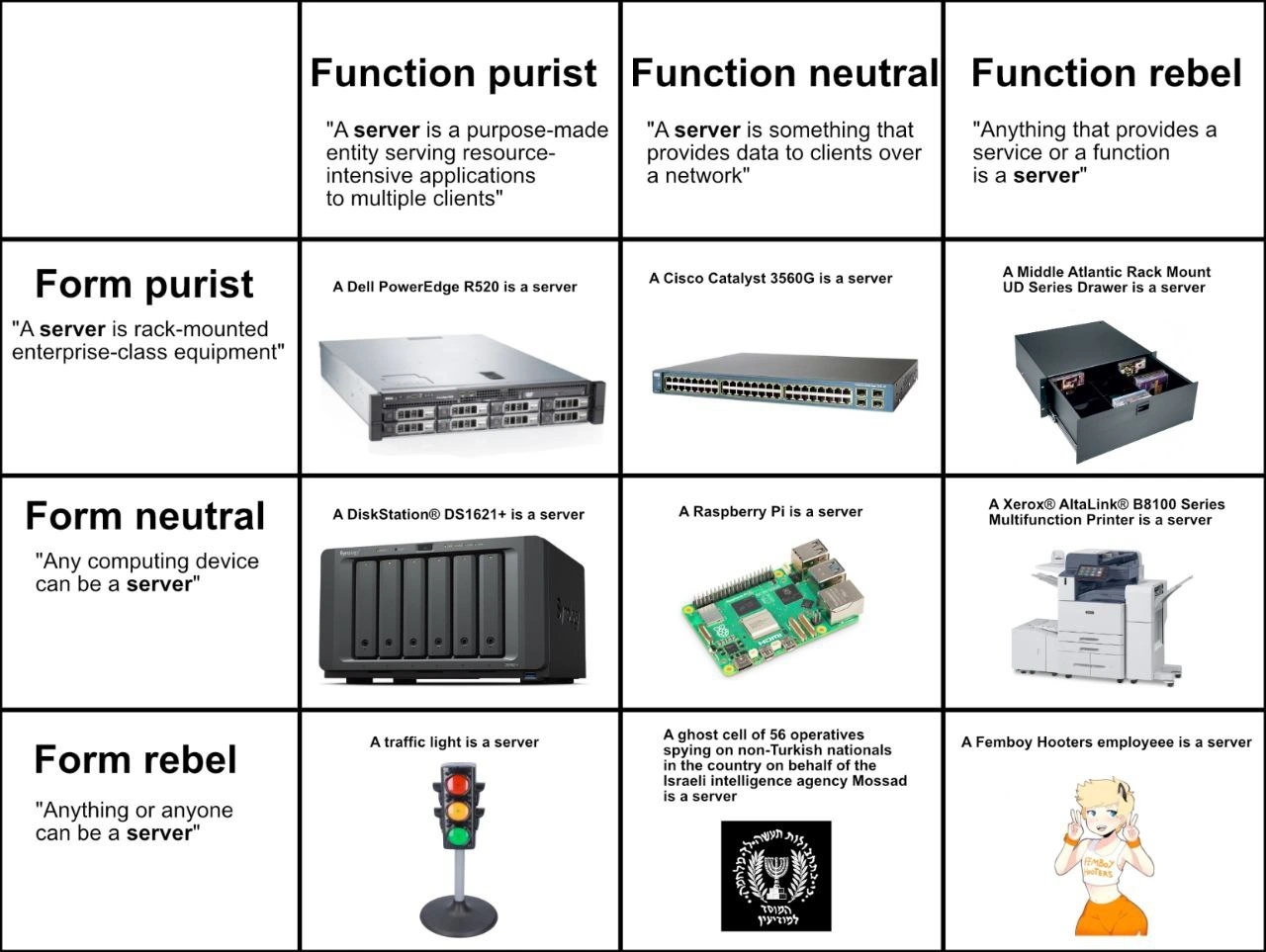
Let’s break down each part of this meme and clarify what’s being shown, especially for those newer to hardware and infrastructure concepts. We have a 3x3 grid of images, each with a caption declaring something “is a server.” The grid is arranged by two criteria: physical form (the rows) and the device’s function (the columns). We’ll go through the nine examples one by one:
Dell PowerEdge R520 – This is an enterprise-grade rack server made by Dell. It’s a flat, wide machine that slides into a data center rack. It’s designed for heavy-duty tasks (like running databases, virtual machines, corporate applications) and for serving many users at once. If someone asked “what is a server?” in a typical IT context, showing them a Dell PowerEdge wouldn’t raise any eyebrows. It fits the form purist idea (it’s literally built to live in a server rack) and the function purist idea (it serves resources to many clients). In the meme’s terms, it’s the gold standard of servers – no controversy here.
Cisco Catalyst 3560G Switch – A Cisco Catalyst 3560G is actually a network switch, not a traditional server. A switch’s job is to connect devices in a network and forward data between them. Physically, this switch looks kind of like a server (it’s also a rack-mountable box with ports, usually living in the same rack as servers). Functionally, though, it doesn’t host applications or files; it operates at the network level (directing traffic between servers and clients). In the meme, it’s placed under function neutral (where a server is defined as anything providing data over a network). By that definition, you could argue a switch “provides data to clients” because it passes network packets along – essentially serving data from one port to another. It’s a bit of a stretch because we normally reserve the word server for something like a file server or a web server (not a switch). So the meme humorously calls the switch a server to illustrate the Function neutral mindset. For a newcomer: think of it this way – if you ask a strict network engineer “Is a switch a server?” they’d probably say “No, it’s network equipment.” But if you ask in a very general way “Does this device serve data to others?” – yes, it moves data around, so someone with a broad view jokingly might go, “sure, why not, it’s serving data!”
Middle Atlantic Rack Mount Drawer (UD Series) – This is literally a sliding drawer that you can install in a server rack to hold things (like tools, cables, or manuals). It has no electronics, no computing power – it’s basically a metal box on rails. The meme labels this drawer as a server in the top-right cell, which corresponds to form purist (because it’s a rack-mounted piece of gear) and function rebel (defining a server as anything that provides any service). The drawer does provide a “service” in a mundane sense – it holds stuff for you (it serves as a storage space). But calling it a server is definitely a joke. This highlights how a form purist might see something in a rack and think of it as part of the server equipment, but only a function rebel would actually call a dumb metal drawer a “server.” For someone new to this: picture calling a kitchen cabinet an “appliance” because it’s in your kitchen serving a function – technically it’s doing something for you, but it’s not what we usually mean by an appliance. Same vibe here. The humor is in the mismatch between the usual meaning of server and this object.
Synology DiskStation DS1621+ NAS – A Synology DiskStation is a popular NAS (Network Attached Storage) device. It’s basically a mini server dedicated to storing files. The DS1621+ model in particular is a box that can hold multiple hard drives and has a processor and memory to run a specialized operating system for file sharing, backups, media streaming, etc. The meme places this in the middle-left cell: form neutral (it’s not a standard rack server; it can sit on a shelf or desk) and function purist (it definitely serves data to multiple clients, like a file server for your home or office). Many would indeed call a NAS like this a “home server” or “file server.” In fact, devices like Synology blur the line – they are servers in capability, though not in the classic shape. For a junior dev or someone new: if you’ve ever used Google Drive or a shared network folder, a NAS is the kind of server that could be providing that – just on a smaller, self-hosted scale. So here the meme is pretty spot-on: the DiskStation is considered a server by a broad but reasonable definition. It’s showing how even if the form factor is different (no big rack, just a small box), it still counts as a server to most people because of its function (delivering files, media, etc., to users on the network).
Raspberry Pi – This is a tiny single-board computer often used by hobbyists, students, and even professionals for all sorts of projects. A Raspberry Pi can run a full operating system (Linux typically) and can definitely act as a server for things like a personal website, a home automation controller, or a DNS blocker. The meme puts the Pi in the dead-center cell, which is form neutral (any computing device) and function neutral (any device providing data over a network is a server). In practical terms, yes – a Raspberry Pi can be a server. For example, you could install Apache or Nginx (web server software) on it and host a website that other devices on your network (or even on the internet, if set up right) can access. It’s not powerful compared to a huge Dell server, but it works for small scale needs. This example is great for juniors to understand: the definition of “server” really can be as simple as “a computer that serves data to other computers.” The Raspberry Pi might just be a $35 board, but if it’s serving a webpage or database to clients, it’s fulfilling the role of a server. A lot of relatable first-time experiences in IT involve turning a Pi into some mini-server, which is probably why the meme included it. It’s saying “See, even this little guy can be a server, so our definition must be pretty flexible!”
Xerox AltaLink B8100 Series Multifunction Printer – This is a big office printer/copier/scanner combo. Many offices have something like this: a networked printer that employees print to, and that can also email scanned documents, etc. The meme lists it in the middle-right cell: form neutral (it’s a device, not necessarily a traditional server chassis) and function rebel (anything providing a service is a server). So, is a printer a server? Not in the usual sense – we usually say “the printer” or “the print server” only if there’s a separate computer managing print jobs. But interestingly, a lot of modern printers do have a small web server inside (for configuration) and offer services (printing is a service to users, scanning-to-email is a service, etc.). To a newbie: when you print a document from your laptop to a network printer, your laptop is effectively a client sending a request, and the printer responds by providing the printing service. In that light, the printer is acting like a server (specifically a print server for that task). However, calling it one is kind of unconventional, so it’s funny. The meme is playing with our expectations. By a rebel definition, sure, call anything that serves a function a server – even the office printer that everyone yells at when it’s jammed. It’s a bit of a pun: the printer “serves” prints, ergo “server.” It’s in the same spirit as calling a vending machine a “server” because it serves snacks. It makes you stop and think, “Well, I guess… in a very literal sense... but no one says that!” That cognitive dissonance is what makes it humorous.
Traffic Light – Here we have a standard traffic light (red, yellow, green). The meme puts this in the bottom-left cell: form rebel (anything, not necessarily an electronic computer device) and function purist (serves multiple clients in a dedicated way). So, how on Earth is a traffic light a server? Let’s break it down: A traffic light controls an intersection, which means it’s “serving” instructions to many drivers (the drivers are like “clients” who receive the service of traffic control). It’s purpose-built (only does that one job, day and night). Modern traffic lights are actually controlled by computerized systems (timers, sensors, sometimes a centralized traffic management system). But even without considering the tech inside, the meme just whimsically says, “It provides a service (managing traffic), so by our loose definition it’s a server.” This is definitely an absurd example meant to induce a laugh. For a new dev: don’t worry, nobody actually calls a traffic light a server in IT! 😁 This is showing the extreme end of broad definitions. It’s like saying, “If we’re being that flexible, we might as well include a traffic light.” It emphasizes how silly things get when you detach words from their usual context.
Mossad Ghost Cell of 56 Operatives – This is the most complex and bizarre example in the meme. Mossad is the national intelligence agency of Israel. A “ghost cell” of operatives sounds like a secret group of agents working undercover. The text says they’re “spying on non-Turkish nationals in the country on behalf of Israeli intelligence agency Mossad.” That sounds like a line from a spy novel or a real-world news report. This is placed in the bottom-middle cell: form rebel (again, not a physical device at all, we’re talking about people) and function neutral (something that provides data to clients over a network). In a warped sense, those operatives gather information (data) and send it back to their handlers or HQ (clients) possibly via some communication network. So the meme is humorously labeling this spy ring as a “server.” For someone new: clearly, spies are not servers in any normal meaning. This is the meme being intentionally ridiculous to push the definition to its breaking point. It’s highlighting that if you only care about the abstract idea of providing data over a network, you could call even an espionage operation a server (since it provides secret data over an intel network). It’s a joke – likely referencing some news story or just concocted for shock value – that shows how off-the-wall the conversation can get. The important takeaway: this is making fun of overly broad definitions. It’s supposed to make you laugh and think, “Alright, that’s so far outside the box, it’s just silly.”
Femboy Hooters Employee – This is an anime-style illustration of a femboy Hooters server (waiter). Now, to unpack that: “Hooters” is a real American restaurant chain known for wings, beer, and waitresses in tank tops – commonly referred to as servers (as in serving tables). A “femboy” is internet slang for a feminine-presenting boy/guy (often an LGBT+ subculture thing). At some point, the internet jokingly imagined a spin-off called “Femboy Hooters” where the roles are flipped (instead of female waitresses, you have cute femboy waiters). It’s a popular meme concept on Twitter and Reddit. Here, the meme uses that in the bottom-right cell: form rebel (a person, not hardware) and function rebel (providing any service counts). So yes, a waiter literally is called a server in everyday language – their job is to serve customers food and drinks. By the loosest definition, a femboy hooters waiter is indeed a “server.” This example is basically a big pun. It ties the whole chart together by saying “look, we’ve even left the tech realm entirely, and it still fits our ridiculous definition of server!” For someone unfamiliar with the reference: just picture a restaurant server (like a waiter) being called a server – that’s normal English usage. The “femboy Hooters” part is just a funny specific flavor added to make it more internet-culture-y and absurd. The meme is ending on this note to be extra silly and also to make a linguistic joke (computer server vs restaurant server). It’s the kind of thing that makes tech folks snort because it’s so unexpected in a tech meme. And if you do know about the Femboy Hooters meme, it’s an extra layer of "I see what you did there."
In summary, each cell in this grid is showing a different example of what someone might call a “server” depending on how strict or loose they are about the term. The top-left starts normal (big rack server – yes, obviously a server) and the bottom-right ends in total silliness (a person at a meme-themed restaurant). Everything in between escalates through various pieces of hardware, gadgets, and even non-hardware, illustrating both Hardware concepts and some surreal leaps. The meme’s structure itself is like a mini taxonomy of servers, but done in a jokey way. For a newcomer, it’s educational and humorous: you learn what a traditional server looks like (Dell PowerEdge), what other equipment exists in infrastructure (switches, NAS, Raspberry Pi, etc.), and at the same time you see an inside joke about how people sometimes bicker over definitions in the tech world. By the end, the phrase “is a server” has been applied so loosely that it loses its conventional meaning – and that’s the satirical point. If you found yourself asking “Wait, how is that a server?” for some of these, that confusion is exactly what the meme is exploiting to get a laugh. 😉
Level 3: The 'Server' Spectrum
At the highest level, this meme pokes fun at the semantics of "server" in tech by laying out a 3×3 grid along two axes: form (physical form factor) and function (role/purpose). Each axis runs from purist (strict definition) to rebel (extremely loose definition). Essentially, it's a matrix of how people in Infrastructure and Systems Administration circles might define what counts as a server. The humor comes from stretching these definitions to absurd extremes. If you've ever been in a hardware team meeting or a late-night ops debate about what qualifies as a "real server", this hits home as classic HardwareHumor and SysadminHumor rolled together.
On the form axis (rows), we have:
- Form purist: Only traditional rack-mounted, enterprise-grade hardware counts as a server. These are the folks who elevate rack servers with redundant power supplies and ECC memory as the one true lineage of "server". If it doesn’t slide into a 19-inch rack and hum loudly in a data center, they hesitate to call it a server.
- Form neutral: Any computing device can be a server. This view is more inclusive: a server could be a tower PC, a laptop, or a tiny single-board computer, as long as it’s running server software. Rack mount not required – if it computes and responds to requests, it qualifies.
- Form rebel: Anything or anyone can be a server. This is tongue-in-cheek – it’s the idea that we completely ignore physical form. A server could be literally any object or person that "serves" something. At this extreme, the definition is so loose it crashes into RelatableHumor territory (we all know that one person who takes definitions too far).
On the function axis (columns), we have:
- Function purist: A server must fulfill a specific, heavy-duty purpose: e.g. serve resource-intensive applications to multiple clients. This is a strict textbook definition focusing on what it does: handling multiple clients, heavy loads, and serious tasks. By this view, if a machine isn’t crunching data or hosting a multi-user service, can we really call it a server? (Cue the "No true server" arguments among veterans.)
- Function neutral: A server is simply anything that provides data or services to clients over a network. This is the broad network architecture definition – if it responds to requests and sends back data (be it a web page, a file, a print job), then congratulations, it’s a server. This is basically the client-server model 101 definition. It doesn’t demand the server be high-end or specialized, just that it serves data upon request.
- Function rebel: Anything that provides any service or function is a server. This breaks out of the IT context entirely. If it serves something, then by playful logic, it’s a server. Feeding the dog? You’re a "food server". Traffic light giving cars the go-ahead? That light serves the flow of traffic, ergo “server”! It’s an intentionally goofy expansion of the term that lampoons how some people use jargon way beyond its intent.
Now, combine these axes in a grid, and we get nine scenarios (depicted with images in the meme) that range from perfectly reasonable to absolutely absurd – all labeled as “a server.” This structured spectrum is where the comedy unfolds for those of us in tech: it’s highlighting how the term “server” can be both rigidly defined and wildly overextended depending on who you ask.
The top-left cell (form purist + function purist) is 100% conventional – the comfort zone of any old-school sysadmin. It shows a Dell PowerEdge R520, a true-blue enterprise rack server. Of course that’s a server! It’s the archetype of a server: specialized hardware engineered to run 24/7, serving many users. No one would argue about that one. This is the meme starting from a point of normalcy.
Move to the right (form purist + function neutral) and things get interesting. It shows a Cisco Catalyst 3560G switch labeled as a server. A switch? In a rack? To a function-neutral thinker, a switch does provide a service on the network (it routes and forwards data for clients), so in a loose sense, it’s serving data. But to a purist, calling a switch “a server” is almost heretical – a switch is network infrastructure hardware, not an application server. This panel plays on that gray area: the device is physically at home in a server rack (making the form purists nod slightly), but functionally it’s not what we traditionally mean by a server. Yet, by a broad definition, it does “serve” network packets. Seasoned network engineers might chuckle here – we’ve all heard someone in management mistakenly refer to a switch or router as “one of the servers” because, well, it lives in the server room and has blinky lights just like a server. Technically, a fancy switch often is a powerful computer dedicated to switching tasks (some run Linux under the hood!), but calling it a server is definitely mixing categories.
Then the top-right cell (form purist + function rebel) goes full absurd while still looking the part: it shows a Middle Atlantic Rack Mount UD Series Drawer – basically a rack-mounted drawer for holding equipment – labeled as a server. This is a perfect joke: by form, it’s literally a rack unit (it slides into the rack like a server chassis), but by function it’s just a drawer. It has no computing capability; it “serves” only in the sense of storing screwdrivers or snacks. Only a function rebel would dare call a metal drawer a “server” with a straight face. This parodies those who think anything in a rack might as well be a server. It’s also an ironic nod to how sometimes non-IT folks touring a data center will point at anything in a rack and ask, “Is that a server too?” – and you have to smile and say, “No, that’s just a drawer (or a power strip, etc).” The humor here also tickles the Hardware geeks: we love our rack gear, but even we wouldn’t call a drawer full of cables a “server”!
Moving to the middle row, we relax the form requirement to form neutral (so any computing gadget is fair game), but we start again on the left with function purist. The middle-left cell (form neutral + function purist) shows a Synology DiskStation DS1621+ NAS. Now, a NAS appliance like this is indeed a server in many respects: it runs an OS, has a CPU, and serves files to multiple client machines. Functionally, it fits the purist’s idea of “serving resources to multiple clients” (it’s literally a file server). But form-wise, it’s not a classic rack server – it’s a small desktop form factor box with drive bays. To the form purist, it might feel like calling a Honda Civic a truck – it's not in the same class as that Dell PowerEdge. However, many practical sysadmins and home lab enthusiasts would comfortably call a NAS box a server because it performs server duties (and the Synology DiskStation line is quite powerful!). This panel probably resonates with IT folks who’ve had the “is a NAS a server?” debate. It’s poking at the subtle gatekeeping in infrastructure: some insist only enterprise gear counts, while others focus on capability over shape.
The very center cell (form neutral + function neutral) features a Raspberry Pi with the caption “A Raspberry Pi is a server.” This one is delightful because it’s a common RelatableHumor scenario. A Raspberry Pi is a tiny $35 single-board computer – definitely not rack-mounted or enterprise grade (it’s literally the size of a credit card). But thanks to how versatile it is, people often run small servers on it: personal web servers, home automation hubs, Pi-hole DNS servers, you name it. So under a broad functional definition (“provides data to clients over a network”), a Raspberry Pi absolutely can be a server. It might be low-power, but it runs Linux and can host a website, so why not? Seasoned devs smile at this because many of us have tried hosting our own little project on a Pi at home. It’s the classic entry into server tinkering – “I turned my Pi into a web server!”. Here the meme is essentially saying “See? Any computing device can be a server if it’s serving something.” It also hints at that shift in mentality with cloud and edge computing: the line between server, PC, and gadget is blurry. To a form purist this is borderline – a Pi is more toy than server – but to a rebel or even neutral person, the Pi qualifies. SysadminHumor often includes the Raspberry Pi as the beloved underdog server; we know it’s not a powerhouse, but it’s so darn useful.
The middle-right cell (form neutral + function rebel) shows a Xerox AltaLink B8100 Series multifunction printer labeled as a server. This is where the meme starts to really exaggerate the function definition. A network printer is indeed a computerized device (it has a processor, memory, runs firmware, and often has an IP address with a web interface). Does it provide a service? Yes – printing, scanning, faxing – to people on the network. But do we normally call the office printer “a server”? Not really, we just call it the printer. However, to someone taking “anything that provides a function” literally, the printer serves documents on demand, so sure, it’s a “print server” of sorts. This panel satirizes how if you bend the definition, everyday devices become "servers." It’s funny to imagine a helpdesk or IT procurement argument: “We have 10 servers… well, 9 servers and also the printer, but hey that’s basically a server too, right?” In SystemAdministration reality, printers do show up on the network and even have their own tiny web servers for remote management (ever configure a printer through a browser?). So there’s a grain of truth: the printer is a network node serving jobs. It’s just that calling it a server would get you side-eyes from any sysadmin not being facetious. This is a nod to the absurdity we sometimes embrace when we say “yeah, everything’s a server these days.”
Now the bottom row goes form rebel – meaning we’ve thrown physical computing devices out the window. Here the meme leaps from physical tech into truly anything. Bottom-left (form rebel + function purist) shows a traffic light labeled as a server. A traffic light is definitely not a computer in the traditional sense (though modern ones are actually networked and programmatically controlled – IoT, anyone?). But think conceptually: a traffic light serves the function of directing traffic (multiple cars = multiple clients) according to programmed rules (kind of like responding to conditions). It’s purpose-built, and it’s critical infrastructure, albeit not in the realm of IT. By a really abstract functional analogy, it’s serving cars the “service” of traffic control. This is hilarious because it’s a wildly academic stretch: only a joker with a penchant for abstract thinking would call a traffic light a server. It highlights the absurdity of debating terms like this – you can justify almost anything if you loosen the criteria enough. Experienced engineers might jokingly say, “Sure, and my coffee machine is a server because it serves me coffee every morning.” We laugh because we recognize the silliness inherent in taking a technical term outside its domain.
Bottom-middle (form rebel + function neutral) is perhaps the most bizarre: it shows the emblem of Mossad with a description of “a ghost cell of 56 operatives spying ... is a server.” This one comes out of left field, blending spy thriller with a server meme. The phrase is describing an actual clandestine spy cell (56 operatives in a foreign country gathering intelligence for Mossad, the Israeli intelligence agency). Under an extremely rebellious interpretation: they collect data (intelligence) and provide it to a “client” (their agency HQ). It’s data over a network (covert communications). So by the letter of the broad definition, you could facetiously label this spy ring a “server.” This is intentionally over-the-top and it’s what gives the meme that extra WTF factor that makes people spit out their coffee. It’s funny because it’s so outlandish to see espionage described in the dry terms of IT infrastructure. Nobody in their right mind would call a group of spies a server, and that’s exactly the point – the meme is illustrating how crazy you can get if you follow the “anything that provides data to clients” definition without any common-sense limit. It’s also a cheeky nod to current events or conspiracy humor: the idea that spies serve data in a network of espionage. For geeks, it’s like mixing Tom Clancy with sysadmin jargon – the sheer incongruity elicits a laugh. This panel essentially says, “See how ridiculous this semantic game can become?” If you found yourself doing a double-take at the Mossad reference, that’s the meme working as intended.
Finally, the bottom-right cell (form rebel + function rebel) caps it off with the image of an anime-style Femboy Hooters employee and the caption “A Femboy Hooters employee is a server.” This is a multi-layered punchline. First, a femboy Hooters employee is obviously not hardware at all – it’s a human being – so form could not be more rebel. Second, we’ve stretched function to the colloquial: a restaurant server (waiter). Here the meme makers exploit the double meaning of the word “server” – in common English, a server can indeed mean a person who serves food at a restaurant. Hooters is a well-known restaurant chain famous for its waitstaff (typically female servers); the internet has a running joke about alternate-universe restaurants like “Femboy Hooters” where the servers are femboys (effeminate men). So this panel is a pop-culture reference colliding with tech humor. It’s hilarious because it’s so out-of-scope for an IT discussion – we’ve veered into cheeky internet meme territory. The phrase “a Femboy Hooters employee is a server” is 100% true (in plain English) and 100% irrelevant to any serious definition of computer servers, and that contrast is comedy gold. It’s the meme’s final wink to the audience: we’ve gone completely off the rails. It underscores the absurdity of the whole exercise – if you carry on debating what counts as a server without context, you’ll end up calling literally anything a server, even a crossdressing waiter bringing you hot wings. This last panel also taps into RelatableHumor for those who live online: if you know the femboy hooters meme, you get an extra layer of chuckle, and if you don’t, it’s still obviously a pun (person who serves = server).
All together, the meme is satirizing the endless form-vs-function debates in tech. It resonates with devs and ops folks who’ve seen arguments in chatrooms or meetings get pedantic about terminology. “Is that hefty network switch technically a server? What about my beefy desktop running a Minecraft server – does that count?” There are purists who almost treat the word “server” as a badge of honor only earned by big iron in data centers. And there are rebels or pragmatists who joke that anything doing a task for others is, in a sense, a server. This meme takes that contrast and runs wildly to the horizon with it. The result is a hilarious Infrastructure Mad Libs where by the end, the word “server” has been abstracted beyond recognition. Experienced developers find it funny because we’ve all seen this kind of logic taken too far. It’s a gentle roast of our tendency to split hairs (or conversely, to stretch definitions) about tech terms. It reminds us not to take jargon too seriously – otherwise you’ll end up like the function rebel, pointing at a random traffic light or a team of spies or a waiter in a comedic anime drawing and insisting, “Hey, it fits the definition of a server!” 😂
Description
A 3x4 alignment chart meme titled 'What is a server?' that categorizes different items as servers based on two axes: 'Form' (Purist, Neutral, Rebel) and 'Function' (Purist, Neutral, Rebel). The top row defines the function axis: 'Function purist' ('A server is a purpose-made entity serving resource-intensive applications to multiple clients'), 'Function neutral' ('A server is something that provides data to clients over a network'), and 'Function rebel' ('Anything that provides a service or a function is a server'). The left column defines the form axis: 'Form purist' ('A server is rack-mounted enterprise-class equipment'), 'Form neutral' ('Any computing device can be a server'), and 'Form rebel' ('Anything or anyone can be a server'). The grid is filled with images corresponding to each intersection, starting with a Dell PowerEdge R520 for 'Form purist/Function purist' and becoming increasingly absurd. Other examples include a Cisco switch, a Raspberry Pi, a traffic light, a rack drawer, a multifunction printer, an Israeli intelligence cell, and finally, a 'Femboy Hooters employee' for 'Form rebel/Function rebel'. The meme humorously deconstructs the term 'server', showing how its meaning can stretch from precise technical hardware to abstract concepts and puns, a relatable debate for IT professionals
Comments
21Comment deleted
A senior engineer is a Function Purist but a Form Rebel: they'll insist on five nines of availability while serving critical traffic from a 10-year-old laptop under their desk
Architecture principle #897: the minute you concede that a switch is a “server,” the CFO starts counting traffic lights as edge nodes and the Femboy Hooters waiter ends up in the PagerDuty rotation - taxonomy is optional; 3 AM alerts are not
After 20 years in the industry, I've learned that 'server' is just a state of mind - much like 'production-ready' or 'temporary workaround'. The real alignment chart would have a fourth dimension for 'what management thinks a server is' featuring Excel spreadsheets and Sharon from accounting's desktop that's been running that critical Access database since 2003
This alignment chart perfectly captures the eternal infrastructure debate: to the form purist, your Kubernetes cluster isn't legitimate unless it's running on 2U Dell servers with redundant PSUs, while the form rebel insists that traffic light controlling pedestrian flow is technically serving requests over a network. The real senior engineer move? Recognizing that the Raspberry Pi in production (form neutral) is simultaneously the most pragmatic and most terrifying choice on this chart - because we've all seen that one critical service running on a Pi 3B under someone's desk that nobody dares to touch
Hooters servers scale horizontally with zero latency but demand tips for SLA uptime - outshines most K8s clusters
Call it form-purist or function-rebel - if it has an IP and an SLA, it’s a server; if it has rack rails and no login, it’s furniture
A server is whatever Finance depreciates over three years and PagerDuty pages you for; everything else is marketing
that mossad bit was real funny ngl Comment deleted
What would you expect from an employee literally s e r v i n g people? Comment deleted
waiter Comment deleted
Serving food, excuse me Comment deleted
oh, the guy serving people is a slave merchant in that case Comment deleted
people who serve the society Comment deleted
binmen Comment deleted
the universe is a giant server Comment deleted
negro. the fucks a wayland copypasta doing here? Comment deleted
meh. transphobic copypasta and borderline spam? I don't need that here Comment deleted
Love that it's a RPI 5 already Comment deleted
We are up to date Comment deleted
a server should be able to serve multiple users at once Comment deleted
We should redo this meme but with frameworks Comment deleted