The Stack Overflow Hire Paradox
Why is this DevCommunities meme funny?
Level 1: Internet vs Real Life
Imagine you’re really good at an online quiz game where you earn tons of points for answering questions. You have the highest score and you’re super proud of it. Now, you go to a real job interview and brag, “You should hire me because I have so many points in that game!” Surprisingly, the interviewer says “Okay, you’re hired.” On your first day at work, the boss starts to ask you to do something, and before they even finish, you snap, “Ugh, that’s a dumb question to ask.” 😲 You can guess what happens next – you’d be in big trouble. This silly story is funny because the person acts the same way at work that they did on the internet game. Being a star in an online forum or game doesn’t mean you can ignore manners or skip proving your actual ability in real life. In real life, you have to stay respectful and show you can do the work, not just boast about your points. The meme makes us laugh by showing how ridiculous it would be if someone confused their online reputation with real-world skills – and learned the hard way that you can’t treat your boss like a newbie asking a “stupid question.”
Level 2: Reputation Points IRL
At its core, this meme is contrasting online credentials with real-life behavior. Stack Overflow is a popular Q&A website where programmers help each other by asking and answering questions. When you give a good answer on that site, other users can upvote it, and you earn reputation points. This reputation is like a score that shows how much the community trusts you – the more you have, the more you’ve been recognized for helpful answers. Some developers are really proud of having, say, 10k or 20k reputation on Stack Overflow. It’s a bit like getting a bunch of gold stars for helping others with their coding homework. 🌟
Now, in a job interview, when the interviewer asks, “Why should we hire you?”, they’re expecting the candidate to talk about their skills, experience, projects, or how they can help the company. It’s a chance to highlight things like programming expertise, problem-solving ability, teamwork, etc. If someone answers only with “I have a lot of reputation on Stack Overflow,” it would come across as strange. Having a high Stack Overflow score can be nice (it shows you’ve answered many questions), but it’s not a typical qualification you mention without context. In fact, focusing on that alone could be seen as an interview red flag – a warning sign to the interviewer that the candidate might be a bit out of touch or overly proud of something not directly relevant to the job. A good hiring manager in Career_HR knows that “internet points” don’t equal real-world coding productivity or good communication skills.
The second part of the meme is about attitude and etiquette. Once this fictional candidate is “hired,” their new boss begins to ask, “Could you…” (probably assigning a task or asking a work-related question). But the developer interrupts with, “That’s a stupid question.” 😬 In real life, that’s extremely unprofessional. In a workplace, if your manager or anyone asks you something, even if it seems obvious, you wouldn’t respond by insulting the question. You’d explain or help out. The meme is jokingly showing someone acting in the office the way a grumpy Stack Overflow user might act online. On Stack Overflow and other DevCommunities, it’s unfortunately common to see frustrated experts dismissing basic questions by saying things like “This is trivial, why are you asking?” or by downvoting the question. The phrase “That’s a stupid question” directly mocks that kind of rude response. The humor (and cringe) comes from imagining a developer who doesn’t switch off that snarky qna_culture attitude and actually tells their boss something so blunt. We immediately know this would end badly – either a stern talking-to or getting fired. Essentially, the meme highlights how behavior that might be (barely) tolerated on an online forum is completely out of line in a professional office. The lesson: StackOverflow reputation might show you answer a lot of questions, but it doesn’t give you a free pass to be disrespectful in real life. Respect, collaboration, and relevant skills matter far more when you’re trying to land and keep a job.
Level 3: Stack Overconfidence
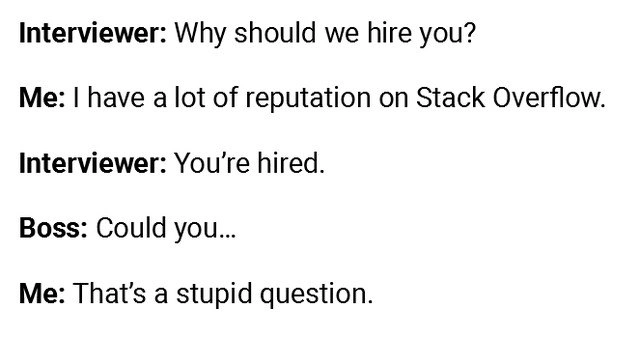
This meme sets up a cringeworthy interview scenario colliding with developer Q&A culture. An interviewer asks the classic question, “Why should we hire you?” and the candidate’s one-line answer is, “I have a lot of reputation on Stack Overflow.” In reality, Stack Overflow reputation is just an internet points system for helpful answers on a Q&A site – it’s not a recognized job credential. Yet in the joke, the interviewer instantly replies, “You’re hired,” as if a high reputation score alone proves the candidate’s worth. This absurd hiring decision highlights the satire: measuring a developer by their XP StackOverflow points instead of real skills is a tech-world exaggeration of bad HiringAndInterviews practices.
Once “hired,” the punchline comes when the boss starts to ask the new developer for something (“Boss: Could you…”), and our freshly minted hire cuts them off with, “That’s a stupid question.” 😬 Here the meme hilariously merges online behavior with office life. On StackOverflow, experienced users sometimes respond curtly or close questions that seem repetitive or poorly researched – essentially saying RTFM (Read The Fine Manual) or dropping a sarcastic LMGTFY link. It’s a form of qna_culture gatekeeping. The meme imagines a cocky developer who flexes their high rep, then treats their real-life boss like a newbie asking a dumb duplicate question. The result is comedic disaster: what might earn upvotes online becomes an interview_red_flag and a workplace facepalm.
For seasoned engineers, the humor cuts close to home. We know a hefty Stack Overflow rep doesn’t automatically translate to designing scalable systems or debugging a 3 A.M. outage. (Your boss would much prefer you quietly fix the production bug instead of staying up to farm upvote points by writing another answer about it.) High reputation can indicate someone who’s active in the dev DevCommunities, but it can also inflate ego. The meme skewers this StackOverflow-fueled arrogance. It’s a reminder that in software Career_HR terms, smart hiring values communication and real-world problem-solving over vanity metrics. A candidate who boasts “I’m a 50k rep user, NBD” while lacking humility or teamwork? Interview red flag. This scenario is every hiring manager’s nightmare and every jaded developer’s smirk: the hotshot who treats coworkers’ questions with the same dismissive tone reserved for FAQs on a forum. In short, the meme gets its laugh from a culture clash – online hero meets office zero, all thanks to an overdose of Stack Overconfidence.
Description
A text-based meme presented as a short, humorous script on a plain white background. The text, in a clean, black, sans-serif font, outlines a dialogue. First, an 'Interviewer' asks, 'Why should we hire you?'. 'Me' replies, 'I have a lot of reputation on Stack Overflow.' The interviewer is immediately convinced, saying, 'You're hired.' The scene then shifts to the new job, where the 'Boss' begins to ask a question, 'Could you...'. Before the boss can finish, 'Me' interrupts with the punchline, 'That's a stupid question.' The humor critiques the culture of Stack Overflow, juxtaposing the value placed on reputation during hiring with the notoriously abrupt and sometimes arrogant behavior of high-reputation users on the platform. It's a commentary on how skills valued in an online forum don't always translate to positive collaboration in a professional workplace
Comments
7Comment deleted
A high Stack Overflow reputation proves you can answer well-defined questions with existing solutions. A job requires you to solve poorly-defined problems with no solutions, while being polite to the person who created the problem
His 40k Stack Overflow rep seemed impressive - right up until sprint planning, when he marked every user story “possible duplicate” and demanded a minimal reproducible backlog
After 20 years in tech, I've learned that the people with 50k Stack Overflow reputation are either the best engineers you'll ever hire, or they're about to spend six months building a custom ORM because ActiveRecord is "fundamentally flawed in ways management wouldn't understand."
Ah yes, the classic Stack Overflow paradox: 10k reputation means you're brilliant at solving problems, but also that you've internalized the platform's 'marked as duplicate' reflex so deeply that every question from your boss triggers your inner moderator. The real interview question should have been: 'Can you resist the urge to close-vote real-world requirements as too broad or opinion-based?' Because that Stack Overflow reputation wasn't earned by suffering fools gladly - it was earned by meticulously explaining why their question is actually seven different questions, none of which show sufficient research effort, and all of which have been answered in 2009 by Jon Skeet
Hiring on SO rep is like choosing a DB by GitHub stars: blazing p95 reads, but every write to culture deadlocks
SO rep: the only metric where 50k points outweighs zero emotional intelligence
We hired the 100k‑rep Stack Overflow guy; now sprint planning gets closed as duplicate, and the CEO is told to provide a minimal reproducible business case