The Unending Reign of the C Programming Language
Why is this Languages meme funny?
Level 1: Old but Gold
Imagine you have a very old toy that your grandparents passed down to you. It’s simple and a bit worn out, but it’s super sturdy. Over the years, you get a bunch of new, flashy toys – one was the hottest thing last year, another was really popular a few years ago. But one by one, those new toys break or stop being fun, and you put them away. Yet that old toy keeps on working and never goes away. In fact, you still play with it because it just does its job so well. This meme is joking in the same way: the old toy is the C programming language (lasting for ages), and the broken toys being carried off are other programming languages that were popular for a while but eventually "died" out or got set aside. It’s funny because usually we expect new things to replace old things – like new toys replacing old toys – but here the old thing is outliving all the new ones. It’s a playful way to say sometimes the old, reliable thing ends up lasting the longest of all.
Level 2: Rise and Fall of Languages
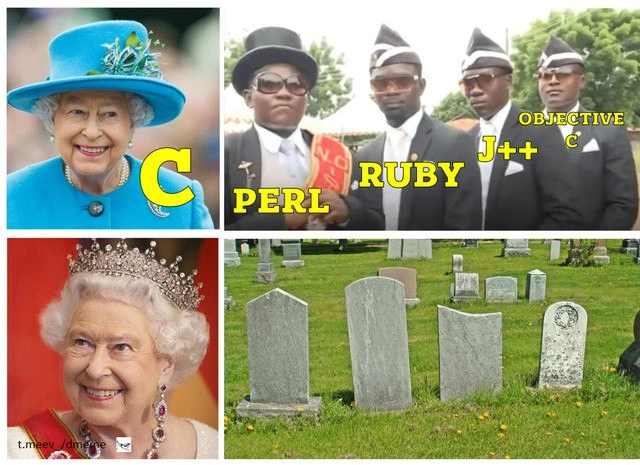
This meme highlights how programming languages come and go, using a funny scene. The big yellow C on the Queen’s photo represents the C programming language, which is very old (created in the early 1970s) yet still extremely important and widely used. In contrast, the group of dancing pallbearers carrying a coffin represents a set of languages that are considered “past their prime” or declining in popularity. The dancing coffin carriers are labeled Perl, Ruby, J++, and Objective-C, and the coffin itself is labeled "Ruby". This is referencing a viral coffin dance video that became a popular meme format – usually to humorously signal the death of something (in this case, the “death” of a programming language’s popularity). The joke is that these languages are giving Ruby (one of their own) a spectacular funeral, implying Ruby is on its way out, and they themselves might not be far behind. In the bottom-left, the Queen (again representing C) is shown in full royal attire with a crown, symbolizing that C has achieved a kind of enduring royalty in the programming world. The bottom-right image shows a cemetery with tombstones, suggesting there are other programming languages that have already died off completely – basically a graveyard of old languages from the past.
Let’s break down the key players in this meme:
- C – A very old, low-level programming language invented in 1972. It’s used for building operating systems (like Windows, Linux, macOS), embedded systems (like the software in appliances or robots), and high-performance applications. C is legendary for how long it’s been around and how it still remains relevant. Think of C as the sturdy foundation that many other technologies are built on. Even today, every programmer learns a bit of C or its concepts, and a lot of modern languages (C++, C#, Java, etc.) are directly influenced by C’s syntax and design. It’s not very fancy or beginner-friendly (you manage memory manually with pointers, which can be tricky), but it’s reliable and extremely fast. That’s why C has survived and is still in use – it’s like an old machine that just keeps on working.
- Perl – A scripting language created in the late 1980s. Perl was hugely popular in the 1990s for writing quick scripts, automating tasks on Unix servers, and powering early web CGI scripts (like form handling on websites). It was known for having very concise code (sometimes Perl code looked like random symbols – a joke was that Perl is a “write-only language” because only the author can read it later!). Perl’s motto was “There’s more than one way to do it,” emphasizing flexibility. Over time, however, Perl’s popularity declined. By the 2000s and 2010s, people were using newer languages like Python and Ruby that were easier to read and maintain. Today Perl is not gone, but it’s definitely seen as an older choice; not many new projects use Perl compared to its heyday.
- Ruby – A programming language from the mid-1990s, but it became famous in the mid-2000s thanks to the Ruby on Rails framework, which made it easy to build web applications. Ruby is known for its elegant, human-readable syntax (inspired by Perl but cleaner) and a philosophy of developer happiness. In the late 2000s, Ruby (with Rails) was the hot tech for startups – it made developing websites fast and fun. However, in the 2010s, Ruby started losing momentum. Competing languages and frameworks emerged: for example, JavaScript (Node.js) became a powerful alternative for web servers, and Python’s simplicity attracted many new learners. Ruby also had some performance issues at scale (it’s generally slower than compiled languages). So, while Ruby is still used (lots of existing Rails applications out there!), it’s not the hype magnet it once was. In this meme, Ruby is literally shown as the one in the coffin, meaning the joke is that Ruby might be “dying” in terms of trendiness or growth.
- J++ – This one might be the least familiar, because it’s essentially already a “dead” language. J++ (pronounced “J plus plus”) was Microsoft’s short-lived implementation of Java in the late 1990s. At that time, Java was growing rapidly, and Microsoft wanted its own version integrated with Windows. J++ ended up being discontinued after a legal dispute with Sun Microsystems (the creator of Java). Microsoft pivoted and created the C# language for the .NET platform a couple of years later, leaving J++ behind. By 2004, nobody was using J++ — it’s an example of a language that basically vanished. Including J++ in the pallbearers is a tongue-in-cheek way to say “even already-dead languages are carrying this coffin,” which adds to the absurd humor.
- Objective-C – A programming language that was the main language for developing software on Apple’s platforms (macOS and iOS) for many years. It’s actually older (created in the 1980s) but became widely used after 2000 when Apple made it the core of OS X and later iPhone app development. Objective-C is essentially the C language with some extra syntax and features (for object-oriented programming). It’s known for its quirky square-bracket syntax for method calls. In 2014, Apple introduced Swift, a modern language designed to be safer and more approachable than Objective-C. Swift quickly took over as the preferred language for Apple app development. So while tons of existing apps and Apple system code were written in Objective-C (and some still are), by 2020 almost all new iPhone/macOS apps are written in Swift. That puts Objective-C in the “declining” category — not many people are excited to learn it now, and over time its use is shrinking. It’s not completely dead (lots of legacy code still around), but it’s definitely being phased out. In the meme, seeing Objective-C helping carry the coffin signals that it’s one of those languages on its way to joining the others in the graveyard.
The cemetery tombstones in the bottom-right are a general nod to all the languages that have already met their fate. Throughout the history of computing, many programming languages have been invented — some stick around, and many others eventually lose relevance. For example, languages like COBOL, Fortran, and Lisp from the 1950s-60s are extremely old; interestingly, they actually still exist in niche areas (COBOL runs on old banks and government systems, Fortran in scientific computing, etc.), but they feel like ghosts from another era. Other languages truly went extinct, like ALGOL or Turbo Pascal or Visual Basic 6, which you'll hardly find in use today. The tombstones could represent any of those truly “dead” languages. The message is that the tech world moves fast, and many languages end up in the graveyard of history once they’re obsolete or replaced. It’s a bit like seeing the ruins of ancient civilizations in a history book — except it’s computing history.
To a junior developer or someone new to tech, this meme is explaining a kind of ironic reality: older technologies don’t always die; sometimes they outlast the newer ones. The programming language C has been around longer than many of the people using it, yet it’s still one of the top five or ten languages in use today. On the other hand, languages that were super popular when you were maybe in grade school (or not even born yet) are now considered outdated or “dead”. It’s like fashion trends: what was cool 15 years ago might now be laughed at, and something classic from 50 years ago (like a vintage suit) might come back or never left. C is the classic that never left. The meme’s humor comes from using the coffin dance, which is a lighthearted meme way to say “rest in peace” to something, combined with these language names. The fact that the Queen (C) is smiling and appears twice (young in one panel, older with a crown in another) reinforces how long C has been reigning through generations of tech. The queen outlived many younger figures in real life; similarly, C outlived these newer languages in the tech world. For a new developer, it’s a hint: trends come and go, so don’t write off the old stuff too quickly! A language like C might seem old-fashioned compared to Python or JavaScript, but it’s still incredibly important and will likely be around to bury a few more “cool” languages that haven’t even been invented yet. In other words, “Old but gold” holds very true in programming.
Level 3: C's Eternal Reign
In the pantheon of programming languages, C is like the monarch who’s seen empires rise and fall and is still on the throne. This meme cleverly uses the famous coffin dance meme (the dancing pallbearers) to illustrate how some once-mighty languages are being carried to their graves, all while C stands apart, smiling and unshakeable. It's a slice of DeveloperHumor that draws on TechHistory: over decades, many “hot” languages have emerged with fanfare only to decline or become niche, but the C language keeps on going strong. Seasoned developers recognize this pattern of LanguageEvolution – today’s celebrated language can become tomorrow’s legacy code. Here, C is personified as Queen Elizabeth II (known for her exceptional longevity), an apt symbol for a language from 1972 that remains fundamental in modern computing. Meanwhile, the pallbearers are labeled with Perl, Ruby, J++, and Objective-C, and the coffin they carry is marked "Ruby" – these are the “recently deceased” or declining programming languages being given a flamboyant farewell. The bottom-right image of a cemetery full of tombstones drives home the joke: countless languages have already been buried in the graveyard of tech history. In effect, the meme humorously asks: Which newer language will C attend the funeral of next?
Why is this so funny (and a bit poignant) to experienced devs? Because it’s too real. Many of us have lived through hype cycles where a language was touted as the C-killer or the next big thing. Yet, time and time again, C outlives the pallbearers carrying those predictions. It pokes fun at LanguageWars and trend-chasing in our industry. For example, in the late ‘90s and 2000s, people joked that languages like Java (and Microsoft’s variant J++) or later scripting languages would make low-level C programming obsolete for most tasks. Instead, C held its ground. Perl, created in 1987 and loved for powerful text-processing one-liners, was once nicknamed “the Swiss Army chainsaw” of scripting – indispensable on early web servers and system admin scripts. But as years passed, cleaner and more maintainable options (like Python) rose, and Perl's use drastically faded. Ruby, born in the mid-90s and popularized by the Ruby on Rails web framework, was the cool web language in the late 2000s. Startups proudly built in Ruby for its elegance and developer happiness. Fast forward a decade: Ruby's shine dulled as performance limitations and competition from JavaScript/Node.js, Python, and newer frameworks sent it into decline. Objective-C was Apple’s primary programming language for iOS and macOS apps for years — a mash-up of C’s efficiency with a Smalltalk-style messaging syntax. It dominated the App Store era from 2008 to 2014. But then Apple introduced Swift, a more modern language, effectively ushering Objective-C toward retirement. And J++ (Visual J++), Microsoft’s attempt in the late ‘90s to create its own Java-like language for Windows, didn’t just decline — it died young. A lawsuit from Sun Microsystems over Java’s control ended J++ and gave birth to C# on the .NET platform. Each of these pallbearer languages had its glory days; each was objectively important in its time (pun intended, looking at you Objective-C!). Yet here they are in 2020, figuratively dancing at a funeral — either already considered outdated or on a downward trend in popularity.
Meanwhile, C continues its stoic march through the decades. Why does C outlive them all? Technically speaking, C hits a sweet spot of being low-level enough to run fast and close to the hardware (you manage memory with pointers, no bulky runtime to slow it down), yet high-level enough to be portable across countless platforms. It’s essentially the lingua franca of system programming: operating systems (like Unix/Linux, Windows kernels), embedded systems (microcontrollers, firmware), language runtimes (the CPython interpreter for Python, the Ruby MRI interpreter, etc.), and performance-critical libraries are overwhelmingly written in C. This gives C a kind of invisible dominance — even when you code in a higher-level language, there’s a good chance C is under the hood. In fact, there’s rich irony in those pallbearer labels: Objective-C is literally an extension of C; Perl and Ruby are implemented in C; even Java’s original JVM and Microsoft’s J++ runtime were built with a lot of C/C++ code. So here we have C, the ultimate survivor, grinning like a monarch, while languages built on its shoulders limp off into the sunset. It’s a classic tech history lesson wrapped in a joke: platforms and fads come and go, but a well-designed low-level language can stick around essentially forever, because so much infrastructure depends on it.
From an industry perspective, the meme highlights how LanguagePopularity is fickle. Often it’s driven by trends, corporate backing, or killer apps/frameworks. Perl was king when the web was young, Ruby reigned during the Web 2.0 startup boom, Objective-C rose with the iPhone revolution. But as technology moved on, each faced either stagnation or replacement:
- Perl – superseded by easier-to-read scripting languages. Its slogan “There's more than one way to do it” became a double-edged sword; flexibility bred complex, unreadable code in large projects. As maintenance pain grew, Python and others stepped in with one obvious way to do things.
- Ruby – beloved for Ruby on Rails which made web development fun and rapid. But its performance and concurrency limitations (and perhaps the rise of Node.js and stricter scalability demands) meant fewer new converts after 2015. The cool kids moved to JavaScript on the backend, Go, or stayed with Java/Python, leaving Ruby a bit frozen in time.
- Objective-C – a staple for two decades on Apple platforms. By 2020 it’s not “dead” (plenty of legacy apps), but Swift’s safer memory model and modern syntax mean new projects rarely choose Objective-C. Apple signaled clearly that Objective-C is the past; Swift is the future.
- J++ – a historical footnote. It never had a chance to decline gracefully; it was axed and replaced. But it stands in for many niche languages that had short lifespans.
The graveyard in the bottom-right panel winks at the many other languages that have already met their end. Think of languages like ALGOL, Ada, Smalltalk, or even early web languages that few talk about anymore. Some older languages are truly dead (nobody is starting new projects in them), while others survive only in legacy systems or academic interest. The tombstones remind senior devs of the impermanence of most technology. It’s both amusing and a bit sobering: we pour years into mastering tools that might be obsolete by mid-career. But then there's C, the exception to the rule, the ancient titan that just won’t quit. It’s still ranked at the top of many indexes (like TIOBE) in 2020, battling alongside newer giants like Python and Java. Seeing C portrayed as the smiling Queen at yet another funeral is a tongue-in-cheek acknowledgement that reports of C’s death have always been greatly exaggerated. 🚀 In an industry that loves to proclaim things “dead” the minute something shiny comes along, the old-timer C continues to quietly run the world, outliving the pallbearers themselves. The humor here has an edge of cynicism born of experience: those who’ve been in tech long enough have a front-row seat to this parade of progress, and they know that sometimes the hype gets buried long before the old code does.
Description
A four-panel meme comparing the longevity of programming languages. The top-left panel shows a smiling Queen Elizabeth II with a large yellow 'C' superimposed, symbolizing the C programming language. The top-right panel features the famous 'Coffin Dance' pallbearers, with each person labeled as a different programming language: 'PERL', 'RUBY', 'J++', and 'OBJECTIVE C'. The bottom-left panel shows another picture of the Queen, looking timeless and regal. The bottom-right panel is a photo of a graveyard with several weathered tombstones. The meme uses the Queen's long life as a metaphor for the enduring relevance of C. In contrast, the languages associated with the Coffin Dance meme and the graveyard are portrayed as obsolete or 'dead.' This resonates with senior developers who have witnessed numerous language hype cycles, yet continue to rely on C for systems programming and performance-critical tasks, recognizing its foundational and persistent nature in the tech industry

Comments
7Comment deleted
They say C is a dead language, but it's really more of a lich. It's ancient, powerful, and all the new flashy languages are secretly just phylacteries for its soul
Every decade we schedule C’s funeral, and every decade the supposed pallbearers show up written in C, realize they still depend on it, and climb into the coffin themselves
After 50 years of 'C will be replaced by X', C is still here compiling your kernel while its supposed successors are being deprecated faster than you can say 'undefined behavior'. Turns out manual memory management is like a cockroach - ugly, causes problems, but survives every extinction event
C remains the immortal monarch of systems programming - still running your OS kernel while Perl, Ruby, and Objective-C get the pallbearer treatment. Meanwhile, J++ went straight from Microsoft's labs to the cemetery without passing GO, proving that even with corporate backing, you can't force developers to adopt a proprietary Java clone. The real irony? C is older than all of them combined, yet it's the 'modern' languages that needed life support
C remains the ABI monarch: every “C‑killer” (Perl, Ruby, Objective‑C, even J++) gets a coronation, then ships a runtime written in C, exposes an FFI, and quietly books the pallbearers
Every decade we schedule C’s funeral; then the pallbearers remember who owns the ABI, the kernels, and the embedded toolchains - so we end up engraving their names instead
C's manual memory management: the ultimate immortality hack - GC languages get collected, but pointers reign eternal