The Holy Trinity of a Stack Overflow Snippet
Why is this DevCommunities meme funny?
Level 1: Copied Homework
Imagine you have a tough homework assignment, and you decide to copy the answers from the internet or a friend. How would your teacher or friends guess that you didn’t do it all by yourself? First, the answer sheet you hand in has extra notes and explanations that you never usually include – it’s way more detailed than your normal work (that’s like the code having comments explaining things). Second, some of those notes are written in Spanish, even though you normally write in English – oops, that’s a big clue you grabbed it from someone else who speaks Spanish! Finally, and most surprisingly, all your answers are correct and your solution works perfectly on the first try. Normally, you might make a mistake or two, but this time it’s 100% right, as if an expert did it. When something is too good and even has hints of someone else’s style (or language), it’s a clear sign you copied your answers. The meme is joking that code can be a bit like that homework – if it’s unusually well-written, unexpectedly multilingual, and miraculously flawless, everyone knows you got a little help from the big collective “cheat sheet” on the internet. It’s a funny and lighthearted way to say sharing and copying answers happens in programming just like in school, and the clues can give it away!
Level 2: Spot the Snippet
Let’s break down this joke in simpler terms. The meme lists three big hints that a piece of code in your project was copied straight from the internet (specifically from a site like StackOverflow, a famous question-and-answer site for programmers):
The code has comments. In programming, comments are notes or explanations written alongside the code to help humans understand what’s going on. They might look like this in code:
// This is a comment(for languages like JavaScript/C#) or# This is a comment(in Python). Comments are ignored by the computer; they’re just there for us, the developers. Now, why is “the code has comments” a sign of copy-pasting from Stack Overflow? Because many developers, especially when rushing or working on internal projects, forget or neglect to write comments. It’s an unfortunate reality of CodeQuality in many codebases: plenty of functions and modules have no explanation at all. However, when someone posts an answer on Stack Overflow, they often include comments to explain their solution (since they’re teaching others). So if you stumble on a function in your company’s code that suddenly has nice explanatory comments, it could mean it was lifted from an answer or tutorial. It’s like finding a toy with an instruction leaflet attached – a sign it came from a store rather than being homemade. The meme plays on this contrast: code in the wild (from the community) is frequently well-documented, whereas code written under deadline pressure might have zero comments. So seeing comments at all is a funny clue: “hmm, we usually don’t comment our code, where did this come from?”The comments are in Spanish. Most programming languages use English keywords (like
if,else,while) and many teams worldwide use English for their code and comments, even if they speak another language natively. This is partly tradition and partly to make it easier for diverse teams to collaborate. Now imagine you find a chunk of code in your project and the comments explaining it are written in Spanish (or any language that your team generally doesn’t use). For example:# Comprueba si un número es par (means "Checks if a number is even") def es_par(n): return n % 2 == 0In the above code snippet, the comment
Comprueba si un número es paris Spanish. If the developers on your team don’t typically speak or write Spanish, such a comment is a pretty strong indicator that the code was copied from somewhere else. Perhaps the person who originally posted that solution on Stack Overflow (or a blog) spoke Spanish and left that note. Finding it in your code is like finding a clue in a mystery: it points to an external origin. It also highlights how DevCommunities are global. You might be using code written by someone on the other side of the world! This is actually pretty cool – it shows how knowledge is shared without borders. But from a practical standpoint, a comment in an unexpected language sticks out. It can be a bit amusing, too: if you can’t read the comment, you might run it through Google Translate out of curiosity, only to chuckle and say, “Yup, this is definitely copy-pasted from a Spanish forum or Stack Overflow answer.” In short, Spanish comments (or any foreign-language notes) in your code are a flashing sign that says, “I didn’t write this myself; I borrowed it.”The code actually works! This part of the joke plays on a common experience: code rarely works perfectly on the first try. Usually, when you or your teammates write new code, you have to run it and then debug errors or fix mistakes because programming is tricky. There’s even a lighthearted saying among developers: “Did you test it? Well, it compiles… I’m sure it’s fine!” (often said sarcastically, because simply compiling doesn’t mean the code is bug-free). So, when a piece of code runs correctly from the get-go – no bugs, no tweaks needed – it’s almost suspicious in a funny way. The meme suggests that if your code works flawlessly immediately, maybe it’s because someone else already tried, tested, and refined it (for example, the collective community on Stack Overflow). In reality, Stack Overflow answers tend to be vetted by many people. A highly upvoted solution has probably been used by dozens or hundreds of other developers in their projects, so any obvious bugs got ironed out long ago. That’s why a copy-pasted snippet can feel magically reliable. You drop it in and boom, problem solved. For a junior developer, this might seem awesome – and it is useful! – but it’s good to be aware why it’s working so well. It’s not magic; it’s that you imported a solution that’s already been proven. The humor here is that for once you’re not seeing the dreaded error messages or debugging for hours – the borrowed code spared you that pain. It’s a bit like using a cheat code in a game: suddenly everything is easy and you’re almost looking around wondering “why was that so simple?” In developer humor, we exaggerate by saying the fact it works at all is the biggest clue it wasn’t our own code.
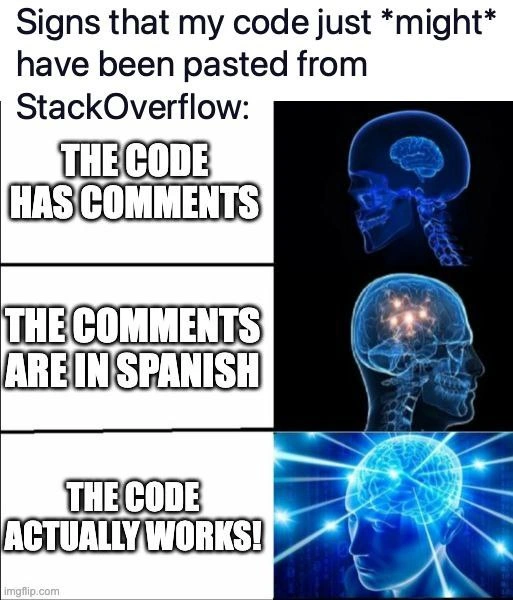
All together, these three signs form a relatable joke in the programming world. StackOverflow is a go-to resource when you’re stuck on a coding problem. Most developers have at some point copied a chunk of code from a StackOverflow answer into their own project. This meme is essentially poking fun at ourselves for doing that. It lists comically obvious evidence: nicely written comments (we rarely do that ourselves under pressure), comments in another language (clearly from a global source), and the code working perfectly (ha, we wish our original code did that!). The format used – the expanding_brain_meme – is a popular meme template where each row represents a concept and an image of an increasingly radiant brain, implying a rising level of “brain power” or enlightenment. Here, the enlightenment is tongue-in-cheek: by the final glowing brain, the developer realizes, “Oh, this code is not just similar to a StackOverflow snippet – it definitely is from StackOverflow!” Each panel’s text gets more extraordinary, and so does the brain’s glow. The last line “THE CODE ACTUALLY WORKS!” next to the most explosively illuminated brain is the ultimate punchline, because in tech circles we joke that our own code seldom works on the first try.
This meme falls under CodingHumor/DeveloperHumor because it’s making fun of something programmers find very familiar and funny. It’s relatable humor: nearly every coder, from a beginner to an experienced engineer, has had that moment of relief when an answer online saved their day. We also collectively recognize the little quirks that come with those answers – like the original author’s style peeking through. It’s worth noting that copying code isn’t inherently bad – developers share code specifically to help others – but it is important to understand what the code does. A junior developer might learn a lot by studying those well-commented snippets (maybe even picking up a bit of Spanish along the way!). And if you ever do paste such code, it’s a good habit to adjust it to your project’s style and maybe translate or rewrite the comments so that all your team members can understand. That said, the comedic scenario here assumes someone just dropped the code in wholesale, comments and all, and that’s why it’s obvious to everyone. It’s funny because it’s true: these things do happen in real life. The next time you see a strangely perfect bit of code with // comentario in it, you’ll know exactly why and have a little laugh.
Level 3: Forensic Code Clues
At a senior engineer’s glance, Stack Overflow-copied code practically has fingerprints all over it. The meme humorously presents an “expanding brain” progression of clues that any battle-tested dev can recognize. In the first panel (with a dimly lit brain), the text shouts “THE CODE HAS COMMENTS” – a tongue-in-cheek sign of external origin. Why is that funny? In many rushed codebases, inline documentation is sparse or nonexistent. Suddenly encountering nicely formatted comments in a code file is a bit like finding a detailed instruction manual in a pirate treasure chest. It hints that the snippet was lifted from a more tutorial-like context, such as a Stack Overflow answer where the original author kindly explained their code. Code comments, especially well-written ones, stand out in a sea of hastily written production code. seasoned developers sarcastically joke that if code has clear comments, it probably wasn’t written at 2 AM by their sleep-deprived teammate. It’s a clue from the DevCommunities circuit – the code carries a whiff of communal knowledge.
Moving to the second panel (the brain image now firing on more neurons), the meme ups the ante: “THE COMMENTS ARE IN SPANISH”. Now the origin of this mysterious code snippet becomes even more obvious. In a typical project where everyone writes comments in English (or whatever the team’s primary language is), stumbling on a comment like // Comprueba si el número es primo is a dead giveaway. This implies the code was likely copied from an answer or article written by a Spanish-speaking developer. It’s a humorous nod to how international our programming community is – solutions come from all over the world. In a large knowledge-sharing ecosystem like Stack Overflow (which even has an español version for Spanish-language Q&A), you might find that perfect code snippet authored by Juan from Madrid or María from Mexico City. Experienced devs have seen it all: Chinese characters in comments, Cyrillic variable names, or Spanish documentation lovingly left intact. The presence of a foreign language in your code’s commentary is a glaring clue that the code wasn’t originally concocted in-house. And let’s be honest, it’s also hilarious: imagine a code review where someone asks, “Since when do we comment our functions in Spanish?” – cue the sheepish grin of the copy-paster. This panel highlights the Developer Experience (DX) of our globalized trade: sometimes quick knowledge transfer comes with multilingual flavor. It’s a positive thing (knowledge has no borders!), but it definitely leaves identifiable traces. A seasoned engineer will chuckle seeing // TODO: mejorar el rendimiento in an otherwise English codebase – it screams CopyPasteCoding heritage.
Finally, the meme’s punchline arrives in the third panel, paired with the ultimate galaxy brain radiating enlightenment: “THE CODE ACTUALLY WORKS!”. This is the most luminous brain tier for a reason – it’s the cosmic-level revelation that confirms our suspicions. Think about it: your team’s fresh code rarely runs perfectly on the first try. There are usually bugs to debug, off-by-one errors, missing null checks, you name it. But this particular snippet? It slides into your application like butter and solves the problem without a single runtime error or tweak. That kind of smooth success can feel almost miraculous in a real-world development cycle. It’s the tell-tale sign that the solution has been battle-tested already – likely by the collective wisdom (and upvotes) of Stack Overflow’s community. RelatableHumor alert: every developer knows the surreal joy of pasting code from a trusted source and having it fix your bug instantly. It’s both satisfying and faintly suspicious. Seasoned devs jokingly call this phenomenon “StackOverflow-driven development”. You copy a snippet that you half-understand, drop it in, and when it runs on the first go, you sit there in stunned appreciation (and maybe a pinch of doubt, did that really just work?). The meme brilliantly hyperbolizes that feeling: the fully radiant brain suggests an almost enlightened state when you realize you won’t need to pull an all-nighter debugging – because someone else already did that hard work for you.
This expanding-brain format is a perfect vehicle for the joke. Each row escalates the obviousness of the Stack Overflow copy-paste: from the mild surprise of actual comments, to the bigger surprise of foreign-language comments, to the ultimate shock that the code works flawlessly. It pokes fun at real DeveloperExperience_DX patterns. In practice, when we’re desperate to solve a bug, we often grab a copy_paste_snippet from the web. The results can be surprisingly positive (hey, it compiles and passes tests!). Yet these snippets carry their CodeQuality quirks – they might not follow your project’s style, they might include extraneous comments or oddly named variables, and as in this meme, they might come with commentary in whichever language the original author spoke. A seasoned engineer reading the code can practically play detective (a bit of source code forensics): “Aha, the use of respuesta as a variable name and that Spanish comment – this must be from Stack Overflow user so-and-so’s answer!” We’ve even seen cases where developers leave the original answer’s attribution or link as a comment (which, by the way, is the polite thing to do given Stack Overflow’s licensing). More often though, it’s only these subtle clues that remain.
In summary, from a senior perspective, this meme lands so well because it’s spot-on about industry life. It lightheartedly exposes the quiet reliance developers have on community knowledge. The code that “just works” without drama is practically a love-letter to Stack Overflow’s existence. The humor also hides an implicit piece of advice: maybe we should strive to write our in-house code with the same clarity (comment your code, folks!), thoroughness, and care that those highly-vetted Stack Overflow answers have. And if a random snippet from the internet saves your hide at 3 AM, perhaps take a moment to translate the Spanish comment – or don’t, and let it stand as a proud badge of the global coder community. After all, if it ain’t broke (and you can’t read Spanish), don’t fix it! 😅
Description
A three-panel 'Expanding Brain' meme captioned, 'Signs that my code just *might* have been pasted from StackOverflow:'. The first panel shows a simple brain scan next to the text 'THE CODE HAS COMMENTS', suggesting this is a rare but notable occurrence. The second panel displays a brain with glowing neural activity next to 'THE COMMENTS ARE IN SPANISH', indicating a higher level of strangeness and a stronger sign of external sourcing. The final panel shows a fully illuminated, god-like brain radiating light, with the punchline: 'THE CODE ACTUALLY WORKS!'. This meme humorously ranks the surprising discoveries in a piece of code, with the ultimate miracle being that a snippet copied from the internet works without any modifications. For experienced developers, the joke is deeply relatable, touching upon the poor state of code documentation, the global nature of platforms like Stack Overflow, and the common pain of seemingly correct online solutions failing in practice
Comments
9Comment deleted
The original author of that Stack Overflow post from 2011 is now a principal engineer who has no memory of writing it, but their perfectly-working, Spanish-commented solution is silently running half the internet
When the PR shows comments in Spanish, variable names in Hungarian, and effortlessly fixes a decade-old edge case nobody remembers - congrats, you’ve just merged SOaaS into production
The real senior engineer move is leaving the Spanish comments in production because they're the only documentation that explains why the regex works, and touching it would anger the ancient gods of Stack Overflow karma who blessed this code with functionality
The real senior move is recognizing the Spanish comments are from a 2011 Stack Overflow answer that's been copied into production codebases across three continents, still works flawlessly despite using deprecated APIs, and nobody dares refactor it because the original author's account was deleted and the approach is so elegant yet inscrutable that it's essentially become archaeological infrastructure - a digital Rosetta Stone where 'funciona perfectamente' is the only documentation you need
You can tell it’s from StackOverflow when the mission‑critical path is a 2012 regex with a Spanish comment “no tocar” - and it’s somehow the most reliable thing we ship
Spanish comments in SO code? That's enterprise-grade battle-testing - no senior dev wrote those; a global hero did, and it survived prod
Forget SAST - my StackOverflow detector is (comment_language != team_locale && snippet passes CI); posterior probability of paste origin approx 1.0
pov: You speak Spanish and you posted that code as an answer to SO question, knowing it does not work Comment deleted
20 downvotes, top answer Comment deleted