The Base64 Reveal of a Stack Exchange Sock Puppet
Why is this DevCommunities meme funny?
Level 1: A Hidden Note Uncovered
Imagine you and your friends are playing detective, and you find a note that looks like complete gibberish – just a random mix of letters and symbols. It doesn’t make sense at first, almost like a secret language. But one clever friend says, “Hey, I think I know this code!” They pull out a special decoding tool (like a secret decoder ring from a cereal box, or an app on their phone) and start translating the strange text. Bit by bit, the gibberish turns into a real message in English. Surprise – the note actually says who was behind the big mystery you all have been curious about!
In this story, a bunch of tech-savvy folks did exactly that. Some mysterious person named Cleo had everyone guessing, kind of like a masked character in a game. People suspected Cleo was actually someone else in disguise. Then they discovered a hidden note on two profile pages – the kind of pages where users introduce themselves. The notes were written in a special code (called Base64, though you don’t need to remember that). At first glance it was just a mess of characters, but the community worked together to decode it, just like solving a puzzle. When the secret code was cracked, it clearly said that Cleo was a made-up character created by a person named Vladimir. In other words, the mystery hero (or trickster) was unmasked!
It’s a bit like finding a secret message under a scavenger hunt clue that reads, “The treasure was hidden by Johnny.” Everyone kind of guessed it was Johnny all along, but seeing the message in the secret code made it official. The group of friends (or in this case, online developers on Reddit and StackExchange) were excited because they finally had proof of who was behind the mask. They solved the mystery together using their coding skills, and that’s why this is funny and satisfying – it shows how even serious tech communities have moments of playfulness, like detectives cracking a code to reveal the truth.
Level 2: Base64 Breadcrumbs
This meme might look complex, but it boils down to a few key concepts that even newer developers can grasp. Let’s break it into pieces. First, Base64 encoding – what is that? Basically, Base64 is a way to take any data and represent it using common text characters. It uses 64 different symbols (the letters A–Z, a–z, digits 0–9, and a couple of symbols like + and /, with = for padding) to encode binary data. Why do this? Because sometimes you need to send or store binary stuff (like images or just weird bytes) in a system that only handles text. By encoding it in Base64, you turn it into a string of regular characters. It’s not magic or encryption – it doesn’t hide the data from someone who knows how to decode it – but it does make the data look like random text. A telltale sign of Base64 is that it often ends with one or two = characters (these are just padding to align the data). If you’ve ever seen a long string in a config file or an email that’s just a mix of letters, numbers, plus signs and slashes, chances are it was Base64.
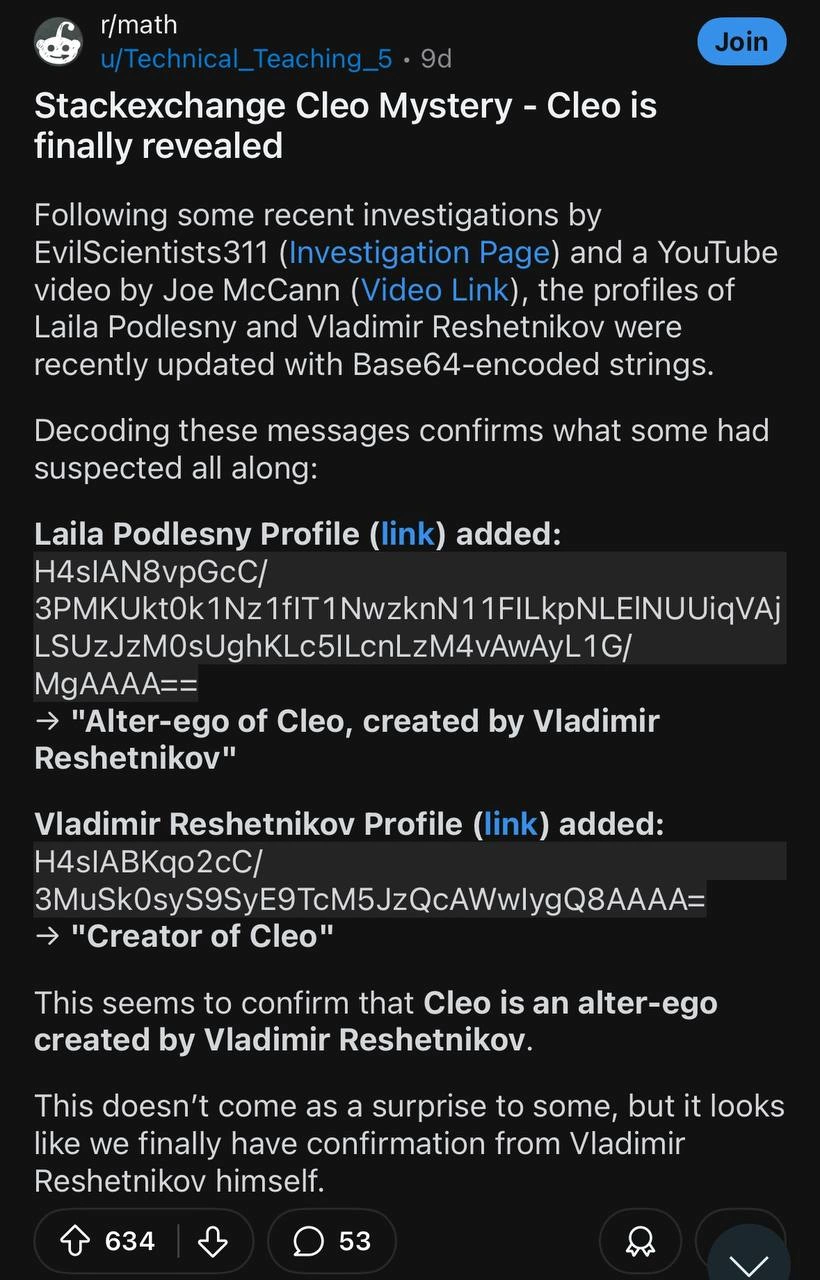
In the screenshot, the Reddit post shows two grey code blocks containing exactly that kind of gibberish text. Anyone with a bit of tech experience would think, “Aha, those look like Base64-encoded strings!” The people investigating the Cleo mystery recognized this and decoded them. Decoding Base64 is straightforward with the right tools – there are online decoders, or you can use programming languages or command-line tools. For example, using Python you could do:
import base64, gzip
data = base64.b64decode("H4sIAN8vpGcC/3PMKUkt0k1Nz1fIT1Nw...")
text = gzip.decompress(data).decode('utf-8')
print(text)
This would output the hidden English message. In this case, when they decoded the first string from Laila Podlesny’s profile, it turned into the sentence "Alter-ego of Cleo, created by Vladimir Reshetnikov." The second string from Vladimir’s profile became "Creator of Cleo." So basically one profile’s “about me” section literally contained the phrase that Cleo is an alter-ego (a second identity) created by Vladimir. The other profile straight-up said Vladimir is the creator of Cleo. It’s a bit like finding two puzzle pieces that fit together to tell a story.
Now, why is that significant? Let’s talk about StackExchange profiles and the drama here. StackExchange is the platform family that includes Stack Overflow (for programming questions) and lots of other Q&A sites (like one for mathematics, which is likely where Cleo was active). Users on these sites have profiles where they can write a short bio or anything they want to share. It’s usually just fun facts or their interests, maybe their real name or a link to their blog. But here, two users left strange encoded messages instead. That was a big clue that something unusual was up. It’s not every day you see Base64 text in someone’s profile!
The content of those messages revealed a Sockpuppet situation – that’s when one person has multiple accounts and pretends they’re separate people. “Cleo” was apparently a user that many in the community were curious (or suspicious) about. The phrase “alter-ego of Cleo, created by Vladimir Reshetnikov” is basically saying Cleo’s account was a second persona made by this Vladimir guy. In other words, Vladimir was behind Cleo the whole time. This confirmation was a big deal because it unmasked the real identity behind a possibly famous or infamous account. On Q&A sites, sockpuppets can be used to cheat the system (for example, upvoting your own posts with the other account, or accepting your own answers). So if Cleo was getting a lot of attention or causing controversy, finding out it was just Vladimir all along is like unmasking the villain in a mystery story.
The Reddit angle here is interesting too. The meme is a screenshot of a Reddit post (notice the r/math at the top and the dark-mode interface favored by many developers for its eye-friendly look). This means a Reddit user wrote a post explaining how they finally solved the “Stackexchange Cleo Mystery.” Essentially, folks on Reddit took it upon themselves to investigate something happening on StackExchange. This is a great example of how developer communities often overlap and collaborate. One community (Reddit) was analyzing clues left on another platform (Stack Exchange) to get to the truth. The post got a lot of upvotes (634 as shown), which tells us many people found this discovery interesting or important. Even the title “Cleo is finally revealed” has a triumphant ring to it – like the finale of a long-running detective saga in the tech world.
To sum up the technical part: we have Base64 encoded messages hidden in user profiles, and decoding them gave a readable secret that solved an online mystery. And to sum up the community part: a bunch of determined users worked together to find and decode those clues, confirming that one person was secretly behind another account. If you’re a newer developer or just new to these online tech communities, this is a peek into the culture: devs love puzzles, they notice weird details like encoded text, and they often band together on forums to figure things out. It’s both practical (uncovering misbehavior) and a bit of fun (who doesn’t enjoy cracking a code and feeling like a detective?). In the end, the mystery of Cleo was cracked with a few lines of decoding – a very hacker-ish ending to an online whodunit.
Level 3: Hidden in Plain Bytes
On the surface, this looks like a routine Reddit thread about some StackExchange intrigue. But to a seasoned developer, a few details jump out immediately: those blocks of gibberish text ending in == scream Base64 encoding, the cross-platform detective work (StackExchange profiles being discussed on Reddit) hints at serious developer sleuthing, and the whole post oozes that “we solved a puzzle!” energy. This isn’t your usual Q&A content; it’s a full-blown community-driven digital forensics saga playing out in real time. And yes, it’s as delightfully nerdy as it sounds.
Let’s unpack the technical cleverness here. The meme shows two grey code blocks on the Reddit post, each filled with what looks like random characters: one starts with H4sIAN8vpGcC... and the other with H4slABKqo2cC.... To an experienced eye, a string like that (especially with the == at the end) practically waves a flag saying “I’m Base64, decode me!” In fact, H4sI is a telltale prefix often seen when something was gzip-compressed before being Base64-encoded. In plainer terms, someone took a text message, compressed it into a tiny blob, then encoded it in Base64 — a double layer of disguise. It’s like they wrote a note, crumpled it into a smaller ball, and then painted it with an alphabet soup so you’d need the right decoder ring to read it. Classic move for hiding a secret in plain sight.
What do these encoded strings reveal once unscrambled? Exactly the bombshell everyone suspected. The first code block, found on Laila Podlesny’s StackExchange profile, decodes (after a quick base64 → gunzip combo) to “Alter-ego of Cleo, created by Vladimir Reshetnikov.” The second string on Vladimir Reshetnikov’s own profile decodes to “Creator of Cleo.” In other words, two user profiles quietly announced that Cleo is an invented persona — a sockpuppet — engineered by Vladimir. It’s the online equivalent of leaving a signed confession tucked behind a painting, except the painting is a user profile and the confession is in geeky code.
For context, StackExchange (the network behind sites like Stack Overflow and the math Q&A forum in question) takes a dim view of sockpuppets and deception. An alter ego account can skew trust and voting, so uncovering one is a big deal. The whole “Cleo mystery” had evidently been brewing as community gossip: who is Cleo, really? Some users had theories, and tension was building on the forums (StackExchange drama, as we call it). Instead of an official announcement, the answer came via these covert Base64 messages. It’s both hilarious and fitting that the truth was dropped not in a formal post, but hidden in profile metadata — as if the culprit or an insider couldn’t resist adding a dash of spy-thriller flair to the revelation.
What’s especially humorous is how developers handled this: like a code-breaking team on a mission. The Redditors in r/math effectively became detectives. Someone noticed the weird strings on those profiles (maybe thinking, “Hmm, that doesn’t look like a typical user bio, more like encoded data…”). Immediately, the hive mind kicked in: decode the Base64! It’s almost Pavlovian in tech circles — see a string of random As, 9s, + and / characters, especially if it ends with the padding = signs, and our first thought is “I bet this is Base64, let’s grab an online decoder or a quick script and check.” Sure enough, out pops legible text confirming the long-suspected plot twist. One can imagine the triumphant “Gotcha!” moment when the decoded phrase appeared on someone’s screen.
The irony of using Base64 here is that it’s not a security measure — it’s an encoding, not encryption. Anyone who recognizes it can reverse it in seconds. In fact, that was the point: the message was meant to be found by those savvy enough to look. It’s like a secret handshake or a wink to the tech-savvy: “If you can read this, you’ll know the truth.” This adds a layer of nerdy humor to the whole affair. Instead of just outing the sockpuppet in plain text (which would be too easy, right?), the reveal turned into an Easter egg hunt for the community. It’s a perfect example of tech culture at play — even when dealing with a serious matter (exposing an impersonation), developers just have to make it a code puzzle.
And of course, the climax is satisfyingly anticlimactic: Cleo was Vladimir all along. To some veteran users, that wasn’t a surprise at all — they might’ve been saying “Called it!” for weeks. But getting definitive proof through a clever hack made the journey worthwhile. It’s a bit like spending days debugging a system to find out the bug was exactly what you thought from the start – validating, yes, and still rewarding in a weird way. The community got to rally together, flex their decoding skills, and close the case with a flourish. This meme nails that vibe: a mix of relief, vindication, and geeky glee, all wrapped up in Base64 and solved by Reddit sleuths who just wouldn’t let a mystery stay unsolved.
Description
A screenshot of a Reddit post from the r/math subreddit, titled 'Stackexchange Cleo Mystery - Cleo is finally revealed'. The post details the resolution of a long-standing mystery within the Stack Exchange community regarding the identity of a user named 'Cleo'. It explains that following investigations, the profiles of two users, Laila Podlesny and Vladimir Reshetnikov, were found to contain Base64-encoded strings. The post shows the decoded messages: Laila's profile reveals 'Alter-ego of Cleo, created by Vladimir Reshetnikov', and Vladimir's profile reveals 'Creator of Cleo'. This confirms that 'Cleo' was a sock puppet account. This story is significant for the technical community as it involves online identity, community-driven investigation, and a nerdy method of confession (Base64 encoding) on a platform known for its rigorous technical standards
Comments
7Comment deleted
Revealing your elaborate sock puppet scheme via Base64 is the developer equivalent of a Scooby-Doo ending: you pull off the mask, and it was the high-rep user all along... and he would have gotten away with it if it weren't for those meddling kids and their online decoders
Cleo got “mystery-solved” the moment Reddit piped her Gzip+Base64 blob into an online decoder - proof that we’ll architect zero-trust meshes all day, yet still confuse string encoding with cryptography
When your authentication system is so secure that the only way to prove your identity is to Base64 encode "I am me" in your profile and hope someone with too much free time notices
When your Stack Overflow reputation is so legendary that people start forensically analyzing Base64 strings in your profile to uncover your alt accounts - because apparently 2.8 million rep points under one identity just isn't enough flex. This is what happens when the community that debugs production incidents for fun turns its collective attention to platform metadata: they treat user profiles like they're reverse-engineering a proprietary binary protocol. Nothing says 'senior engineer energy' quite like discovering someone's sock puppet through character encoding analysis rather than, you know, just asking them
Only in dev communities do we run forum drama through an incident runbook: spot H4sI, base64 -d | gunzip, mark RCA as “identity misconfiguration,” and close it as Working-As-Encoded
Base64 sockpuppets on Stack Overflow: hiding in plain sight until some dev runs 'base64 -d' and your rep farm CAPs out
StackExchange plot twist: Cleo’s secret identity was guarded by gzip+Base64 - when your opsec starts with H4sI, anonymity is just a serialization detail