Skip to content
DevMeme
6020 of 7435
When engineers brag about SSH access to your smart mattress’s firmware
Security Post #6590, on Mar 28, 2025 in TG

When engineers brag about SSH access to your smart mattress’s firmware

Why is this Security meme funny?

Level 1: We Are Not The Same

Imagine two people both ended up inside someone’s house, but in completely different ways. One was invited in through the front door because he was polite and friendly – he earned trust, and the homeowner said “Sure, come on in!” The other sneaked in through a hidden back door that the homeowner didn’t even know about – basically, he broke in without permission. Both are “in the house,” but one did it the right way and the other did it the wrong way. They are not the same, right?

That’s exactly the point of this meme, just with a “smart bed” instead of a house. One guy got into her bed in the normal, friendly way (she liked him, so it’s okay). The other guy got into her bed in a sneaky way (he used a secret trick on her smart bed’s computer to get in). The meme is joking that the second guy is bragging about his sneaky, techy method as if it makes him special. It’s funny because it’s a very weird and creepy way to “get into someone’s bed,” and no normal person would think that’s better! It’s basically saying: one of these things is not like the other.

So, in simple terms: the meme uses a silly comparison to show how absurd it is that an engineer could remotely access a person’s high-tech mattress. It’s like someone proudly saying, “I didn’t need to be nice or charming, I literally hacked my way in – hahaha, I’m so superior,” which is meant to make you laugh because it’s such a bad and ridiculous thing to do. The phrase “We are not the same” just drives home how different (and not equal) those two actions are. It’s a funny way to highlight a real problem: one method respects privacy and consent, the other totally doesn’t. And that’s why this meme is both humorous and a little bit scary – but mainly, it’s making a joke out of a tech goof-up.

Level 2: Unauthorized Under Covers

Alright, let’s break this down in simpler terms. This meme is about a smart bed and a serious security oops that happened with it, turned into a joke. IoT (Internet of Things) refers to everyday objects that are connected to the internet so they can send/receive data or be controlled remotely. A smart mattress (like the one from a company called Eight Sleep) is part of IoT – it’s a bed equipped with sensors and internet connectivity. For example, it might track your sleep patterns (heart rate, tossing and turning, temperature, etc.), let you warm up the bed via a smartphone app, and generally brag that it’s bringing “Silicon Valley innovation” to your sleep. Cool, right?

Well, here’s the not-so-cool part: a news report came out that this smart mattress had a backdoor in its software. A “backdoor” means a secret way to get into a system that’s not documented or disclosed as a normal feature. It’s like a hidden entrance only the builders know about. In this case, the backdoor allowed the company’s engineers to SSH into any bed. Now, what does “SSH into” mean?

SSH stands for Secure Shell – it’s a protocol and tool that lets you remotely log into a device over a network. Think of it as opening a secure command-line window on another computer from far away. Developers and system administrators use SSH all the time to manage servers. You type something like ssh username@device-address, and if you have the right credentials (password or cryptographic key), you get a shell (terminal) on that device where you can enter commands. It’s powerful because it’s as if you’re sitting at that machine typing into it directly, even if the machine is actually across the country. SSH is encrypted, so it’s secure against eavesdropping on the network – but it doesn’t magically stop someone from logging in if they do have the right credentials.

So when we say engineers could SSH into the mattress, it means the mattress was essentially running some kind of computer inside (likely a small Linux-based system) that had an SSH server listening for connections. The firmware of the bed – that’s the built-in software that runs the bed’s hardware – had this SSH access enabled. And the company had kept a way to get into that firmware remotely. Maybe they all shared a special username/password or a cryptographic key that was the same for every device (the specifics weren’t in the meme, but that’s typically how a backdoor works). This would let them log in to any customer’s mattress’s system over the internet.

Why would they do that? The optimistic explanation: for maintenance and support. If a customer had an issue, an engineer could remotely connect to diagnose or fix it. The cynical explanation: they didn’t fully think through security and left a developer shortcut in production. Either way, they left the door unlocked on a device that lives in people’s bedrooms. That understandably freaks people out — it’s a huge privacy concern. You don’t normally expect that the manufacturer can silently poke into your mattress’s brain while you’re sleeping on it!

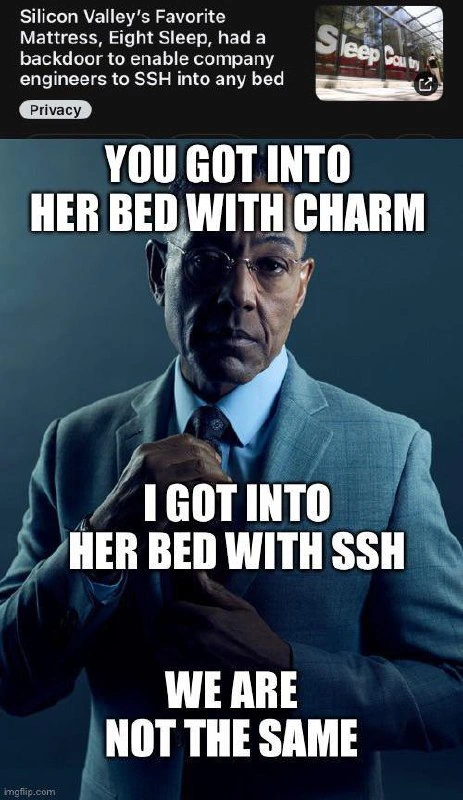
Now let's talk about the meme text and imagery. The impact-font text in white uppercase is typical for memes and it’s split into three lines:

  • “YOU GOT INTO HER BED WITH CHARM”
  • “I GOT INTO HER BED WITH SSH”
  • “WE ARE NOT THE SAME”

The phrase “got into her bed” generally means becoming intimate or close – basically, succeeding in dating/romance to the point of being invited to someone’s bed. “With charm” implies the first guy used his personality, wooed her, was nice or attractive enough that she willingly let him in. It’s the normal way someone might end up in another person’s bed (consensually and socially).

The second line flips the meaning: “I got into her bed with SSH.” Now we’re talking about literally accessing the bed, not the person. It means the second guy didn’t woo the woman at all; instead, he remotely logged into the bed’s firmware using tech skills. It’s a pun because “getting into her bed” sounds the same, but the method is completely different (one is romantic, the other is geeky and quite creepy in context). He’s effectively saying, “I gained access to her smart bed’s computer system by hacking it.”

Finally, “WE ARE NOT THE SAME” is a popular meme catchphrase. It’s usually used humorously when someone compares two things or people that aren’t actually comparable, often to boast. Here it underscores the contrast: the first guy and the second guy both physically ended up connected to “her bed” (one in person, one digitally), but the meme emphatically says these are not equivalent at all. In other words, don’t confuse my nerdy, high-tech stunt with your ordinary charm – they’re on completely different levels. It’s dripping with irony because the high-tech stunt of hacking into a bed is not portrayed as better in any moral or practical sense – it’s just wildly different (and pretty outrageous). The humor comes from that over-the-top comparison. It’s like a nerdy one-up: “Sure, Casanova, you impressed her, but did you penetrate her firewall?” (Yikes, that even sounds wrong – which is exactly why it’s funny and cringey at the same time).

The image behind the text on the bottom is a stern-looking, well-dressed man adjusting his tie. This is a common meme image used to show confidence or a kind of suave, alpha (or sigma) male attitude. He looks like he’s saying “I’m the boss, I’m superior.” By pairing that image with the ridiculous statement about SSH, the meme doubles down on the joke. It’s portraying the SSH hacker as if he’s some ultra-cool mastermind who thinks he’s hot stuff for doing this. The contrast between the serious tone of the image and the absurdity of the action (hacking a mattress) makes it funnier. It’s very much ironic humor. No one in their right mind actually thinks breaking into a person’s IoT device is cooler than winning someone’s affection normally – that mismatch is the whole point of the joke.

Also, notice the top part of the meme is styled like a news headline screenshot. It even has a little “[Privacy]” tag and a photo of a “Sleep Country” store. This shows that the scenario is based on a real news story about a privacy issue. It gives context: Silicon Valley’s favorite mattress, Eight Sleep, had a backdoor... etc. So the meme is directly referencing a true event (or at least a reported event). Knowing that, we understand the meme-maker didn’t just invent the concept of SSH’ing into a bed out of thin air – it actually happened, and they are riffing on it. For someone new to this, it’s a good lesson: the Internet-of-Things world has produced some bizarre security horror stories, and this is one of them.

To spell out why people find this both funny and concerning:

  • Funny because: It’s an absurd comparison (dating vs hacking a bed), and it highlights the extreme nerdiness of bragging about tech exploits. Plus, “getting into her bed with SSH” is just a crazy phrase. Who imagines a mattress needing virus scans or having a Linux shell? It’s a mix of two worlds (romance and computer security) that never usually meet, which is comedic. The meme format with the confident guy and the punchy text is a classic way to deliver an internet joke.
  • Concerning because: If you have a smart bed, you probably didn’t expect that someone at the company could remote-control it. It makes you think about your own smart devices: what if your smart TV or smart fridge has a similar backdoor? It’s a bit scary – a PrivacyConcern for sure. Companies sometimes rush products to market and leave doors open either by accident or design. This meme flags that in a humorous way, but it’s definitely pointing to a real issue: smart devices need smart security.

For a junior developer or someone just learning about security, the takeaway here is: be careful what you connect to the internet, and be mindful of security. Just because something uses a password or is in your home doesn’t mean only you can access it. If the device’s maker wasn’t careful, unauthorized access (like this security flaw) can exist. The backdoor in the Eight Sleep mattress is a textbook example of what can go wrong in IoT design.

In summary, Level 2 explanation: The meme jokes that one person impresses a girl and is invited to her bed normally, whereas another person literally hacks into her smart bed’s software using an admin access (via SSH), and then brags that you can’t compare the two. It’s highlighting an actual tech security screw-up (a company left a secret way into everyone’s internet-connected mattress) and turning it into a play on words and ego. You learn a bit about IoT, SSH, and why a “backdoor” is bad, all wrapped in a joke format. The humor lands because it’s such a techie thing to boast about and such a ridiculous scenario that it makes you laugh and cringe simultaneously.

Level 3: The Internet of Beds

On a more practical level, this meme rips into the absurd reality of modern IoT gadgets and their notorious security vulnerabilities. We’ve connected everyday objects – even a mattress – to the internet, creating what you might call the “Internet of Beds.” And with that comes the classic IoT problem: cool smart features, lousy security hygiene. The news headline in the meme reveals that Eight Sleep (a company known for high-tech “smart” mattresses) included a backdoor allowing engineers to SSH directly into any customer’s bed. That’s right, someone at headquarters could quietly jack into the bed’s firmware over the internet. If that phrase alone doesn’t raise an eyebrow for seasoned developers, nothing will. It’s equal parts hilarious and horrifying: hilarious because of how ridiculously on-the-nose it is for IoT security failures, horrifying because of the blatant PrivacyConcern.

Think about it from an experienced dev’s perspective: SSH access to a mattress’s firmware is not a feature you brag about – it’s a glaring SecurityVulnerability. The meme brilliantly contrasts two “achievements” involving getting into someone’s bed:

YOU GOT INTO HER BED WITH CHARM
I GOT INTO HER BED WITH SSH
WE ARE NOT THE SAME

The top caption implies a person succeeded in the age-old social goal of being charming enough to be invited into a woman’s bed (a wink at intimacy or dating success). Then the second caption one-ups it in pure nerd fashion: I got into her bed with SSH – meaning the speaker gained access to the bed itself using a tech hack. The final line, “We are not the same,” underscores the tongue-in-cheek superiority: the hacker-type is jokingly asserting that his method of “getting into bed” is on a whole different level. It’s playing on a popular “we_are_not_the_same” meme format where people compare ordinary actions with absurd or elite ones to claim, often ironically, that they’re superior. Here, the superiority claim is obviously facetious – it mocks the idea that hacking into a mattress is something to be proud of.

From a senior developer or security engineer’s standpoint, the humor really lands because it’s rooted in truth. The industry has seen an endless parade of IoT security flaws: from smart fridges that leaked Gmail logins, to baby monitors and security cameras with default passwords, to thermostats that became crypto-miners. The phrase “Silicon Valley’s favorite mattress” sets the stage: this isn’t a random no-name gadget, but a trendy product embraced by tech elites. Yet, it harbored a hardware privacy breach so blatant that it reads like satire. The smart_bed_security fiasco with Eight Sleep is basically a greatest-hits of what not to do in IoT design:

  • An intentional backdoor (likely for “maintenance” or support) that was not disclosed to users.
  • Engineers with the ability to peek or tinker with devices in people’s bedrooms without consent.
  • Possibly a single hard-coded password or SSH key across all devices (the meme doesn’t detail it, but that’s a common IoT mistake).
  • No easy way for users to disabled that remote access, since it was under the hood in the firmware.

It’s the kind of screw-up that makes security professionals facepalm and mutter, “of course they did that.” A veteran engineer might dryly note, “Sure, give all your devs root access to every customer’s bed. What could possibly go wrong?” – fully expecting the answer is “everything.” This meme got big laughs on tech forums because so many of us have seen similarly ridiculous oversights. It’s both a joke and a shared war story: Remember that time a mattress company literally had a root shell open to the world? It’s the stuff of late-night infosec horror tales (the kind you ironically joke about over coffee after a 3 AM incident).

In real-world scenarios, a backdoor like this can lead to firmware privilege escalation for malicious actors, not just the intended engineers. If an outsider discovered the access method, they could potentially control the mattress remotely: imagine hackers making your bed uncomfortably hot in the middle of the night, or siphoning off personal sleep data, or using the device as a node in a botnet (the “internet_of_beds” might start participating in DDoS attacks!). It sounds far-fetched, but insecure IoT devices have been hijacked for exactly such purposes in the past – why not a bed? The meme doesn’t need to spell all that out, but every developer who’s been around knows the precedent. We laugh, and we wince, because it’s “funny cuz it’s true.”

There’s also an element of social commentary: the meme juxtaposes social engineering (in the human charm sense) with computer engineering. One guy uses charisma and gains a partner’s trust to be invited into her bed. The other guy bypasses trust entirely, using technical prowess to literally infiltrate the bed’s software. The line “We are not the same” drips with irony – the SSH route is arguably not something to be proud of (it’s creepy!), yet the meme frames it as a flex. It’s poking fun at a certain stereotype: the uber-nerd who values technical achievement (even a questionable one) above social skills, and who might actually joke that hacking a mattress is cooler than normal dating. It’s an absurd geek humor moment, highlighting how out-of-touch that priorities can be (“I pwned her bed, bro” 🤦‍♂️).

And let’s not ignore the image of the man in the suit adjusting his tie. That image exudes smug confidence – it’s often used as the “sigma male” or ultra-competent badass meme template. Here, it portrays the engineer/hacker patting himself on the back for his ultimate infiltration: gaining remote shell access to someone’s sleeping place. The suited man’s serious, proud expression contrasts with how ridiculous the content of his brag is. That contrast heightens the comedy. The top part of the meme even looks like a legitimate news snippet (complete with a Privacy label and a photo of a mattress store), grounding the joke in reality. Once you realize it’s an actual news headline, the phrase “I got into her bed with SSH” becomes even funnier (and scarier). They’re essentially meme-ifying a real privacy scandal. The meme creator is saying: This actually happened – a company could get into your bed’s system remotely – and that’s as crazy as someone thinking hacking a bed is comparable to seducing a person.

For those of us in tech, there’s an extra layer of “we are not surprised.” We’ve seen so many IoT devices with sloppy security that an IoT mattress with a backdoor feels sadly on-brand. It’s the kind of news that makes you sarcastically joke, “Next up: hackers DDoS your pillow for ransom.” The laugh comes with a side of frustration. Why do these companies keep doing this? Probably convenience: it’s easier for engineers to troubleshoot devices if they can just SSH in from the office. But that convenience is a huge trade-off against security and DataPrivacy. It’s a textbook example of why privacy concerns in IoT are real and why folks joke that the S in IoT stands for “security” (there is no S – that’s the joke).

In summary, at the senior perspective, this meme is highlighting a real-world IoT security blunder through dark humor. It resonates with developers and security engineers who’ve been burned by such issues before. We chuckle at the phrasing and the bravado of “I got in with SSH”, even as we shake our heads at the incompetence (or negligence) that made the joke possible. It’s a meme that says: “Welcome to the future – even your bed can be hacked – and yes, we’ll make a joke about it to keep from crying.” We are not the same, indeed.

Level 4: Root of Trust (Lost)

At the deepest technical level, this meme highlights a fundamental breach of device trust architecture. In a well-designed IoT system, each smart device should have its own unique cryptographic identity and follow a strict root-of-trust model – meaning the hardware and firmware use secure keys to ensure only authorized updates and access occur. However, the revelation that Eight Sleep mattresses included a hidden SSH backdoor means the vendor effectively shipped a universal skeleton key inside every bed. From a security engineering standpoint, this undermines the entire cryptographic trust chain.

Consider how SSH (Secure Shell) normally works: it relies on key pairs or credentials to grant remote access. Ideally, each device would have its own private key or credentials, and only the owner or authorized services could log in. But a corporate backdoor implies a single master credential or common key was baked into all mattresses' firmware. This is like having one master password that unlocks every unit the company ever sold. No matter how strong the encryption or how complex the password the user sets on their Wi-Fi, an all-powerful backdoor account trumps it – it's an open invitation to the system that bypasses normal authentication. In cryptographic terms, it nullifies the principle of unique keys and device isolation.

If each bed indeed shared the same login method for company engineers, then the attack surface is enormous: one leak or exploit of that credential would grant remote root access to every customer's mattress. The integrity of the device’s software (firmware) is compromised at a fundamental level. Security models like Zero Trust (which says "verify everyone, trust no one by default") are completely negated if the manufacturer themselves built in a blind trust mechanism for their engineers. In essence, the root of trust for these IoT mattresses was broken by design – hence "trust lost."

This scenario evokes Ken Thompson’s classic “Reflections on Trusting Trust.” If the very firmware from the vendor comes with a hidden gap in defenses, users can’t really trust anything about that system, no matter what it claims about encryption or privacy. It’s a bit like a castle with high walls and locked gates, but the builder secretly installed a back door behind a tapestry; the strength of the front gate doesn’t matter if the enemy has the keys to the back door. Firmware privilege escalation is basically built-in here: the manufacturer’s access bypasses user control, giving them root privileges on hardware in your home. From an academic security perspective, this is a textbook violation of the end-to-end security model – the kind of thing security folks discuss in post-mortems and research papers as an example of what not to do. The math, protocols, and algorithms that normally protect IoT communications (like encryption, secure boot, code signing) are all rendered moot when someone with knowledge of the backdoor can simply log in and take over.

In short, the meme’s situation is not just a one-off joke – it’s a serious instance of compromised device trust at the architectural level. By embedding a secret login into the mattress’s system, the designers have effectively said: “We (and anyone who discovers our secret) own this device more than the user does.” It’s a sobering thought that makes security veterans shake their heads: all the fancy IoT innovation collapses because of one SecurityFlaw that breaks the chain of trust. And as we’ll see, it also creates fodder for some very pointed humor in the developer community.

Description

The meme is a two-part composite. At the top is a screenshot-style headline reading, “Silicon Valley’s Favorite Mattress, Eight Sleep, had a backdoor to enable company engineers to SSH into any bed,” with a small storefront photo of a ‘Sleep Country’ sign on the right and a grey ‘Privacy’ pill-button below. Beneath that, a blue-tinted portrait shows a sharply dressed man in a suit adjusting his tie, exuding the typical ‘sigma male’ confidence pose. Bold white, all-caps Impact text is overlaid in three blocks: “YOU GOT INTO HER BED WITH CHARM” across his forehead, “I GOT INTO HER BED WITH SSH” across his chest, and “WE ARE NOT THE SAME” near the bottom. The humor riffs on IoT security failures - specifically that Eight Sleep allowed remote shell access to customer mattresses - contrasting social charisma with unauthorized root access and highlighting the privacy nightmare of internet-connected hardware
Comments

21
Anonymous ★ Top Pick Nothing ruins pillow talk faster than finding a company engineer running sudo chmod 777 /dev/heater from 3,000 miles away
  1. Anonymous ★ Top Pick

    Nothing ruins pillow talk faster than finding a company engineer running sudo chmod 777 /dev/heater from 3,000 miles away

  2. Anonymous

    While most engineers debug their sleep() functions, Eight Sleep engineers were literally debugging actual sleep - though I suspect their code reviews never covered the 'pillow talk' protocol or the race conditions that occur when two people try to adjust the temperature settings simultaneously

  3. Anonymous

    When your IoT mattress has better SSH access than your production servers, but worse security practices than a 1990s CGI script. At least when Eight Sleep engineers said they were 'committed to uptime,' they meant it literally - they could check if you were still in bed at 3 AM during an incident

  4. Anonymous

    Charm gets you guest access; SSH keys grant sudo - permanently

  5. Anonymous

    If your mattress needs a bastion host and a SOC runbook, you didn’t buy bedding - you deployed an unaudited edge device with prod SSH

  6. Anonymous

    Protip: if your mattress needs a bastion host, your threat model isn’t insomnia - it’s prod SSH to intimacy with zero IAM boundaries

  7. @drznpy 1y

    I’d be more worried about the fact that fucking mattresses nowadays runs a whole ass linux system and ssh

  8. @drznpy 1y

    In the year of the lord 2025 “i’ve jailbroken my mattress and installed my own linux on it” is a valid statement and that’s both cool and insane, though

    1. dev_meme 1y

      "Yes, I host my personal website on a mattress, so what?"

      1. @drznpy 1y

        If this was 2016 they would have used all the mattresses across the world to mine bitcoin or monero… the heat dissipation would have been a feture, not a bug

        1. dev_meme 1y

          Now they just train AI with it instead, I wish we could go back in time when people communicated via sticks & stones

  9. @MagikarPoweruh 1y

    Is it running Spring? 🙃

  10. @TheFloofyFloof 1y

    Mine Bitcoin on it Call it sleepcoin

  11. @callofvoid0 1y

    why would it need to have a fuckin os

    1. @mira_the_cat 1y

      why not?

    2. @mira_the_cat 1y

      os is a useful thing even for embedded devices, no?

    3. Deleted Account 1y

      Ask that to the guy that invented smart toothbrush

      1. @mira_the_cat 1y

        and all home automation

        1. Deleted Account 1y

          Yes

  12. @jaaaaded 1y

    can it run doom though

  13. D Y 1y

    Saw a commercial on the landing page. Damn I need this bad

Use J and K for navigation