SQL Refreshes: An Escalating Series of Poor Choices
Why is this Databases meme funny?
Level 1: Bazooka for a Fly
This meme is basically joking about using a massive overkill solution for a tiny problem. Imagine you have a little bug in your data – kind of like a pesky fly in your room. There are a few ways you could handle it:
- The normal way: gently catch the fly or shoo it outside (this is like using the right tool to update the data, affecting only what’s needed).
- A bigger way: get a flyswatter and slap everything in a corner, maybe making a bit of a mess (that’s like deleting all the data and then putting back what you want – it gets the job done but is a bit messy).
- An extreme way: instead of dealing with the fly, you decide to spray the entire room with bug killer and then redecorate (this is like dropping the whole table and recreating it – you definitely got rid of the fly, but you destroyed a lot in the process!).
- The craziest way: you call in a demolition crew to burn down the house and then you build a brand new house just because of that one fly (that’s equivalent to dropping the entire database and starting over).
😅 Obviously, burning down your house to get rid of a fly is a wild overreaction – and that’s exactly why it’s funny. The meme makes us laugh because the developer in the joke goes from a sensible fix to a ridiculously out-of-proportion fix. It highlights a feeling we all recognize: sometimes when you’re frustrated by a pesky problem, it tempts you to do something drastic just to reset everything. But we also know that’s a silly impulse. So, seeing it illustrated with Winnie-the-Pooh getting fancier as the solutions get crazier is just plain goofy. The heart of the joke is “Don’t use a bazooka to kill a fly” – it’s making fun of using a huge destructive method to solve a small issue, which is both absurd and entertaining.
Level 2: When in Doubt, Delete
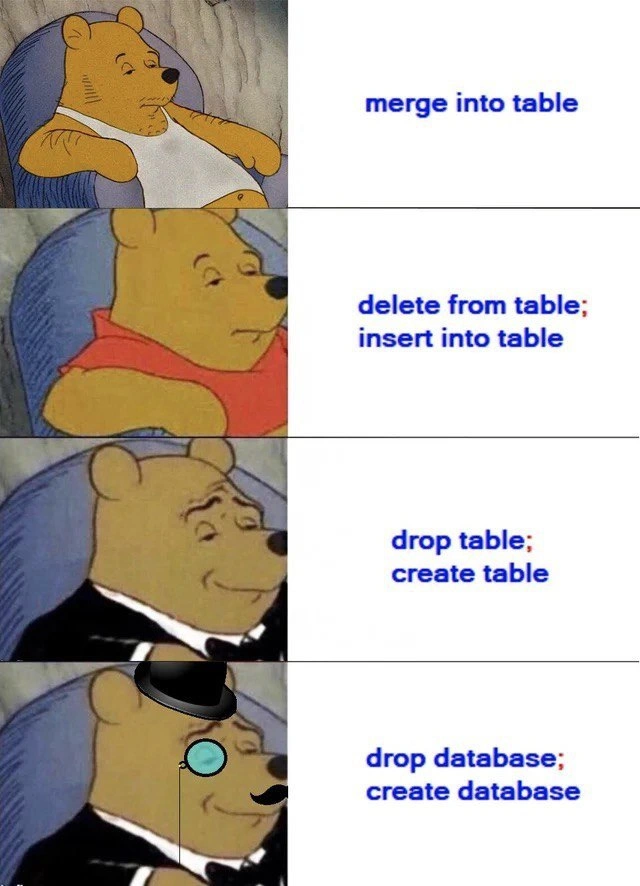
Let’s break down the meme in simpler terms. We have four SQL code examples, each more drastic than the last, next to increasingly fancy images of Winnie-the-Pooh. SQL (Structured Query Language) is the language used to manage and query relational databases (like MySQL, PostgreSQL, SQL Server, etc.). Each code snippet is a method to "fix" or update data in a table, but they range from normal to hilariously overkill:
“MERGE INTO table” – This is a single-command solution for updating/inserting data (an upsert). Imagine you have some new data and you want to apply it to an existing table: if a row exists, update it; if not, insert it. The
MERGEstatement can do that in one go. It’s a proper way to handle changes without losing anything. In the first panel, Pooh is just chilling, looking unimpressed. Why? BecauseMERGEis the standard, no-big-deal approach – nothing crazy here. It’s like the everyday tool a database developer would use to handle changes safely.“DELETE FROM table; INSERT INTO table” – These are two separate SQL commands. First
DELETE FROM tableremoves data (potentially all rows in the table if no condition is given). ThenINSERT INTO tableadds new data back in. Essentially, this sequence throws away the old contents and replaces them with new ones. Pooh in the second panel looks a bit meh/irritated, which matches this approach – it’s a bit of a lazy or blunt way to do things. Instead of carefully updating what’s changed, the developer just wipes the slate clean and then writes new stuff. This can be okay in some scenarios (like refreshing a lookup table or during a bulk reload), but it’s riskier: if something goes wrong after the delete, you’ve got an empty table! It’s also slower and heavier if the table is large, and you temporarily have no data in that table. It’s like saying, “I’m not going to clean this small spot; I’ll just throw out the whole canvas and start over.”“DROP TABLE; CREATE TABLE” – Here it gets more extreme.
DROP TABLE table_namecompletely deletes the entire table from the database – not just the data, but the table’s structure (definition) too.CREATE TABLEthen makes a brand new empty table of the same name. In the third panel, Pooh is dressed in a tuxedo, as if this is some high-class maneuver. But actually, this is a very heavy-handed tactic. It’s as if the developer said, “Forget fixing the data or even the table’s contents – I’m going to remove the whole table and just start from scratch.” This would definitely solve any data discrepancy (since all data is new) and even some design issues (you can define the table anew), but it’s overkill for most bugs. In real life, doing this means the table is completely unavailable in between (any code that expects that table will fail while it’s dropped). It’s usually done only if you really need to rebuild that table from zero, perhaps during a planned maintenance or migration. Seeing Pooh look smug about it is the joke – because it’s treating a drastic measure as if it’s clever.“DROP DATABASE; CREATE DATABASE” – The final form, shown with Pooh in a top hat and monocle (super fancy!).
DROP DATABASE myDBwill destroy the entire database named myDB – all tables, all data, everything gone in one command.CREATE DATABASE myDBmakes a new, empty database of that name. This is essentially pressing the nuclear reset button. It’s rare to ever do this unless you’re tearing down a test environment or completely re-initializing a system from backups. In the meme, this over-the-top solution is presented as the fanciest, posh answer to a problem – which is pure irony. No beginner (hopefully) would think of doing this to fix a small issue, and any experienced person knows this is usually a terrible idea unless you truly intend to wipe out all your data. The humor is that each step jumps to a larger scale of deletion, and the final step is absurd: it’s like fixing a squeaky door by burning down the house and rebuilding it. Pooh’s fancy attire mocks the notion that this extreme approach is somehow elegant or smart.
Context for a newer developer: This meme is an example of developer humor about databases. It riffs on the idea of an escalation strategy – basically, solving a problem in an increasingly aggressive way. In a database context, an ideal fix for, say, merging new records would be to just update or insert what you need (like using MERGE). But the joke imagines someone going “Nope, too simple,” and instead, at each stage, choosing a more drastic solution:
- First fix: do it the nice, right way (
MERGE). - Second fix: “I’ll just delete everything and re-add” (bigger hammer, less finesse).
- Third fix: “Why stop at the data? I’ll drop the whole table and remake it” (even bigger hammer!).
- Final fix: “Go big or go home – drop the entire database!” (ultimate hammer, basically blowing it all up).
This resonates with developers because it’s a tongue-in-cheek exaggeration of real scenarios. For instance, if you’ve ever been frustrated that your data changes aren’t reflecting correctly, you might jokingly say, “Ugh, I’m about to drop the whole database and start over.” It’s a form of dark humor – you don’t actually want to do that (since it would cause massive data loss), but the thought crosses your mind when nothing seems to work. The meme takes that frustration to an extreme, for comedic effect.
Key terms explained:
- Upsert: A combination of “update” and “insert.” It means updating existing records with new information or inserting them if they don’t exist. The
MERGEstatement is a formal way to do an upsert in SQL. Not all databases useMERGE(for example, MySQL uses different syntax likeINSERT...ON DUPLICATE KEY UPDATE), but the idea is the same. It’s a precise way to fix data without affecting unrelated data. - DELETE + INSERT: Two separate Data Manipulation Language (DML) commands.
DELETEremoves data. If used without a condition (likeDELETE FROM table;with noWHEREclause), it deletes all rows in the table.INSERTadds new rows. Doing them back-to-back without wrapping in a transaction can be dangerous because once the delete happens, the data is gone unless the insert fully succeeds. It’s simpler to code, but it’s like clearing a bookshelf completely before putting new books – effective if you want a full refresh, but overkill if you only needed to replace a book or two. - DROP TABLE: A Data Definition Language (DDL) command that removes the table’s definition from the database entirely. It’s like ripping out an entire page from a book – the page (table) is gone from the book (database). Any relationships that other tables had to this table (like foreign keys) are now broken until you create that table again.
- CREATE TABLE: A command to make a new table. After a
DROP TABLE, you’d useCREATE TABLEto rebuild it. However, that new table starts empty (no data), and you’d have to insert or restore data into it. - DROP DATABASE: This deletes the entire database and everything in it – all tables, data, procedures, everything. It’s like deleting a whole document or, say, formatting a hard drive partition – you lose absolutely everything in that one command.
- CREATE DATABASE: Makes a new, empty database. This would be akin to creating a fresh storage space to fill with new tables/data. After dropping a database, you might recreate it and then run some scripts to rebuild all the tables from scratch (assuming you have those scripts or backups).
New developers learn pretty quickly that while commands like DROP are powerful, they’re also dangerous. There are legendary horror stories of someone running DROP TABLE or DROP DATABASE on the wrong server (e.g., production instead of local), causing massive outages. This is why teams have safeguards: backups, restricted permissions (you typically don’t let just anyone run a drop on prod), and peer reviews for changes. The meme is funny because it’s obviously bad practice to solve a small data update with such overkill, so it’s poking fun at the thought process: “I can’t figure out this merge, so I’ll just burn it all down and start over.” It’s an exaggerated worst-case scenario that plays on the fears (and laughs) of anyone who works with databases.
Also, note the Winnie-the-Pooh meme format being used: It’s the one where Pooh Bear’s pose and outfit change to imply increasing sophistication or pretentiousness. Usually, normal Pooh vs. fancy Pooh is used to compare a plain term to a more highfalutin term. Here, that format is repurposed: the more outrageous the SQL command, the more posh Pooh becomes. That contrast is inherently silly and is a big part of why it’s humorous. It visually says, “Oh, you think that’s a solution? How about this really fancy (read: ridiculously extreme) solution?”
For a junior developer or someone new to databases, the take-home lesson (besides the chuckle) is: there are levels of doing things in SQL, and not all are equal. The meme humorously illustrates why the simplest, targeted solution (upsert/merge) is usually preferable to the nuclear solution (drop everything). It underscores the importance of not using a bazooka to kill a fly – which leads us to the simplest analogy...
Level 3: Scorched Earth Upsert
At the highest technical level, this meme lampoons a database anti-pattern that senior engineers know all too well: escalating a simple data update into a full-blown teardown. We have Winnie-the-Pooh becoming progressively more "sophisticated" as the SQL commands become more destructive:
Panel 1 – Normal Pooh, half-asleep:
MERGE INTO table ...– The standard upsert operation. In SQL (especially SQL Server/Oracle),MERGEis a single-statement solution to insert new rows or update existing ones in one go. It’s the proper, atomic approach: one command, minimal fuss, and it respects ACID properties (Atomicity, Consistency, Isolation, Durability) if done right. Pooh looks bored, implying this correct solution is just too mundane to be meme-worthy. (After all, it actually solves the problem without any drama – where’s the fun in that?)Panel 2 – Pooh in a red shirt, mildly annoyed:
DELETE FROM table; INSERT INTO table;Here we see a two-step brute force: wipe the table’s data, then reinsert fresh data. Pooh’s expression is a bit disapproving – as it should be. This is essentially a manual upsert via destructive DML: first delete everything (or at least the rows you plan to replace), then insert new data. It’s a hacky workaround when you don’t know how (or can’t) do a proper merge. Experienced devs cringe because if something fails between the delete and insert, you’ve just emptied your table with no guarantee of recovery – a one-way ticket to DataLoss if not wrapped in a transaction. It’s like saying, “I can’t be bothered to compare and update rows, I’ll just drop all the old data and put in new data.” Effective? Sometimes. Efficient or safe? Not so much.
Panel 3 – Pooh in a tuxedo, smirking:
DROP TABLE some_table; CREATE TABLE some_table (...);Now we’ve escalated to schema-level carnage. Dropping a table deletes the table and its data and schema entirely, then we recreate it from scratch. The meme shows Pooh looking classy as this approach goes full “scorched earth” on that one table. This is an extreme refresh strategy – maybe used when the table structure itself needs to change, or when a clean slate feels easier than cleaning up rows. In real life, this means downtime for anything depending on that table: queries will error out while it’s dropped. It’s a bold move: you’re saying “to heck with what’s there, let’s rebuild fresh.” Veteran devs have seen this in midnight deployments or poorly planned migrations – it works in a brute-force way, but it nukes any data not reinserted and can wreak havoc on dependent systems (foreign keys pointing to that table? Broken. Application expecting data to be there? Also broken). Pooh in a tux is an ironic nod – as if this destructive solution is an elegant, high-class tactic.
Panel 4 – Pooh with top hat, monocle, and mustache:
DROP DATABASE prod; CREATE DATABASE prod;The final form: the nuclear option. Wipe the entire database and start over. Pooh is now ultra-refined, implying this is the crème de la crème of solutions (the joke being that it’s actually the most absurd). This is the ultimate developer escalation strategy for a database bug: “Oh, some records are out-of-sync? Let’s just rebuild the whole darn database!” It’s an absurd scenario because in any serious environment this would be catastrophic – you’d destroy not just one table, but every table, all at once. Only in throwaway test environments or in exaggerated humor would this be considered a “fix.” Yet, it lampoons a real mentality: when frustrated, some devs say half-jokingly, “I might as well drop the database and start clean.” The monocle and mustache pretend it’s a fancy, intellectual solution, poking fun at how ridiculous that idea is. In reality, doing this in production would mean total data loss (hope you have a DatabaseBackup handy!) and likely unemployment by morning.
Why it’s funny to seasoned devs: It captures the dark humor of database maintenance and bug fixes gone awry. Each panel raises the stakes – it’s an exponential backfire waiting to happen. We’ve all seen seemingly trivial data fixes turn into nightmares when someone takes a shortcut. The meme format (inspired by the classic Winnie-the-Pooh escalating sophistication meme) flips the script – the more outrageous the SQL, the more debonair Pooh becomes. It’s irony at its finest: the “classier” approach in the comic is actually the most brute-force, destructive method. This speaks to a veteran’s soul because it’s a shared joke about terrible best practices.
In the real world, proper DatabaseDesign avoids these scenarios. We have primary keys, constraints, and transactions to update data safely. But here the joke suggests chucking all that careful design out the window and going HAM with DROP statements. Senior engineers laugh (perhaps nervously) because many have war stories: e.g., “Remember that one script that dropped a table instead of truncating it? Yeah, production wasn’t happy…” It’s both funny and cringe-inducing: funny because it’s an exaggeration, cringe because we know someone somewhere actually tried a version of this.
The humor also highlights the importance of process and safeguards – in a well-run system, you’d have backup/restore tested, you’d restrict permissions (no developer should be able to just drop prod database on a whim), and you’d use versioned migrations or proper upsert logic. The meme wryly glosses over all that, which is exactly the point. It tickles the DatabaseHumor bone: only in a joke (or a horrifying 3 AM incident report) do you see a DROP DATABASE as a sanctioned fix for a bug. It’s a cautionary tale wrapped in comedy – and every battle-scarred DBA reading it will likely chuckle, then immediately go double-check their backup scripts… just in case.
Description
A four-panel meme using the 'Tuxedo Winnie the Pooh' format to show increasingly absurd solutions for updating data. In the first panel, a relaxed, casual Pooh sits next to the text 'merge into table'. In the second panel, a slightly more composed Pooh in a red shirt is paired with 'delete from table; insert into table'. The third panel features a dapper Pooh in a tuxedo, next to the commands 'drop table; create table'. The final, most elegant panel shows Pooh with a top hat, monocle, and mustache, alongside the ultimate command: 'drop database; create database'. The meme humorously illustrates the escalation of brute-force solutions in database management. It satirizes the thought process from a sensible, efficient data operation (MERGE) to progressively more destructive and lazy methods, culminating in the most catastrophic 'fix' possible. For experienced developers, it's a relatable joke about the temptation of scorched-earth tactics when faced with complex data state issues, or a caricature of a junior developer's approach to a problem they don't fully understand
Comments
11Comment deleted
Some call dropping the database a 'destructive operation.' I call it achieving a guaranteed idempotent state for my ETL script
Progressive data sync at enterprise scale: MERGE, DELETE + INSERT, DROP TABLE, DROP DATABASE, and - once you’re truly cloud-native - the senior engineer’s silver bullet: `terraform destroy && terraform apply` (because nothing beats idempotent scorched-earth consistency)
The evolution from MERGE to DROP DATABASE is just the natural progression of a senior engineer who's been asked to 'just quickly sync the data' one too many times - eventually you realize the most elegant solution is scorched earth with a monocle
The progression from MERGE to DROP DATABASE perfectly captures the senior engineer's journey: start with the elegant solution, realize it doesn't handle edge cases, escalate to DELETE/INSERT, discover schema drift, then finally embrace the 'works on my machine' nuclear option. Bonus points if you run this on Friday at 4:59 PM in production without a backup - because who needs transaction logs when you have confidence and a resume ready?
The senior migration ladder: MERGE (still believes in joins), DELETE+INSERT (gave up on upsert), DROP TABLE (has backups), DROP DATABASE (has event replay, prays retention isn’t seven days)
MERGE for juniors; DROP DATABASE for architects who know backups are just theoretical
After wrestling ANSI MERGE, Postgres ON CONFLICT, and MySQL DUPLICATE KEY - plus SQL Server’s MERGE footguns - you learn the only portable upsert is treating the schema like a cache
drop building; create building Comment deleted
rm -rf / install OS Comment deleted
Remove bios Reflash bios Comment deleted
Sell computer Buy computer Comment deleted