The Senior Developer's Classic Catchphrase
Why is this DesignPatterns Architecture meme funny?
Level 1: No Easy Answer
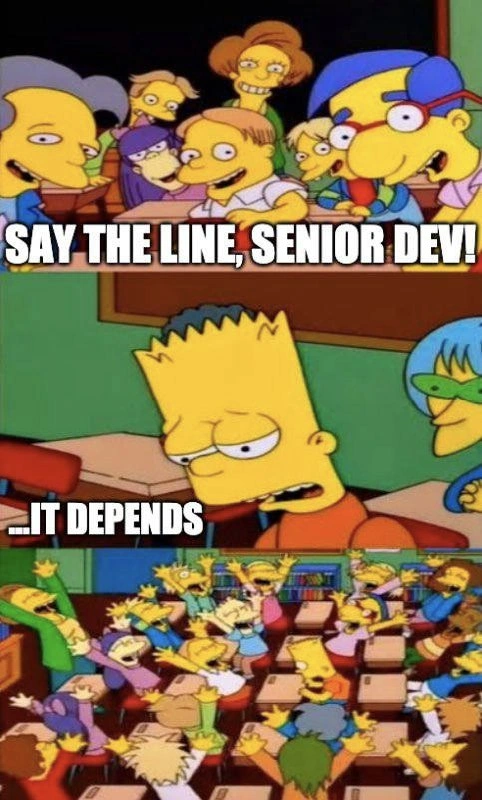
Imagine you ask a question like, "Is it better to have ice cream or cake for dessert?" Instead of a simple answer, your parent replies, "It depends." Maybe it depends on whether you’ve had any vegetables today, or if it’s a special occasion. It’s not a clear yes or no because the answer can change based on the situation. In the meme, a classroom full of kids is begging a senior developer (portrayed by Bart Simpson) to say his famous line. That line is "it depends." When he finally says it, the whole class cheers wildly. This is funny because everyone was expecting that exact answer – it’s like a favorite catchphrase that never surprises anyone. The joke is that a very experienced developer almost always answers big questions with "it depends", just like a cartoon character always saying their signature line. The reason he says this is simple: in life (and in coding), there’s usually no one right answer for every situation. You have to look at what’s going on – all the little details – before deciding what’s best. So the class cheering is a playful way to show they all knew the answer wasn’t going to be a straightforward yes or no. It’s celebrating the idea that real wisdom sometimes sounds like a funny, non-committal answer. Basically, the meme tells us in a lighthearted way that complex questions don’t have simple answers — and everyone finds it both true and amusing.
Level 2: Context is Key
At its core, this meme is highlighting how senior developers communicate and make decisions. When a junior developer excitedly asks, “Which option is better? Should we choose A or B?”, the senior developer’s response is often "It depends." This phrase might sound like a dodge, but it’s actually full of meaning. Let’s break down the key ideas (and some terms) to see why that seemingly simple phrase is so famous in developer circles:
Software Architecture: This refers to the big-picture structure of a software system — how all the pieces (databases, services, user interface, etc.) fit together. When someone asks an architecture question like, “Should our app be a single big application or split into microservices?”, there isn’t one right answer for every case. A senior dev will say “it depends” because the best architecture depends on things like how large the app will grow, how many people work on it, how important speed or scalability is, and so on. Each architecture style has advantages and disadvantages. For example, microservices bring flexibility and independent scaling, but depend on your team’s ability to manage a more complex, distributed system. A monolith (one big application) is simpler to develop initially but can become hard to maintain as it grows. The DesignTradeoffs here might include weighing ease of development vs. scalability. The senior engineer knows you must consider these factors before deciding, hence "it depends (on our goals and constraints)."
Design Patterns: These are typical solutions to common coding problems – basically reusable templates for how to structure your code (examples include the Singleton, Observer, Factory patterns, etc.). Juniors often learn about these patterns and want to apply them everywhere. But an experienced dev knows each pattern shines only in the right situation. If you ask, “Should I use a particular design pattern for this task?”, a senior might reply, “It depends what you’re trying to achieve.” That’s because using a pattern in the wrong context can add unnecessary complexity. For instance, the Singleton pattern ensures only one instance of a class exists, but if overused it can make testing and flexibility harder. The Strategy pattern is great for interchangeable behaviors, but it depends on whether you actually need that flexibility. In other words, patterns are tools in a toolbox – the senior dev is telling you to pick the right tool for the job rather than blindly following a rule.
Trade-offs: This word comes up a lot because it’s central to why “it depends” is said in the first place. A trade-off means you give up one thing in return for another. In technology, almost every choice forces a trade-off. Want the program to run faster? You might use more memory or write more complex code, trading simplicity for speed. Want the code to be super clean and easy to understand? You might write it in a clear but slightly less optimized way, trading some efficiency for readability. There’s a famous saying: “Fast, cheap, or good – pick two.” In software terms, we often juggle performance, development cost/time, and quality/maintainability. The senior dev’s "it depends" is short for "We need to decide which factors matter most in this situation." They are implicitly asking: What are we optimizing for? For example, if someone asks “Should we cache this data for speed or always compute it fresh?” – a senior dev will answer “It depends on how frequently the data changes and how critical speed is versus accuracy.” They will then discuss the trade-off: caching (storing the result) gives speed, but might serve slightly outdated info; recomputing is always accurate but slower. Neither choice is universally correct – it depends on what the project needs.
Communication and Experience: The way a senior dev communicates reflects their experience. When they say "it depends", they’re not trying to be frustrating. In fact, they’re being honest that a quick yes/no answer would be misleading. Part of senior-level Communication is managing expectations and explaining complexities in a way others understand. Often, right after saying "it depends," a good senior dev will list the factors that it depends on. They might say something like, "It depends on the expected load, the team’s familiarity with the technology, and how quickly we need to deliver. Let’s discuss those…". This turns a simple question into a deeper discussion where the group learns about design trade-offs and architectural trade-offs together. In the meme, of course, we skip straight to the punchline for humor. But in a real meeting, "it depends" is usually the beginning of an analytical conversation. It’s actually a teaching moment: the senior is implicitly encouraging less experienced devs to think critically rather than accept a blanket rule.
Think of it from a junior developer’s perspective (if you’re new to this, you might have felt this too). You ask a straightforward question hoping for a straightforward answer. Instead, you get this ambiguous "it depends." Initially, that can be confusing or even annoying — you just want to know the “right” way to do something! But as you gain more experience, you start to see why the senior dev answered that way. There usually isn’t a single “right” way that works for every situation. The RelatableDeveloperExperience here is the realization that context dictates the solution. Many new devs have that lightbulb moment the first time they design a system or debug a tough issue: suddenly those vague answers they got make sense.
The use of a Simpsons meme (the say_the_line_meme format) adds a layer of fun to this lesson. In that format, a crowd demands a familiar catchphrase, and when it’s delivered, everyone cheers wildly. Here the catchphrase is the senior developer’s "it depends", which in the world of developers is as iconic (and as predictable) as Bart Simpson’s chalkboard gags. It shows that even communication quirks of experienced devs are fodder for jokes. But embedded in the joke is reassurance: if you always find yourself considering the details before answering, congratulations — you’re thinking like a senior engineer. And if you’re a junior who keeps hearing this phrase, know that it’s not a brush-off; it’s an invitation to dig deeper into the problem and really understand it.
To sum up this level: “It depends” has earned its fame in the programming world because it captures a fundamental reality of engineering. There are no absolute answers without context. Good design is all about understanding requirements and constraints. That’s why senior devs sound like a broken record with this phrase — they’ve learned that asking the right questions is more important than having a quick answer. And that’s exactly what the meme humorously spotlights: the wisdom of uncertainty packaged as a running joke.
Level 3: No Silver Bullet
Team: "SAY THE LINE, SENIOR DEV!"
Senior Dev (weary Bart Simpson): "...it depends."
(Entire class erupts in celebratory chaos)
In this meme, a classic scene from The Simpsons is reimagined to poke fun at SeniorEngineerLife. The team of eager juniors (the classroom kids) demand the Senior Developer recite his catchphrase. And of course, he delivers the timeless answer: "It depends." The room goes wild not because the answer is exciting, but because it’s the expected response — a developer in-joke everyone in the room relates to. This humorous scenario hides a deeper truth about software architecture and design discussions: experienced engineers often reply with "It depends" because almost every technical question involves nuance and trade-offs.
Why is this funny? For those in the know, "It depends" is practically the senior dev mantra. It’s the go-to response when pressed about whether one technology, design pattern, or approach is better than another. The humor comes from recognition: every developer who’s been around the block has heard (or given) this seemingly evasive answer. The meme exaggerates it by treating "It depends" like Bart Simpson’s famous catchphrase — the senior_dev_catchphrase. The entire class cheering is an ironic celebration; it’s as if the whole team was waiting for that inevitable answer and can finally rejoice when it arrives. It’s both poking fun at the predictability of seniors and acknowledging that this answer is usually correct. In developer culture and DeveloperHumor, hearing "it depends" is a RelatableHumor moment — an inside joke about how design trade-offs work.
From an experienced engineer’s perspective, "Which database is best?", "Should we adopt microservices?", "Is this design pattern the right one?" — the honest answer to all of these is "It depends." What does it depend on? A myriad of factors: the scale of your system, the team’s expertise, performance needs, maintainability, deadlines, legacy constraints, you name it. Seasoned devs have been burned enough times by one-size-fits-all advice to know there is no silver bullet in software. This phrase signals that context is king in engineering decisions. The meme nails this RelatableDeveloperExperience: junior folks often crave a clear directive or the “one correct solution,” while seniors know that everything in engineering is a series of careful choices.
The enthusiastic classroom in the meme is a playful twist: instead of groaning at a non-answer, the juniors are thrilled. In real life, a junior might feel frustrated by an ambiguous answer, but deep down most devs come to appreciate why "it depends" is the only truly honest answer for complex questions. It’s become a running joke on tech forums and in architecture review meetings — ask a senior a complicated question and you expect to hear "it depends" before anything else. The meme uses a Simpsons_reference to dramatize this recurring scenario, amplifying the humor with a pop culture touch. Bart Simpson’s resigned face as he says the line mirrors a senior dev’s face in a meeting after being asked yet another question that has no simple answer. And the rejoicing classmates resemble younger developers or team members who find comfort (or comic relief) in the senior’s predictability.
On a more serious note, the meme highlights a core truth in DesignPatterns_Architecture: every solution has pros and cons. Experienced architects and developers understand the importance of design trade-offs and architectural trade-offs. They know two contradictory facts can both be true in different contexts. For example, storing data in memory can make things fast but uses more memory (trade-off between speed and memory). Using microservices can improve modularity but adds complexity to deployment and communication. There’s always a balance to strike. The "it depends" answer isn’t dodging the question — it’s acknowledging that the best decision hinges on specific priorities and constraints. It’s a concise way of saying, "Let’s discuss the requirements and context before jumping to a conclusion." In other words, developers must communicate that there is no universal right answer without understanding the situation — hence the inclusion of Communication as a category for this meme.
The humor lands so well because it’s satire of real life: how many times have we been in a design review or planning meeting where one poor soul asks a seemingly straightforward question, only to get a sigh and "Well... it depends" from the senior engineer or architect? At this point, it’s practically an office ritual. The meme exaggerates it by treating that answer like a treasured punchline everyone has been dying to hear. For veteran developers, this is a knowing chuckle at our own habits — we’ve become Bart Simpson with our catchphrase. For less experienced devs, it’s a glimpse of the nuanced thinking they’ll eventually adopt (and the gallows humor that comes with it). It’s the perfect intersection of DeveloperMemes and practical wisdom: we laugh because it’s true.
Description
A three-panel meme using the 'Say the Line, Bart!' format from The Simpsons. In the first panel, a classroom of children eagerly looks towards Bart, with the caption 'SAY THE LINE, SENIOR DEV!'. The second panel shows a close-up of a weary and unenthusiastic Bart Simpson, who mutters the words '...IT DEPENDS'. The third and final panel depicts the entire classroom erupting in wild, joyous celebration, cheering and throwing their hands in the air. The meme humorously captures a quintessential experience in software development where complex questions are often met with the nuanced answer 'it depends'. This response signifies a senior developer's understanding that there are no one-size-fits-all solutions in technology; the 'best' approach is always contingent on specific context, constraints, and trade-offs. It's a rite of passage for junior developers to learn that the simple, direct answers they seek are often supplanted by this phrase, which opens the door to a deeper discussion about architecture and design
Comments
18Comment deleted
A junior dev asks if they should use a monolith or microservices. The senior dev says 'it depends,' and instantly the project's deadline is extended by six months for 'further analysis.'
“It depends” isn’t fence-sitting; it’s the cache-miss that forces stakeholders to fetch the actual requirements from origin
After 20 years, I've finally mastered the art of giving definitive answers that are technically correct, legally defensible, and completely useless to whoever asked the question
The most accurate answer in software engineering is always 'it depends' - because choosing between microservices and monoliths, SQL and NoSQL, or tabs and spaces requires understanding scale, team size, latency requirements, consistency needs, and whether your CTO read a Medium article last night. Senior engineers have learned that every architectural decision is a trade-off analysis disguised as a simple question, and the junior devs who initially groan at 'it depends' eventually become the seniors who wield it like a Zen koan
Juniors pick yes/no; seniors say 'it depends'; architects cite CAP theorem trade-offs
“It depends” is the only idempotent answer - until you hand me SLAs, data shape, and blast radius, any other response would violate the ADR’s preconditions
It depends - the senior dev compression algorithm for latency budgets, CAP, SLOs, compliance, and procurement lead times, all collapsed into two words
Lol Comment deleted
loL Comment deleted
LoL Comment deleted
that's illegal Comment deleted
I am illegal Comment deleted
u r legal Comment deleted
A bit difficult for me Comment deleted
When you ask a senior about technical question, the usual answer will be "It depends" followed by examples of different scenarios and the best solution — Should I switch to linux? — It depends. If you have to work with proffesional software, including microsoft word, adobe products, etc, you might want to stay on windows... Comment deleted
Hahah, got it, thanks Comment deleted
brigady! Comment deleted
This is a good one. Comment deleted