Computational Apiology: The Bees Inside the Box
Why is this Hardware meme funny?
Level 1: Little Bees, Big Math
Imagine you have a HUGE math problem to solve, but luckily you’ve got a giant team of helpers. Let’s say you have a million friendly little bees 🐝 that are super good at math (just pretend!). You give them a big job, like adding up a bunch of numbers. Each little bee takes a tiny piece of the problem – maybe one bee adds two numbers, another bee compares two other numbers, and so on. They all work together really fast, each doing their small part. Before you know it, the entire big math problem is solved! And you didn’t have to do much at all, because the bees did all the busy work for you.
That’s basically what a computer does, but with electricity instead of bees. The meme is joking that inside your computer there’s a whole bunch of busy bees doing calculations so that you don’t have to. Of course, in real life there aren’t real insects in there – the “bees” are make-believe. The truth is a computer has lots of tiny electronic parts doing the work. But it’s funny (and kind of cute) to think that maybe there’s a tiny bee colony in the CPU making everything run. The reason it’s humorous is because it takes something really complicated (all the math and electronic stuff happening in a computer) and explains it in a ridiculously simple way (with cartoon bees). So basically, the meme is saying: “Ever wonder how your computer figures things out so quickly? Easy, it has millions of little helpers inside solving math problems for you!” It makes us laugh because we know it’s not true, but it feels true that the computer is working hard on lots of little tasks. In the end, the message is: your computer does a ton of calculations behind the scenes, so you can just enjoy the result – and that idea is easier to picture (and giggle at) when we imagine those calculations being done by a swarm of cute, busy bees.
Level 2: From Bees to Bits
Let’s break down what’s really going on inside a computer, in case the bee analogy has you curious (or concerned!). A computer’s CPU (Central Processing Unit) isn’t filled with insects; it’s filled with microscopic electronic parts that do all the number crunching. The key players are transistors – tiny switches that can turn on or off extremely fast. “On” can represent a 1 and “off” a 0. Everything in computer data is built out of those 1s and 0s, which is what we call binary. Instead of bees carrying numbers, imagine millions (actually billions in modern chips) of little switches flipping on and off in a coordinated dance – that’s how the CPU thinks and calculates. The meme’s talk of “doing a lot of math” is referencing the fact that at its core, a CPU is constantly performing arithmetic and logical operations. It adds numbers, compares values, moves data around – but it does this really, really fast and in tiny, tiny steps.
So where do the bees come in? They don’t, in reality – the bees are a cute metaphor, a bit of TechHumor to make you smile while hinting at the truth. Think of each bee in the picture as standing in for a bunch of transistors working on a calculation. In real hardware, transistors are grouped together to form logic gates (little circuits that do things like AND, OR, NOT operations on bits). Then gates are grouped to create an Arithmetic Logic Unit (ALU), which is the part of the CPU that handles basic math (addition, subtraction, etc.). When you ask your computer to calculate 2+2, the ALU’s transistors toggle in a precise pattern and out pops the result 4 – no winged insects needed! The meme’s phrase “so you don’t have to” simply emphasizes that the computer automates tedious calculations. Long ago, people had to solve long equations by hand; now your laptop or phone does millions per second for you. It’s doing the heavy lifting, sparing you the effort – that’s the basic promise of computing, delivered with a punchline.
This kind of meme is a humorous_hardware_abstraction. Abstraction means hiding complex details behind a simple interface. When you play a video game or run a spreadsheet, you don’t see the millions of tiny electrical operations happening – you just see the result. The meme jokingly “reveals” those hidden details by inventing a silly scenario (bee_math_explanation!) instead of the real electronic one. It’s part of a broader ComputerScienceHumor tradition: joking about complicated tech by imagining something ludicrous under the hood. By exaggerating the idea of tiny workers inside the machine, it actually gets a basic concept across: a computer works by doing a huge number of simple operations very quickly. The how_computers_work_meme style often operates this way – using a fun visual to hint at real workings. Here, the meme_visual_zoom on the green circuit board with bees and floating numbers is saying, “Inside this hardware, stuff is happening – maybe not literally bees, but definitely lots of little actions all at once.”
For a newcomer, the takeaway is: no, computers aren’t magical bee hives, but they are astonishing in what they do. The CPUArchitecture of a chip is designed so that these billions of transistors all cooperate to execute your instructions. It’s a bit like a well-organized factory assembly line, but on a microscopic scale and insanely fast. The developers who engineered these systems use physics and electronics, not beekeeping, to make computers work. But we use fun analogies like this to remind ourselves (and explain to others) that under the sleek case of a PC, something is buzzing with activity. In reality it’s electrical currents through silicon pathways – invisible to our eyes. So picturing friendly bees makes that invisible idea more relatable (and humorous). The next time you see a joke about hamsters in a server or tiny men in the printer, you’ll recognize it as the same kind of wink to the complexity behind everyday tech. It’s Hardware meets humor. And who knows – maybe imagining “bee circuits” will actually help some folks remember how binary switching works! Just remember to eventually swap the bees out for electrons in your understanding. 😉
Level 3: Bees in the Machine
For the seasoned engineer, the humor in this meme comes from its absurd literalism of a classic HardwareHumor trope. We often joke in DeveloperHumor circles that inside every machine is a little something magical making it work – whether it’s tiny elves coding, a hamster running in a wheel to power your PC, or in this case, a swarm of math-savvy bees in the CPU. Here, the meme explicitly asks:
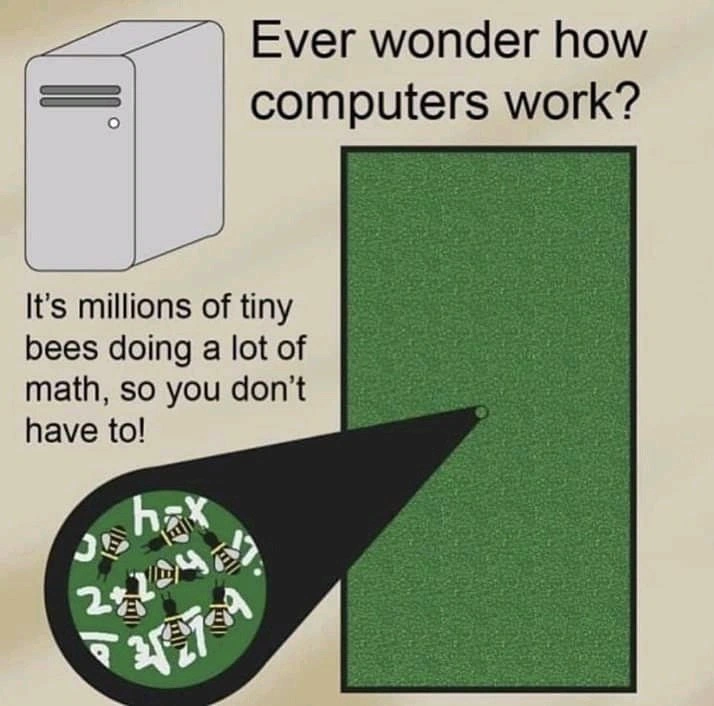
Ever wonder how computers work?
It’s millions of tiny bees doing a lot of math, so you don’t have to!
This format – posing a serious question then giving a silly answer – is a staple of the how_computers_work_meme genre. The punchline riffs on the idea that what a computer really does is an enormous amount of number-crunching behind the scenes. It takes the invisible processes of a microchip and turns them into a cartoon humorous_hardware_abstraction. Seasoned devs chuckle because we recognize the grain of truth: a computer does perform tons of arithmetic so humans “don’t have to.” But instead of describing binary calculations and logic gates, the explanation veers into whimsical nonsense with “millions of tiny bees.” It’s the juxtaposition of a correct concept (lots of math is happening in hardware) with an obviously incorrect mechanism (bees!) that makes this TechHumor land so well.
From an experienced perspective, there’s also a nod to how mysterious computers can seem to the uninitiated. We engineers know that under the hood of that simple grey tower are transistors, capacitors, clocks – a whole city of electronics orchestrated to execute instructions. But if you don’t know about those, a CPU might as well be a magical honeycomb of activity. In fact, the meme’s meme_visual_zoom (the magnifying glass zooming into a green circuit board) is showing what a real CPU die might look like up close – except instead of microscopic circuits, we see adorable bees flitting around numbers and symbols. It’s a playful visualization of what’s otherwise abstract: normally you’d picture electric currents or binary bits (ones and zeros) moving in there, but that’s hard to draw and not funny. Bees flying among equations – now that’s a visual that makes even seasoned devs smirk. It reminds us of all the times we’ve had to simplify tech for others. (Admit it, who hasn’t jokingly explained an overload as “the server’s powered by tired hamsters” during an outage?) This meme is essentially doing that with bee_math_explanation flair.
The slogan “so you don’t have to” is something we programmers and hardware folks deeply appreciate. It harkens back to why computers were invented in the first place: to automate tedious calculations. In the 1940s, before electronic computers, human “computers” (often teams of people with pencils) would do math laboriously. Now, a machine does the boring math millions of times faster. So saying “bees doing a lot of math so you don’t have to” is just a silly way to personify the CPU’s role as the ultimate math grunt worker. ComputerScienceHumor often takes these profound efficiency gains and frames them in tongue-in-cheek ways like this.
There’s also an easter egg for the historically inclined: we call errors in code “bugs,” and the first documented computer bug (in 1947) was a literal insect (a moth) stuck in a Harvard relay computer. So insects and computing have crossed paths in reality – just not quite as helpfully as this meme’s bees. 🐝 When Grace Hopper found that moth, they taped it into the logbook and jokingly wrote “First actual case of bug found.” That was a real bee-sized creature in a computer, but it was causing problems, not solving math. The meme flips that script: these cartoon bees aren’t bugs, they’re features! They represent everything working perfectly, a friendly swarm of problem-solvers. A senior dev, remembering that anecdote, might grin at the irony: if only debugging were as sweet as beekeeping in a CPU.
Ultimately, Hardware geeks see this meme and appreciate it as a love letter to abstraction. We know the CPU isn’t magic – it’s a triumph of engineering, with billions of transistors switching reliably. But explaining that intricacy to someone without context can be daunting. So we have fun with it. The meme’s absurd explanation is like saying, “Look, it’s too complicated to explain properly, so let’s just say bees do it.” It’s funny because it knowingly oversimplifies to the point of nonsense. For any developer who’s tried to explain to a non-tech friend what a CPU actually does, this meme hits home. It captures that tongue-in-cheek frustration and delight in equal measure. We laugh, and then maybe we’re inspired to actually explain the real logic – after the chuckles subside. In short, this little image combines DeveloperHumor with a dash of truth, reminding us of the incredible, unseen colony of switches buzzing away under our computer’s hood (and glad that it’s electrons, not real bees, doing the work – our rigs run hot enough without a hive in there!).
Level 4: Turing-Complete Hive
At the most theoretical level, this meme tickles a deep idea in CS_Fundamentals: in theory, computation can be performed by almost anything, even a swarm of insects, as long as they collectively implement the right logic. A modern CPU is essentially billions of tiny components switching on and off, performing billions of operations per second. The joke imagines those components as millions of tiny bees each doing math. Remarkably, from a computation theory standpoint, a sufficiently organized hive could mimic a computer’s logic. In academic terms, you could call this hypothetical beehive a "Turing-complete hive mind" – if each bee carried out logical operations (like a living logic gate), the colony as a whole could compute anything a normal computer could (given enough time and, uh, honey). This is a whimsical take on the principle that CPUArchitecture at its core is just countless simple operations (0s and 1s, or binary states) combined to achieve complex results.
Of course, the practical constraints make the idea of bee-powered computing absurdly funny. Modern CPUs run at gigahertz speeds (billions of cycles per second); no bee colony can move that fast or stay that coordinated. If one bee could do, say, one addition per second, you’d need billions of bees flitting about in perfect synchronicity to match a 3.5 GHz processor – an impossible feat (and a very noisy data center). This contrast highlights just how astonishing silicon-based CPUs are. They leverage quantum electron flows and nanoscale transistors to vastly outperform any biological or mechanical “computer.” The meme’s absurd image of bees with math symbols is actually an indirect nod to the massive parallelism inside real chips. In a way, a high-end CPU does behave like a well-organized swarm: billions of transistors (instead of insects) switching in concert under a global clock signal, each transistor a tiny workhorse contributing to an overarching task. This is where the humor hides a grain of truth – a CPU’s power comes from many simple units working together, just not in the form of fuzzy stripy pollinators.
There’s some fun computer science lore that resonates here, too. The phrase “busy as a bee” evokes the famous Busy Beaver problem in theoretical CS – a coincidence that senior nerds might smirk at. The Busy Beaver problem asks: what’s the maximum amount of output a tiny Turing machine can produce? It’s a thought experiment about the limits of computation. Swap in “busy bee” and you’ve got a mental image of our bee-driven CPU wringing out as much math as possible from its hive. 🐝 Similarly, the meme’s tiny_bees_computing fantasy underscores the universality of computation: you can, in principle, build computers out of anything – gears, light, DNA, even hypothetical bees – as long as you can reliably represent two distinct states (like 0 and 1) and enact logic. We normally choose silicon and electrons because they’re insanely fast and reliable (and don’t need nectar breaks). But it’s delightful (and a bit absurd) to imagine a programmable bee colony performing algorithms. This deep cut of humor teases the boundary between hardware reality and abstract computation theory, turning a core truth – that computation is just math at scale – into a fanciful scenario that’s too wild to be real.
Description
A humorous, diagram-style meme explaining the inner workings of a computer. On the top left is a simple illustration of a beige computer tower. Adjacent to it, the text asks, 'Ever wonder how computers work?'. Below this, a large green rectangle represents a circuit board, with a cone-shaped magnifier zooming in on a small section. The magnified circular view reveals a whimsical scene: cartoon bees flying amidst various mathematical symbols, numbers (like '2' and '4'), and the word 'hax'. Accompanying text explains the phenomenon: 'It's millions of tiny bees doing a lot of math, so you don't have to!'. The meme is an absurdist take on the complexity of computer hardware and processing. For developers, it's a funny abstraction that playfully dismisses the intricate reality of transistors, logic gates, and the arithmetic logic unit (ALU) in favor of a silly, magical explanation. It taps into the feeling that modern hardware is so complex it might as well be powered by tiny, intelligent creatures

Comments
19Comment deleted
I knew my code was buggy when the kernel pan-OS dump file just contained a note from the queen bee demanding better working conditions and more honey
Hyper-threading is really just two bees sharing the same hexagon - looks great on the slide deck until the hive hits 95 °C and both start blocking on the same nectar bus
After 20 years of explaining distributed systems, microservices, and parallel processing, I've realized this bee metaphor is actually more accurate than most architecture diagrams - at least the bees have a queen to coordinate consensus, unlike our Kubernetes clusters
This perfectly captures why we have abstraction layers - because nobody wants to manually orchestrate millions of transistor state changes just to increment a counter. Though honestly, after debugging some legacy enterprise code, I'd take the bees. At least their 'hive mind' architecture has better documentation than most microservices I've inherited
Bees scaling compute horizontally with zero orchestration overhead - unlike my K8s cluster, no drama over resource quotas
If computers are just millions of bees doing math, Amdahl’s Law is the part where adding more bees doesn’t help - your queen scheduler is still single‑threaded and the waggle‑dance consensus saturates the nectar bus
Explains hyper-threading: two bees time-slicing one thorax while cache coherence argues over which honeycomb owns the line
Bugs, not bees Comment deleted
Does sb know how to re-create computer using redstone in minecraft? Comment deleted
Using bees Comment deleted
But I told using redstone. If so do you know how? Comment deleted
bees already exist in minecraft. Just do it with those. Comment deleted
a metric ton of sr latches Comment deleted
go to a college and learn how to make a processor Comment deleted
Somebody rebuilt the MOS6502 Comment deleted
You should start sucking a lot of dicks I think Comment deleted
Computer Organization and Design: the Hardware/Software Interface: Third Edition Book by David A Patterson and John L. Hennessy Comment deleted
Read the book. Learn how to build processors. Build processor in Minecraft Comment deleted
GPUs in a nutshell Comment deleted