Skip to content
DevMeme
2720 of 7435
The Irrational Fear of Lowercase SQL
Databases Post #3005, on Apr 22, 2021 in TG

The Irrational Fear of Lowercase SQL

Why is this Databases meme funny?

Level 1: Big Letters Feel Safer

Imagine you’re learning to write, and you always write certain important words using BIG LETTERS. Maybe your teacher or parent showed you to write the word “STOP” or “HOMEWORK” in capitals so it stands out. Now, one day someone asks you to write those words in small letters instead. It’s the same word, and you know it means the same thing, but it feels weird because you’ve always used big letters for it. You might even giggle and say, “I don’t want to – it feels wrong!”

That’s basically what’s happening in this meme, but with computer code. One person asks, “Do you like writing your database commands in big letters or small letters, and why?” And another person shouts back (using big letters, of course): “I USE BIG LETTERS, I’m strangely afraid of using the small letters!” It’s funny because they’re treating the choice like a spooky monster, even though it doesn’t really matter. It’s like insisting on using your favorite color crayon every time – using a different crayon won’t ruin the picture, but it just doesn’t feel right to you. The joke shows that even grown-up programmers have their little habits and comfort zones, and changing something as simple as big letters vs. small letters can seem super uncomfortable. In the end, it’s a silly fear, and that’s why we laugh – we all have our own “big letter” habits that make us feel safe, even if everyone else thinks it’s no big deal.

Level 2: Upper vs Lower Showdown

Let’s break down what’s going on. SQL stands for Structured Query Language – it’s the language we use to talk to relational databases. We write commands like SELECT, INSERT, UPDATE to get or change data in a database table. Now, SQL as a language doesn’t care about uppercase vs lowercase for its keywords. For example, these two queries are equivalent to the database:

-- SQL keywords in uppercase (a common style)
SELECT first_name, last_name 
FROM users 
WHERE active = TRUE;

-- SQL keywords in lowercase (works the same, just a different style)
select first_name, last_name 
from users 
where active = true;

Both queries will return the active users’ first and last names. The database engine treats SELECT and select as the same instruction. So why do developers sometimes have strong feelings about using uppercase or lowercase? It comes down to code formatting and personal or team style guides. A style guide is basically a set of rules or recommendations for writing code in a consistent way (part of overall CodeStyleGuides in software projects). Consistency helps multiple developers read and understand each other’s code more easily – that’s a CodeQuality concern. So teams might say: “When writing SQL queries, always capitalize the SQL keywords.” This means every time someone writes a query, they’ll do SELECT ... FROM ... WHERE ... in caps, just like how some writing conventions capitalize the first letter of a sentence. Other teams might do the opposite and use all lowercase, especially if they think all-caps looks like shouting or if they prefer how lowercase blends with the rest of the code.

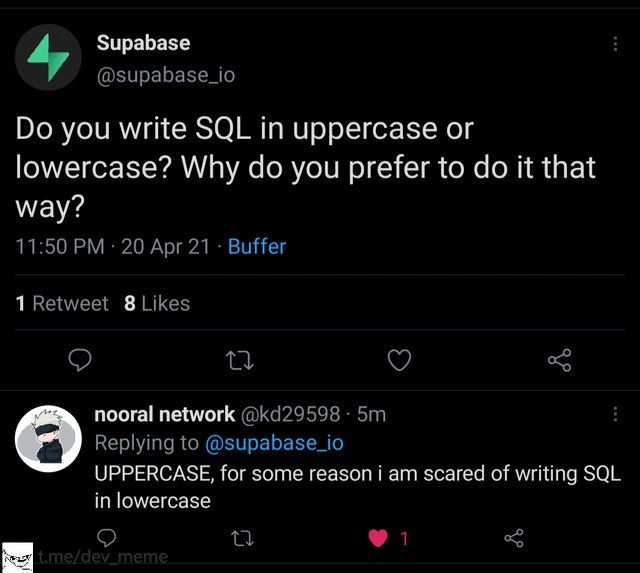
In the meme’s screenshot (which shows a tweet in dark mode, white text on black background), the company Supabase asks developers: “Do you write SQL in uppercase or lowercase? Why do you prefer to do it that way?” Supabase is a tech company that provides a database platform (built on PostgreSQL) – they were just stirring up some friendly discussion in the community, since this is a classic DeveloperHumor topic. The funny reply comes from a user who says in all caps: “UPPERCASE, for some reason I am scared of writing SQL in lowercase.” This reply is humorous for a couple of reasons. First, the person answered the question in UPPERCASE letters, which kind of shows their preference instead of just telling it. It’s like they’re demonstrating their style as they speak. Second, they use the word “scared” – obviously, writing in lowercase isn’t truly dangerous, but they’re exaggerating to say “I’m so used to uppercase that doing it differently makes me super uncomfortable.” A lot of developers can relate to this feeling. It’s not actual fear; it’s more like “lowercase SQL just looks wrong to me!”

Think of it this way: if you’ve always seen SQL keywords in one style, seeing them in the other style is jarring. Imagine opening a code file and everything that usually stands out (like commands) suddenly looks plain. For someone accustomed to uppercase keywords, select * from users where id=5; might at first glance hide the structure of the query – nothing pops out, because they expect the big, bold SELECT and WHERE. It’d be like reading a book title that wasn’t Capitalized Properly – it might take your brain an extra second to parse it. That “ugh, it looks weird” reaction is what the tweeter is calling “being scared.” It’s a funny exaggeration of the discomfort from breaking a habit.

This touches on formatting_preferences in coding. Just as we debate NamingConventions (like whether to name variables user_name or userName), developers debate how to format query keywords. Neither choice is right or wrong for the computer, but once a convention is set, deviating can feel almost like a mistake. Some people have even configured their text editors or SQL client tools to automatically uppercase keywords as they type, so they never have to worry about it. There are also formatting tools that can reformat your SQL queries to a standard style. All of this is to maintain consistency – so that when you read someone else’s query, it’s in a familiar style and you can focus on what it’s doing, not how it looks.

The meme is light-hearted DatabaseHumor poking fun at how attached we get to these conventions. The “fear” of lowercase isn’t literal; it’s the developer saying, “I’ve done it this way for so long that doing it differently just feels wrong.” It’s akin to a writer who always uses the Oxford comma feeling uneasy if told to drop it – nothing truly bad happens, but it feels like breaking a rule. And because the reply was written in all caps (which on the internet is the equivalent of shouting), it adds an extra chuckle for developers: the person is practically shouting that they prefer not to shout their SQL keywords quietly (the irony!).

In summary, the tweet and reply humorously highlight a common formatting preference in programming. We find it funny because it’s a trivial choice that somehow manages to inspire strong opinions. It’s a reminder that in software development, small style choices can become running jokes or even points of pride. And if you ever join a team writing SQL, don’t be surprised if the first thing you learn is whether they’re an uppercase-or-lowercase kind of team – you wouldn’t want to scare the seniors by doing it the “wrong” way! :laughing:

Level 3: Making a Case for Uppercase

In the world of SQL and databases, this meme hits on a surprisingly passionate code-style debate: should SQL keywords be written in UPPERCASE or lowercase? Technically, most SQL databases are case-insensitive for keywords – SELECT and select mean exactly the same thing to the database engine. The query’s logic or result won’t change based on letter casing. Yet, here we see a developer emphatically choosing uppercase, even joking that they’re “scared” of writing SQL in lowercase. Why would a seasoned developer care, or even feel fear, about something so superficial?

It turns out this is about human readability and long-standing conventions, not machine interpretation. Many SQL style guides and legacy tutorials strongly prefer uppercase for commands (SELECT, FROM, WHERE, etc.). This tradition dates back to early database documentation and books, which often printed SQL keywords in all caps to distinguish them from table or column names. Before modern IDEs with colorful syntax highlighting, uppercase keywords stood out in monocolor text, making queries easier to read at a glance. Over years, developers internalized this as a marker of "proper" SQL. Writing select * from users in all lowercase might technically run just fine, but to an experienced DBA or a developer who’s seen thousands of queries, it looks odd, maybe even unprofessional. It’s similar to how we instinctively uppercase constants in many programming languages or use uppercase for acronyms – it’s a visual cue.

From a CodeQuality perspective, consistency is king. Teams often agree on one style and stick to it for clarity. A mixed-case query like Select * From Users where ID = 5; is jarring; it seems sloppy because it breaks a uniform pattern. So, seniors establish CodeStyleGuides: some mandate uppercase SQL keywords for clarity and tradition, while others prefer lowercase to match the surrounding code or avoid the “shouting” look. The humorous angle is that such guidelines, meant to reduce friction, sometimes create almost superstitious attachments. The reply in the meme – “UPPERCASE, for some reason I am scared of writing SQL in lowercase” – is funny because it’s hyperbole with a kernel of truth: after years of always doing SELECT in caps, doing select can genuinely make a dev uneasy, like breaking a tiny rule of the universe. It’s an inside joke among developers (DatabaseHumor at its finest) about how even trivial choices can feel monumental when you’re conditioned to a convention.

This meme also subtly plays on internet etiquette: writing in all caps is usually considered yelling. The user responds about uppercase in uppercase, as if shouting their preference from the rooftops. It’s an ironic, self-referential twist that seasoned devs find amusing – they’re literally screaming “UPPERCASE” to proclaim their love for not writing in lowercase. The combination of a straightforward question (posed by Supabase, a company known for its database platform) and the comically intense answer resonates with anyone who’s seen minor stylistic choices blown out of proportion. It’s a gentle jab at our own DeveloperHumor quirks: we know logically it doesn’t matter, but emotionally, we’ve all had that “this just feels wrong” reaction to an alternative formatting.

In practice, changing the case doesn’t break anything (SQL will happily execute either), but the NamingConventions and CodeFormatting habits run deep. Senior developers chuckle because they’ve been in code reviews nitpicking things like comma placement or casing – trivial in function, critical in team conventions. They might recall that the real “fear” isn’t that the database will reject lowercase (it won’t), but maybe that a code reviewer or the resident DBA will. :wink: The meme captures that shared experience where a tiny stylistic choice becomes an almost existential dilemma in developer culture. Experienced devs nod knowingly because they’ve seen teams spend entire meetings arguing about formatting (tabs vs spaces, anyone?). The SQL uppercase_vs_lowercase argument is another chapter in that saga. Ultimately, it’s funny because it’s true: smart people can be irrationally attached to harmless preferences, and in the grand scheme, it’s a lighthearted reminder not to take ourselves too seriously.

Description

This image is a screenshot of a conversation on Twitter, initiated by the official account for Supabase (@supabase_io). The first tweet, posted on April 20, 2021, asks the developer community: 'Do you write SQL in uppercase or lowercase? Why do you prefer to do it that way?'. Below it is a reply from a user named 'nooral network' (@kd29598), whose profile picture is an anime character. The reply humorously confesses, 'UPPERCASE, for some reason i am scared of writing SQL in lowercase'. This meme captures a long-standing, semi-serious debate within the programming world. While most SQL databases are case-insensitive regarding keywords, a strong convention exists to write commands like 'SELECT', 'FROM', and 'WHERE' in all caps for readability, to distinguish them from table and column names. The joke lies in the user's dramatic and irrational 'fear' of deviating from this norm, a feeling that resonates with many senior developers who have had this stylistic choice ingrained in them since they first learned the language, making the alternative feel fundamentally wrong
Comments

30
Anonymous ★ Top Pick I write my SQL keywords in uppercase for the same reason I use `sudo` - I need the database to know I'm not making a request, I'm issuing a command
  1. Anonymous ★ Top Pick

    I write my SQL keywords in uppercase for the same reason I use `sudo` - I need the database to know I'm not making a request, I'm issuing a command

  2. Anonymous

    I write SQL in ALL CAPS so that when EXPLAIN ANALYZE exposes a seq-scan on the 2 TB table, at least the query is shouting in panic with me

  3. Anonymous

    The real fear isn't writing SQL in lowercase - it's explaining to the DBA why your 'select * from users where 1=1' query brought down production because you thought case sensitivity only mattered in the WHERE clause, not in your career trajectory

  4. Anonymous

    The fear of lowercase SQL is real - it's like we've been conditioned by decades of O'Reilly books and Stack Overflow answers to believe that `SELECT * FROM users WHERE id = 1` will somehow execute differently than `select * from users where id = 1`. Spoiler: the query optimizer doesn't care about your existential dread over case sensitivity, but your code reviewer with 20 years of Oracle experience absolutely does

  5. Anonymous

    I uppercase SQL so I can yell at the database without paging SRE - and to avoid Oracle-to-Postgres migrations that create both Users and users when someone quotes an identifier

  6. Anonymous

    UPPERCASE for keywords - lowercase is harmless until someone quotes identifiers; then Oracle folds up, Postgres folds down, and your ORM folds the team

  7. Anonymous

    UPPERCASE SQL keywords: the only highlighter that survives a DBA's 20-year-old query dump without mercy-kill

  8. @Roman_Millen 5y

    Keywords in lowercase, table/column names in uppercase — that's what I prefer.

    1. @prkiso 5y

      select KITTENS from ANIMALS where no this is just wrong

      1. @Roman_Millen 5y

        It might look scary but it's actually helpful for reading the queries in case you don't have a syntax highlight.

        1. @prkiso 5y

          SQL is scary anyway. I feel like I'm gonna drop the table and not know

          1. @Roman_Millen 5y

            Good thing that SQL queries are often used not directly in sources or DBMS workbench, but in a special console where you can't do anything but "select".

            1. Сифуд Кстолу 5y

              or "DROP"

    2. Сифуд Кстолу 5y

      +1

  9. @Roman_Millen 5y

    KITTENS column in ANIMALS table — now this on the other hand is scary 😢

    1. @prkiso 5y

      Yes it's a zoo with animals for columns and enclosures for rows

  10. @mynameahdeez 5y

    DROP DATABASE *

  11. @dellism1 5y

    for some reasons database works better if you shout at it

    1. @Ra_zor 5y

      Well, that's some serious tech, you convinced me

  12. @AmyCupcake 5y

    SELECT ROMEO FROM ART WHERE FORE

  13. @ProAbdulrahman 5y

    lowercase, because it is easy to read

  14. @ErinIlya 5y

    комменчу на русском, я у мамы опасный

    1. dev_meme 5y

      english only please! warning 1/3 for @ErinIlya

  15. @ErinIlya 5y

    commenchy na russskom

    1. dev_meme 5y

      still not english. don't test me, comrade. warning 2/3 for @ErinIlya

    2. Deleted Account 5y

      hahaha, "commentator"

  16. @ErinIlya 5y

    asd

    1. dev_meme 5y

      👀

    2. dev_meme 5y

      *sad, I assume

  17. @Roman_Millen 5y

    Whatever. As long as keywords and names differ. It also depends on what config is used for DBMS. For the DB I used not so long ago writing names in caps was the only option.

Use J and K for navigation