Sprint Planning Meets Three-Year Estimate
Why is this Agile meme funny?
Level 1: Guessing The Unknown Box
Imagine someone gives you a wrapped box and asks how long it will take to fix what is inside. You say you need to open it first, but they demand an answer right now. So you say "three years" because the box might contain a loose screw or an entire broken bicycle. The meme is funny because software tasks often look small from the outside but may hide a ridiculous amount of unknown work.
Level 2: Estimate Before Discovery
An estimate is a guess about how much effort or time a task will take. In software, that guess can be hard because tasks often hide surprises. A change that sounds simple might require reading old code, fixing tests, updating data, or coordinating with another team.
Sprint planning is a meeting where a team decides what work to attempt in the next sprint, often one or two weeks. To plan capacity, the team needs some sense of task size. That is why the character in the meme keeps asking for an estimate.
The engineer's first answer is reasonable: the task could go many different ways, so more investigation is needed. That is called requirements uncertainty or technical uncertainty. The team does not yet know enough to give a confident number.
The joke happens when planning still demands a number. The engineer responds with THREE YEARS, which is absurd, but it expresses a real feeling: if you force someone to estimate unknown work, they may protect themselves with a huge buffer.
For junior developers, this is a common lesson. Saying "I do not know yet" is not failure. Sometimes the right next step is a spike, prototype, code reading session, or small investigation ticket. Good planning makes space for learning before pretending the answer is precise.
Level 3: Uncertainty Draws First
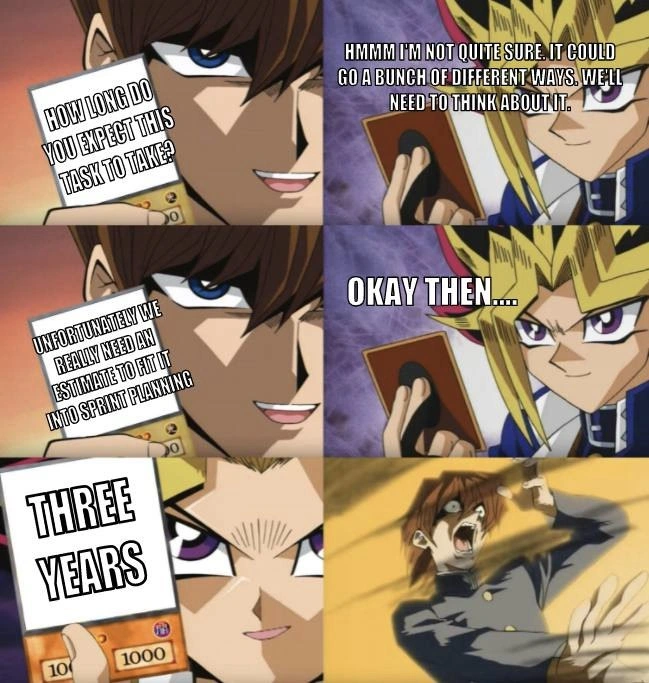
The meme uses a dramatic card-game format to stage a familiar sprint-planning interrogation. One character asks:
HOW LONG DO YOU EXPECT THIS TASK TO TAKE?
The engineer answers:
HMMM I'M NOT QUITE SURE. IT COULD GO A BUNCH OF DIFFERENT WAYS, WE'LL NEED TO THINK ABOUT IT.
Then management pressure arrives:
UNFORTUNATELY WE REALLY NEED AN ESTIMATE TO FIT IT INTO SPRINT PLANNING
So the engineer plays the only card left:
THREE YEARS
That final card is funny because it converts uncertainty into a number in the most aggressively honest way possible. The task may be small, but the unknowns are not. The code might be isolated, or it might touch authentication, billing, data migration, legacy integrations, and the one service nobody has deployed since 2019 because "it just works." The estimate is not measuring effort anymore. It is measuring the size of the fog.
The experienced developer pain is that Agile planning often asks for a scalar answer before discovery has happened. Sprint planning wants a box: this ticket belongs in this sprint, with this effort, under this capacity. Engineering reality sometimes offers a probability cloud with dependencies, missing requirements, stale documentation, and one suspicious comment that says TODO: temporary.
The meme is not saying estimates are useless. Estimates help coordinate work, set expectations, and expose risk. The satire is about pretending that an estimate extracted under pressure is equivalent to understanding. If the answer "we need to think about it" is not allowed, the system incentivizes either fake precision or absurd padding. Here the engineer chooses padding so large it becomes a protest.
This is where Scrum can go sideways. Story points, sprint commitments, velocity charts, and roadmap dates are tools, not reality generators. When stakeholders need certainty but the task contains genuine ambiguity, the planning ritual can become theater: everyone knows the number is weak, but the board needs a number, so the number receives a little hat and a Jira ticket.
Description
The image is a six-panel Yu-Gi-Oh-style meme using characters holding cards and reacting dramatically. The visible text asks, "HOW LONG DO YOU EXPECT THIS TASK TO TAKE?" and the engineer answers, "HMMM I'M NOT QUITE SURE. IT COULD GO A BUNCH OF DIFFERENT WAYS, WE'LL NEED TO THINK ABOUT IT." A follow-up card says, "UNFORTUNATELY WE REALLY NEED AN ESTIMATE TO FIT IT INTO SPRINT PLANNING," followed by "OKAY THEN...." and a final giant card reading "THREE YEARS," after which the other character recoils in shock. The joke targets Agile estimation pressure: when uncertain technical work is forced into sprint planning, the only honest number may be absurdly large.
Comments
2Comment deleted
Jira demanded a scalar, so the engineer returned the only estimate with adequate error bars: three years.
Clients are absolute dumb when it comes to estimating price or time, failing to do minimum on their part, as in not bringing guitar to the shop to estimate repair cost or not writing brief and technical requirements Comment deleted