Presenting My Spaghetti Code with Unearned Pride
Why is this CodeQuality meme funny?
Level 1: Spaghetti Surprise
Imagine you’re helping cook dinner and you make a huge mess with the spaghetti. 🍝 Noodles are tangled everywhere, sauce is splattered all over the kitchen, and the pot is boiling over. Now, picture a friend or a parent walking into the kitchen and seeing spaghetti hanging off the ceiling and sauce on the walls – their eyes go wide and they look completely shocked 😱 because the kitchen is a disaster. You, the one who made the mess, feel so embarrassed that you just want to hide under the table so nobody sees you. This meme is just like that, but with computer code. The spaghetti code is like the messy spaghetti all over the kitchen. The other programmers are like the people who walk in and get scared by how chaotic it looks. And “Me” – the person who wrote that messy code – is like the embarrassed cook hiding in shame. It’s funny because it shows in a playful way how a programmer might feel when they realize they made a big mess in their work and others have to see it. Just like a kid who made a mess and feels guilty, the programmer is hiding while everyone else is shocked at the mess. The humor makes it clear: sometimes in coding we make a monster mess by accident, and it’s both scary and silly when others discover it!
Level 2: Untangling the Noodles
Let’s break down the meme and concepts for a newer developer or someone without much background in these terms. Spaghetti code is a casual term programmers use to describe code that’s a big jumbled mess. Think of a bowl of spaghetti noodles all tangled together – you can’t easily follow one noodle from start to finish, right? In the same way, spaghetti code is written without a clear structure: everything is intertwined. For example, you might have one huge function doing a million things, or lots of pieces of code all depending on each other in confusing ways. If you try to figure out how the program works, you keep jumping from one part to another, like trying to trace a single noodle in a pile. It’s frustrating and easy to get lost. This is obviously bad for CodeQuality because good code should be easy to read and understand.
Now, why do we call it spaghetti? Well, it’s just a funny visual metaphor. No actual pasta is involved in coding (🍝 though if code could smell, spaghetti code would smell like trouble). We also have related metaphors like "spaghetti code" versus "lasagna code" or "ravioli code." Those terms aren’t as common, but some developers joke that good code should be like lasagna (layered and organized) or ravioli (encapsulated in neat packages), whereas bad code is like spaghetti (one big tangled pile). The key idea is that spaghetti code lacks organization. It often happens when someone writes a quick solution without planning or when a program is maintained over time by different people adding hacks upon hacks. Over months or years, the code can become this fragile, scary mishmash that everyone is afraid to touch. At that point, we say the project has accumulated Technical Debt – meaning the easy shortcuts taken earlier (like not splitting code into proper modules, or not rewriting something properly) have built up a "debt" that the developers will eventually have to "pay back" by doing the hard work of cleaning up (kind of like how ignoring a leaky roof makes repairs more expensive later).
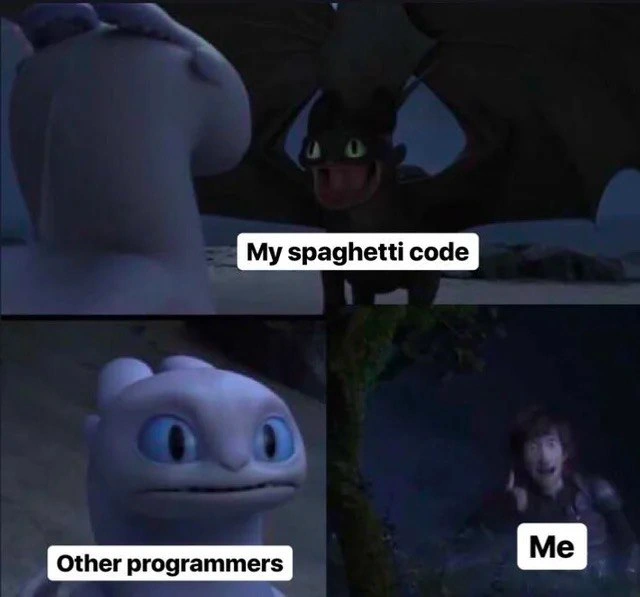
This meme uses a scene from How to Train Your Dragon to depict that situation in a funny, relatable way. In the top panel, we see the black dragon named Toothless sneaking up with a goofy/scary expression. Here, Toothless represents "My spaghetti code." So imagine your messy code is this creature creeping up. In the movie, he’s actually playful, but in the meme context, that dark dragon embodies the scary_code you wrote. In the bottom-left panel, the white dragon (called the Light Fury in the movie) turns around looking completely shocked and alarmed – her eyes are wide, like "Oh no!" The caption on her says "Other programmers." That means when other developers (maybe your teammates or anyone reviewing your code) see the messy spaghetti code, they react with surprise, dismay, maybe even a little fear. It’s like they encountered a monster unexpectedly. And finally, in the bottom-right panel, there’s a human character (Hiccup from the movie) crouching in the dark with a startled or guilty expression. He’s labeled "Me." This is supposed to be the developer who wrote the spaghetti code, now hiding in shame after seeing others react to it. Basically: “I know my code scared you... and now I’m just gonna hide here and pretend I’m not responsible.” 😅 It’s a humorous exaggeration of the embarrassment one feels showing bad code to peers.
Let’s talk about CodeReviews in this context. A code review is when other programmers look at your code (often before it gets merged into the main project) to catch mistakes or suggest improvements. It’s a quality control practice and also a teaching tool. However, it can be nerve-wracking if you suspect your code isn’t great. If you submit some code for review and it’s full of problems (like our spaghetti code), you might expect comments like "This function is doing too much," or "This is really hard to follow." The meme plays on that anxiety. The other programmers are shocked because spaghetti code can be truly confusing or full of CodeSmells. A code smell is a bit of developer slang meaning a hint or sign that something is wrong in the code. For example, an extremely long function or a variable name that makes no sense could be a code smell. Spaghetti code is basically a big pile of code smells – it likely violates a bunch of recommended design principles. Common code smells associated with spaghetti code include:
- Huge functions or classes that try to do everything at once.
- Deep nesting and complex conditionals (
if/elseinsideif/elsemany levels deep) that make flow hard to follow. - Global variables or states that any part of the program can change, causing “action at a distance” (something changes over here and affects something way over there).
- Duplicate code copied in multiple places (so if you fix a bug in one copy, you might forget to fix it in the others).
- Lack of clear modularity – there aren’t well-defined functions or modules with single purposes; everything is intertwined.
When another developer encounters these issues, it feels overwhelming. They might literally cringe or gasp (just like that white dragon’s face 😀). And if you’re the author, you probably anticipated that reaction, hence the feeling of self_shame. Maybe you wrote it in a hurry or when you were less experienced, and now you’re aware of how horrifying it looks to fresh eyes. This feeling is super common in the developer world. In fact, DeveloperHumor often involves making fun of one’s own past coding mistakes – it’s a way to bond with others over the universal truth that nobody writes perfect code all the time. This meme is a form of developer self-deprecation: the meme creator is poking fun at themselves for having written such frightening code.
Now, on the brighter side: spaghetti code can be fixed! The process of cleaning up messy code is called refactoring. That means reorganizing and rewriting parts of the code to improve its structure and readability, without changing what the code actually does for the end user. It’s like tidying up a messy room – you don’t throw away everything; you put things in order so it’s easier to find and work with them. In a code context, refactoring spaghetti code might involve breaking a huge function into smaller functions each with a clear job, eliminating global variables by passing needed data around in a cleaner way, adding comments or better names for clarity, and generally implementing some proper design patterns (like dividing logic into layers – e.g., a separate layer for database, one for business logic, one for user interface, akin to layers of lasagna). The meme doesn’t show the refactoring (it stops at the shame part for comedic effect), but in reality, a good team will often say, “Okay, we have to deal with this tech debt.” There might even be a task created in the project tracker like “RefactoringNeeded: untangle module X because it’s become spaghetti code.” Clearing technical debt by refactoring is important, but it requires the team (and management) to agree to spend time on it, which is another story (and often another meme).
In summary, at this level we understand that the meme is illustrating a common programming scenario: spaghetti_code represents ugly, hard-to-maintain code; other programmers represent colleagues who have to read or work with that code and are shocked by its state; and "Me" represents the original coder feeling embarrassed or ashamed. It’s funny in a sad-but-true way. Practically every developer has written something they’re not proud of or that ended up as a big mess. And almost every developer has also had the experience of looking at someone else’s code and going "What were they thinking?!" This meme gets a laugh because it captures both sides at once with a perfect visual metaphor from a popular movie. It’s a bit of CodingHumor that uses pop culture to make the lesson memorable: write code you won’t be ashamed of later (or you too might feel like hiding from a dragon’s glare in the code review!).
Level 3: Here Be Spaghetti Dragons
At the highest technical level, this meme highlights the dread of spaghetti code and the very real code_review_anxiety that senior engineers know all too well. Spaghetti code is the natural enemy of CodeQuality – it's code so entangled and unstructured that working with it feels like venturing into a dark cave where “Here be dragons.” In fact, the term spaghetti code has been scaring programmers since the 1970s, originally describing convoluted programs full of GOTO statements that twisted flow control into knots. Modern spaghetti code might not use literal gotos, but it has the same effect: functions calling each other in unpredictable ways, global state modified all over the place, and no clear architecture. This results in a CodeSmell so strong that any experienced dev can sniff it out immediately.
In the meme's first panel, the black dragon (Toothless) labeled "My spaghetti code" sneaks up like an ominous creature. This perfectly represents how Technical Debt can lurk in a codebase: a beast born from rushed fixes and lack of refactoring that suddenly jumps out at unsuspecting maintainers. When other programmers finally encounter that beast in a CodeReview, their reaction is much like the wide-eyed white dragon (the Light Fury) – equal parts surprise, horror, and “What on earth am I looking at?!” The humor here comes from shared trauma: every seasoned developer has at some point opened a file only to be terrified by what they found – a tangle of logic that defies comprehension. It's a mix of scary_code and dark DeveloperHumor. We laugh because we've all been the Light Fury, startled by a wild snippet of legacy code that seems to have a mind of its own.
Why does this happen? Often, time pressures and unrealistic deadlines force developers to write quick and dirty implementations – the code "works" but it's held together with duct tape and dreams. Each quick fix or ad-hoc solution adds another noodle to the tangled heap. Over time, the project accumulates a TechnicalDebt monster: a creature comprised of copy-pasted blocks, mysterious global variables, and functions hundreds of lines long doing ten different things. Such a beast violates all the holy grails of software design (like single responsibility and modularity). The Other programmers in the meme are terrified because they know touching this code can set off a chain reaction of bugs. Indeed, maintaining spaghetti code is risky – change one part and something breaks in a completely unrelated area, as if the noodles of logic are so intertwined that pulling one causes a knot somewhere else.
Let's consider a bite-sized example of what spaghetti code might look like in practice, to see why it provokes such fear. Imagine code where functions call each other in convoluted ways and share state indiscriminately:
# A contrived example of spaghetti code (simplified)
data = {} # global state shared everywhere
def process(x):
data['value'] = x # side effect on global state
if x > 0:
process(x - 1) # recursive call (tangled control flow)
else:
do_something() # some external dependency, opaque behavior
data['result'] = x * 42 # another side effect after recursion
In this snippet, the flow jumps around and modifies global data from multiple places. It’s hard to tell what data will contain at any given time or why process calls itself recursively for certain values. There's no clear separation of concerns or order of execution. This kind of unpredictability and hidden coupling is exactly what makes other developers go wide-eyed in fear when they read code like this. The TechDebt beast isn’t just theory – it’s right there in the process() function, doing five things at once with zero documentation. No wonder the Light Fury dragon (our startled reviewer) looks like they've seen a ghost!
The human element in the meme – the crouching figure labeled "Me" – encapsulates DeveloperSelfDeprecation and the shame a coder feels presenting such code to peers. It's funny because it's true: many a programmer has wanted to hide under their desk after a particularly brutal code review of something they wrote at 2 AM under duress. The author knows their code is a horror show, so they preemptively make themselves the butt of the joke. This self-aware humor is a common coping mechanism in coding humor circles. By labeling their code a monster (the dragon) and themselves as the ashamed Hiccup hiding in darkness, the meme creator is basically saying, "Yes, I know my code is awful – you don’t have to tell me. I’m already in hiding!" It’s equal parts catharsis and camaraderie: other devs laugh because they’ve been on both sides – the one writing a monstrosity and the one screaming internally when reading someone else’s.
Crucially, the meme also hints at a solution without explicitly showing it: the embarrassment implies that the coder knows the code needs improvement. In real life, that next step is dragon training refactoring. Just as Hiccup in How to Train Your Dragon learns to befriend and tame the dragon, a responsible developer must tame the spaghetti monster by refactoring messy bits into cleaner, modular pieces. Yet, refactoring a big ball of spaghetti is non-trivial – it requires time, tests, and careful untangling of logic. This is why spaghetti code often persists and scares generation after generation of programmers. Fixing it is harder than writing it in the first place. When deadlines loom, the cycle can repeat: developers might add band-aid fixes to the spaghetti code (to avoid breaking it), which only makes the tangle worse. It’s a vicious cycle of fear and quick fixes. Senior engineers recognize this pattern and that knowing sigh (or sarcastic remark) they give when encountering it is part of the shared language of tech: “Ah, this section... here be dragons.” In other words, proceed with caution, for this code has claimed many brave souls before.
Ultimately, the humor and horror of this meme stem from a universal truth in software development: writing clean code is hard, and almost everyone has accidentally created a monster at least once. The TechDebt dragon might be scary, but by acknowledging it (even through a joke), developers collectively encourage each other to slay the beast with better practices. Until then, we'll keep making memes to laugh through the pain – because sometimes it’s better to laugh at your spaghetti code than to cry.
Description
A three-panel meme using the 'Toothless Presents Himself' format from the movie 'How to Train Your Dragon'. In the top panel, the black dragon Toothless is labeled 'My spaghetti code,' puffing his chest out proudly. In the bottom-left panel, the white dragon Light Fury, labeled 'Other programmers,' looks back with an expression of confusion and disgust. In the bottom-right panel, the character Hiccup, labeled 'Me,' is hiding behind a tree, giving a thumbs-up with a proud and encouraging look on his face. This meme humorously depicts the disconnect between a developer's pride in their own complex, tangled code and the negative reaction of their peers who have to read, review, or maintain it. It highlights the common scenario where a programmer, often a junior or someone working in isolation, creates 'spaghetti code' - code that is convoluted and unstructured - but perceives it as a clever or functional solution, unaware of its poor quality from an external perspective
Comments
7Comment deleted
Some developers write spaghetti code and call it job security. The rest of us call it a full-employment act for the refactoring team
Watching the new hire run `git blame` on the 4-KLOC if-else chain that still clears $10M/day, silently praying the Mercurial-to-Git migration scrubbed my name
The code that survived three architecture reviews because I was the only one who could explain why the circular dependency between the auth service and the user service was actually a feature, not a bug
The real tragedy isn't the spaghetti code itself - it's that after 15 years, you've learned to rationalize every goto, every global variable, and every 2000-line function as 'performance optimizations' and 'business requirements,' while secretly knowing that refactoring would take three sprints and executive buy-in you'll never get. At least Toothless had the excuse of being a dragon; we're just protecting our job security through code obfuscation
It’s not spaghetti - it’s a hand‑rolled service mesh made of if/else routing, global state, and temporal coupling; pairs perfectly with a 900‑line utils.ts
Other devs stare at my spaghetti code; I run, because every strand is a business rule and tugging one triggers payroll, compliance, and a 2 a.m. incident
Peers admire the 'intricate' nesting like a Light Fury; I know it's fifteen-year-old callback hell plasma-blasting my on-calls