Elliptic Curve Cryptography Kills Romance
Why is this Cryptography meme funny?
Level 1: He Gave Her Math
Imagine your friend really wanted a shiny gift – say, a cool toy or a sparkly ring – something that shows you care about them. But instead of that, you hand them a math problem or some super complicated puzzle. How do you think they’d feel? Probably confused, maybe a little upset, definitely not excited. That’s what happened in this joke.
A ring (the kind you wear on your finger) is usually a special surprise to show love. It’s like giving someone a big delicious chocolate cake for their birthday – it makes them happy and they feel loved. But what this guy did was more like giving a friend a long instruction manual or a tricky riddle instead of a cake. Even if that riddle is really clever or that manual is about something cool, it’s not what they were hoping for. It doesn’t sparkle, it doesn’t taste good, and it doesn’t make them feel special in the way they wanted.
So, in the story of the meme: She wanted a ring (a nice gift that shows “I want to be with you forever”). He gave her an elliptic curve (basically, he gave her math and nerdy stuff instead of a ring). And as you might guess, now he is single – which means she did not want to stay with him after that. It’s a funny little poem because it’s such a silly mistake. The guy was using his brain when he should have been using his heart.
To put it super simply: it’s like if you asked for a puppy for your birthday, and instead, your friend gave you a textbook about dogs. Even if the book is really interesting, you’d be like, “Uh… this isn’t what I wanted.” In the end, the lesson is know what matters to the people you care about. A big hug or a real ring would have worked fine – a bunch of fancy math, not so much. That mismatch is why we laugh. It’s obvious to us that he goofed up in a big way by overthinking it. The situation is exaggerated and silly, which is what makes it a joke. So, the guy lost the girl because he gave her numbers instead of a ring, and we’re reminded that sometimes being too nerdy can backfire in real life.
Level 2: Geek Proposal Gone Wrong
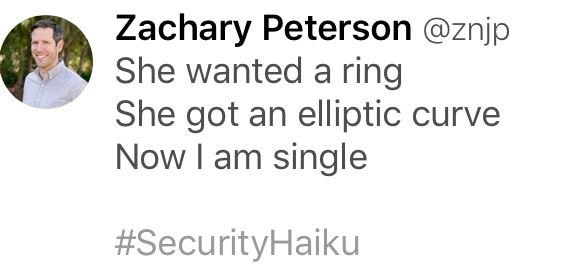
This meme is a classic piece of tech humor that mixes up a love story with a heavy dose of nerdiness. Let’s break it down in simpler terms. The text is written as a short poem, specifically a haiku, which is a three-line poem (typically 5 syllables, then 7, then 5) often used for artistic or funny expressions. The three lines read:
She wanted a ring
She got an elliptic curve
Now I am single
Right away, you can see the setup of a tiny story. Line 1, “She wanted a ring,” sets the expectation: someone (a woman in this case) was hoping to receive a ring, as in an engagement ring. In many cultures, when you propose marriage, you offer a ring (usually with a diamond) as a symbol of commitment. It’s shiny, expensive, and meaningful – basically the thing most people expect when you pop the question.
Line 2, “She got an elliptic curve,” delivers the twist. Instead of a ring, she got something called an elliptic curve. If you’re new to this term, an elliptic curve is not a piece of jewelry at all – it’s a concept from mathematics and cryptography (the science of secret codes). In very simple terms, an elliptic curve is a special kind of mathematical equation that looks like a gentle loop or curve when you draw it out. Why do computer security people care about it? Because elliptic curves can be used to create very secure encryption keys. This is known as Elliptic Curve Cryptography (ECC), which is a type of cryptography algorithm. Algorithms are just procedures or formulas, and cryptography algorithms are methods to scramble and descramble information so that only the right people can read it. ECC is popular in modern cybersecurity because it allows strong security with shorter keys (you might have heard of RSA encryption – ECC is a newer alternative that achieves similar security with less data).
Now, here’s the thing: giving someone an elliptic curve isn’t a normal gift at all. You can’t hold or wear an elliptic curve. It’s not an object, it’s basically a bunch of numbers and equations. Imagine expecting a beautiful ring in a jewelry box, and when you open it, you find a piece of paper with some complicated math scribbled on it, or maybe a USB drive with an encryption key file. That’s essentially what this joke is saying happened. It’s a huge letdown!
Line 3, “Now I am single,” is the punchline. It tells us that as a result of this botched proposal, the relationship is over – she did not say yes. In fact, presumably, she was so unimpressed (or maybe upset) that she left him. The humor here comes from the obvious cause-and-effect: of course he’s single now, because he completely missed the mark on a romantic gesture. It’s a bit self-deprecating, as if the guy is admitting with a sigh, “Well, I blew it by being a clueless nerd.”
To someone who isn't technical, the phrase "elliptic curve" might sound like gibberish. That’s part of why the meme is funny to those in the know – it intentionally uses jargon in a context where it absolutely doesn’t belong. In the world of DeveloperHumor, this kind of scenario (mixing up tech priorities with real life) is common comedic fodder. It’s exaggeration, sure, but not totally alien. Many of us in tech have had moments where we got too nerdy when something more straightforward was needed. This meme just takes that to an extreme for effect.
Let’s clarify a bit more about what an elliptic curve means in the context of security, since that’s key to the joke:
- Elliptic curves are used in encryption and digital locks. When your web browser connects securely (that little padlock icon on websites) or when you send a secure message, algorithms like ECC might be working behind the scenes. They help in creating public keys and private keys (like secret passwords, but mathematically related).
- The reason people in security love elliptic curves is that they allow for very strong security. A small key (256 bits is a common size, which is just a string of 256 ones and zeros) can provide a level of security that would take a super long time for a hacker to break (longer than the age of the universe, practically) by brute force. This is similar to older methods like RSA which might need a 2048-bit key for comparable security.
- However, none of that awesome property makes any sense in the context of a marriage proposal! It’s like responding to “Will you love me forever?” with “I promise, with a probability of 2^(-128) that I’ll ever betray you” – it’s super technical and misses the emotional point.
Now, aside from the tech itself, notice the meme format. It’s presented as a social media post (it looks like a tweet). The hashtag #SecurityHaiku suggests this was part of a trend or just a personal tag the author used, combining security topics with the haiku form. There’s a community of cybersecurity professionals who do fun challenges like writing haikus about their field – to lighten the mood, share a laugh, and make creative jokes that only fellow geeks might fully appreciate. So this post by “Zachary Peterson” was probably shared among people who work in security or cryptography, and they instantly understood the humor.
For a junior developer or someone new to these concepts, here’s why the meme is funny:
- Expectation vs Reality: Everyone knows a ring is the traditional thing to give when proposing. That’s the expectation. The reality delivered in the meme is completely off-base – an elliptic curve (i.e., math). It’s like a doctor proposing by giving an X-ray scan of a healthy heart instead of a ring, or a chef proposing with a recipe instead of a ring. The thought process is "I’ll do something related to what I’m good at," but it fails to consider what the other person actually wants.
- Terminology Pun: The word “ring” is simple, but this computer guy humorously interpreted it as something else. It’s not directly said in the meme text, but underlying it is the pun that in very advanced math and computer science, “ring” has meaning (like a mathematical ring or even things like ring signatures in cryptography). It’s as if his brain auto-completed “ring” to something technical (elliptic curve!), completely sidestepping the obvious meaning (a jewelry ring).
- Haiku Nerdiness: The fact it’s written as a haiku shows the person is intentionally being witty and compact. Haikus often have a twist or a poignant image in them. Here the twist is comedic. For a new dev, it’s worth noting that tech communities often enjoy these creative formats – it’s not all serious all the time. We write jokes in code, we write poems about firewalls, we even have entire forums (like subreddits or Twitter feeds) full of inside jokes. This one stands out because it blends a CyberSecurity meme with a relationship theme.
Let’s decode any remaining terms:
- Single: Just to be clear, “Now I am single” means the person is not in a relationship anymore. In one line, he’s telling us the outcome: she presumably said "No" or broke up with him after this ill-fated proposal.
- Security in the hashtag context refers to information security (not like home security or anything). So #SecurityHaiku means haikus about data/cyber security stuff.
The categories listed for this meme are Cryptography and Security, which tells us the joke centers on those topics. Indeed, elliptic curve cryptography is a big concept in both cryptography (the math/tech of codes) and security (the practical side of keeping information safe). The common tags like ECCEllipticCurveCryptography and CryptographyAlgorithms highlight exactly the tech being referenced. Meanwhile, TechHumor and DeveloperHumor tags indicate this is a joke meant for the techie crowd, and boy, does it deliver if you’re in that crowd. It’s one of those jokes where, if you get it, you probably chuckle and maybe share it with your colleagues. If you don’t get it, it looks really strange – which, in a way, is part of the fun for insiders.
In summary, for a newer developer or someone not yet familiar with ECC: the meme is poking fun at a security engineer who took a very literal, nerdy approach to something that required a romantic approach. It’s as if he proposed with code or math instead of a ring. The result was predictably a disaster. It’s funny because it exaggerates how people like us (developers/engineers) can sometimes prioritize clever technical stuff over plain common sense in social situations. It’s also a bit of an ego-buster for the security field – like, “hey, you might be saving the world with encryption, but you still gotta buy a ring if you want to propose!” The emotional core is the disconnect: he was speaking in geek language when she expected heart language. And even if you don’t know ECC deeply, you can understand: giving math instead of jewelry is a recipe for disappointment in this context. So the meme uses a niche concept (elliptic curve) to highlight a very universal comedy trope: the clueless lover who messed up the proposal in epic fashion.
Level 3: No Key to Her Heart
For seasoned developers and security engineers, this meme prompts equal parts laughter and a sympathetic cringe. It paints a vivid picture of the stereotypical uber-nerd whose idea of romance is hopelessly entangled with his love for encryption. She wanted a ring – a classic symbol of commitment. He gave her an elliptic curve – a symbol only a cryptography geek would gush over. The punchline “Now I am single” lands with a deadpan finality that feels all too plausible to anyone who’s seen tech obsession collide with real-world relationships.
Why is this combination of elements so humorous to an experienced dev? Because it’s absurd yet relatable in the tech community. We’ve all met that engineer who is so passionate about a technology (be it cryptography, AI, Linux, you name it) that they try to apply it to everything – even situations where it absolutely doesn’t belong. This meme is basically that guy’s life as a three-line story. It exaggerates the trope of the socially oblivious programmer: the kind who might genuinely think a cryptographic algorithm is an acceptable substitute for a heartfelt gesture. It’s a cautionary tale wrapped in humor, a reminder that what flies in a code review doesn’t necessarily fly in a marriage proposal.
The humor draws on shared experiences and knowledge. In security circles, everyone knows what elliptic curve cryptography is and how proud we are of its strengths. A senior engineer reading this immediately recognizes “elliptic curve” as a cornerstone of modern secure systems – and probably recalls spending long nights implementing or troubleshooting ECC for SSL certificates or blockchain projects. So the idea of literally gifting someone an elliptic curve (maybe he generated an SSH key pair or presented a fancy printed graph of the curve?) is outrageously silly. It’s overkill and completely mis-targeted. That’s what makes it funny: he treated a romantic partner like a codebase, offering a technical solution where an emotional one was needed. It resonates because many of us have, in milder ways, done something similar – maybe not this extreme, but perhaps we’ve given a gadget when a thoughtful personal gift was called for, or we’ve responded to an emotional situation with logic rather than empathy. This meme is the extreme caricature of that tendency.
Let’s break down the scenario with a bit of role-play:
- Her perspective: She’s expecting a proposal, likely picturing a heartfelt moment and a sparkling ring. Maybe friends and family have told her “if you like it then you should put a ring on it,” and she’s been dropping hints. A ring is a clear symbol – it says “I want to marry you” without uttering a word.
- His perspective: He’s a brilliant security engineer absolutely infatuated with cryptography. In his world, few things are more meaningful than a robust encryption scheme. He probably got swept up in the idea of doing something clever and unique. Why give an ordinary diamond when you can impress with mathematics, right? Perhaps he even composed this haiku as part of the proposal, thinking it’s poetic (it is, just in a SecurityHaiku kind of way). In some corner of his mind, equating love with an elliptic curve felt like a grand gesture – after all, curves are beautiful, right? And unbreakable encryption – what better metaphor for eternal love?
The hashtag #SecurityHaiku hints that this was part of a larger infosec in-joke. Security professionals often blow off steam by writing humorous haikus about their trade (firewalls, passwords, hacker weirdness – everything’s fodder for a haiku). So Zachary (the poster) likely crafted this as a playful tweet to entertain peers. The fact it’s a haiku (a 5-7-5 syllable poem) adds a touch of elegance and discipline – much like good code. It’s concise, structured, and delivers a payload (in this case, a punchline) efficiently. Senior devs appreciate that economy of expression. We’re used to reading dense, information-packed lines – whether code or poetry – and a haiku is basically the poetic equivalent of a tight snippet of code that does something unexpected.
Speaking of unexpected, the line “She got an elliptic curve” is where every security engineer’s brain does a double-take. It conjures a hilarious image: maybe he literally handed her a printout of an elliptic curve equation or a hand-drawn graph of the curve with little hearts on the axis. Or perhaps he generated a fancy key pair and engraved the public key on a locket (“Look darling, it’s 256 bits of pure love!”). It’s a ridiculous scenario, but one that’s not entirely unimaginable in a community where people have proposed with QR codes, easter-egg messages in code repositories, or even video game achievements. Sure, sometimes those geeky proposals work out (when both people share the humor and context). But in this meme, clearly she wasn’t on the same page – hence the final line “Now I am single.”
This final line hits like a comedic brick. It’s the anti-climax that every experienced dev sees coming the moment they read the first two lines. There’s a sense of “Yep, what did you expect, buddy?” It underscores an unwritten rule that even the most CyberSecurity-obsessed professionals know deep down: don’t sacrifice the human touch for tech when it really counts. You might encrypt your love letters or joke about needing multi-factor authentication for dating, but when the time comes to propose, just get the ring. Otherwise, as the meme succinctly puts it, you’ll be single.
Another layer of humor seasoned folks might catch: “ring” has multiple meanings even in tech. Besides the algebraic ring mentioned earlier, there are also ring signatures and ring networks. One could imagine a security engineer momentarily thinking, “She wants a ring... maybe a Ring signature scheme or a token ring network?” before reality (hopefully) sets in. The meme plays on this tendency of experienced devs to over-analyze simple words for their technical meanings. We joke about these misunderstandings all the time – e.g., hearing “cookies” and thinking HTTP cookies instead of actual cookies. Here, “ring” triggered “elliptic curve” in the person’s mind, perhaps because ECC is at the forefront of their brain. The experienced meme consumer laughs because they’ve been there: that moment you parse something in the most convoluted tech way first, then realize normal people don’t mean it that way.
To illustrate just how far off-base our cryptography-loving proposer was, consider this tongue-in-cheek snippet of Python-like pseudocode:
# Nerdy "proposal": generate an ECC key instead of buying a diamond ring
private_key = generate_ecc_key(curve="secp256r1") # Using a common 256-bit elliptic curve
public_key = private_key.get_public_key()
print("Will you marry me? Here is my public key:", public_key)
# Expected output: A very unimpressed girlfriend and a long silence...
# She was not impressed by its 256-bit strength.
In a senior developer’s mind, this code block is hilarious because it’s so wrong for the situation. It’s like the logical conclusion of our guy’s thought process: he treats proposing like a software problem to solve or a secure key exchange. The comment # She was not impressed by its 256-bit strength. is a wry nod to the absurdity – 256-bit encryption is fantastic for protecting data, but it does nothing to win someone’s heart if they wanted a tangible expression of commitment.
Real-world scenarios echo this kind of humor in milder forms. You might have senior colleagues who jest about needing a pull request approval to get married or setting up a JIRA ticket for relationship milestones. These jokes land because they invert the seriousness of personal life and the procedural nature of tech work. This meme is doing the same inversion with the stakes dialed up: a life event (proposal) handled with a tool of the trade (cryptography) and failing spectacularly. Senior engineers find it funny because they know how easily one can get tunnel vision. We spend years mastering complex systems – encryption schemes, algorithms, coding paradigms – and sometimes we get so comfortable in that world that we momentarily forget not everything (and certainly not love) operates by those systems.
There’s also a gentle poke at the Security field here. Security professionals famously have their own mindset and humor. They’re the ones who might actually joke, “Honey, I’d give you the keys to my heart – but it’s asymmetric encryption, so I’ll give you the public key instead and you can verify my love’s signature.” It’s over-the-top, and this meme lovingly mocks that tendency. The hashtag and context indicate this was shared among peers, who likely responded with their own witty haikus or puns (perhaps about broken hearts and broken ciphers). In fact, a senior dev might recall other #SecurityHaiku gems floating around, making this a sort of communal laugh. It’s an inside joke, requiring knowledge of ECC to get the punchline – and insiders relish that. It’s not elitist so much as it is celebrating the quirky passion they have for these topics.
From an industry perspective, the meme also slyly acknowledges the rapid advancement of cryptography. A senior dev who’s been around might chuckle thinking, “Back in my day we wooed partners with RSA keys, now these kids use elliptic curves,” referencing how ECC has overtaken RSA in many applications. Of course that’s tongue-in-cheek; nobody actually proposed with RSA keys either (we hope!). But it’s fun to frame it as an ongoing saga of nerdy one-upmanship.
Ultimately, what makes experienced engineers grin at this image is the familiarity of the disconnect portrayed. It’s the kind of thing you might hear swapped as a funny story at a conference after a couple of drinks: “Remember that guy who actually tried to propose using a code snippet in a greeting card?” It encapsulates a lesson we’ve learned over time: no matter how much you love your technology, don’t forget the human equation. In other words, use the right tool for the job – and cryptography is absolutely not the right tool to propose marriage. As one might jokingly conclude: AES-256 can secure your secrets, but it won’t secure you a fiancée. Lesson learned: sometimes you need a rock, not a crypto scheme, to truly seal the deal.
Level 4: Finite Fields of Love
At the heart of this meme is a collision between abstract algebra and romance. In cryptographic terms, the joke swaps a literal diamond ring with an elliptic curve – a deep mathematical object used for encryption. To appreciate the humor at this level, you need to understand how Elliptic Curve Cryptography (ECC) works. ECC is built on the algebraic structure of elliptic curves defined over finite fields. These aren’t curves you draw with a compass; they’re defined by equations like:
$$ y^2 = x^3 + ax + b ,, $$
often calculated modulo a large prime number (forming a finite field). For example, the Bitcoin elliptic curve (secp256k1) uses ( y^2 = x^3 + 7 \pmod{p} ). Points on such a curve can be added together in a special way, forming an abelian group (commutative group). The security of ECC comes from the elliptic curve discrete logarithm problem: given a point $P$ and another point $Q = k \cdot P$ (where $k$ is an integer and “·” denotes repeated addition on the curve), it’s computationally infeasible to find $k$ even though it’s easy to compute $Q$ from $P$ and $k$. This one-way trapdoor behavior is what makes ECC so powerful for encryption and digital signatures – it’s hard math that protects your secrets.
Now, how does this relate to a ring? In advanced math, a ring is an algebraic structure (a set with addition and multiplication, like the integers modulo n used in RSA encryption). However, elliptic curve groups operate mostly in the realm of fields and groups, not rings. So when the meme says "She wanted a ring, she got an elliptic curve," there's a double layer:
- She expected a shiny circular ring (jewelry), but instead he offered an elliptic curve (a mathematical construct).
- In algebraic terms, she hoped for a ring (as in a simple, well-known structure) but received a far more esoteric structure (an elliptic curve over a field).
It’s a nerdy twist on the phrase “put a ring on it,” where the security engineer quite literally thought of a ring in terms of cryptography or math instead of a gemstone. An elliptic curve in ECC is defined over a finite field (often denoted as GF(p) for some prime p), and the set of points on it with the point addition operation isn’t just any gift – it underpins modern secure communication protocols. In the world of cryptography algorithms, giving someone an elliptic curve could be interpreted as offering them an entire cryptosystem or a super-strong encryption key. From a purely technical perspective, that’s immensely valuable – a well-chosen 256-bit ECC key can secure data better than a 3072-bit RSA key, which is an impressive feat of mathematics.
However, this is exactly why it’s funny: what’s precious to a cryptographer is worthless to a fiancée expecting a diamond. The meme highlights a fundamental mismatch of value systems. He essentially offered a partner awesome math instead of a rock on a ring. To the cryptography nerd, a proven elliptic curve (like the coveted Curve25519 or a NIST P-256 curve) is a thing of beauty – elegant equations, security guarantees, perhaps even more eternal than diamonds in a metaphorical sense. But to the recipient who isn’t steeped in ECC, it’s like receiving gibberish. All the finite field arithmetic, the group law on the curve, the proof-of-security based on the hardness of solving ( Q = kP ) – none of that translates to “Will you marry me?” in plain English.
In a way, the meme is a celebration of cryptography’s complexity. It name-drops elliptic curves, something that only emerged in practical cryptography a few decades ago (Miller and Koblitz introduced ECC in the mid-1980s). ECC has since become a cornerstone of modern Security protocols (TLS, secure messaging, cryptocurrency wallets, etc.), largely because it provides strong encryption with smaller keys. The nerdy protagonist of the haiku likely thought giving an elliptic curve was giving something profound. After all, an elliptic curve key pair is a serious commitment in security terms – it’s the basis of trust and authentication in many systems! It’s as if he was saying, “Our love is as unbreakable as the discrete log problem on a 256-bit elliptic curve.” From a mathematician’s standpoint, that’s high praise – he’s comparing love to something practically unbreakable.
But here’s the rub: human relationships don’t run on encryption strength. A 256-bit key offers approximately 1.16 x 10^77 times more combinations than a typical 4-digit romantic gesture (just kidding 😜), but it offers zero clarity to someone expecting a proposal. The poor woman in the meme got an Elliptic Curve Digital Signature Algorithm (ECDSA) reference instead of an engagement ring. That’s the ultimate geek misfire. All the number theory – the curve equation, the modular arithmetic, the point doubling and addition, the cofactor and the generator point – none of it matters in the context of a marriage proposal. So at this deepest level, the humor also speaks to the beauty and absurdity of specialization: being so deep in your field (cryptography) that you momentarily forget not everyone speaks that language. The meme tickles cryptographers because it’s an exaggerated parody of themselves: “We love ECC so much, we’d propose with it.” It’s a tongue-in-cheek reminder that even the most elegant cryptographic ring signatures won’t substitute for an actual ring on the finger.
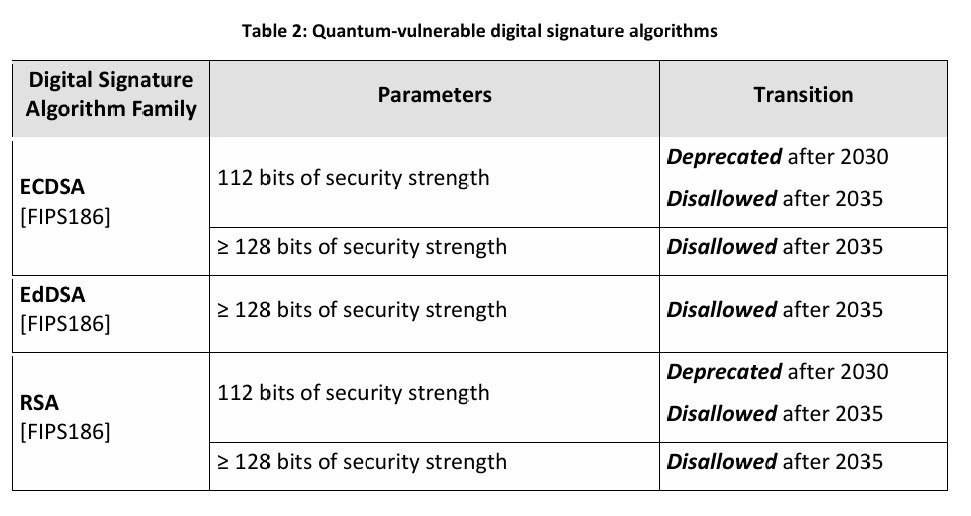
In summary, this haiku packs a dense punch of technical wit. It’s referencing the sophisticated world of elliptic curve math—rife with finite fields, modular arithmetic, and intractable problems—and shoving it starkly into a scenario governed by social norms and emotional intelligence. The result is a delightfully nerdy fiasco that only makes sense if you know both worlds. For those who do, the phrase “She got an elliptic curve” is hilariously over-the-top as a proposal stunt. It’s like proposing with an encryption key: mathematically priceless, romantically worthless. And for the cryptography aficionados reading the haiku, there’s an extra chuckle in realizing that rings and curves also have specific meanings in math – so it’s a multi-layered pun. The haiku format (5-7-5 syllables) is just the cherry on top, adding an aesthetic structure to a joke already structured by mathematical concepts. This level of humor operates in a rarefied zone: you need to know your CyberSecurity and your calculus to fully appreciate why this is comedic gold (or should we say, 24K cryptographic gold?). It’s a proud display of niche knowledge, presented in the most ironically inappropriate context imaginable.
Description
A screenshot of a tweet from Zachary Peterson (@znjp). The image shows his profile picture, a smiling man in a collared shirt, next to a three-line poem. The text reads: 'She wanted a ring / She got an elliptic curve / Now I am single'. Below the poem is the hashtag '#SecurityHaiku'. The background is plain white. This meme uses a pun to create humor, contrasting the romantic expectation of a proposal (a 'ring') with a highly technical concept from cryptography. Elliptic Curve Cryptography (ECC) is a powerful method for securing communications. The joke lies in the absurdity of a tech professional being so engrossed in their field that they would offer a mathematical construct instead of a symbol of commitment, leading to the predictable end of the relationship. It's a niche joke that resonates with anyone in the security or cryptography space who understands the term 'elliptic curve.'
Comments
7Comment deleted
Their relationship suffered from a key exchange problem: she wanted a diamond, he offered a Diffie-Hellman
Turns out “I got you something with perfect forward secrecy” is less romantic when the ring involves O(log p) point multiplication instead of a Tiffany SKU - proposal rejected like an unauthenticated TLS handshake
She should've known something was wrong when I said our relationship needed perfect forward secrecy and my commitment came with a 256-bit guarantee
The real tragedy here isn't the breakup - it's that he probably spent three hours explaining why secp256r1 offers better security properties than a diamond's resale value, complete with whiteboard diagrams of point multiplication. At least with elliptic curves, you can mathematically prove the relationship is secure... unlike the one he just lost
Proposed with ECC - smaller keys, bigger mistake; apparently the only ring she wanted wasn’t in the signature scheme
Elliptic curves: ECDH handshakes seal secure connections, but never proposals
Pro tip: “put a ring on it” isn’t a request for P‑256 - commitment latency trumps cipher strength; handshake failed, no mutually supported ciphersuite