A Mind-Blowing Realization About the Future of Corporate Competition
Why is this IndustryTrends Hype meme funny?
Level 1: Lemonade Stand Scheme
Imagine two kids have lemonade stands. One kid, Alice, has a fancy space-themed lemonade stand (maybe her parents gave her a big budget, like the rich space company). Another kid, Ben, has a normal lemonade stand (he’s like the regular Earth business). Alice wants everyone to buy lemonade from her only. Instead of just making better lemonade, she does something sneaky: she tells the school teacher and parents that Ben’s lemonade stand is using plastic cups that hurt the environment. Everyone cares about the playground being clean and green, so the parents create a new rule: no lemonade stands can use plastic cups. Ben can’t afford the special eco-friendly cups, so he has to close his stand. Meanwhile, Alice can afford the fancy cups (she had more resources all along), so her lemonade stand is the only one left. She basically pretended to be very concerned about the environment to get a rule made that just so happens to knock out her friend’s stand. Alice looks like a hero for “saving nature,” and at the same time, she gets what she wanted: no competition for selling lemonade. The meme’s joke is like that – it’s funny (and a bit shocking) because Alice wasn’t really just being kind; she was being clever to win, all while wearing a big green smile.
Level 2: Greenwashing 2.0 Unpacked
Let’s break down the joke in simpler terms. The meme suggests that in the future, space mining companies (businesses that plan to extract minerals from outer space, like asteroids or the Moon) might spend a ton of money on environmental causes on Earth. Why? To make Earth mining companies look bad or get them regulated out of business. Those Earth-based mining companies are the “terrestrial competitors” – terrestrial just means “of the Earth.” So basically, space miners would invest in Earth environmental campaigns to help pass strict green laws or build public pressure that shuts down mines here on the ground. It’s like saying: “We care about Earth’s environment so much, let’s ban dirty mining!” – and coincidentally, that leaves the space miners as the only source of those metals (cha-ching 💰).
A key term here is greenwashing. Greenwashing is when companies pretend to be environmentally friendly just to improve their image (for example, a polluting oil company running ads about how green and sustainable they are). The meme describes an extreme version, almost a “greenwashing 2.0.” Instead of just making ads, these future companies would literally fund environmental groups or initiatives. It looks generous and green, but the ulterior motive is to undermine their rivals. This is a form of corporate strategy: win the market by changing the rules in your favor rather than by pure competition. Sometimes this is jokingly called regulatory warfare – using regulations (laws and rules) as weapons against competitors. If new environmental rules make it impossible for Earth mines to operate, the space mining startup wins by default.
We can also talk about environmental lobbying: lobbying means trying to influence lawmakers or public policy. So environmental lobbying is pushing for stronger environmental protections. Usually that’s done by genuine activists and NGOs for the planet’s sake. But here we imagine space companies sponsoring that lobbying for profit motives. It’s a cheeky twist on StartupCulture. Many startups love to say they are “saving the world” or “making life better.” They pepper their pitches with buzzwords like “sustainable,” “green tech,” “clean innovation.” In reality, some also play hardball behind the scenes. This meme jokes that a space startup might take the saving Earth idea so literally that they aggressively sponsor environmental rules – not only to do good, but to knock out the old-school competition.
Think of how each term connects:
- Space mining – mining in space for resources. A hyped future industry (IndustryTrends_Hype).
- Terrestrial competitors – companies on Earth doing mining. The ones who’d get hurt by new environmental rules.
- Greenwashing – superficial or deceptive claims of being eco-friendly. Version “2.0” here means a new, bigger approach: actually donating money to appear eco-friendly (and to alter the playing field).
- Corporate strategy – a plan companies use to gain advantage. In this case, the plan is funding eco-causes to indirectly win market share.
- Regulatory warfare – battling your rivals by pushing laws or regulations that make their life harder. It’s warfare with paperwork instead of weapons.
- Environmental lobbying – contacting and persuading governments or the public to adopt greener policies. Usually done by environmental groups; in our scenario, paid for by space companies.
- Astro-capitalism – a buzzwordy way to describe capitalism venturing into space. Private companies seeking profit in the cosmos (like mining asteroids for $$$) and acting like big industries always have.
- Tech hype cycle – the pattern where new tech ideas get a lot of excitement and promises (sometimes Buzzwords galore), then reality hits. Space mining is at that super-excited stage in a lot of talks. This meme plays with one wild idea from that excitement.
- Startup culture – the ethos of startups, often involving bold, world-saving mission statements, disruptive ideas, and sometimes a “move fast and break things” attitude. Here it’s “move fast and break Earth’s mining industry (while claiming to save Earth)”.
So the meme is funny because it takes the noble idea of protecting the environment and shows a sneaky ulterior motive. It’s saying, what if a future space mining startup’s way to “help Earth” is actually a sneaky business move? The top character says “blow my mind,” and the other delivers this shocker: that environmental philanthropy could be used as a competitive weapon. The bottom character’s stunned face mirrors our reaction: Whoa, that’s twisted… but I can imagine it! It’s humor with a side of truth about how businesses sometimes operate. Essentially, the meme is a commentary on CorporateCulture: even doing good (like funding green causes) can have a cynical business twist when big money and competition are involved.
Level 3: Galactic Green Gambit
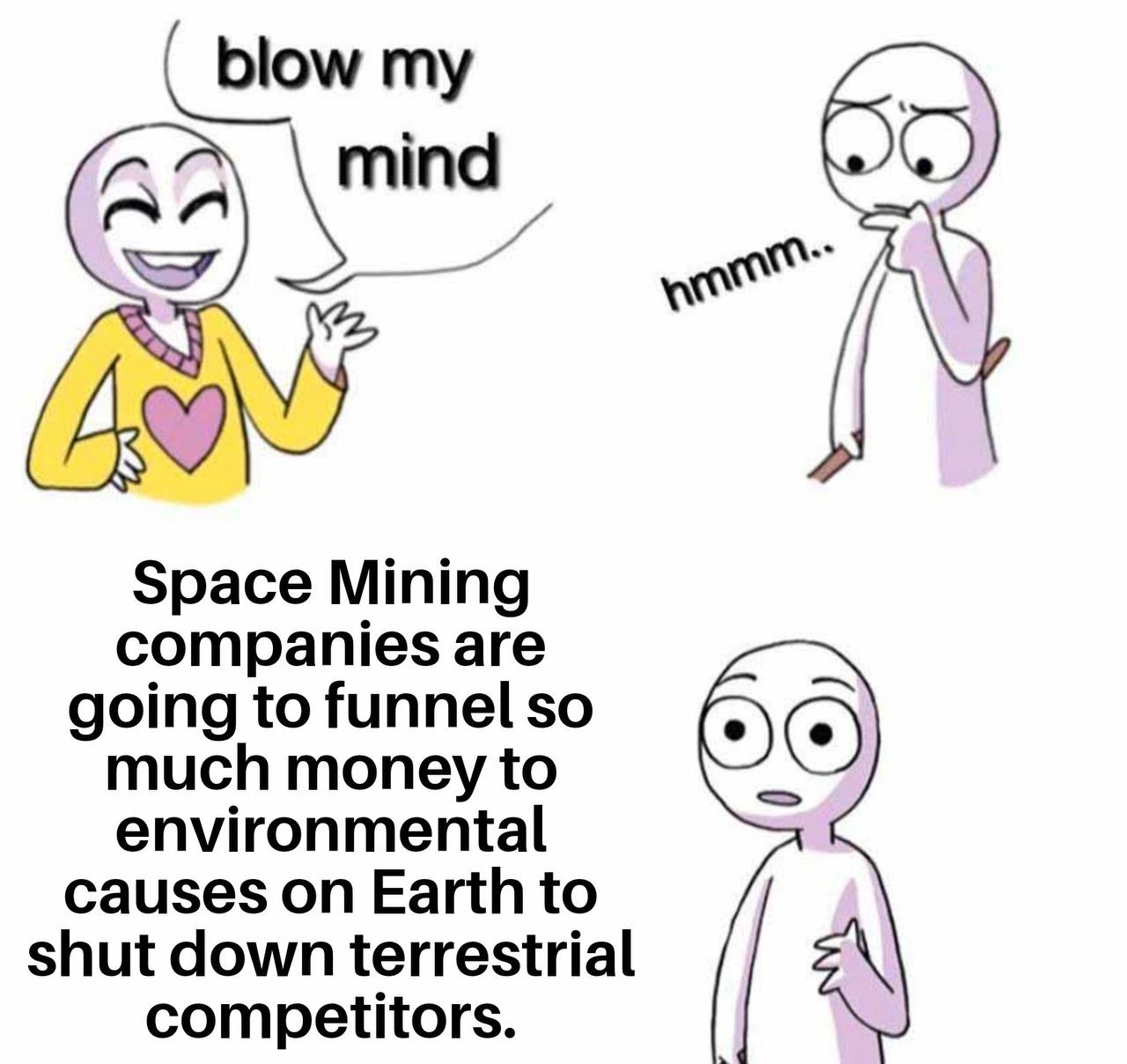
At first glance, this meme’s punchline reads like a satirical corporate master plan. In the familiar “blow my mind” format, one stick figure drops the mind-blowing idea:
“Space Mining companies are going to funnel so much money to environmental causes on Earth to shut down terrestrial competitors.”
For seasoned industry observers, this hits a darkly humorous nerve. It suggests an IndustryTrends scenario where the next big space tech hype—space_mining—weaponizes altruism as a CorporateStrategy. The absurdity (and brilliance) lies in using environmental_lobbying as a competitive tool: picture future asteroid-mining startups bankrolling huge greenwashing_2_0 campaigns on Earth. On the surface, they’re “saving the planet”; underneath, they’re tactically hobbling Earth-based mining (their terrestrial_competitors). It’s a perfect storm of TechHypeCycle exuberance and CorporateCulture cynicism. Senior tech folks chuckle (perhaps nervously) because it’s a satire with a kernel of truth about how cutthroat StartupCulture can hide behind lofty missions.
This scenario spoofs a known strategy often dubbed regulatory_warfare. Instead of out-innovating competitors, companies out-lobby them. It’s essentially corporate jiu-jitsu: using the opponent’s strength (here, public eco-conscience) against them. Historically, we’ve seen analogous tactics. There’s even an economics parable called “Bootleggers and Baptists”: during Prohibition, illegal bootleggers secretly supported the “Baptists” pushing for alcohol bans – the moral crusaders got their prohibition (satisfying their cause), and the bootleggers got rid of legal competition (boosting their profits). In our meme, space miners play the bootleggers, gleefully funding environmental “Baptists” who campaign to restrict Earth mining. The result? Astro_capitalism gains a monopoly, all while wearing a halo of eco-friendliness. 🤖 Greenwashing 2.0 indeed – it’s like classic greenwashing (making a polluting business look eco-friendly) but taken to a Machiavellian extreme where philanthropy becomes a weapon.
Why is this funny to a tech veteran? It’s plausible in a crazy way. We’ve all seen big tech and startups cloak themselves in “making the world better” rhetoric while engaging in ruthless tactics. This meme riffs on that dissonance. The idea of space mining has been an IndustryTrends hype for years – think of bold startups promising limitless asteroid resources, backed by billionaire investor excitement. In the real world, such companies talk about saving Earth’s environment by moving dirty mining off-planet. The meme takes that noble narrative and gives it a wicked twist: what if those same companies don’t just talk green, but actively buy green policies to eliminate their Earth-bound rivals? It’s an outrageous escalation that highlights how Buzzwords and idealism can be co-opted as corporate artillery. Seasoned devs and engineers have sat through enough all-hands meetings and heard enough “disruptive, sustainable, mission-driven” pitches that this kind of cynical endgame, while exaggerated, feels uncomfortably familiar.
In the big picture, the “Galactic Green Gambit” is poking fun at the future of competition. Space mining isn’t mainstream yet, but the meme imagines its hype cycle peaking with massive budgets not only for R&D and rocket fuel, but for lobbyists and PR campaigns on Earth. It’s CorporateCulture satire: the space miners might win not by better tech alone, but by outmaneuvering old industries via politics and public opinion. For a tech historian type, it echoes the robber baron era 2.0 – instead of railroads and oil monopolies, we have asteroid miners using Save the Earth slogans as a smoke screen. The humor has a wry bite: we expect StartupCulture to “think outside the box,” but funneling space cash into environmental NGOs to bankrupt your earthly competition? That’s some next-level thinking outside the atmosphere. The final panel’s wide-eyed shock captures our realization: oh wow, they could actually do that! It’s a laugh of both surprise and rueful agreement that in a high-tech future, even green ideals might be leveraged in hostile takeovers.
Description
This is a three-panel comic meme format that illustrates a surprising insight. In the first panel, a cartoon character with a purple hue and a yellow shirt says, 'blow my mind'. In the second panel, another character looks thoughtful, with the text 'hmmm..' next to them. The third panel shows this second character with wide, shocked eyes, representing their mind being blown by the text presented in the bottom left. The text that causes this reaction is: 'Space Mining companies are going to funnel so much money to environmental causes on Earth to shut down terrestrial competitors.' The humor is derived from this cynical but clever prediction about future capitalism. It reframes a seemingly altruistic act (funding environmental causes) as a ruthless, strategic business move to eliminate competition by lobbying for regulations that would only affect their Earth-based rivals. This resonates with a tech-savvy audience that appreciates systems thinking and the often-unintuitive drivers of business and technology
Comments
7Comment deleted
They're not just disrupting a market, they're launching a DDoS attack on terrestrial mining, where the payload is a massive donation to the Sierra Club
It’s the ultimate ‘serverless’ strategy - just outsource your externalities to an asteroid and call the Earth API deprecated
Just like how we deprecated jQuery by funding React development, space mining companies will deprecate Earth mining by funding Greenpeace - it's the ultimate 'git push --force origin/environment' strategy
The ultimate regulatory arbitrage: when your competitive advantage isn't just being in a different market segment, but literally being in a different gravitational well. It's the enterprise architect's dream - build such a massive moat that your competitors need to violate the laws of physics to cross it, then lobby to make their current operations economically unviable. Classic 'embrace, extend, extinguish' strategy, except the 'extend' phase involves leaving the planet entirely. Who needs antitrust enforcement when you can just make Earth-based operations so regulated they collapse under their own compliance weight?
ESG as a feature flag: set earth_mining=false and let the regulatory_capture pipeline run - cheaper than a DDoS, and it scales to orbit
Classic startup pivot: Offload terrestrial mining to 'microservices' powered by enviro-lobbyist pods - orchestrated for total Earth cluster shutdown
Space mining’s GTM is Regulation‑as‑a‑Service: fire a “save Earth” webhook and return 451 Unavailable For Legal Reasons to every terrestrial competitor