Skip to content
DevMeme
6190 of 7435
AstroForge Promotes Asteroid Mining as the 'Based' Solution to Earth's Resource Scarcity
IndustryTrends Hype Post #6787, on May 23, 2025 in TG

AstroForge Promotes Asteroid Mining as the 'Based' Solution to Earth's Resource Scarcity

Why is this IndustryTrends Hype meme funny?

Level 1: Space Shopping Trip

Imagine you really, really want a special toy, but every store in your city has sold out of it. There’s just none left on Earth that you can easily get. That’s frustrating, right? Now, instead of saying “Oh well, I’ll wait or find a different toy,” your friend jokes, “No worries! I heard there are tons of that toy on the Moon. Let’s just take a rocket and go get some from space!” It sounds silly and over-the-top – you’d probably giggle at how ridiculous that idea is.

This meme is funny for a similar reason. Grown-ups in tech need certain materials (kind of like special ingredients or parts) to make cool gadgets and machines. Lately, those parts have been hard to get, like the toy that’s sold out. It’s causing delays and headaches. So someone made a joke: “If we can’t find these materials around here, let’s go all the way to outer space and fetch them from asteroids!” Asteroids are rocks that float in space, and some might have the stuff we need. But going to space to mine things is like going on the craziest, farthest shopping trip ever. It’s thousands to millions of times farther than a trip to the store – more like a trip to another world! It’s such an extreme solution that it makes people laugh. We know nobody’s actually going to do their shopping on an asteroid today; the joke just shows how desperate or creative people feel when they can’t get what they need easily. It’s like saying, “I’ll go to the ends of the universe to get this thing I want!” – a funny exaggeration that helps us smile about a tough situation.

Level 2: Asteroid Mining Crash Course

Let’s break down the meme’s idea in more straightforward terms. The tweet shown is from a company (@astroforge) hyping asteroid mining – that means harvesting minerals and metals from asteroids in space. Why talk about mining space rocks? Because critical materials used in our gadgets and hardware are becoming hard to find or expensive on Earth. These can be things like lithium (for batteries), cobalt (for electronics), or the so-called rare earth elements (special metals used in everything from smartphones to wind turbines). Despite the name, rare earths aren’t magically scarce like gold; they’re “rare” because they’re hard to mine in large, pure quantities. Modern tech needs a lot of these materials, and right now we mostly dig them out of the ground in a few places on Earth. That leads to resource_scarcity and sometimes political or trade headaches – for example, if one country controls most of the supply, they can limit access, causing a hardware_supply_crunch worldwide.

Now, the meme jokes that the supply-chain backlog – basically the big delay in getting new hardware and components – has extended “all the way to the Kuiper Belt.” A backlog in supply chain terms is the pile-up of orders that haven’t been fulfilled on time. In recent years, people ordering new cars, gaming consoles, or high-end GPUs learned this word well, because they were waiting months for products due to a global supply backlog. The meme exaggerates this to a galactic scale: the Kuiper Belt is a region of our solar system way past Neptune that’s full of asteroids and icy bodies (Pluto is one of the famous Kuiper Belt objects). By saying the backlog goes to the Kuiper Belt, it humorously suggests we’re now sourcing parts from the far outer solar system – an obvious joke about how slow and far-fetched the supply line has become. It’s like saying, “We have to go extraterrestrial to get our next shipment of chips!” The Kuiper Belt reference is especially extreme because even among space-mining ideas, Kuiper Belt objects are really far away – much farther than the main asteroid belt between Mars and Jupiter. It emphasizes the ridiculous scale of this idea.

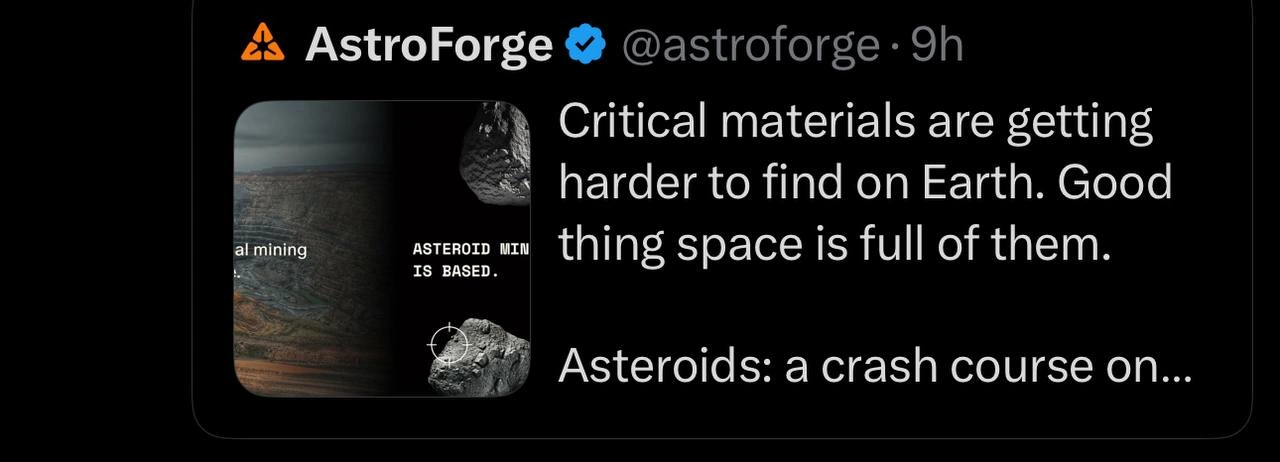
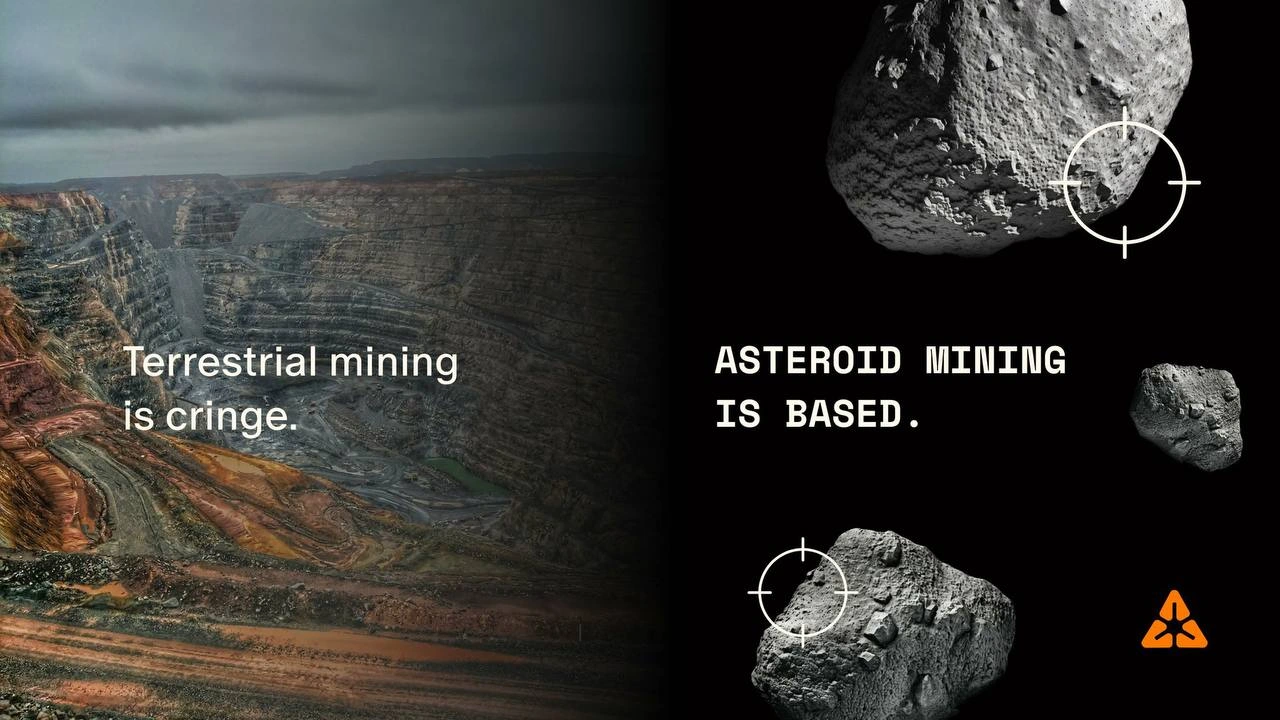
The image itself is split in two: on the left, you see a large open-pit mine on Earth (the kind of huge hole where companies extract metals or minerals). You can make out the terraced slopes and the earth tones of rock and soil. This represents the old way: digging up Earth for resources. On the right side, it’s almost pure black (the darkness of space) with two pictures of gray, cratered asteroids. One asteroid image is near the top-right, and another smaller one is near the bottom with a little white targeting reticle (crosshair) drawn over it, as if to say “this is our mining target.” Between these asteroids, written in bold white monospace font, are the words “ASTEROID MINING IS BASED.” That phrase is intentionally a bit confusing at first glance. In internet slang, calling something “based” is a very online way of saying it’s awesome, admirable, or worth supporting (it’s a meme-y term; originally it meant someone is being themselves without concern for approval, now it’s just a form of praise). So, “asteroid mining is based” is like saying “asteroid mining is cool and legit.” It’s not saying “based on what” (though it plays on that double meaning humorously by using a techy monospaced font, almost like code). The company is trying to sound confident and edgy to get people interested.

So, the tweet’s text and image together claim: Earth is running out of easy-to-get materials, but hey, look, space has plenty! It even teases an educational thread or article (“Asteroids: a crash course on…”) likely meant to get readers to learn more (and indirectly to buy into the hype). This is where IndustryTrends_Hype and StartupHumor come in. Space startups – new companies aiming to do business in space – often use grand language about the future_of_manufacturing or solving Earth’s problems with space resources. It’s part of the TechHypeCycle: a new idea (like asteroid mining) goes from being unknown, to over-hyped as the Next Big Thing, and then (sometimes) to a reality or a disappointment. Right now, asteroid mining is mostly hype and early experiments; no one has actually brought back an asteroid full of gold or platinum to sell. But startups like AstroForge use that hype to attract interest, talent, and investment. They throw around buzzwords: “critical materials,” “limitless resources,” “space is full of them” – these phrases get engineers and investors excited about a futuristic solution to a current problem.

From a junior developer or tech newcomer perspective, it helps to know why these materials matter. For instance:

  • Your smartphone’s tiny vibration motor and speakers use rare earth magnets (neodymium is a common one) to be small but strong.
  • High-performance computer chips might use a bit of element like tantalum or gallium in their manufacturing process.
  • Electric car batteries need a lot of lithium and cobalt.

If these resources become harder to source, everything gets more expensive or delayed — hence the hardware tradeoffs: do we find new mines on Earth (which could be costly and environmentally damaging), recycle more aggressively (slow and limited), or look to totally new frontiers like asteroid_mining? The meme cuts to that wild third option with a laugh. It’s essentially saying: “We’re so desperate for parts, maybe we’ll mine asteroids next!” – a sentiment a techie might joke about after reading one too many news articles about chip shortages or a hardware_supply_crunch stopping them from getting a new graphics card.

Also, let’s clarify the Kuiper Belt bit in simpler terms: Imagine the solar system as a series of zones. We live on Earth, which is the third planet from the sun. Between Mars and Jupiter, there’s the Asteroid Belt, which is where most asteroids in the inner solar system hang out. Now go much further out, past all the planets to the region around Pluto and beyond – that’s the Kuiper Belt. It’s like an even larger, further ring of floating rocks, ice, and dwarf planets. It’s far. For context, the Asteroid Belt (where people first imagine mining) is about 2-3 times farther from the Sun than Earth is. The Kuiper Belt is about 30+ times farther out than Earth. We’re talking billions of kilometers/miles away. No one is seriously proposing we send miners or robots to the Kuiper Belt for resources anytime soon – it would take decades just to travel there and back with current tech. So when the meme says the backlog goes to the Kuiper Belt, it’s definitely a hyperbole to make us chuckle. It’s using extraterrestrial_supply_chain as an absurd concept: a supply chain so stretched that it literally leaves the planet, leaves the solar system’s inner parts, and goes way out to its fringes. This exaggeration lands as humor because it highlights how crazy the idea of fixing supply issues with space mining feels right now.

In simpler terms, this meme is an HardwareHumor snapshot of how some startups respond to a real problem. The real problem: “We can’t get enough X to build our tech on time.” The wacky proposed fix: “Let’s get X from asteroids in space.” It’s both a bit sarcastic (since the person sharing the meme likely finds the company’s tweet overly optimistic) and a bit hopeful (because, hey, what if someday it works?). If you’re newer to the tech scene, know that this is common: big bold ideas emerge whenever we hit a wall with current methods. Some are genuinely promising, others are more like publicity stunts. Part of learning the industry is telling which is which. Here, asteroid mining is an extreme example – definitely in the realm of speculative_venture right now. That’s why it’s grouped with StartupHumor: we’re kind of poking fun at the starry-eyed startup playbook where the solution to any earthly problem is, quite literally in this case, out of this world.

Level 3: Kuiper Belt Backorders

At the highest level, this meme riffs on hardware supply woes by taking them to a cosmic extreme. It’s a screenshot of a tweet from a space-mining startup (AstroForge) that boasts: “Critical materials are getting harder to find on Earth. Good thing space is full of them.” In the image, we see an open-pit mine on Earth contrasted with asteroids floating in the void. A bold monospaced caption in the preview flatly proclaims ASTEROID MINING IS BASED. This tongue-in-cheek wording immediately stands out to seasoned engineers — it mixes TechHypeCycle buzz with internet slang in a way that screams startup bravado. The very title given to this post, “When the supply-chain backlog extends all the way to the Kuiper Belt,” telegraphs the joke: our part shortages are so bad, we’re jokingly sourcing inventory from beyond Neptune.

On a serious note, experienced folks recognize the IndustryTrends_Hype being poked at here. Over the past couple of years, the hardware supply crunch has been painfully real. Lead times for new servers, GPUs, and other components skyrocketed due to global supply-chain snarls and resource constraints. If you tried to order a high-end GPU during the chip shortage, you might’ve waited months — it felt like an eternity. This meme wryly exaggerates that feeling: “Don’t worry, the new GPUs are coming… they’re just being mined from an asteroid in the Kuiper Belt, so give it a few years.” Seasoned engineers have been through these shortages (memory chips in the 80s, hard drives in the 2010s, and the recent silicon drought) and have heard grandiose solutions before. When a startup cheerfully tweets that asteroid_mining will save the day, the veteran eye-roll is tempered by humor: we want it to be true, but we’ve seen enough TechHypeCycle promises to know better.

This leads to the core comedic contrast: terrestrial vs. extraterrestrial supply chain. On the left of the image, a sprawling open-pit mine represents business-as-usual for sourcing critical materials — it’s dirty, finite, and increasingly insufficient. On the right, the vast darkness of space dotted with asteroids represents the speculative venture of off-world mining — tantalizingly abundant, but absurdly distant. By stating “space is full of them,” the tweet hits a classic StartupHumor note: it sounds like a Silicon Valley optimist’s fix to a real problem, delivered with casual confidence. Engineers recognize the subtext: sure, asteroids are rich in platinum, gold, and rare elements, but getting them is an entirely different story. Resource_scarcity on Earth has met its meme match in extraterrestrial_supply_chain optimism. The phrase “extends all the way to the Kuiper Belt” underscores how outlandish this is — the Kuiper Belt is far (way past Pluto!), far beyond even the main asteroid belt where most asteroid mining dreams focus. For the senior crowd, that specific reference is a wink: it caricatures hype by pushing it to the last stop in the solar system. It’s as if the meme is saying, “Our backlog isn’t just global, it’s interplanetary, folks.”

Experienced devs and hardware folks also catch the cheeky use of the word “based” in ASTEROID MINING IS BASED. In internet parlance, “based” means cool, grounded in truth, or worthy of respect (originating from meme slang, largely outside formal tech). Seeing it in a corporate-ish tweet preview is jarring and amusing. It’s a deliberate buzzwordy crossover aimed at the tech-savvy Twitter audience. Essentially, AstroForge is meme-ing while marketing: calling asteroid mining “based” both endorses the idea enthusiastically and nods to meme culture. Developers fluent in meme-speak chuckle at the audacity — it’s like a CEO suddenly saying “this AI is lit fam 🔥” in a press release. It’s funny because it’s a startup adopting the voice of internet insiders, blurring professional boldness with shitpost-y flavor.

Underneath the humor, there’s truth that senior engineers appreciate: modern technology depends on exotic materials (from lithium and cobalt in batteries to neodymium in high-strength magnets and certain rare earth elements in electronics). We’ve seen hardware tradeoffs firsthand — want a more powerful EV battery or a faster processor? You might need more palladium, more tantalum, more gallium. But those resources often come from geopolitically fraught or limited sources on Earth. The meme riffs on an IndustryTrends_Hype solution to that very predicament: if Earth’s supply is limited or politically tricky, startups say “look to space.” Indeed, companies over the past decade (Planetary Resources, Deep Space Industries, and now outfits like AstroForge) have pitched asteroid mining as the next gold rush. Many of us remember the fanfare when those ventures launched — and the quiet fizzle when timelines slipped and funding dried up. This historical cycle isn’t lost on the older crowd. So when AstroForge tweets a “crash course” on asteroid riches, the senior engineers grin knowingly. It’s not (just) cynicism; it’s the shared experience of having witnessed grand visions collide with physics and economics. We’ve heard “unlimited resources in space” before, and while it’s scientifically plausible (asteroids do contain immense metal wealth), the gap between a slide deck and a shippable solution is, well, about 3.7 billion miles wide (roughly the distance to the Kuiper Belt).

In a way, the meme is a playful mirror held up to our TechHypeCycle habits. It captures how hype can leap from genuine problem (resource scarcity & supply bottlenecks) to almost sci-fi answer (asteroid mining supply chain) in a single breathless tweet. The seasoned perspective finds the humor in that leap. It’s funny because it’s true — tech startups often do pitch moonshot ideas when conventional approaches falter. At the same time, it’s funny because it’s ridiculous — we’re not solving today’s GPU shortage by slingshotting rockets to the outer solar system… at least not this sprint. The meme format lets veterans laugh at the absurdity while nodding to the real frustration of waiting for hardware. After all, when your server order has been delayed for six months, joking that it’s “stuck in orbit around Neptune” is a coping mechanism as much as a quip. In summary, this level reveals how the meme blends StartupHumor, HardwareHumor, and a hefty dose of IndustryTrends_Hype satire, creating a joke that hits home for anyone who’s been at the mercy of a supply chain — or a venture capitalist’s wild solution to it.

Description

A screenshot of a tweet from the verified account AstroForge (@astroforge). The tweet text reads: "Critical materials are getting harder to find on Earth. Good thing space is full of them. Asteroids: a crash course on...". Below the text is an embedded image split into two parts. The left side shows an aerial view of a massive open-pit mine on Earth with the words "Terrestrial mining" partially visible. The right side is black, featuring two detailed illustrations of asteroids. Overlaid text declares "ASTEROID MINING IS BASED." with one of the asteroids marked by a circular target graphic. This image is a promotional piece for asteroid mining, a concept involving the extraction of valuable minerals and materials from asteroids and other near-Earth objects. For a technical audience, it touches upon themes of resource depletion, supply chain logistics for the tech industry (which relies on rare earth metals), and the immense engineering and robotics challenges of space-based extraction. The use of the slang term "based" is a self-aware attempt to connect with a younger, tech-savvy audience, humorously framing a high-concept industrial process in meme-like terms
Comments

7
Anonymous ★ Top Pick Our current tech stack is built on rare earth minerals. The next-gen stack will apparently be built on rare asteroid minerals. Hope the latency is better
  1. Anonymous ★ Top Pick

    Our current tech stack is built on rare earth minerals. The next-gen stack will apparently be built on rare asteroid minerals. Hope the latency is better

  2. Anonymous

    Procurement said lead times for new GPUs hit 18 months, so the architects added “mine asteroid, then terraform” to the CI pipeline - finally a use-case where ‘multi-region deployment’ is truly planetary

  3. Anonymous

    Just like how we keep mining npm for packages that somehow solve our exact problem, AstroForge wants to mine asteroids for rare earth elements. The difference is, when an asteroid dependency crashes your system, it's literal

  4. Anonymous

    When your startup's elevator pitch is literally 'we're going to space because Earth's resources are running out,' you know we've reached peak Silicon Valley optimism. Nothing says 'sustainable business model' quite like asteroid mining - where the only thing harder than the technical challenges is explaining to investors why your Series A runway needs to account for orbital mechanics. At least when this crashes, it'll be a literal crash course

  5. Anonymous

    Critical materials scarce on Earth? Good - finally a supply chain where dependency hell involves literal asteroid collisions, not just yanked npm packages

  6. Anonymous

    New procurement OKR: implement a multi‑asteroid strategy - lead time is now the next launch window; please add Hohmann transfers to the sprint board and express SLOs in synodic periods

  7. Anonymous

    When procurement calls Earth a single point of failure and proposes “multi‑planet redundancy,” you know someone thinks the CAP theorem stands for Cobalt Availability Partition

Use J and K for navigation