Skip to content
DevMeme
431 of 7435
The Esoteric Depths of Sorting Algorithms
CS Fundamentals Post #499, on Jul 31, 2019 in TG

The Esoteric Depths of Sorting Algorithms

Why is this CS Fundamentals meme funny?

Level 1: Below the Surface

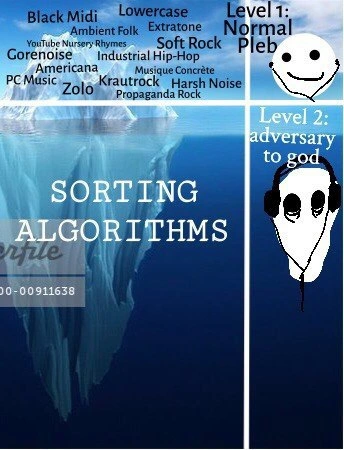
Imagine an iceberg in the ocean. You see a small bit sticking out on top – that’s what everyone notices. But most of the iceberg is hidden underwater, huge and mysterious. This meme says knowing a bunch of fancy-sounding things (like rare music genres: think of someone who can name dozens of cartoon shows or candy types just to impress others) is just the tiny tip of the iceberg. The big part under the water is like understanding something really fundamental and important – in this case, how sorting works in computers. It’s making a funny point: anyone can list a bunch of names (that’s easy, like showing off you know 50 Pokémon or every kind of ice cream flavor), but truly understanding a core idea (like figuring out how to quickly organize a messy pile of numbers or cards) is a much deeper skill. It’s the difference between knowing names and knowing how. So the meme jokes that learning those deep computer science ideas (sorting algorithms) is a far bigger deal than the shallow stuff on top. In simple terms: surface knowledge is easy, but real knowledge lies below the surface, hidden and huge – just like an iceberg.

Level 2: Beyond .sort()

Let’s break this down in simpler terms. Sorting algorithms are methods for organizing a list of items (like numbers or words) into order (say, smallest to largest). If you’re a beginner or junior developer, you’ve probably used library functions like Python’s list.sort() or JavaScript’s array.sort() and seen your data magically ordered. It feels simple on the surface – just call the function and you’re done – just like someone casually naming a bunch of music genres without context. But what’s happening behind that .sort() call is anything but simple. The meme’s iceberg metaphor is perfect here: the part of the iceberg you see (above water) is calling .sort() or knowing a few famous algorithm names, but the gigantic part hidden below is how sorting actually works and how much there is to know about it.

Think of some common sorting algorithms you might have heard of in a CS class or online tutorial: Bubble Sort, Selection Sort, Insertion Sort, Merge Sort, QuickSort, Heap Sort. Each of these is a step-by-step procedure to rearrange items. For example, Bubble Sort repeatedly swaps out-of-order neighbors and is very simple to code – but it’s notoriously slow for large lists (it takes about O(n^2) steps for n items, meaning if you double the number of items, it takes four times as long to finish!). On the other hand, QuickSort uses a clever “divide-and-conquer” strategy to sort much faster on average – roughly O(n log n) steps, which scales way better for big lists. If those notations are unfamiliar: Big O notation is a way to talk about how an algorithm’s running time grows as the input size (n) grows. It’s like saying, “Bubble sort takes on the order of n squared steps” vs “Quicksort takes on the order of n times log n steps.” The lower the exponent or slower the growth, the faster the algorithm for large inputs. An O(n log n) algorithm (like QuickSort or Merge Sort) will outperform an O(n^2) algorithm (like Bubble Sort) as soon as n becomes even moderately large.

Now, the meme labels an everyday person as Level 1: Normal Pleb (pleb is slang for a regular, unexceptional person) and the deep expert as Level 2: adversary to god. This dramatic wording is just for humor—no one is literally challenging deities here! It’s saying that to reach Level 2, you must dive so deep into knowledge that you’re almost on a god-like level in that domain. In our context, that domain is sorting algorithms and CS fundamentals. A “normal pleb” developer might only remember the basics: maybe they recall that Merge Sort is “good” and Bubble Sort is “bad” performance-wise, or they just know how to call a sort function and get results without thinking how it works. That’s like someone who can list a bunch of niche music genres just because they saw them in a YouTube video, but doesn’t necessarily understand or appreciate the music itself.

To go Beyond .sort() means to peek behind the curtain of that sorting function. A curious junior might ask, “How exactly is my array being sorted when I call this?” and discover, for instance, that Python’s sorting is done by Timsort, which is a hybrid algorithm designed to be super efficient on real-world data patterns (it’s the reason sorting an already nearly-sorted list is very fast in Python). Or they might learn that in C++, the std::sort typically uses Introsort – which is QuickSort that switches to Heap Sort in worst-case scenarios to avoid pathologically slow performance. These details show that there’s a lot of algorithm design and decision-making happening in something as “simple” as sorting. It’s like learning that your car’s automatic transmission isn’t magic – it’s a complex system of gears that shifts intelligently as you speed up, and knowing about it helps you use it better (or fix it when it breaks).

The iceberg meme format (iceberg_meme_format) usually implies that what most people know is just the “tip.” Here, all those weird music categories at the top are things a know-it-all novice might spout to seem knowledgeable. The giant block of SORTING ALGORITHMS below suggests that real knowledge in the tech world runs much deeper. As a learner, you start with “What is sorting? I can sort a list of numbers.” That’s above the surface. Then you learn different algorithms to do it, and each has its pros and cons – you go a bit underwater. Then you learn about AlgorithmComplexityAnalysis, maybe why some sorts are faster, the idea of worst-case vs average-case performance – you’re now diving deeper. Further down, you might explore how to sort huge data that doesn’t even fit in memory (using external merge sort on disk, for example, or distributing sorting work across multiple machines). By this point, you’re far below the casual knowledge zone and definitely no longer a “pleb”!

The meme wording “adversary to god” is likely just a humorous way to say “next-level boss mode”. In games or myths, an adversary to a god is an incredibly powerful being. In the context of someone learning sorting algorithms, it suggests an expert who has basically mastered a foundational skill so well that they stand out remarkably. It’s not mocking religion or anything – just an exaggerated metaphor common in internet humor. And the little ghost-like figure with headphones at Level 2 could be a random spooky/funny image to represent this super-expert (maybe suggesting they’ve become a bit “inhuman” or transcendent with knowledge, in a playful way).

To sum up this level: sorting_algorithms_depth refers to how much deeper the computer science concepts go beyond what beginners see. This meme compares it to memorizing a list of rare music genres. Anyone can list names (you could memorize “Ambient Folk” or “PC Music” in a few minutes), but it takes real study and practice to understand algorithms thoroughly. The humor and truth here is that learning fundamentals like sorting might actually be a steeper, more meaningful challenge than collecting trivia. And once you do learn those fundamentals, you’ll see the tech world differently—like realizing the iceberg beneath the waterline has been supporting everything above all along.

Level 3: Algorithmic Abyss

At first glance, the meme humorously contrasts obscure music trivia with the vast depth of sorting algorithms. Seasoned developers will recognize that beneath the surface of even “simple” tasks like sorting lies a whole iceberg of complexity—much like the hidden bulk of an iceberg under water. The dozens of niche genre names (from Black Midi to Gorenoise) are analogous to superficial factoids one might collect without much effort. In contrast, the gigantic SORTING ALGORITHMS text submerged below hints at the profound computer science fundamentals that truly separate a “Normal Pleb” from an “adversary to god”. This is an exaggeration, of course, but it playfully suggests that mastering algorithm design and Big O notation is an almost divine-level feat compared to memorizing random lists.

For the veterans in algorithm design, the joke hits a sweet spot. Sorting algorithms are among the first topics in CS classes, yet their mastery is anything but trivial. While a newbie might think “sorting is solved—just call sort() and done,” experienced devs know there’s an entire universe under the hood. Realizing that the Python sorted() function is implementing Timsort (a hybrid adaptive algorithm combining merge sort and insertion sort) can be an eye-opener. It’s like discovering that the soft rock track you casually enjoyed was actually produced with dozens of intricate layers in the studio. The iceberg’s mass represents those hidden layers of knowledge: algorithmic complexity analysis, data structure trade-offs, and decades of research papers refining what seems straightforward.

AlgorithmComplexityAnalysis comes into play heavily with sorting. A senior developer recalls that fundamental proof: any general comparison-based sorting has a lower bound of Ω(n log n) comparisons. In other words, no matter how clever you are, you can’t sort n items by only comparing them in less than on the order of n log n steps. This isn’t just a random fact – it’s a profound truth derived from counting the number of possible orderings (n! permutations) and realizing a decision tree of comparisons must have enough leaves to distinguish all those possibilities. The meme’s phrase “adversary to god” winks at this idea: even a mythical all-knowing being can’t break the n log n barrier for comparison sorts without extra information. In algorithm theory, we often imagine an adversary providing the worst-case input or withholding information to force our sorting procedure to work hard. Here, mastering sorting algorithms means you’ve grappled with these adversarial arguments and fundamental limits, essentially challenging “god-tier” problems. It’s a playful hyperbole that resonates with those who’ve sweated over algorithm proofs – you feel like you’ve battled a deity of complexity and maybe, just maybe, held your ground.

The juxtaposition of music_genres_vs_algorithms also pokes fun at different kinds of expertise. Anyone can read Wikipedia for an hour and rattle off "Musique Concrète" or "Krautrock" and feel fancy. But understanding why QuickSort on random data averages O(n log n) time, yet degrades to O(n^2) in the worst case (and how choosing a median pivot or randomizing can fix that) – that’s deeper knowledge earned through study and failure. It’s the difference between collecting trivial knowledge (like Pokémon names or obscure music facts) and internalizing core principles that let you solve real problems. One is breadth without depth; the other is depth that can create breadth. The meme exaggerates this gap for comedic effect. In developer culture, someone who just memorizes API calls or uses libraries blindly is the “pleb” here – like someone bragging they know 100 band names. Meanwhile, the truly skilled coder who dives into algorithmic complexity is akin to a guru who can derive solutions from first principles – an “adversary to god” (i.e., almost superhuman in their understanding).

Notice the iceberg format label Level 1: Normal Pleb vs Level 2: adversary to god. This is a tongue-in-cheek hierarchy. The Normal Pleb is happy knowing a bit of surface-level stuff: maybe they remember one or two sorting methods by name (Bubble sort? That thing I learned once?) – comparable to knowing a couple of popular music genres. The Level 2 guru, however, has descended into the icy depths of the sorting_algorithms_depth. They've not only heard of Merge Sort, Heap Sort, or QuickSort, but perhaps implemented variants from scratch, analyzed their performance, and even toyed with exotic ones like Radix Sort or Counting Sort (which break the comparison model for linear time under certain conditions). To them, terms like AlgorithmDesign and BigONotation aren’t abstract academia, but daily tools. They might chuckle at the dark humor of Bogosort (an intentionally terrible algorithm that randomly shuffles items until by chance sorted – a bit like playing random notes hoping for music) or know that Stooge Sort and Gnome Sort exist (sorting algorithms so inefficient or niche they’re like the “Gorenoise” of the algorithm world). This kind of deep cut knowledge adds to the humor, as it’s the CS equivalent of being able to discuss micro-genres that almost nobody’s heard of. Except here, those micro-genres are actual sorting methods, algorithmic paradigms, or performance corner-cases that only a passionate CS_fundamentals nerd would know.

The meme is pointing out an escalation in complexity: learning a list of fancy-sounding things might impress casual onlookers, but truly grokking algorithms elevates you to another plane. It resonates especially with developers who remember struggling with sorting algorithm assignments, or preparing for coding interviews where you suddenly realize knowing why QuickSort uses divide-and-conquer or how merge sort handles data recursively is far more valuable than just knowing their names. It’s a gentle jab at those who prioritize breadth of trivia over depth of understanding. In a way, it’s also celebrating the learning journey: many of us started as “plebs” memorizing facts, but as we dive deeper (like exploring the iceberg underbelly), we transition into stronger problem solvers – maybe not literally adversaries to deities 😄, but certainly far more formidable programmers.

Description

An 'iceberg' meme format, where the tip of the iceberg, labeled 'Level 1: Normal Pleb' with a simple smiling character, is populated with various obscure music genres like 'Black Midi', 'Krautrock', and 'Gorenoise'. The vast, submerged part of the iceberg, labeled 'Level 2: adversary to god' with a distorted, intense character wearing headphones, contains the text 'SORTING ALGORITHMS'. The humor arises from the surreal and absurd juxtaposition. It treats sorting algorithms, a fundamental computer science topic, as the deep, esoteric, and almost terrifying secret hidden beneath a surface of obscure music. For developers, it's a meta-joke about the over-emphasis on algorithm theory in academia and interviews, presenting it as a comically profound and dark subject

Comments

7
Anonymous ★ Top Pick I finally reached the 'adversary to god' level. Turns out it's just knowing when to use radix sort instead of quicksort and understanding why TimSort is the default in Python
  1. Anonymous ★ Top Pick

    I finally reached the 'adversary to god' level. Turns out it's just knowing when to use radix sort instead of quicksort and understanding why TimSort is the default in Python

  2. Anonymous

    Music hipsters boast about Black Midi; real elitists debate whether Introsort’s median-of-three pivot is too mainstream - nothing says “adversary to god” like rewriting std::sort and watching the AWS bill float up from the abyss

  3. Anonymous

    The real adversary to god is explaining to the PM why your radix sort optimization saved 200ms on a batch job that runs once a month at 3am

  4. Anonymous

    The real adversary-to-god moment isn't implementing quicksort - it's explaining to a PM why you spent three days optimizing a sort that runs in 2ms instead of 3ms, only to watch them add it to a O(n³) nested loop in the UI layer

  5. Anonymous

    Pleb sorts bubble up top; god-tier devs plumb bogosort's abyss, where average case meets eternal runtime

  6. Anonymous

    Pleb tier: debating quicksort vs mergesort; adversary-to-god tier: realizing the comparator must be a strict weak ordering and yours isn’t because Product wants “VIPs first unless inactive, then newest unless EU, then alphabetical ignoring emoji” - now TimSort throws and your complexity is O(n·support tickets)

  7. Anonymous

    Everyone argues QuickSort vs MergeSort; the real boss fight is when your comparator violates transitivity, the data doesn’t fit in RAM, locale collation meets NaN, and O(n log n) quietly degrades to O(iops)

Use J and K for navigation