Skip to content
DevMeme
612 of 7435
The Recruiter's Easter Egg
Career HR Post #700, on Sep 24, 2019 in TG

The Recruiter's Easter Egg

Why is this Career HR meme funny?

Level 1: Hidden Help Wanted

Imagine you have a coloring book, and on one of the pages, written very faintly in invisible ink, there’s a secret note that says, “Hey, we think you’re really creative – want to join our art club?” You wouldn’t see that note just by casually flipping through the book. But if you’re curious and take a special light to the pages (or look very closely), you suddenly spot this hidden message. It feels exciting and exclusive, like you’ve discovered a little secret meant only for certain eyes. That’s exactly what’s happening with this website: the site looks normal to everyone, but it has a secret note tucked away in its code saying, “We’re hiring, come join our team!” Only a curious developer who peeks behind the scenes would find it. It’s funny and heartwarming because it’s like the website is whispering a private invite to the people who love to explore.

Level 2: HTML Hide-and-Seek

Let’s break down what’s happening here in simpler terms. In HTML (the language that structures webpages), anything written inside <!-- --> is an HTML comment. Comments are notes or hints in the code that browsers ignore – they don’t show up on the webpage that users see. Developers use comments to leave reminders or temporarily disable code, but in this case the comment is used for fun: it contains an ASCII art message advertising a job. Now, ASCII art means creating pictures or stylized text using the characters on your keyboard (letters, numbers, symbols). So instead of an image, the words “We are hiring” are drawn using lots of characters arranged in big letters. It’s like pixel art, but with characters. Below that, still inside the comment, there’s normal text saying they’re looking for enthusiastic developers in Zurich and even a link to the jobs page. None of this would ever appear on the actual webpage for a regular visitor – it’s hidden content meant only for those who look at the code.

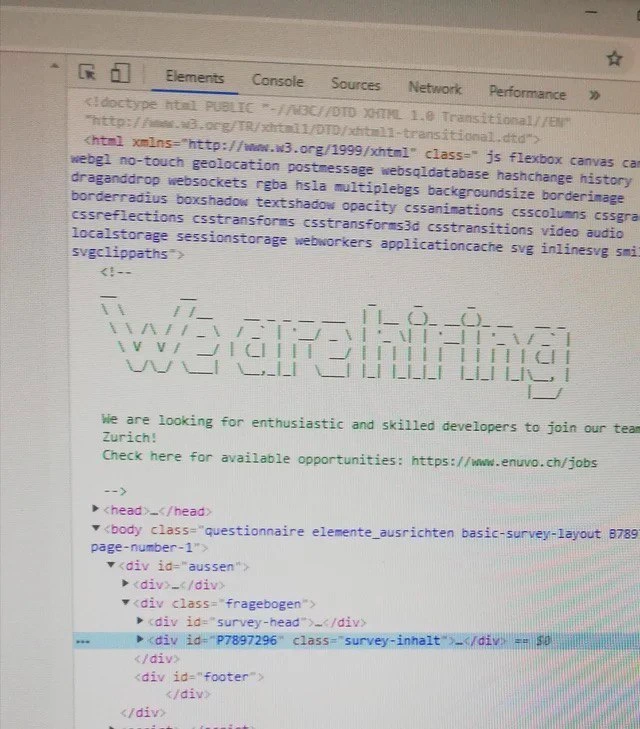
How do you even see this hidden message? That’s where the browser’s developer tools come in. Every modern web browser has a set of tools for developers (often opened by pressing F12 or right-clicking “Inspect”). One of these tools is the Elements panel, which shows you the page’s HTML structure. In the meme’s image, the person has that Elements tab open, revealing the raw HTML of the page. Scrolling through it, they found this special comment. The ASCII art stands out in the sea of code because it’s large and stylized. Here’s a simplified peek at how such a comment might look inside the HTML:

<!--
 _    _      _                         _     _           
| |  | |    | |                       | |   (_)          
| |  | | ___| | ___ ___  _ __ ___   ___| |__  _  ___ ___  
| |/\| |/ _ \ |/ __/ _ \| '_ ` _ \ / _ \ '_ \| |/ __/ __| 
\  /\  /  __/ | (_| (_) | | | | | |  __/ |_) | | (__\__ \ 
 \/  \/ \___|_|\___\___/|_| |_| |_|\___|_.__/|_|\___|___/ 

 We are looking for enthusiastic and skilled developers to join our team in Zurich!
 Check here for available opportunities: https://www.enuvo.ch/jobs
-->

Everything between <!-- and --> is ignored by the browser, so this big chunk is invisible on the page itself. But in the code view, you can read it clearly.

This clever little trick is essentially a hidden_job_posting aimed at developers. It’s sometimes affectionately called a “view_source_recruiting” strategy, because it relies on someone viewing the page source or using dev tools to find the message. The idea is that if you’re the kind of developer who habitually inspects websites’ code (maybe to learn how a feature is implemented, or just because you’re curious), then you might stumble upon this surprise. And if you do, you immediately know two things: (1) the company has a sense of humor and appreciates developers, and (2) they’re hiring and you might be a candidate. It’s basically a way to recruit that says “we only want those who find this.” Pretty neat, right?

For a junior developer or someone new to front-end, let’s also clarify why those other bits of code are there around the comment. In the screenshot, you see <head> and lots of <div> tags with classes like fragebogen or an ID like survey-inhalt. Those are just parts of the website’s layout and functionality (it looks like the page might be a survey or form given the names). The <html> tag at the top has classes like js flexbox canvas webp no-touch; these are added by a library (likely Modernizr) to indicate which features the browser supports (for example, “webp” class means the browser can display WebP images). This isn’t directly related to the Easter egg, but it tells us we’re looking at a real Frontend page with modern features. The key element of interest is the big comment in the middle with the ASCII job ad.

So, in summary: the company hid a message in the HTML code saying “We are hiring” with fancy text art and details about the job. Only someone who looks at the code (a developer, basically) would find it. It’s like a secret offer only revealed to those with the curiosity to seek it. That’s why people are saying these kinds of job adverts are the best — because they’re fun, unobtrusive, and they feel like a wink from one developer to another. If you ever inspect a site and find something like this, you’ve essentially uncovered a little html_comment_easter_egg meant just for you! It’s both a surprise and perhaps an invitation to your next career opportunity.

Level 3: Inspected Element of Surprise

Behind this seemingly normal webpage lies a cheeky convergence of WebDev cleverness and Career ambition. The meme highlights a real-world tactic where companies hide a recruiting message in the website’s source code – a literal Easter egg for developers. In the screenshot, a developer has opened the browser DevTools (the “Elements” panel) and uncovered an HTML comment with ASCII art spelling out “We are hiring”. This hidden gem is basically a covert hidden_job_posting meant only for those curious enough to peek under the hood of the site. It’s a perfect inside joke in DeveloperCulture: only the kind of person who inspects page source (likely a tech-savvy developer) will ever see this. In other words, the first test of the job is literally view_source_recruiting – if you find the ad, you’re exactly the kind of inquisitive developer they want to hire!

This blend of Frontend code and recruiting is hilarious and brilliant for a few reasons. First, it’s targeting a super-specific audience: people who recognize an HTML comment (<!-- like this -->) and love exploring the internals of a webpage. No ordinary user scrolling the site would catch a whiff of this hiring plea; it’s essentially a secret handshake for coders. Second, the company went the extra mile to render we_are_hiring_ascii_art in a comment. That’s a nod to old-school hacker culture – using text characters to draw big block letters taps into nostalgic ASCII art vibes from early computing. It immediately catches a developer’s eye when scanning the markup, like a huge neon sign in the middle of all the <div>s and <span>s. Third, it’s a form of HiringHumor that celebrates developers’ habits. Many of us have a reflex to “inspect element” on every cool site we visit (either to learn how something’s done or just to satisfy curiosity). Discovering a “We are hiring” banner hidden in there feels like the webpage just winked at you and said, “Psst, you’re one of us. Interested in joining the crew?” It’s both a recruiting tool and a compliment to the developer’s inquisitiveness.

From a senior dev perspective, there’s also an appreciation for the technical authenticity of the scene. The snippet shows real front-end details: the <html> tag is cluttered with Modernizr-generated classes like flexbox, webp, no-touch (indicating feature support in the browser), and the <body> contains structured <div>s (id="aussen", class "fragebogen", etc.). This isn’t some dummy code; it’s a production page with all the usual HiddenComplexity of modern web development – feature detection, layout containers, survey widgets – and smack in the middle of it, an Easter egg message. It’s like finding a secret note inside a car’s engine. The contrast between serious code and playful message makes it extra amusing. Only a developer comfortable with reading through that jungle of code would stumble on the ASCII “We are hiring” billboard. It’s a reward for being curious and detail-oriented. Imagine debugging an issue at 2 AM, combing through logs or HTML, and instead finding a job offer – talk about an unexpected plot twist!

This practice of hiding recruitment messages in code has popped up enough that it’s become a beloved InsideJokes trope in tech circles. It shows that the company’s dev team (and HR by extension) gets developer humor. They know that traditional ads or HR emails might be ignored, but a sly message in the source will make developers grin. It’s a way of saying, “We’re developers too, and we play the same games. Come join our fun.” The community reaction – “These kinds of job adverts are the best” – underscores that we developers appreciate a recruiting approach that respects our passion for technology. In the Career_HR world, it’s hard to stand out, but burying your hiring pitch in HTML comments is like hiding golden tickets for coders. It not only finds candidates, it flatters them. After all, if you’re the type to discover this html_comment_easter_egg, you’re likely a good fit for a team that values curiosity and clever hacks.

Description

A photograph of a computer screen displaying a website's source code within a browser's developer tools, specifically in the 'Elements' tab. Embedded within an HTML comment tag `<!-- -->`, there is a large ASCII art graphic that spells out 'We're hiring'. Below the art, a message reads: 'We are looking for enthusiastic and skilled developers to join our team in Zurich! Check here for available opportunities: https://www.enuvo.ch/jobs'. This image showcases a clever and targeted recruitment technique. By hiding a job posting in the source code, the company, enuvo.ch, is directly appealing to curious developers who inspect web pages, treating it as an 'Easter egg' for the technically inclined. For senior engineers, this signals a company that understands and values its technical staff, attempting to connect with them on their own turf and demonstrating a playful, developer-centric culture

Comments

7
Anonymous ★ Top Pick Some companies use LinkedIn to find developers. Others just leave a pull request open in the console
  1. Anonymous ★ Top Pick

    Some companies use LinkedIn to find developers. Others just leave a pull request open in the console

  2. Anonymous

    Recruiting via an HTML comment: if you instinctively hit Ctrl-Shift-I, scroll past 300 lines of Modernizr classes, and spot the ASCII, you’re already qualified to debug our 2 AM webpack sourcemap fiascos

  3. Anonymous

    Finally, a recruiter who understands that the best developers are already debugging someone else's code at 2 AM instead of updating their LinkedIn profiles

  4. Anonymous

    Nothing says 'we want senior developers' quite like hiding your job posting in the DOM where only people who habitually inspect element will find it. It's the technical equivalent of a secret handshake - if you're not opening DevTools on every website 'just to see how they built it,' you're probably not paranoid enough for this role. Bonus points if you found this while debugging why their CSS wasn't working

  5. Anonymous

    Posting the job in a DOM comment next to an XHTML Transitional doctype is the perfect pre‑screen: if they can find it, they can maintain it

  6. Anonymous

    Hiring frontend wizards to tame the recruiter CMS's 'ausrichten basic-survey-layout' apocalypse - prior art for tech debt

  7. Anonymous

    Recruiting via HTML comments on an XHTML 1.0 page with Modernizr class‑soup is a perfect funnel: only candidates who debug applicationCache and div‑soup for sport will ever see it

Use J and K for navigation