A cryptographic misunderstanding in haiku form
Why is this Cryptography meme funny?
Level 1: Not That Kind of Ring
Imagine your best friend really wants a special gift – say, a nice birthday cake for their birthday. Instead of a cake, you show up with a heavy book about the science of baking. How do you think your friend would feel? Probably confused and disappointed, because you gave them knowledge when they just wanted something sweet and simple.
That’s what happened in this joke, but with a proposal. A woman hoped to get a ring, like the kind you give someone when you ask them to marry you (a symbol of love). But the man (who is a total computer nerd) gave her something completely different – a complicated math idea from his work, thinking it was somehow a great gift. It’s like she said, “I want something shiny and meaningful,” and he answered, “Here, have this super fancy code formula I love!” As you might guess, she didn’t appreciate that at all. It wasn’t what she wanted, or even something she could understand or use.
Because he totally misunderstood what would make her happy, the plan backfired and now he’s left all alone. The humor is in how ridiculously off-target his gift was. It’s a bit like watching someone use a sword to butter toast – the tool is impressive but completely wrong for the task. In everyday terms: he messed up big time by being too nerdy at the worst moment. The meme makes us laugh because it shows how being super into your own world (like computer security) can lead to funny and disastrous results when you don’t pay attention to normal expectations. In short, he gave the wrong kind of ring, and it cost him his happily-ever-after – a silly lesson wrapped in a tiny three-line poem.
Level 2: Security Haiku Decoded
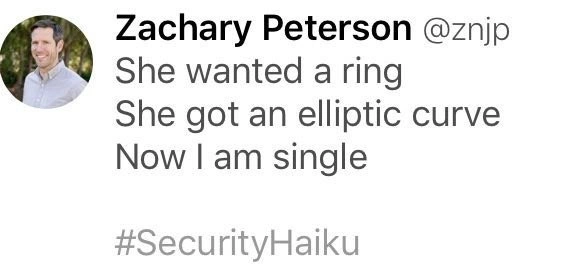
This meme is basically a screenshot of a tweet that’s formatted as a haiku – a short three-line poem. The hashtag #SecurityHaiku tells us the theme: it’s a haiku about information security (infosec) or cryptography. Let’s break down the lines in normal terms:
“She wanted a ring” – In plain English, this means a woman expected an engagement ring. In relationships, when someone says “I want a ring,” they’re usually talking about the ring you get when someone asks you to marry them. It’s a symbol of love, commitment, and a proposal. So, the setup is a romantic expectation.
“She got an elliptic curve” – Instead of getting the ring she wanted, she received something called an elliptic curve. Now, if you’re not into cryptography, that might sound odd. An elliptic curve here refers to Elliptic Curve Cryptography (ECC), which is a modern method for securing data. It’s a type of math used in encryption algorithms. Essentially, elliptic curves help create really strong keys to lock up information so only authorized people can unlock it. It’s used in all sorts of secure communications (for example, when your web browser connects to a bank, it might use elliptic curve cryptography to establish a secure connection).
But here’s the thing: an elliptic curve isn’t a physical object like a ring. You can’t wear it on your finger. You can’t even see it — it’s an abstract concept or maybe some data or a piece of code at best. So, saying “she got an elliptic curve” is a humorous way to say he gave her something totally unexpected and inappropriate in context. It’s like if someone expected jewelry and instead got math. This line is the big joke pivot of the haiku. It mixes up a romantic gift with a technical term, creating a silly contrast.
“Now I am single” – This is the conclusion of the little story. Because he completely messed up the gift (and the whole proposal scenario), the relationship ended. “Now I am single” means the woman presumably said goodbye, since he clearly didn’t fulfill her very reasonable wish for a ring. It delivers a punchline by being short and matter-of-fact: I tried something stupid, and now I face the consequences.
So overall, the haiku is a mini story: a guy’s partner wanted a ring, but the guy (being a super nerdy security enthusiast) gave her something from his world – an encryption concept – instead of a ring. As you’d expect, that didn’t go over well, and now he’s alone. The humor comes from the mismatch: romantic expectation vs. technical response.
For someone new to this kind of tech humor, a few terms might need explanation. Cryptography is the science of secrets – basically methods to protect information (like passwords, messages, or credit card numbers) so that only the right people can access them. Elliptic Curve Cryptography (ECC) is one approach to do this, relying on fancy mathematics (elliptic curves) to create strong encryption keys. It’s very prevalent in modern security because it’s efficient and secure. But again, it’s not a tangible thing; it’s not like a gadget or a device, it’s just mathematical formulas and algorithms often implemented in software.
Now, about the format: calling this a “security haiku” is itself a playful twist. A haiku is a form of poetry that traditionally doesn’t rhyme but has a pattern of syllables (5 syllables in the first line, 7 in the second, 5 in the third). It often captures a small poignant moment or image. Here the author applied it to a techie joke. The hashtag #SecurityHaiku suggests that perhaps on Twitter, security professionals were sharing many of these kinds of poems, turning their experiences or jokes into haikus. It’s a creative outlet in the developer and infosec community – showing that even people who work with code and encryption have an artsy, humorous side.
For context, InfoSec Twitter (short for Information Security Twitter) is just a way of referring to the community of security experts and enthusiasts on Twitter. They often share news about hacks, discuss cryptography, and yes, make jokes that only those in the field might fully appreciate. When you see something like this meme, it’s likely that Zachary’s followers are other security folks who immediately chuckled at the mention of an “elliptic curve” in a proposal scenario. It’s an inside joke: if you know, you know. If you don’t, it looks bizarre – which is exactly why we’re decoding it here.
In simpler terms, this meme is lampooning the stereotype of the overly technical computer guy. It highlights how a developer or security engineer might misinterpret a normal human request (“I want something romantic”) as a problem best solved with technology or knowledge (“Here’s a brilliant cryptographic solution!”). Of course, that’s the wrong approach for a love interest! Developer humor often thrives on these contrasts – taking a mundane situation and injecting a hyper-technical element into it. The result is absurdity, which equals comedy. You don’t actually need to know the nitty-gritty of elliptic curves to find it funny; just knowing it’s a very brainy thing in tech, and not at all a romantic item, is enough to get the joke.
Finally, it’s worth noting that no one in real life would literally give an encryption algorithm in place of a ring (one hopes!). This tweet is an exaggerated joke, a what-if scenario that makes us laugh at how incompatible those two worlds are. It’s a reminder that for all the sophisticated algorithms and security measures we deal with in tech, we should still remember common sense when it comes to personal relationships. Otherwise, as this meme humorously warns, you might end up technically brilliant but single. 😅
Level 3: Key Exchange Failure
For seasoned developers and security folks, this meme lands as a classic case of geeky miscommunication. It’s presented as a tweet by Zachary Peterson (with the hashtag #SecurityHaiku), which clues us in that it’s part of an InfoSec Twitter in-joke. The structure is a 5-7-5 syllable haiku, a playful format that tech people sometimes use to encapsulate their world in tiny poetic nuggets. Here we have the worlds of romance and cryptography colliding in three deadpan lines:
She wanted a ring
She got an elliptic curve
Now I am single
In the first line, the setup is a classic romantic scenario: she wanted a ring – presumably an engagement ring, symbolizing a marriage proposal. This is the “expectation” in a normal human relationship. By the second line, the expectation is comically subverted: she got an elliptic curve. To anyone in tech (especially in the security or cryptography field), this line immediately lights up the brain: elliptic curve refers to Elliptic Curve Cryptography, a topic we deal with in securing data. The crux of the humor is that he gave her something so absurdly technical in place of a ring that it’s doomed from the start. An elliptic curve isn’t even a physical object you can hand over; it’s like giving someone a concept or a bunch of math. It’s hard to imagine a more misguided “gift.”
Why is this so funny to insiders? Because it exaggerates a truth we recognize: people in tech (guilty as charged!) can become so engrossed in our own world of code, algorithms, and gadgets that we occasionally respond to real-world situations with hilariously inappropriate solutions. This particular scenario is like the ultimate nerd snafu – treating a marriage proposal like it’s a key exchange protocol. It’s as if the proposer thought, “Why give a normal ring when I can give something truly valuable like state-of-the-art cryptography!” That line of reasoning is both uproariously silly and endearingly believable to those who’ve seen how deep infosec folks can get into their tech.
The punchline arrives in the third line: Now I am single. Of course he’s single now! The humor lies in the absurd proportionality: naturally, if you answer a heartfelt life milestone with a cybersecurity algorithm, you’re going to faceplant in the relationship. It’s a form of nerdy self-deprecation. Those of us in the developer and security community laugh because we’ve all been there in some fashion – maybe not proposing with encryption, but perhaps answering a simple question with too much technical detail, or prioritizing a server uptime over a date night. The consequences in the joke are exaggerated to comic effect (instantly single, ouch!), but that exaggeration drives home the point.
This meme also riffs on terminology in a punny way. Notice how it plays on the word “ring.” In everyday life, that’s a piece of jewelry. But to a computer scientist, ring might momentarily register as a term from mathematics or a “ring network” or other technical contexts. And an elliptic curve, while not a ring in the mathematical sense (it actually forms a group over a field), is part of very esoteric lingo. It’s the kind of gift only someone stuck in “engineer mode” would even consider. Seasoned engineers find that contrast hilarious – it’s like mixing oil and water. It also hints at the common trope that highly specialized experts often have a tough time with “normal” people’s expectations. The infosec Twitter community loves jokes like this because it’s a gentle roast of their own habits and priorities. The hashtag and format indicate this was likely part of a fun thread where professionals try to outdo each other coming up with clever security-themed haikus. Everything from encryption algorithms to breach stories get this humorous treatment, compressing complex tech ideas into terse, often wise-cracking poetry.
In practice, no sane person actually “gives” an elliptic curve when someone expects a ring – that’s what makes it obviously a joke. But it’s an exaggerated parable. Consider how security engineers might genuinely get excited about generating a new key pair or discovering a more secure curve. To them, ECC is shiny and amazing, much like a diamond ring is shiny and amazing to the average person. The meme is basically saying: “I was so deep in my security geekiness that I completely misread what my partner valued.” The fallout is immediate and clear. For a senior dev or security professional reading this, there’s a mix of laughter and a tiny cringe of recognition. We’ve all had moments where we had to be reminded that not everything in life is a computer science problem to be solved.
There’s also an undercurrent of industry inside-joke here: ECC is a big deal in modern cryptography (it’s used in everything from HTTPS certificates to cryptocurrency wallets). By name-dropping elliptic curves, the meme signals “this is developer humor, a bit niche.” Those who know, know. It’s not just any random geek term; it’s one of the crown jewels of cryptographic algorithms. The dramatic irony is that such a sophisticated concept is completely the wrong answer to a simple human need. In a way, it’s poking fun at the over-engineering tendency in tech – the idea that an engineer might deliver an elegant, high-tech solution that utterly fails to address the actual problem or desire.
Ultimately, “She wanted a ring / She got an elliptic curve” is a concise joke about misaligned priorities. It’s the ultimate fail of reading the requirements (relationship edition 😅). A proposal isn’t the time to show off your knowledge of Curve25519 vs secp256k1 or to recite encryption key lengths. It’s a time for a genuine human connection. The protagonist of this haiku learned that the hard way – now he’s cryptographically enlightened but romantically alone. For those of us reading it, it’s a funny reminder: no matter how advanced our security skills are, we should remember to interface with loved ones on the right layer of abstraction. Because no amount of encryption can secure you against a facepalm moment like this one.
Level 4: Cryptographic Curveball
At the deepest technical layer, this little poem is referencing elliptic curve cryptography (ECC) – a fairly advanced topic in the world of computer security. ECC is a form of public-key cryptography based on the algebraic structure of elliptic curves over finite fields. In simple terms, it leverages the mathematics of points on a curve to create encryption keys. The security of ECC comes from the Elliptic Curve Discrete Logarithm Problem (ECDLP): given a point $P$ on a curve, it's easy to compute $Q = k \cdot P$ (adding $P$ to itself $k$ times), but virtually impossible to figure out $k$ if all you have is $P$ and $Q$. This one-way mathematical trapdoor is what makes ECC so powerful for encryption and digital signatures.
To give a flavor of the math: an elliptic curve is defined by an equation like
$$ y^2 = x^3 + ax + b \pmod{p}, $$
which plots a looping curve when you draw it out. Points on this curve can be added together in a special way that yields another point on the curve. Thanks to that structure, you can define a multiplication operation (repeated addition) of a point by a number. For example, if you take a base point $G$ on the curve and multiply it by a secret number (say k ), you get another point $kG$. Sharing $kG$ doesn’t reveal k (because of the ECDLP hardness), yet two parties can use such exchanges in an ECDH (Elliptic Curve Diffie–Hellman) key exchange to establish a shared secret. This is exactly how many modern secure protocols work under the hood – from establishing an HTTPS connection to agreeing on a key in a messaging app. ECC has become a foundation of modern security protocols because it provides strong security with much smaller keys than older methods like RSA.
Now, the humor here is that none of this high-powered math makes for a good marriage proposal. The meme’s author jokes that instead of giving his partner a ring (the expected token of engagement), he gave her an elliptic curve. In a literal sense, you can’t give someone an elliptic curve – it’s not an object, it’s an abstract mathematical model. Maybe he meant he offered to teach her about elliptic curve algorithms or gave her some code/keys based on ECC. Either way, it's ridiculously impractical as a gift. The term “ring” itself even has meaning in abstract algebra and cryptography (a ring is an algebraic structure with addition and multiplication), and elliptic curve formulas operate over finite rings/fields (like the integers modulo a prime). So if we’re being ultra-nerdy, he technically gave her a kind of ring… just the kind defined in a number theory textbook rather than a jewelry box. 🤓
From a cryptography standpoint, an elliptic curve is a beautiful piece of mathematics — secure, unbreakable (so far), and elegant. But as this haiku implies, what’s unbreakable in theory can still break your heart in practice. The contrast between a shimmering engagement ring and an invisible elliptic curve algorithm is maximal: one symbolizes love and commitment, the other symbolizes encryption and security protocols. He basically treated a romantic, human situation as if it were a computer security problem to solve. The result? A cryptographically strong proposal that completely failed the human compatibility test. It’s a funny illustration that even the most brilliant algorithm can’t solve every problem – sometimes, social engineering (the good kind, like understanding human expectations) is the real key. In other words, this may be the one case where an unbreakable code leads to a broken relationship.
Description
This image is a screenshot of a tweet from a user named Zachary Peterson (@znjp). The tweet is formatted as a haiku, a three-line poem. The text reads: 'She wanted a ring / She got an elliptic curve / Now I am single'. Below the poem is the hashtag '#SecurityHaiku'. The humor stems from a clever and niche technical pun. The word 'ring' is a double entendre, referring both to a piece of jewelry symbolizing commitment and to a mathematical structure (an algebraic ring) used in cryptography. The speaker, a tech professional, mistakes their partner's romantic desire for a technical request, offering an 'elliptic curve' - a fundamental component of modern Elliptic Curve Cryptography (ECC) - instead of an engagement ring. The punchline, 'Now I am single,' highlights the disastrous real-world consequences of this nerdy misunderstanding. The joke is highly resonant with security professionals and developers who understand the underlying mathematical concepts of cryptography
Comments
8Comment deleted
My last relationship also ended over a key exchange problem. I proposed Diffie-Hellman in public, she was expecting a house key
Apparently a ring signature isn’t what she meant by “put a ring on it” - now my commitment scheme is the only one still intact
She should've known something was off when he proposed with a 256-bit commitment scheme instead of a diamond
This is the cryptographic equivalent of bringing a Merkle tree to a family reunion - technically correct, but completely missing the social context. The real tragedy here isn't the breakup; it's that he probably spent the next three hours explaining why ECC provides equivalent security to RSA with smaller key sizes, completely oblivious to why she was packing her bags. At least he can console himself knowing his choice of curve was probably P-256 or secp256k1 - mathematically sound, romantically catastrophic
Proposed ECDLP hardness; her rejection solved it in polynomial time
Turns out a “commitment scheme” isn’t what she meant - an ECDH handshake doesn’t replace a ring
She wanted a ring; I pitched ECC - apparently “smaller but just as secure” only works for key sizes, not proposals
She is right how the hell should she wear it? Comment deleted