Skip to content
DevMeme
2621 of 7435
The Off-By-One Handshake: A Software Dev Interview
CS Fundamentals Post #2900, on Apr 6, 2021 in TG

The Off-By-One Handshake: A Software Dev Interview

Why is this CS Fundamentals meme funny?

Level 1: Almost to Ten

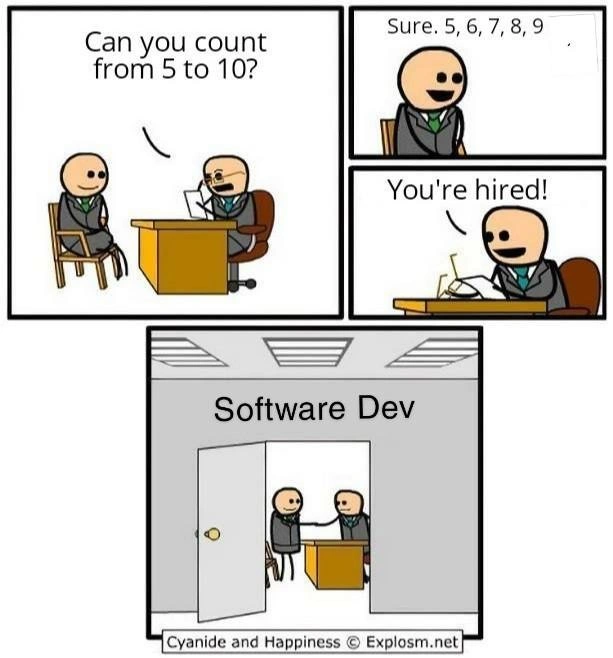
Imagine your teacher asks you to recite the numbers from 5 to 10. You happily go, “5, 6, 7, 8, 9…” and then you stop, forgetting 10. Oops! Now, normally the teacher would correct you, right? But in this silly story, the teacher instead claps enthusiastically and says, “Great job, you get a gold star!” That’s basically what’s happening in this meme. The boss asked the person to count up to 10, the person stopped one number short, and yet the boss is excited and gives them the job anyway.

Why is that funny? Because it’s so obviously wrong that it’s ridiculous to reward it. It’s like if you were supposed to list all the days of the week and you stopped before Sunday, but your friend cheers and says, “Perfect, you remembered them all!” We know that missing the last number is a mistake, so seeing someone get praised (or in this case, hired for a job) after making that mistake feels absurd. It highlights a feeling we can all relate to: sometimes we make a goofy little error, and it’s surprising (and kind of funny) when no one notices and everything goes on as if it’s fine. In simple terms, the meme is joking that even if you can’t count correctly, hey, you might still become a software developer – because everyone messes up like that occasionally! It’s a playful way to say “close enough is good enough,” and it makes us laugh because counting to ten should be easy, yet the mix-up is treated like a success.

Level 2: One Number Missing

Let’s break down what’s happening in simpler terms. In the comic, an interviewer asks a candidate to count from 5 to 10. Counting from 5 to 10 normally means you’d list: 5, 6, 7, 8, 9, 10. But the candidate stops at 9. This kind of slip-up is known as an off-by-one error. It’s called that because your result is off by one increment — you either went one too far or, like here, stopped one too soon. Off-by-one errors are one of the most common bugs new programmers (and yes, even experienced ones) make when writing loops or handling sequences of data.

Why do these mistakes happen so often in code? A big reason is how array_indexing and loops work in many programming languages. Computers often count starting at 0, not 1. For example, if you have a list of 10 numbers in a language like Python or C, the indices (positions) of those items go from 0 up to 9. The number 10 isn’t used as an index because starting at 0 means you end one count early. This is what we mean by inclusive vs exclusive counting. Inclusive counting includes the end number, exclusive counting leaves it out. In programming, functions or loops that generate sequences often leave out the end on purpose. For instance, range(5, 10) in Python will give you [5, 6, 7, 8, 9] and not include 10 at all. That’s exactly what the interviewee unwittingly did – an exclusive count to 10, missing the last number.

Let’s imagine a simple scenario in code to see how easy it is to mess this up:

numbers = [5, 6, 7, 8, 9, 10]  # a list of numbers from 5 to 10
for i in range(5, 10):         # this goes from 5 up to 9
    print(i)                   # it will print 5,6,7,8,9 and then stop
# Oops, 10 is never printed because range(5,10) excludes 10.

If we truly wanted to include 10, we’d need to go one higher in the range (like range(5, 11)). Off-by-one errors often crop up when using loops incorrectly or misunderstanding boundaries. For example, if you have an array of 10 items and you try to loop through it by counting from 1 to 10, you might accidentally skip the first item or try to access an item that isn’t there at the end. The counting_inclusive_exclusive confusion is something every new developer has to learn. You must be clear whether a loop runs up to and including the last index or stops just before it.

In the interview depicted, the manager’s question was very simple on purpose: “Can you count from 5 to 10?” It sounds almost too easy, right? It’s a bit of InterviewHumor to even ask a grown applicant to do that. The candidate’s mistake (stopping at 9) is funny because it reveals a CodingMistakes vibe in the most basic task. It’s like accidentally leaving out the last item in a list. In real developer interviews, you wouldn’t expect someone to mess up counting, but in programming, this exact logical slip-up happens all the time with loop indexes and boundaries. The comic is just translating a coding blunder into a real-world counting exercise.

Now, why does the manager hire this person despite the obvious mistake? That’s part of the joke: it highlights the silliness of the hiring_decision_logic in this scenario. It could be poking fun at how some hiring processes might overlook important details, or how sometimes the bar can be suspiciously low. Another interpretation is that the manager also thinks like a programmer and assumes the answer “5, 6, 7, 8, 9” is correct in a coding sense (maybe thinking zero-indexed or just not paying attention to the missing number). The scene labeled “Software Dev” on the office door cements that this is a developer_interview_meme, riffing on the idea that a person who makes a beginner’s mistake can still land a programming job. This resonates because in software development, everyone has made off-by-one errors, and often these bugs slip past code review or testing if you’re not careful. It’s a gentle nod that sometimes even when we’re wrong, things appear okay — until someone notices that missing “10”.

In summary, the meme uses a simple counting task to represent a typical programming bug. Off_by_one_error might sound fancy, but it just means “whoops, we missed by one.” The comic makes it obvious (missing 10), and then adds irony by rewarding the mistake (the “You’re hired!” punchline). It’s a lighthearted poke at both coding blunders and the quirks of tech interviews, making it clear and funny for anyone who’s written a loop or two.

Level 3: Fencepost Follies

This meme comically exposes a classic off_by_one_error during a developer interview. The manager asks the candidate to count from 5 to 10, presumably expecting an inclusive count (5, 6, 7, 8, 9, 10). Instead, the eager interviewee stops at 9, effectively leaving out the number 10. In coding terms, the candidate performed an exclusive range count – a counting_inclusive_exclusive mix-up that senior engineers recognize all too well. Off-by-one errors are among the most pervasive BugsInSoftware, lurking in everything from loop boundaries to array length calculations. Seasoned developers jokingly call this the fencepost error: if you have a fence with 5 sections, you’ll need 6 posts (one at each end), and counting those wrong by one leads to a fencing fiasco. In software, such a slip means your loop either runs one time too few or too many. It’s a CodingMistakes trope so common that entire memes and jokes revolve around it.

In the comic, the humor is amplified by the hiring_decision_logic (or lack thereof). The manager exclaims “You’re hired!” immediately after the mistake, as if an off-by-one bug is an expected rite of passage for any Software Dev. This plays on InterviewHumor—the absurd idea that even a fundamental mistake can slide through a technical interview. It satirizes real life: sometimes interviews focus on trivia or fail to catch real issues, and occasionally candidates get a pass for reasons unrelated to technical perfection. Perhaps the interviewer himself didn’t notice the mistake, or maybe he did and thought “close enough, this is normal in our codebase!” 😅. The meme’s cyanide_and_happiness_style art (simple characters, dark humor) underscores the silliness: a bright grin and handshake to celebrate a blatantly wrong answer.

From a seasoned coder’s perspective, this scenario hits close to home. We’ve all seen code that almost does what it’s supposed to, but leaves out that last crucial step — like counting up to 9 when 10 was the goal. In fact, you can imagine the interviewee’s brain working like a zero-indexed loop:

for i in range(5, 10):
    print(i, end=" ")
# This prints: 5 6 7 8 9
# The loop uses an exclusive end (10), so it never reaches 10 — classic off-by-one bug.

A loop written this way mirrors the candidate’s answer: it starts at 5 and stops just before 10. Any senior developer can relate to this bug from personal experience — maybe a missing array element in output, a fencepost miscalculation in an algorithm, or that array_indexing mistake where you go out of bounds by one. The meme cleverly takes this ubiquitous programming blunder and sticks it in a job interview, turning a painful “Oops, I missed one!” into a hiring qualification. It’s the kind of joke that makes experienced devs chuckle (and perhaps groan) in recognition. After all, there’s an old tongue-in-cheek saying in programming circles:

“There are only two hard things in Computer Science: cache invalidation, naming things, and off-by-one errors.”

Even the joke about off-by-one errors has an off-by-one error by listing three things instead of two! 🎉 In short, the meme is funny to seasoned devs because it combines a fundamental coding bug with a ridiculous interview outcome. It highlights how easy it is to make a one-off mistake and how, in the world of developer humor, even utterly wrong answers can be ironically seen as a sign that you’re one of the tribe. The manager hiring the applicant despite the mistake lampoons real tech hiring quirks and celebrates the shared understanding that “off-by-one happens to the best of us.”

Description

A four-panel comic from 'Cyanide and Happiness' by Explosm.net, illustrating a classic programmer joke. The first panel shows a job interview setting where the interviewer asks the candidate, 'Can you count from 5 to 10?'. In the second panel, the candidate confidently replies, 'Sure. 5, 6, 7, 8, 9'. The third panel shows the interviewer immediately saying, 'You're hired!'. The final, larger panel provides the context, showing the two characters shaking hands inside an office with a sign on the door that reads 'Software Dev'. The humor is rooted in the common 'off-by-one' error in computer programming. Many programming languages use zero-based indexing and exclusive upper bounds in ranges (e.g., a loop from 5 to 10 would run for indices 5, 6, 7, 8, and 9). The candidate's answer, while mathematically incorrect, perfectly reflects a programmer's mindset, making it an unintentional competency test that he passes with flying colors

Comments

23
Anonymous ★ Top Pick This is the only interview where answering '10' would get you flagged as a potential product manager
  1. Anonymous ★ Top Pick

    This is the only interview where answering '10' would get you flagged as a potential product manager

  2. Anonymous

    Hired on the spot - any dev who instinctively treats “to 10” as an exclusive upper bound will fit right in with our for-loops…and our sprint commitments

  3. Anonymous

    The real tragedy isn't that they missed the off-by-one error - it's that after 20 years in this industry, I've seen production code deployed by 'senior' engineers who would genuinely celebrate getting 5 out of 6 numbers right in a for loop

  4. Anonymous

    This perfectly captures the industry's FizzBuzz paradox: we mock candidates who can't solve trivial problems, yet simultaneously hire anyone who can count to 9. The real kicker? The candidate didn't even make it to 10, demonstrating a classic off-by-one error in their understanding of the requirements - and still got hired. It's the software equivalent of 'we're not looking for perfection, just someone who shows up.' Senior engineers know the truth: the ability to recite numbers has about as much correlation with writing production-grade distributed systems as knowing how to spell 'Kubernetes' has with actually operating a cluster at scale

  5. Anonymous

    Hired for nailing the half-open interval - because in dev interviews, stopping at 9 proves you grok loop invariants better than fencepost arithmetic newbies

  6. Anonymous

    Interview litmus: “count from 5 to 10.” Stop at 9 and you’ve internalized half‑open ranges; include 10 and you’ll internalize our on-call rotation

  7. Anonymous

    We hired them because they parse requirements as [5,10) - keeps the fenceposts out of prod

  8. Алексей 5y

    в чём прикол

    1. Deleted Account 5y

      мем для джунов

      1. Алексей 5y

        а конкретнее?ъ

        1. Terry Filch 5y

          5+6+7+8+9

          1. Deleted Account 5y

            1000-7

            1. @leroifrancais 5y

              Ор

          2. @haievskyi 5y

            шо?

          3. Алексей 5y

            шо?

  9. @haievskyi 5y

    а это не о range(5, 10) > 5,6,7,8,9

  10. Алексей 5y

    а где 10

  11. @haievskyi 5y

    первое включительно последнее нет

  12. @mikhomak 5y

    блять что это зп хуйня ебучая

  13. @mikhomak 5y

    уххх сука даже промолчать не смог

  14. @Subeltz 5y

    english plz

  15. @its_sauce 5y

    - can you count to 10? = of course. 1, 2, 3, 95, 4, 98, 2000, 7, 8, 8.1, 10 - you're hired. Microsoft

    1. @RiedleroD 5y

      you forgot me, xp and vista. Some people say those aren't real numbers, but I'm pretty sure they're just irrational.

Use J and K for navigation