Skip to content
DevMeme
4849 of 7435
New social media platforms, same tech oligarchs
IndustryTrends Hype Post #5309, on Jul 20, 2023 in TG

New social media platforms, same tech oligarchs

Why is this IndustryTrends Hype meme funny?

Level 1: Same Toy, New Costume

Imagine you have an old toy that you’ve played with for a long time – let’s say an action figure or a doll. After a while, you’re bored of it and even make a face like “Bleh, not this again!” when you see it. Now suppose your parent takes that exact same toy but dresses it up with a new costume and funny glasses, and says, “Look, it’s a brand new hero toy!” Suddenly, you get excited and think it’s something totally new and awesome, and you start smiling and playing with it happily. In reality, under the new outfit it was the same old toy all along, just wearing a disguise. But because it looked fresh and different, it felt exciting again. This is just like what’s happening in the meme: people (in this case, software developers) got tired of the old things they had (the old social media platforms), and then when those same kinds of things showed up wearing a “new costume” (new names and a new look), everyone got all happy and interested in them again. It’s funny because we realize we’re kind of tricking ourselves – getting thrilled about something new that isn’t so new after all!

Level 2: Shiny New Toys

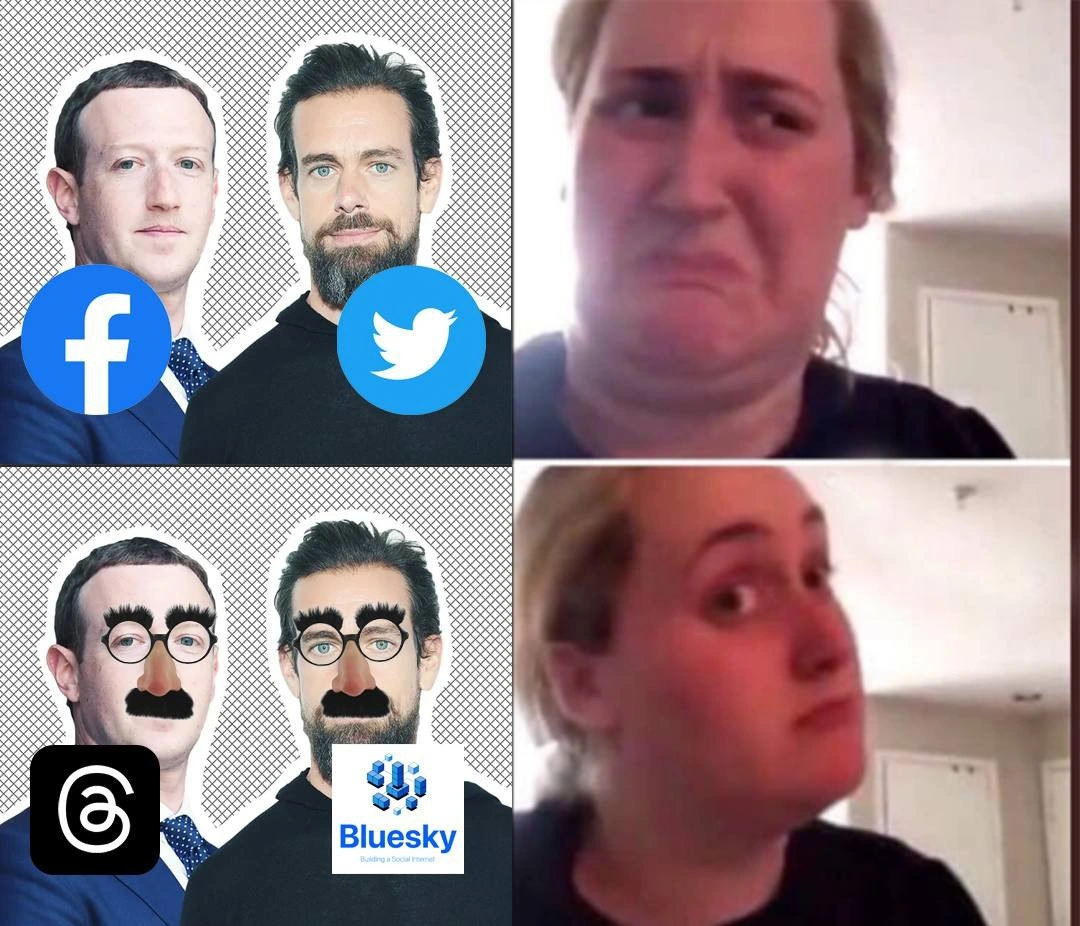
Let’s break down what’s going on in simpler terms. The meme compares two well-known social networks (Facebook and Twitter) with two newer platforms (Threads and Bluesky), and shows how developers react differently to them.

On the left side, we have the familiar giants: Facebook (with its blue “f” logo) and Twitter (with its blue bird logo). These are huge, established social media platforms – you probably use or at least know them. In tech lingo, they’re legacy platforms, meaning they’ve been around a long time and have a lot of history (and baggage). The people shown behind those logos are the big figures associated with them: for Facebook it’s Mark Zuckerberg (Facebook’s founder/CEO), and for Twitter the image is of Jack Dorsey (Twitter’s co-founder and former CEO). In the meme, their faces are blurred out, but the logos give it away. These two platforms have been central in online life for years, but many developers have mixed feelings about them. For instance, Facebook is seen as very corporate and not very open – it controls a huge ecosystem (the FacebookPlatform includes things like the Facebook Graph API for developers, which has had restrictions especially after privacy scandals). Twitter, on the other hand, used to be beloved by developers in its early days for its open API that allowed creating cool Twitter bots and apps. But over the years, Twitter made its platform more closed-off (limiting third-party apps, etc.), which frustrated a lot of programmers who liked tinkering with it. By 2023, especially after changes under new ownership, Twitter wasn’t considered very developer-friendly anymore.

Now, on the bottom-left of the meme, those same two tech CEOs appear again but humorously wearing disguise glasses (a goofy Groucho Marx mask with fake nose and moustache). And instead of the old logos, we see icons for Threads and Bluesky. This represents the new platforms that developers are excited about. Threads is a new app launched by Meta (Meta is the company that owns Facebook and Instagram). Essentially, Threads is like Twitter: it’s mainly for sharing short text updates and conversations, but it’s tied to Instagram accounts. Meta introduced Threads in July 2023 as a direct competitor to Twitter. A lot of people (including devs) jumped on Threads right away because it had a fresh, clean vibe and was an alternative space when Twitter was feeling messy. The funny thing is, Threads is not that different from Twitter – and it’s even run by the same corporation behind Facebook – yet people treated it like something shiny and novel.

Bluesky, on the other hand, is a smaller, invite-only social network that also became popular among tech folks in 2023. Bluesky started as a project funded by Twitter a few years back (when Jack Dorsey was still CEO). It has since become its own independent platform, but Jack is still involved and cheering it on. The big buzzword around Bluesky is that it’s decentralized or at least aiming to be. “Decentralized social” means a social network that isn’t controlled by one central company. Instead of all users being on servers owned by one company (like how all of Facebook is on Facebook’s servers), a decentralized network would let many servers communicate with each other and users could choose where and how to host their content. Mastodon is an example of this idea (it uses a standard called ActivityPub where different servers form a larger “fediverse”). Bluesky is building its own decentralized protocol called AT Protocol (“Authenticated Transfer Protocol”). The details get technical, but the key point is Bluesky promises more user control and interoperability – things developers love in theory. In practice, at the time of this meme, Bluesky was still pretty small and you needed an invite to join (which made it kind of exclusive and hype-y in the dev community).

So, why is the woman in the meme reacting with disgust to Facebook/Twitter (top) and with happiness to Threads/Bluesky (bottom)? Because this reflects how a lot of developers were feeling. Many devs have grown tired of Facebook and Twitter. They see those platforms as “old news” or having issues like: not listening to the community, being too closed, full of ads, or just not cool anymore. For example, Twitter started imposing strict limits on its API (the interface that lets developers build apps using Twitter’s data) and even on how many tweets users could read per day – that upset both developers and regular users. Facebook has a long history of privacy controversies and doesn’t really prioritize outside developers (except for things like Facebook login integration).

In contrast, Threads and Bluesky came along offering something new. Even though Threads is from the same company as Facebook, it launched with a simpler, minimal feature set and promised “we’ll get it right this time” vibes (Meta even hinted Threads will connect with other social networks via ActivityPub, which was surprising and intriguing). Bluesky, being built by folks with Twitter experience, marketed itself as a fresh start: no legacy baggage, a chance to build a social network right from the ground up with developers in mind. Bluesky has an open-source element (parts of its code and protocol are open for anyone to see and even contribute to) and they encouraged developers to try building apps for it early on. This made developers go "Wow, finally a social platform that might actually welcome us!"

The phrase “shiny new toy” often describes how tech enthusiasts react to new platforms or tools. It means we sometimes get overly excited about something just because it’s new and buzzworthy, not necessarily because it’s proven better. In the context of social networks, there’s a hype cycle: first there’s huge excitement and everyone says “This is the future!” (that’s the hype), and later often the excitement dies down when challenges emerge or it doesn’t upend the world as expected. The meme is illustrating that first part – the honeymoon phase where developers are infatuated with the new platforms (Threads and Bluesky) and have turned against the old guard (Facebook and Twitter).

It’s also worth noting the comedic element of the disguise: the meme is cheekily saying Threads and Bluesky are basically Facebook and Twitter wearing a disguise. In reality, Threads is run by Zuckerberg’s team (so, in a sense Facebook/Meta is just rebranding an old idea as new), and Bluesky has Dorsey’s DNA (the Twitter guy) all over it. The developer community, portrayed by the woman’s changing expression, knows this on some level but is choosing to be excited anyway. It’s like they’re saying, “We know these are the same people behind the curtain, but maybe this time the platform will be better for us.” The legacy_vs_modern_platforms conflict here is partly about trust and openness: legacy platforms are seen as having let developers down, while modern ones come with promises (even if those promises are made by the same people!).

In simpler terms: Developers are always on the lookout for social media alternatives that might be more fun or fair. Right now, Threads and Bluesky are those alternatives. The meme humorously captures the almost knee-jerk way the dev crowd goes “Ugh, gross” at anything Facebook/Twitter, but “Oooh yes!” at anything Threads/Bluesky, even though Threads is Facebook’s own product and Bluesky is basically Twitter’s spiritual successor. It’s a playful jab at how we can be a bit hypocritical or naive, chasing the next new platform and hoping it’s different this time. If you’re a junior dev or new to this scene, just know: this kind of platform migration wave happens a lot in tech culture. Today it’s Threads and Bluesky; a few years ago it was maybe Mastodon or Ello (an ad-free social network that had a burst of hype). The tools change, but the pattern (initial hype, eventual reality check) is something you’ll see again and again. The meme is a fun reminder to not take our own hype too seriously.

Level 3: Meet the New Boss

At first glance, this meme hilariously captures a pattern as old as the web: developers ditching one platform for the next big thing. In the left column, we see two blurred tech CEOs in suits – clearly the familiar figures behind Facebook and Twitter (think Mark Zuckerberg and Jack Dorsey) with their giant logos slapped on. The right column shows a woman’s exaggerated reactions: top-right she’s making a disgusted cringe face at those legacy networks, and bottom-right she’s smiling warmly at the next-gen replacements. The bottom-left images reveal the punchline: those same CEOs now don Groucho Marx disguise glasses (big nose, bushy moustache) while brandishing the logos of Threads and Bluesky. It’s literally Zuck and Jack in disguise as “new” platforms. The developer community is the woman in this scenario – eww 🤢 at the old Facebook/Twitter duo, then oooh 😊 at the shiny newcomers, not realizing (or not caring) it’s basically the same players wearing a new costume.

This speaks to the cyclical hype in tech dev communities. One minute, everyone on Tech Twitter is groaning about how uncool or restrictive the old social networks have become (corporate, closed-source, full of ads, API limitations… the usual grievances). The next minute, a couple of “new” social media alternatives appear, promising to be more open or edgy, and suddenly those same cynics are lining up for invite codes. Why is the meme so on-point? Because it’s poking fun at our collective FOMO-driven platform_migration behavior. We’ve seen folks loudly complain “Twitter is dead to developers!” (especially after API shutdowns or Elon’s antics) and immediately flock to the latest Twitter-killer beta. Remember the exodus to Mastodon instances when Twitter rate-limited its API? Or the short-lived enthusiasm for App.net a decade ago? Bluesky and Threads are just the 2023 edition of that story. New platform, who dis? – that’s the attitude: a giddy willingness to embrace anything novel, under the hopeful assumption it’ll be better this time.

What makes this extra funny is that Threads and Bluesky aren’t even truly revolutionary strangers – they’re more like spin-offs from the same old heroes/villains. Threads is literally from Zuckerberg’s Meta empire (Instagram’s baby brother app for text posts). Devs hated Facebook’s walled-garden and data-hoarding ways… yet here they are applauding Meta’s new Threads app as if it’s a savior. It’s the same company with a fresh coat of paint (hence Zuck slyly sporting that fake nose and moustache in the image). Meanwhile Bluesky has big decentralization energy, marketing itself with the tagline “Building a Social Internet” – sounds wonderfully idealistic, right? But Bluesky’s roots trace back to Twitter; Jack Dorsey (Twitter’s co-founder) helped launch it. So Jack basically said “Fine, I’ll build my own Twitter, with blackjack and hookers!” (to paraphrase Futurama’s Bender), and many devs responded with “Shut up and take my money… err, invite!” The meme’s disguise gag highlights this irony: the supposedly modern platforms are the legacy figures in new clothes. We developers are acting like we didn’t recognize them.

The industry trend under the humor is decentralized_social networks hype. Developers have long been itching for platforms that are more open, interoperable, and not under one corporation’s thumb. In theory, a decentralized network means you could own your identity and data, or run your own server – no Big Brother controlling the entire thing. Bluesky taps into that fantasy with its new AT Protocol (a fresh take on federated social networking, akin to Mastodon’s ActivityPub standard but proprietary to Bluesky’s ecosystem). It promises things like algorithmic choice (you can pick what kind of content feed algorithm you use) and portable accounts. That’s catnip for idealistic devs who dream of an internet where users are in control. Threads, while not decentralized at launch, cleverly piggybacked on that sentiment too: Meta announced plans for Threads to support ActivityPub (the Fediverse protocol) in the future, as if to say “Hey devs, we might play nice and open up!” This was a surprising olive branch because Facebook/Instagram have historically been very closed systems. So naturally, the tech crowd hyped Threads as potentially not your grandparents’ Facebook. Supposedly, it might federate with Mastodon and other servers someday – a concept that made devs raise eyebrows in cautious excitement. The meme captures how quickly we geeks will give a thumbs-up 😁 to anything branded “open” or “decentralized” – even if that branding might be a bit of a mask marketing ploy.

From a senior developer perspective, there’s an eye-roll in this meme along with the laugh. We’ve been through these hype cycles. The IndustryTrends_Hype tag is spot on: every few years, disillusionment with the status quo leads us to hail some new platform as the future. We lionize the new contender (often smaller, invite-only, which makes us feel like early adopters of an exclusive club) as being more developer-friendly. There’s truth behind it: for instance, early Twitter had a great open API and third-party apps flourished, but over time they locked things down – leaving devs feeling betrayed. So when another platform (say, Bluesky) comes along promising fresh social API access and no evil corp to yank the rug out, of course devs get starry-eyed. And when a giant like Meta releases a brand new platform (Threads) that isn’t (yet) cluttered with spam and legacy cruft, we’re curious: “Maybe they learned from past mistakes?” It’s a classic grass is greener on the other side mentality.

However, the veteran cynic in us also knows the ending to a lot of these stories. The meme’s underlying nod is: meet the new boss, same as the old boss. Today’s shiny platform can become tomorrow’s problem child. Those disguise glasses on Zuck and Jack hint: nothing fundamentally changed about who’s in charge or what their motives are. Meta still craves ad revenue and user data; Bluesky, even if well-intentioned, could face the same scaling and moderation nightmares as Twitter did. In a few months or a year, developers might be memeing about how “Threads is the new Facebook” once it inevitably adds ads or tightens its garden, or how Bluesky’s decentralization wasn’t so decentralized after all (if, for example, they delay federation to keep control). The cycle might continue with yet another platform down the road. Dev communities tend to have short memories when chasing novelty.

The humor resonates because it’s self-aware: we are collectively both jaded and optimistic. We gripe about legacy_vs_modern_platforms all the time — e.g. “Ugh, Facebook Graph API broke my app again!” or “Twitter’s dev support is non-existent now” — and then turn around and gush on forums about how Threads’ clean start or Bluesky’s new protocol is going to solve everything. There’s a shared knowing laugh here: we recognize our own fickleness. The meme exaggerates it with that dramatic disgust face vs happy face, but it’s not far off from reality:

Dev on Twitter (June 2023): “That’s it, I’m done with this site. Twitter’s no longer developer-friendly. Catch me on Mastodon or Bluesky!”
Same Dev on Threads (July 2023): “Hey everyone, I got early access to Threads and it’s 🔥. Feels so clean here compared to Twitter. Follow me there!”

It’s funny because it’s true. The woman’s grimace and grin are us, collective tech folks, going from hating the old to honeymoon-phasing the new overnight. The meme calls out the hype train we eagerly hop on, even as we kind of know deep down that we might be being sold the same goods in different packaging. In essence, it gently roasts the developer habit of always thinking the next platform will be The One that finally aligns with our ideals (open APIs! no tracking! community-run!) — until it doesn’t, and the search continues. It’s an endless loop of decentralized déjà vu, and we can’t help but chuckle at ourselves for it.

Description

This is a four-panel meme using the 'Kombucha Girl' (Brittany Broski) reaction format to comment on the launch of new social media platforms. In the top-left panel, headshots of Mark Zuckerberg and Jack Dorsey are shown, overlaid with the Facebook and Twitter logos, respectively. The top-right panel shows the Kombucha Girl with a look of disgust and disapproval. In the bottom-left panel, Zuckerberg and Dorsey reappear, but this time wearing comical Groucho Marx glasses, a classic disguise. The logos are replaced with the Threads logo for Zuckerberg and the Bluesky logo for Dorsey. In the bottom-right panel, the Kombucha Girl's expression shifts to one of intrigued interest, leaning forward as if reconsidering. The meme satirizes the idea that Threads and Bluesky are truly new or different, suggesting they are merely the old platforms (and their controversial founders) in a flimsy, obvious disguise, and mocks the tech community's willingness to embrace them despite this
Comments

7
Anonymous ★ Top Pick It's not a fork, it's a 'git checkout -b new-platform' with the same commit history and the same problematic maintainers
  1. Anonymous ★ Top Pick

    It's not a fork, it's a 'git checkout -b new-platform' with the same commit history and the same problematic maintainers

  2. Anonymous

    Migrating from Twitter to Bluesky and Threads feels like the social-graph version of “let’s rewrite it in Rust” - the hello-world demo is glorious, right up until you realise you’ve got fifteen years of nullable relationships and midnight cronjobs that still think in Birdsite SQL

  3. Anonymous

    It's like watching the same distributed systems architects who built the monolith suddenly discover microservices, except they're still using the same single point of failure: themselves. The only thing more centralized than their 'decentralized' platforms is their equity stake

  4. Anonymous

    When you've spent 15 years building distributed systems at scale, survived multiple platform migrations, and architected fault-tolerant microservices - only to watch tech billionaires speedrun the entire 'launch a Twitter clone' playbook like it's a weekend hackathon project. The real engineering challenge isn't building another ActivityPub implementation; it's explaining to your PM why 'just fork Mastodon' isn't actually a three-sprint story

  5. Anonymous

    When the legacy endpoints start returning 429s, you blue‑green deploy your doomscrolling to ActivityPub/ATproto - finally, a migration where the rollout colors are literally blue and sky

  6. Anonymous

    Zuck's Bluesky incognito: DID rotation engaged, but reverse image hashing still federates straight back to the Meta singleton

  7. Anonymous

    FB→Threads and Twitter→Bluesky: choose your federation (ActivityPub vs AT Protocol), same migration plan - copy the graph, swap the logo, and keep trust & safety as the monolith-shaped SPOF

Use J and K for navigation