Skip to content
DevMeme
4850 of 7435
So you're telling me there's a multi-billion dollar bug?
Blockchain Post #5310, on Jul 24, 2023 in TG

So you're telling me there's a multi-billion dollar bug?

Why is this Blockchain meme funny?

Level 1: Candy Jar Caper

Imagine you and a bunch of friends have a big jar of candy that you all won together. To make sure no single friend eats all the candy at night, you split the key to the candy jar into pieces. For example, Alice gets part of the combination, Bobby gets the second part, and Carla gets the third part. The rule is: at least two of you must put your pieces together to open the jar. This way, no one can sneak a treat alone — sounds fair and safe, right? It’s like a team lock: safety in numbers.

But now picture this: one of your friends, let’s call him Sneaky Sam, finds a clever trick. The next time Alice, Bobby, and Sam unlock the jar together (using their pieces of the code in what they think is a secure way), Sam secretly learns the entire combination to the lock during the process. Maybe he observed how the lock turned or did a sneaky calculation in his head while they were opening it. Alice and Bobby didn’t notice anything weird — the jar opened normally, everyone got a piece of candy, end of story. But now Sam has the master key to the jar all for himself. In the following night, Sam comes back to the jar alone. Using the full combination he grabbed, he opens the candy jar quietly and takes all the candy out, without needing Alice or Bobby at all. By morning, the jar is empty and the candy is gone, and the others are bewildered because they never even saw the jar being opened! It’s as if the candy vanished by magic, because the lock wasn’t broken or anything — it was opened with a perfectly valid key. Sam’s sneaky trick left no trace that he used the jar; it just looks like the candy evaporated.

In this little story, the “unbreakable” team system of guarding the candy got defeated by one mischievous insider who figured out how to beat the rules. It’s a bit scary and kind of impressively sly — you might chuckle thinking “Wow, Sam really pulled a fast one on them!” In the real world, replace the candy with money, the jar’s lock with fancy math security, and Sneaky Sam with a crafty attacker. That’s exactly what happened in the TSSHOCK scenario: a system that was supposed to require a team to unlock a treasure was secretly tricked so that one person could grab all the treasure by themselves. It’s a shocking reminder that sometimes, even when we play fair and use teamwork for safety, a clever plan can sneak around those safeguards and run off with the goodies – leaving everyone else saying, “Wait, what just happened?!”

Level 2: Safety in Numbers?

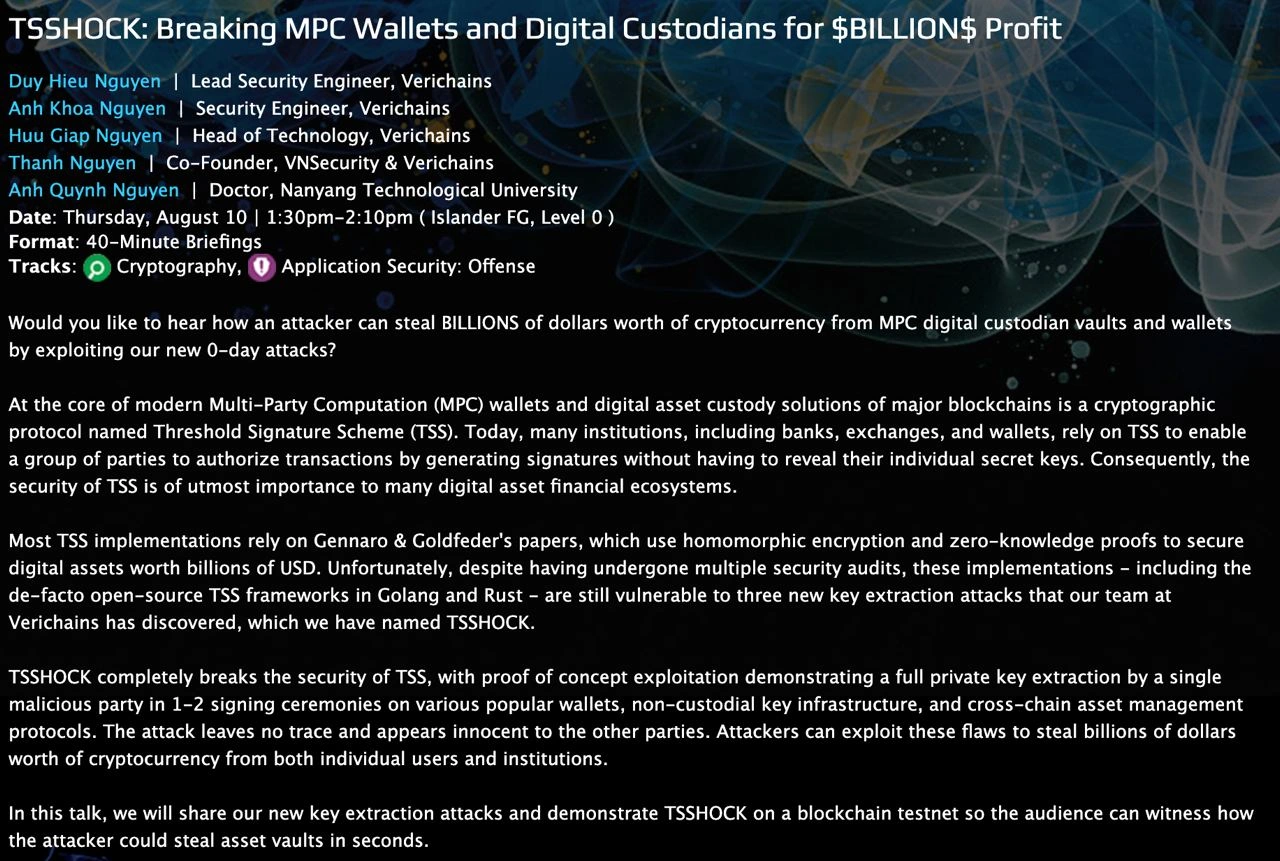
So, what exactly is going on in this ominous-looking slide, and why are developers abuzz about it? The slide is basically an announcement for a talk at a security conference (Black Hat USA 2023) where a team of researchers from a firm called Verichains is revealing a major security vulnerability in how certain crypto wallets work. Let’s unpack some of the jargon in simpler terms:

  • Multi-Party Computation (MPC): This is a fancy way of describing methods that let multiple people (or computers) jointly do some computation without any of them fully seeing each other’s secret data. Imagine three chefs each have part of a secret recipe; MPC is like them mixing ingredients together without any single chef ever seeing the whole recipe. In the context of crypto wallets, MPC allows a private key (the secret needed to authorize transactions) to be split into pieces and held by different parties. No one person has the entire key, but together they can still compute a valid signature to approve a transaction. It’s a modern alternative to one person holding a whole key, aimed at reducing the risk of theft or loss.

  • Threshold Signature Scheme (TSS): This is a specific kind of MPC focused on digital signatures (like the ones used to verify cryptocurrency transactions). “Threshold” means you can define a number k (the threshold) out of n participants that are required to produce a signature. For example, you might require 2 out of a group of 3 servers to sign a transaction. The TSS protocol ensures that if any 2 of them cooperate, you get a valid signature – but with the crucial feature that none of those servers ever had to reveal their part of the private key to each other. They perform an interactive algorithm, passing around encrypted numbers and proofs, and end up with a signature that the blockchain accepts as if a single normal key signed it. This way, you avoid having a single point of failure. Even if one server is hacked, the hacker shouldn’t be able to get the full key or sign transactions alone. TSS is like the digital version of requiring multiple keyholders to turn their keys at the same time to open a vault, except it yields one unified digital “key turn” (the signature) in the end.

  • Digital Custodians / MPC Wallets: These are services (often exchanges, banks, or specialized crypto custody providers) that hold digital assets (like Bitcoin, Ethereum, etc.) on behalf of users or institutions. Because they manage very large amounts of crypto (sometimes worth billions), they use advanced security setups – and MPC with threshold signatures has become a popular one. Instead of storing a private key on one server (which could be a big risk if that server is breached), a custodian might spread the key across multiple servers or even multiple geographic locations. Each piece alone is useless; only when the system coordinates them do they produce a valid transaction signature. This is supposed to greatly increase security. In theory, an attacker would need to compromise several independent machines (or collude with multiple insiders) to steal funds, which is much harder than finding one weakness.

  • 0-day Vulnerability: A "zero-day" is a security hole that was unknown to the software maintainers until the researchers found it – meaning the developers have had zero days to fix it before it became known. It also implies that if bad guys found it first, they could exploit it right away, since no patch or defense was in place. In this case, the researchers are presenting brand-new, previously undisclosed attacks on those MPC wallet systems. Calling it a 0-day means it wasn’t something people were already aware of; it’s a bombshell dropped on the community.

  • Key Extraction Attack: This is exactly what it sounds like – an attack that allows someone to extract (pull out) the secret private key from the system. If you can extract the full private key from an MPC wallet, the whole point of using MPC is defeated. The attacker would now have the single key that can on its own authorize transactions (i.e., move the money). In the slide, they mention “full private key extraction by a single malicious party in 1–2 signing ceremonies.” A signing ceremony in this context just means the process of those parties coming together to produce a signature for a transaction. The alarming part is one malicious party can do it in just one or two tries. Normally, you’d hope that even if one participant in the protocol is evil, they couldn’t learn anything useful – maybe they could prevent a signature or cause an error, but they shouldn’t be able to figure out the key. Unfortunately, these new attacks show it’s possible: after cooperating in good faith just enough to produce a signature (or two), the bad actor can walk away with the complete key in their pocket. They basically trick the protocol into giving up its secrets.

  • Homomorphic Encryption & Zero-Knowledge Proofs: The slide’s text mentions these because they’re the foundational tools that TSS protocols use to stay secure. Homomorphic encryption is a kind of encryption that still allows computations on the data. Think of it like this: normal encryption is a locked box – you can’t do anything with the data unless you unlock it. Homomorphic encryption is a special box that lets you perform certain operations (like addition or multiplication) on the data inside without opening it. TSS uses this so that parties can combine their secret pieces mathematically to form a signature without exposing those pieces. Zero-knowledge proofs (ZKP) are like magic certificates: one party can prove to others “I did this step correctly” or “I know my secret share satisfies some property” without revealing the secret itself. It’s a way to keep everyone honest in the protocol. These are very advanced techniques, and the fact that TSSHOCK broke the system means somewhere these techniques were insufficient. Either the implementation had a bug or the proof wasn’t covering a sneaky case, etc. If you’re a junior dev, just know: homomorphic crypto and ZK proofs are like the high-tech locks and alarms of cryptographic systems. Here, the thieves found a way to disable the alarm and pick the lock, all without anyone noticing.

Now, in plain terms, what did the slide convey? It was basically inviting an audience to hear about a hypothetical but very plausible heist scenario. It asks: “Would you like to hear how an attacker can steal BILLIONS of dollars... by exploiting our new 0-day attacks?” – which is a dramatic way to say they’ve found a set of vulnerabilities that could allow exactly that. They explain that the core security in these modern wallets (the Threshold Signature Scheme, based on academic papers by Gennaro & Goldfeder) is widely used and trusted. These schemes were even audited (security-checked by professionals) multiple times. Despite all that, the team discovered TSSHOCK, a collection of three attacks that completely break the security. In tests, they demonstrated a full private key extraction by just one rogue participant during the normal signing process, and it works on various popular wallets and key management systems out there. "Leaves no trace and appears innocent" means the attack is stealthy – the other co-signers and system monitors wouldn’t be able to tell anything bad happened. The signature process would complete normally; everyone would think “great, we co-signed that transaction successfully as usual,” while the attacker quietly walks away with enough info to later reconstruct the key and empty the wallets. And when they say steal “billions of dollars worth of cryptocurrency,” they’re not exaggerating because some of these digital vaults literally manage that level of funds for exchanges or big investors.

For a junior engineer or someone new to blockchain security, this is a real eye-opener. It’s like finding out the unpickable lock can be picked with a simple paperclip you never thought of. The talk was scheduled in the Cryptography track (because it deals with cryptographic algorithms) and Application Security: Offense track (because it’s about how attackers can abuse an application/system). Essentially, the researchers are showing offensive techniques against a cryptographic system, which is the kind of thing that gets presented at Black Hat (an annual conference where cutting-edge hacks and vulnerabilities are disclosed). After such a talk, you can bet a lot of developers and security teams would rush to implement patches or mitigations. The “cautionary tale” here for engineers is clear: even the most sophisticated security designs can have fatal flaws, so never assume something is unbreakable. If you work on crypto wallets or any system involving secret keys, you’d want to study what TSSHOCK did and ensure your systems aren’t open to the same tricks.

To answer the question “Is it even meme?”: This image isn’t a meme in the traditional sense (it’s not a joke image with a punchline caption). It’s actually a legit conference slide. But it became meme-worthy because of how sensational and consequential its content is. In developer communities, people sometimes share screenshots like this with a mix of admiration and anxiety, almost as a public service announcement wrapped in a bit of dark humor. The idea that one talk can describe a method to potentially become a billionaire via hacking – it’s both thrilling and chilling. So, while you won’t find a classic punchline here, the “meme” is essentially the shock value and tech drama captured in that slide. It’s a snapshot of an infosec moment that everyone in the field finds noteworthy (and a little scary-funny).

Level 3: Billion Dollar Bombshell

For seasoned developers and security engineers, this slide hits like a plot twist in a heist film. It was unveiled as a Black Hat Briefing in August 2023 — Black Hat being the kind of conference where jaw-dropping hacks are announced with dramatic flair. And dramatic it was: “Breaking MPC Wallets and Digital Custodians for $BILLION$ Profit”. That title alone feels surreal, almost meme-worthy in its own right. It’s not every day you see $BILLION$ spelled out with dollar signs on a professional conference slide. It reads like clickbait (“One weird trick to drain crypto wallets – bankers hate him!”), yet it’s very real research. Security folks shared this around partly in disbelief and dark humor: “Is this even a meme?” one asked, because it’s essentially an infosec talk advertisement. But it encapsulates an almost comical irony: the very systems touted as the future of secure blockchain custody turned out to have an Achilles’ heel so severe that a single cunning participant could rob the whole vault. It’s the kind of “so bad it’s funny (but also not funny at all)” scenario that industry veterans have learned to laugh at nervously.

Why is this humorous to the initiated? Because it confirms a cynical trope: nothing is truly secure, especially not in crypto-land, no matter how much cryptography and auditing you throw at it. Here we have major institutions – banks, exchanges, big custodial services – relying on this cutting-edge MPC tech, comforted by academic proofs and multiple audits, thinking their billions are safe. Then a team of researchers (with five Nguyen’s on the slide – a whole family of crypto-breakers!) calmly announces, “Actually, we can steal everything in seconds without a trace.” It’s equal parts terrifying and grimly amusing. Terrifying for obvious reasons, but amusing in that dark, “of course there’s a bug that lets you become a billionaire overnight” way. Senior engineers have seen this pattern before: the more complex and “unbreakable” a system is claimed to be, the more spectacular its failure when someone finally cracks it. It’s reminiscent of earlier fiascos in security: like that time a prestigious security system fails due to a simple oversight. One could draw parallels to something like the Heartbleed bug (where a tiny mistake in code exposed tons of secret keys) or those “unhackable” crypto exchanges that inevitably got hacked. The lesson is the same: never underestimate the human ability to mess up even the most brilliant tech.

Let’s break down the scenario that makes this slide so spicy for veterans. Threshold signature wallets were supposed to eliminate single points of failure. Rather than one private key (that could be lost or stolen), you distribute key control among, say, 3 out of 5 trusted parties. It’s security by committee – safety in numbers. But TSSHOCK turned that idea on its head by showing one bad apple in the committee can silently compromise everyone. That’s essentially an inside job on steroids. In a traditional multi-signature scheme (the straightforward kind where you just collect multiple independent signatures on-chain), if one signer is malicious, they still can’t produce a valid transaction without the others – they’re stuck. But in an MPC/TSS scheme, all participants are performing a joint computation. A malicious participant can play along just enough to trick others into revealing more than they should. It’s as if one of the co-signers was secretly recording the combination each time the group opens the vault. After one or two openings, he has the master combo written down. 😬 Poof, there goes the whole premise of shared trust.

From a senior architecture viewpoint, this is a nightmare scenario. Think of a big crypto exchange or bank using an MPC custody service: one server gets compromised, or one insider goes rogue, and now the attacker has the keys to the kingdom (literally billions in crypto) without setting off any alarms. The blockchain would show “legitimate” signatures were made – nothing abnormal – so by the time anyone notices the funds drained, it’s far too late. The slide explicitly says “leaves no trace and appears innocent to the other parties” – so there wouldn’t even be suspicious logs or failed signatures to tip anyone off. It’s the perfect crime in the crypto world: the valid signature is both the heist and the cover-up, all in one. No wonder the presenters boldly painted “$BILLION$ Profit” on their title – it’s not hyperbole. If you exploit this in the wild, you could indeed steal immense sums.

For veteran devs, there’s also a bit of dark comedy in how this was presented. Security talks often use provocative titles, but this one almost reads like a Vegas magic show: “Come one, come all, see how we pull billions of dollars out of thin air!” The difference being, the magic is real and the rabbit being pulled out of the hat is everyone’s private keys. 😅 The sheer audacity of the exploit is meme-able in itself. We usually joke about bugs causing minor chaos (like “it’s always DNS” causing an outage). But here we have a bug (or rather, a new kind of attack) that could cause global financial chaos in crypto if not fixed. It’s the kind of thing that gives CTOs grey hair overnight. The community response was a mix of “This is incredible research!” and “Oh no, which of our systems are affected?!” Immediately, any crypto engineer familiar with buzzwords like GG18 or threshold ECDSA likely thought of the libraries and products they use. There are popular open-source implementations (for example, Binance’s tss-lib in Go, or others in Rust) that many projects build on. The presenters noted these de-facto frameworks were all vulnerable – meaning a lot of folks had to scramble. Picture war-room meetings at crypto custody firms that week: incident response mode, even though an incident hadn’t happened yet. It’s that pre-emptive panic knowing a bombshell is about to drop at Black Hat.

All of this combined – the sensational framing, the catastrophic implications, and the “we can demo stealing a vault in seconds” promise – turned this conference slide into a standalone meme among devs. It’s an extreme case of Schadenfreude for the security community: we’re horrified by the implications, but we can’t help marveling (and yes, laughing a bit) at how absurdly bad-but-genius it is. It’s a reminder that security is hard. No matter how many PhDs and audits and fancy math proofs you stack, there might be one more clever trick out there that turns your billion-dollar security into a house of cards. The collective reaction: nervous laughter, then a rush to double-check our own systems’ defenses. In short, this “meme” encapsulates a senior-level cautionary tale: even the fortress of cryptography can hide a trapdoor, and you won’t know until someone dramatically opens it at a conference.

Level 4: The Treachery of Thresholds

At the cutting edge of cryptography, systems like Multi-Party Computation (MPC) based wallets use advanced math to split secrets among participants. A Threshold Signature Scheme (TSS) is one such protocol: it lets N parties jointly produce a valid digital signature (for, say, a cryptocurrency transaction) without any single party ever seeing the whole private key. It's like each person holds a fragment of the key, and only by combining their cryptographic contributions can a signature be generated. The beauty of TSS is that an outside observer just sees a normal signature (e.g., an ECDSA signature on a Bitcoin or Ethereum transaction), not realizing it was the product of a group effort. Under the hood, though, there's a flurry of complex math ensuring no individual learns the others’ secret share. Most modern TSS implementations draw from the research of Gennaro & Goldfeder (and others), which introduced clever techniques using homomorphic encryption and zero-knowledge proofs. For example, a common approach uses the Paillier homomorphic encryption scheme to let one party add numbers without decrypting them, combined with zero-knowledge proofs to convince others “I did my part correctly without peeking at your secret.” In theory, this means we can have our cake (distributed trust) and eat it too (single, compact signature, as if there were just one key).

However, cryptographic theory often comes with caveats and careful assumptions. When these protocols are implemented in the real world (say, in open-source libraries in Go or Rust for blockchain custody), they become highly intricate distributed algorithms. There are multiple rounds of communication: exchanging encrypted values, proving knowledge of secrets, blinding and unblinding numbers, etc. Each round and message has to be flawlessly designed to prevent leaks. If even one step is slightly off – an assumption not met, a subtle bug, or an overlooked attack vector – the entire security guarantee can unravel. And that's exactly what TSSHOCK claims to do: it exploits three new key extraction attacks that break those assumptions in Threshold Signature Schemes. Essentially, the researchers found that if one of the participants in the signing protocol is malicious, they can deviate from the protocol in a very specific way that remains undetected by the others’ zero-knowledge checks. By carefully crafting their inputs or eavesdropping on certain intermediate values, the malicious party can accumulate just enough information to reconstruct the full private key after only 1–2 signing ceremonies.

This is a devastating result in theoretical terms. The whole point of threshold cryptography is that splitting a key among parties should prevent any single traitor from doing exactly this! Yet here we are: despite multiple security audits and even peer-reviewed papers backing these schemes, TSSHOCK demonstrates a fundamental break. It’s as if an encrypted vault that was mathematically proven “unpickable” turned out to have a hidden latch that no one noticed before. The deep technical reason could be something like a flaw in how the protocols handle random values or carry out homomorphic operations. For instance, a classic cryptography slip is nonce reuse in ECDSA signatures – if two signatures use the same random nonce k, an attacker can solve a simple equation to recover the private key. In threshold ECDSA, parties jointly generate the nonce and the signature, so they must be super careful never to allow any correlation or reuse. If TSSHOCK forces a scenario where the nonce or partial secrets get reused or reveals more info than they should (perhaps by exploiting a weakness in the homomorphic encryption layer or in the zero-knowledge proof constraints), it could let an attacker solve for the key like a high-school algebra problem. The researchers likely pinpointed an oversight in the protocol's design or implementation – something the original papers didn’t consider under a malicious lens, or something all the code audits missed because it takes a cryptographer’s eye to catch.

From a theoretical standpoint, this is both shocking and fascinating. It reminds the security community that even provably secure schemes can falter if the proofs don't cover the real-world usage or if implementers introduce subtle bugs. Threshold schemes are proven secure under certain models (like assuming less than t malicious parties and idealized conditions), but the TSSHOCK attacks show there was a gap between those models and reality. Perhaps the zero-knowledge proofs in use weren't strong enough (maybe they proved each party did something correctly, but not everything, leaving a side-door), or the homomorphic encryption allowed a crafty participant to perform a malicious computation that the protocol didn't account for. In any case, TSSHOCK is a cryptographic break of the highest order: compromising the confidentiality of keys that were meant to be mathematically unsteal-able. It’s the kind of result that will send researchers back to the drawing board and have implementers rushing to apply patches or redesign protocols entirely. In summary, at this deepest level, the meme-worthy conference slide hints at a spectacular hack rooted in cryptographic complexity — a perfect storm of math, code, and a dash of adversarial cleverness that flips a trusted scheme into a billion-dollar vulnerability.

Description

The image is a screenshot of a presentation slide for a talk at the Black Hat security conference. The slide has a dark, abstract background with blue and green wispy patterns. The title of the talk is 'TSSHOCK: Breaking MPC Wallets and Digital Custodians for $BILLION$ Profit'. Below the title, it lists the speakers, date, format, and tracks, which include 'Cryptography' and 'Application Security: Offense'. The body of the slide is a detailed abstract explaining a new 0-day attack named TSSHOCK that breaks the security of Threshold Signature Scheme (TSS) protocols used in Multi-Party Computation (MPC) wallets, allowing attackers to steal billions of dollars worth of cryptocurrency. The original post caption 'Is it even meme?' highlights the surreal, almost unbelievable nature of the vulnerability's massive financial implications, blurring the line between a serious security announcement and dark, industry-shaking humor. It underscores the fragility of complex cryptographic systems and the cat-and-mouse game between builders and breakers in the high-stakes world of digital assets
Comments

14
Anonymous ★ Top Pick This isn't your typical off-by-one error. This is an off-by-one-billion-dollars error
  1. Anonymous ★ Top Pick

    This isn't your typical off-by-one error. This is an off-by-one-billion-dollars error

  2. Anonymous

    Three audits, two zero-knowledge proofs, and one PhD later, TSSHOCK proves the real threat model is a bored co-signer with 40 minutes to spare at Black Hat

  3. Anonymous

    The most expensive way to learn that "mathematically secure" and "implementation secure" are two completely different conferences

  4. Anonymous

    When your 'thoroughly audited' cryptographic implementation turns out to be a $BILLION treasure map with 'X marks the private key' written in invisible ink that only takes 1-2 signatures to reveal. Turns out homomorphic encryption and zero-knowledge proofs are great at keeping secrets - just not the ones you wanted them to keep. At least the attackers were polite enough to make it look innocent to the other parties; nothing says 'enterprise-grade security' quite like a heist that leaves no trace and passes all your monitoring checks

  5. Anonymous

    MPC: Multi-Party Computation, or Massive Profit Compromise - TSHOCK proves even threshold schemes leak when one party's impl is the chokepoint

  6. Anonymous

    MPC: split the key so no one can steal it - until one signer runs TSSHOCK, does two rounds, and quietly becomes the quorum while your audit report says “looks good.”

  7. Anonymous

    MPC wallets: engineered to eliminate a single point of failure; TSSHOCK reminds us that even with Rust, audits, and ZK slides, we didn’t eliminate the single point of malice

  8. @YaroST12 2y

    Cryptobros taking the L once again?

  9. @callofvoid0 2y

    it better be a meme

  10. @FunnyGuyU 2y

    *a humble request for clarification team support*

  11. @CcxCZ 2y

    Homomorphic encryption is really young subfield of cryptography, so no surprise there. HE is bit like a cold fusion, there's been a lot of talk about it's promises but we're still not certain there is a way to make it really practical in the long run. Not without significant tradeoffs at least.

  12. @CcxCZ 2y

    But yeah, the title is rather clickbaitish.

  13. @Agent1378 2y

    Hahahahaha. So much talk about privacy and security of cryptomoney. Now we see it is not really private nor really secure.

    1. @CcxCZ 2y

      Ehh, from what I gather the impact is quite overstated. Where there's actually significant money at stake SMPC would be one of security layers in place.

Use J and K for navigation