Skip to content
DevMeme
322 of 7435
How to Actually Impress a Veteran Programmer
Languages Post #380, on May 19, 2019 in TG

How to Actually Impress a Veteran Programmer

Why is this Languages meme funny?

Level 1: Showing Off Gone Wrong

Imagine a little kid who wants to impress their parent by cleaning their super messy room. First, the kid picks up one toy off the floor and says, “See? I cleaned everything!” The parent looks at the still-cluttered room and says, “Hmm, it’s gonna take more than that to impress me.” So, the child, wanting to amaze the parent, decides to do something more. But instead of actually cleaning properly, the kid hurriedly shoves all the toys and junk under the bed and into the closet, then proudly announces, “Okay, NOW it’s clean!” Now picture what happens when the parent peeks under the bed or opens that closet – toys and stuff tumble out everywhere. The parent’s eyes go wide and their jaw drops in shock. They’re not impressed; they’re astonished that the kid thought this was a good idea of “cleaning.”

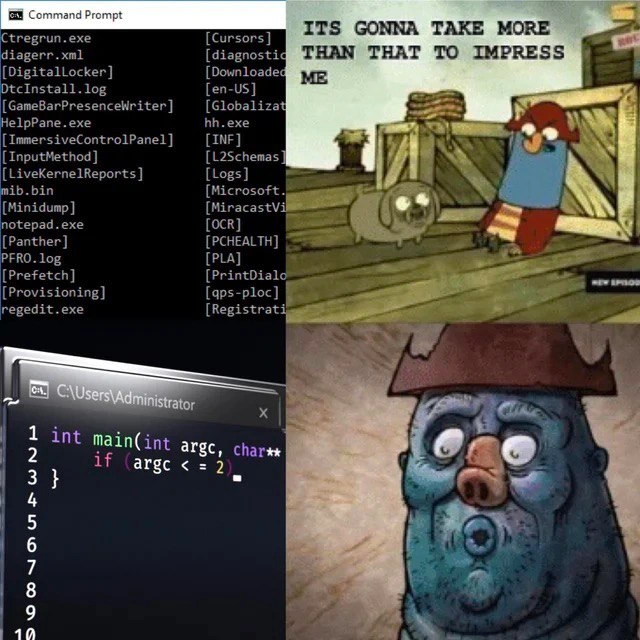
This meme is just like that story. The developer is the kid trying to show off. First, they do something very simple – showing a list of computer files – and expect everyone to be wowed. The experienced judge says, “You’ll have to do better than that to impress me,” just like the parent did. So, the developer tries to do something more “advanced” – writing a bit of code – but they do it really sloppily (kind of like hiding the mess instead of actually organizing it). When the judge sees that messy, half-finished code, they’re shocked and a bit horrified, just like the parent with the mess stuffed under the bed.

In everyday terms: someone tried to show off and it completely backfired. They didn’t do the basic work well, and their attempt to look impressive just made things look worse. It’s funny because we can all imagine that situation – whether it’s a kid, a student, or even an adult – where trying too hard to impress without actually being prepared leads to an “Oh no!” reaction instead of applause. The moral? If you want to impress someone, do the job right… otherwise you might just get a funny shocked face instead of a thumbs up!

Level 2: System32 & Sloppy C

Let’s break down what’s happening for those newer to these concepts. The top-left of the meme shows a Windows command prompt (the text-based window for typing commands, also called a CLI – Command Line Interface). The user ran the dir command, which in Windows is short for “directory listing.” It lists files and folders in the current location. Here, the location is likely the System32 directory (C:\Windows\System32), which is a core folder on Windows computers that contains tons of system files (things like .exe programs that are part of Windows, drivers, and configuration files). By default, System32 is full of oddly named files that regular users don’t normally interact with directly. In the screenshot, you see filenames such as ctregun.exe, DigitalLocker, mib.bin, notepad.exe (that one you might recognize!), and “regret.exe.” Now, regret.exe is not a standard Windows file – it’s placed in the meme as a joke. The word “regret” stands out because it’s an emotion, not a typical technical term. It implies that fiddling inside System32 might lead to regret. In tech jokes, finding a file named “regret” makes people laugh because it’s like Windows is self-aware about how we feel when things go wrong.

So, the person in the meme is basically showing a list of system files and expecting others to go “Wow, amazing!” But in reality, there’s nothing special here – every Windows machine has these files. It’s comparable to showing someone the engine of a car and expecting them to be impressed just because the engine exists. An experienced person would think, “Okay, that’s the standard stuff, what am I supposed to be impressed by?” That’s exactly why the cartoon bird in the next panel says, “It’s gonna take more than that to impress me.” In other words, “You’ll have to show something cooler or more unique, because just showing this basic output isn’t impressive at all.” This sets up the expectation that the developer will try something else, presumably more impressive next.

Now, look at the bottom-left panel. It’s showing some code in a console or editor window. The code is written in C (a programming language). Specifically, we see part of the definition of the main function, which is the entry point of any C program. It starts with int main(int argc, char** .... Normally, it should be int main(int argc, char** argv) – where argc is the number of command-line arguments and argv is an array of the actual arguments (as strings). However, in the meme’s code, it looks like the person didn’t finish typing argv, or perhaps the screenshot cut it off. After that, we see an if statement: if (argc <= 2,. This is clearly wrong syntax in C. Typically, an if-statement in C should look like if (condition) { ... }. For example, if (argc <= 2) { /* do something */ }. Here we expected a ) to close the condition and then maybe a { to open the code block. Instead, there’s a comma , which doesn’t make sense there – it’s likely a mistake. And we see a } on the next line without a matching { before it. All these clues tell us that this code is incomplete or poorly written. It probably wouldn’t even compile (meaning the computer would throw errors and not produce a runnable program). The person was likely trying to check if the program had two or fewer arguments (maybe to print a usage message when not enough arguments are given), but they didn’t finish writing that logic. They also forgot to complete the function signature (char** argv) and proper brackets. In a language like C – which is part of the C Family of languages known for their strict syntax – even a single missing parenthesis or brace will cause the whole program to fail. This code snippet is a textbook example of sloppy C code: missing pieces and typos that would prevent it from running. A seasoned C programmer immediately cringes seeing this, because it’s the kind of error you learn to avoid early on (often after the compiler yells at you a few times!).

Now, the bottom-right panel shows a cartoon pig character with a tricorn hat, bulging eyes, and puckered lips, looking completely shocked. This image is being used as a reaction meme – basically to show how someone reacts emotionally. The idea is that the “judge” who said they weren’t impressed (the bird) is now seeing this terrible code and making a face like “WHAT DID I JUST WITNESS?!” It’s a comically exaggerated shocked face. Why the shock? Because the “more impressive” thing the developer tried to show is actually a blunder. It’s like if someone bragged they could do a magic trick, and when they perform it, they accidentally set their hat on fire – you’d be surprised and a bit horrified, not impressed in the way they intended. In the meme, the developer thought showing some actual coding (in C, no less, which has that aura of being a hard, low-level language) would impress the judge. But since the code is such a mess, it has the opposite effect. The judge is astonished that the developer would even present that proudly.

The text caption that accompanied the meme, “Microsoft is updating the whole s**t,” is a bit of extra color. It’s basically the poster’s snarky remark. Microsoft is the company behind Windows, and the caption jokes that Microsoft is “updating everything” – implying maybe this kind of chaotic code or weird output is a result of some big, clumsy update. People often jokingly blame Windows updates for strange issues or say things like “must be a new Microsoft feature” when something looks wrong. Here, the caption is a crude way to say “This is so bad, maybe Microsoft decided to rewrite everything and this is what we get.” It’s not to be taken seriously – just an additional jab tying the Windows theme together.

To put it simply, this meme is making fun of someone who tries to show off with basic tech tricks and fails spectacularly. First, they do something unimpressive (listing system files). The experienced folks go, “Meh, seen that, not impressed.” Then they try to do something “harder” (writing C code), but do it so poorly that it’s laughable. Now the reaction is shock – not because it’s awesome, but because it’s awful. The humor comes from that misjudgment. If you’re new to programming or IT, the lesson here (wrapped in a joke) is: just doing “techie” stuff isn’t impressive if you don’t do it well. In fact, doing it badly will get you laughter or pity, not praise. It’s a common type of developer humor to exaggerate these situations, so don’t feel bad – pretty much every developer has had a moment where they thought something was cool but it turned out to be trivial or wrong. We laugh at these memes because we’ve been on one side or the other of this scenario at some point!

Level 3: Brace Yourself for Regret

In the top-left panel of this 4-part meme, a developer proudly presents a Windows Command Line Interface (CLI) window with a directory listing of the system folder. The black console output scrolls through C:\Windows\System32 files like ctregun.exe, diagerr.xml, and the pièce de résistance: regret.exe. For a seasoned developer, this is hardly impressive – it’s literally the list of default system files every Windows machine has. Running dir on System32 is the programming equivalent of flexing that you can open Notepad. We see weird file names in System32 all the time (legacy utilities, COM components, things nobody touches). In fact, the presence of a file named regret.exe is hilariously apt; mess around in System32 without knowing what you’re doing, and “regret” is exactly what you’ll get. The meme creator likely snuck that name in as a gag (Windows doesn’t actually ship a program called regret, as far as we know) – it foreshadows the cringe to come.

Top-right, a cartoon blue bird character (from Regular Show, a cartoon known for its deadpan humor) looks thoroughly unimpressed and declares in blocky captions: “IT’S GONNA TAKE MORE THAN THAT TO IMPRESS ME.” This is the “judge” of our meme, and they ain’t wowed by a simple file dump. Every grizzled sysadmin or senior dev has seen the inside of System32 a thousand times – we’ve deleted the Windows.old folder and battled DLL hell. Show us a random list of system files and we’ll shrug: So what? The bird’s attitude nails it: listing some directories or pointing at obscure executables isn’t going to earn you any tech cred. CLI magic? More like CLI 101. You want to impress a veteran dev, you’ll need something more substantial than proving you can navigate to the Windows folder. In other words, “Cool story, bro, but I’m not clapping for that.”

But ah, the meme is a 4_panel_meme_format, so enter panel three: the developer ups the ante. Bottom-left, we zoom into a Windows console or editor showing some color-coded C code. Line 1 begins int main(int argc, char** – and then it cuts off. Line 2 reads if (argc <= 2, – ending in a comma, not a parenthesis. Line 3 is just a } brace hanging there. This snippet is supposed to be the grand reveal, but to any programmer, it’s a hot mess. Let’s unpack: in C (a venerable member of the CFamilyLanguages), int main(int argc, char** argv) is the standard entry-point function, with argc as the count of command-line arguments and argv as the array of argument strings. Here, the coder hasn’t even finished writing argv (the code just says char** with no variable name or closing parenthesis). Then they attempt an if statement to check argc <= 2 (maybe trying to ensure at least 2 arguments were passed), but they wrote a comma instead of the closing bracket – a total syntax error. And there’s a lone } with no matching opening brace {. In short, this code would not compile. It’s an incomplete_main_function with a bungled argc_argument_check. It’s as if someone copy-pasted a snippet from a C tutorial and didn’t even paste the whole thing. For any experienced coder, this isn’t just unimpressive – it’s physically painful to look at. We’ve spent nights chasing down a missing brace or a stray comma; seeing one proudly displayed is like a chef being shown a “gourmet” dish that’s actually raw dough.

Finally, bottom-right, the payoff: the cartoon judge’s reaction. The blue-skinned pirate pig (from Flapjack, another cartoon) has bulging eyes and a puckered, stunned expression. This cartoon reaction face says “HOLY MOLY” without a single word. Remember, the judge said “gonna take more than that” – well, now they’ve gotten more, and it’s so much worse than expected that they’re shocked. The humor is that the judge isn’t impressed in the good way; they’re astonished that the developer thought this would be impressive. It’s like a tech lead challenging a junior, “Show me something cool,” and the junior unveils code that doesn’t even run. The lead’s face goes from bored to horrified: “Wait... you’re proud of THIS?!” As a battle-scarred dev, I’m laughing (and crying) inside. I’ve done code reviews where I felt exactly like that pig – eyes wide, thinking “I have several questions.” The meme brilliantly captures a common dev culture moment: someone shows off a “clever” trick or snippet that is actually a dumpster fire, and the audience is left in stunned disbelief.

At its core, this meme pokes fun at showboating with low-effort tech tricks. The combination of a Windows command prompt and sloppy C code screams “newbie trying to look l33t.” Experienced devs have a high bar for being impressed: we value clean code, working prototypes, maybe an elegant one-liner or a deep bug fix. Simply flashing a terminal full of system file names? Nope. Writing in C for clout, but not even closing your main() properly? That will get our attention, but for the wrong reasons! The caption on the post, “Microsoft is updating the whole shit,” adds an extra layer of snark. It implies that even if this were part of some official Microsoft update, it’s so bad that throwing the whole thing out (updating it all) might be the only fix. It’s an exaggeration, of course – a tongue-in-cheek jab at Windows’ occasional bugginess. As a grumpy old-timer, I chuckle because we’ve all seen rushed, sloppy code make it into production at times, prompting joking threats to “rewrite the whole damn thing.”

So, the joke operates on multiple levels: On the surface, it’s silly – funny file name, cartoon faces, broken code. But to those in the know, it’s a roast of that overconfident dev attitude. We’ve all met the coder who proudly shows something that barely works (or doesn’t work at all). The meme’s answer to that is the deadpan judge: “Try harder, I’m not impressed,” followed by the wide-eyed stare of “I can’t believe you thought that was a good idea.” It’s a cautionary tale wrapped in humor: if you’re going to try to dazzle your peers, make sure you’ve actually got your act together — otherwise you might just end up starring in the next developer humor meme. 😜

Description

A four-panel meme that uses the 'Captain K'nuckles Impressed' format from the cartoon 'The Marvelous Misadventures of Flapjack' to illustrate what truly impresses a seasoned developer. The top-left panel shows a Windows Command Prompt listing various system files and directories, representing a superficial display of technicality. In the top-right panel, the cartoon character Captain K'nuckles looks on, unimpressed, with the text 'ITS GONNA TAKE MORE THAN THAT TO IMPRESS ME'. The bottom-left panel shifts to a code editor with a dark theme, running with administrator privileges ('C:\Users\Administrator'). It displays a snippet of C code: a basic `int main(int argc, char**` function signature with an `if (argc <= 2)` condition. In the final bottom-right panel, Captain K'nuckles's expression has changed to one of wide-eyed shock and awe. The joke contrasts the mundane act of navigating a filesystem with the perceived complexity and 'seriousness' of writing low-level C code, even a simple, incomplete fragment, which commands more respect in developer circles
Comments

8
Anonymous ★ Top Pick Anyone can type `dir`. It takes a special kind of courage to write `char**` and just assume the segmentation fault will happen to someone else
  1. Anonymous ★ Top Pick

    Anyone can type `dir`. It takes a special kind of courage to write `char**` and just assume the segmentation fault will happen to someone else

  2. Anonymous

    Watching the Windows update demo - just a System32 dir dump and an unclosed main() - I finally understood: regret.exe isn’t a file, it’s their CI pipeline’s exit code

  3. Anonymous

    After two decades of enterprise Java frameworks and microservices orchestration, seeing 'int main()' still gives me the same feeling as finding a perfectly balanced binary tree - pure, elegant, and exactly what it needs to be

  4. Anonymous

    Twenty years in and the industry still agrees: competence is invisible, but a dark theme with syntax highlighting is a senior promotion

  5. Anonymous

    When you spend three sprints architecting a microservices mesh with event sourcing and CQRS, only to realize the stakeholder demo is a three-line argument parser that could've been a bash script. The Windows system directory in the background perfectly captures the bloat we're trying to avoid, while our 'impressive' code checks if argc <= 1 - truly revolutionary work that'll definitely justify that principal engineer promotion

  6. Anonymous

    Tasklist brag? Amateur hour. argc < 2 bail-out? Chef's kiss

  7. Anonymous

    Show me a DIR listing and I’m unmoved - show me `if (argc < = 2, …)` and I can hear the compiler whisper “lvalue required” from across the data center

  8. Anonymous

    Opening cmd and listing System32 doesn’t impress me; writing a Windows C CLI whose main(int argc, char** argv) parses quoted paths and Unicode without an off-by-one on argc - that does

Use J and K for navigation