Skip to content
DevMeme
1942 of 7435
The Enthusiastic Start and Inevitable Neglect of Side Projects
DeveloperProductivity Post #2158, on Oct 17, 2020 in TG

The Enthusiastic Start and Inevitable Neglect of Side Projects

Why is this DeveloperProductivity meme funny?

Level 1: Shiny New Toy

Imagine a child who has a bunch of toys they used to play with. One day, the child gets a brand new toy – something bright, shiny, and super exciting. From that moment, this new toy is all the child wants to play with. They carry it around everywhere and maybe even hug it when they go to sleep. Meanwhile, all the other toys they loved before are now sitting ignored in the corner. The teddy bear, the old action figure, the half-finished puzzle – they’re gathering dust and looking pretty lonely. Those old toys are "wilted" in spirit, like they’re sad because no one is playing with them. This situation is a little funny because we can all picture how quickly a kid’s attention shifts when something new and cool comes along. Adults do this too, just with different things. In this meme’s story, the developer is like that child, the new side project is the shiny toy, and the older side projects are the once-favorite toys now forgotten on the shelf. We smile at the meme because it exaggerates a truth we recognize: when you focus on one exciting new thing, it's easy to forget about the old things, which then get a bit lonely (or in the case of projects, they don’t get finished). It’s a playful way to remind us that our excitement has consequences, and it makes us laugh because we’ve all been guilty of abandoning our "old toys" when something new catches our eye.

Level 2: Project Garden

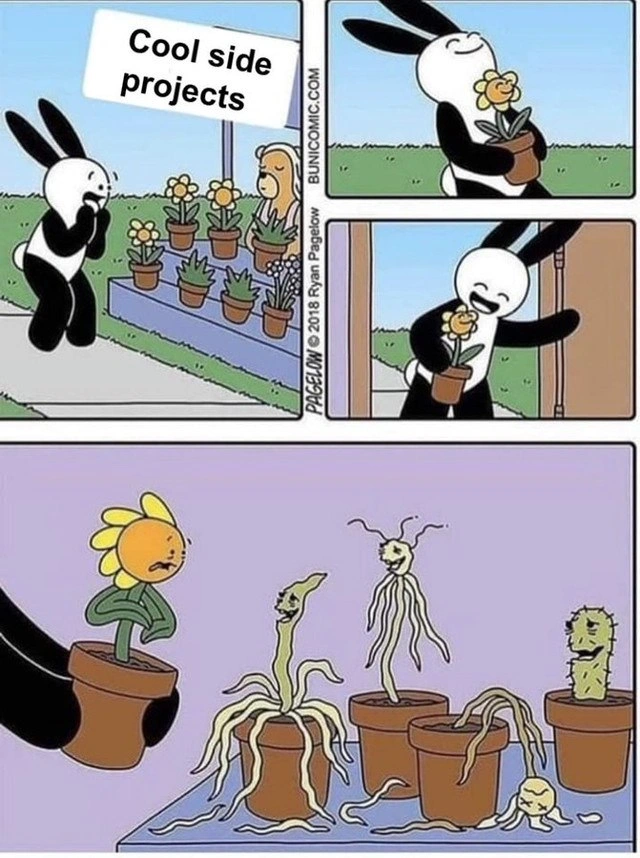
This four-panel comic uses a simple metaphor: the developer’s collection of side projects is like a garden of potted plants. The cute black-and-white bunny character is the developer, and each plant is one of their projects. Let’s break down what’s happening in clearer terms:

  • Side projects: These are personal coding projects that developers work on outside of their main job or primary responsibilities. They can be anything — maybe building a small game, a personal website, a mobile app idea, or experimenting with a new programming language or framework. In the comic, each potted flower represents one such side project a developer has started.

  • "Cool side projects" flower: In the first panel, the bunny sees a particularly attractive yellow flower with a label that says "Cool side projects". That label names the flower as the new, exciting project idea. The bunny’s reaction (hands up to the face in awe, mouth open) is the developer being thrilled about this new idea or technology they just discovered. If you're a developer, especially a new one, you probably know this feeling: say you just heard about a hot new JavaScript library or a cool Python machine learning toolkit, and you think, "Wow, this is so cool. I want to dive into it right now!" The comic exaggerates that excitement by having the bunny literally gasp in amazement at the new flower.

  • Hugging the new project: In the next two panels, the bunny picks up the special flower and hugs it tightly. This represents the developer fully embracing the new side project. In real life, this could mean you start coding immediately, maybe staying up late because you’re "in the zone" with this idea. It could also mean setting up a new repository on GitHub (a popular website where developers store and share code) for the project and writing an enthusiastic README file for it. Essentially, you’re giving this new project all your love and attention at the start — just like the bunny happily carrying the favored flower away.

  • Leaving the old projects behind: Notice that while the bunny is walking off with the new flower, the other potted plants are left sitting on the ledge, unattended. These other plants symbolize the developer’s older projects or tasks that were already in progress. Because the developer is now so focused on the shiny new project, they aren't spending any time on the older ones. In gardening terms, it's like forgetting to water some plants because you got a new plant that's taking all your attention. In developer terms, it's like not writing any new code or fixes for your previous projects because you’re busy with the new one.

  • Wilted, sad plants: The final bottom panel reveals the consequences: the four plants that were left behind have wilted and look practically dead. Three of them are floppy and colorless, and the little cactus is shriveled up with a grimacing face. In simple terms, wilted plants = neglected projects. When a plant doesn’t get water and care, it droops and eventually dies. Similarly, when a software project doesn’t get updates, attention, or love, it sort of "dies" as well (maybe not literally, but it gets out-of-date or never reaches completion). Those sad faces on the plants are a cartoon way to show that the projects feel "abandoned." Of course, code projects don’t have feelings, but the cartoon gives them faces to make us emotionally recognize what's happening: "Oh no, these poor projects have been left to rot."

  • Shiny object syndrome: This is a phrase often used in the developer community (and beyond) to describe the tendency to chase after the newest, coolest thing and lose focus on what you were doing. Imagine a cat that’s easily distracted by a laser pointer — as soon as you shine the little red dot, the cat forgets everything else and chases it. For a developer, a new technology or a fresh idea can be like that laser pointer. One moment you were diligently working on Project A, but then a shiny new idea (Project B) came along, and suddenly Project A is forgotten. "Syndrome" makes it sound like a condition, and humorously it kind of is like one: many of us can't help ourselves when something new appears. In the meme, the bunny’s behavior is exactly shiny object syndrome in action. One cool flower showed up, and boom — all the other plants were out of mind.

  • Developer productivity vs. learning: The categories tag this meme as DeveloperProductivity and Learning. This is because it reflects a real balancing act in a developer's life. On the learning side, having side projects and trying new things is fantastic. It's one of the main ways developers grow their skills. For instance, you might start a side project to learn a new programming language or framework. That’s positive and encouraged. But on the productivity side, there’s a downside: if you keep starting new projects without finishing the earlier ones, you end up with a lot of half-done work and not many completed results. Productivity isn’t just about being busy; it’s about finishing things. In the comic, the developer bunny was very "busy" starting a new project (that’s activity), but in the end, we see a bunch of plants that never fully grew (meaning a bunch of projects that never got completed). The meme humorously highlights this trade-off. Essentially it says, "Yes, you can keep taking on cool new things, but be aware, something else might suffer or get ignored."

  • Procrastination by project-hopping: Procrastination usually means delaying or avoiding something you need to do. A funny angle here is that starting a new project can actually be a form of procrastination with respect to finishing your existing project. For example, imagine you have a side project to build a website and you’ve done most of it, but now you have to write the boring documentation or fix some tricky bugs. You might procrastinate on that by saying, "I’ll get back to it later; let me try making this other cool game idea I just had first." You are working, yes, but you’re working on something new to avoid the tedious part of the old task. The meme shows the outcome: the old project (plant) gets no attention and wilts. Many junior devs and students experience this. It's like when you have homework, and instead of doing it, you suddenly feel the urge to start a completely different creative project — you justify it because it's still "productive" in a sense, but you're really just postponing the task you find difficult. In the developer world, because there’s always a new technology or idea around, it’s very easy to subconsciously procrastinate like this by project-hopping.

To put it simply, this comic is using a garden metaphor to poke fun at a common developer habit. The bunny = a developer (us). The new flower = a shiny new project or idea that we find really cool. The wilted plants = all the other projects or obligations we’ve neglected because of the new thing. It’s funny (and a bit ironic) because it’s true to life. Even if you're new to coding, you might have experienced a version of this: maybe you started learning one programming language, then got intrigued by another and switched, leaving the first one half-learned. Or perhaps you began writing a simple game, but halfway through you thought of an idea for a different app and jumped to that, leaving the game unfinished. The result is a bunch of half-done projects (or half-learned skills) represented by those sad plants.

We find this meme relatable because it captures a real feeling: that mix of excitement and guilt. Excitement for the new thing, guilt for not finishing the old things. The visual of the poor droopy flowers with the bunny's prized flower still in hand is a light-hearted reminder. It basically says, "Hey, we've all been this bunny, getting excited by something new and forgetting to take care of what we already have." It teaches a gentle lesson about focus and time management in a funny, memorable way. And if nothing else, it makes developers laugh and think, "Haha, yep, I recognize myself there."

Level 3: Shiny Object Syndrome

At the senior developer perspective, this meme hilariously captures the shiny object syndrome prevalent in tech. The bunny grabbing the bright, smiling flower labeled "Cool side projects" represents a developer discovering an exciting new project idea or a trendy technology. In that first panel, the bunny gasps with delight — just like an engineer stumbling on a shiny new framework, a fresh API, or a brilliant app concept over the weekend. It's that surge of enthusiasm where you think "This is the coolest thing ever! I have to start building it right now."

Meanwhile, the row of other potted flowers are the older side projects and tasks left behind. Notice how the bunny completely ignores those other plants as soon as the new one catches its eye. This mirrors how developers often behave: as soon as a new repo is initialized or a new tutorial is found, all those previous projects (the ones we swore we'd finish someday) are temporarily forgotten. In the comic, the bunny actually hugs the chosen flower and walks off with it in panel three — an affectionate metaphor for the honeymoon phase of a new coding project, where you're giving it all your attention and love.

Now cut to the final panel: the once-healthy "cool project" flower has a sad frown, facing the lineup of four neglected plants. Those wilted, stringy flowers represent our abandoned repositories and unfinished side hustles. They were alive and promising at one point (we can imagine they used to smile too), but lack of care has left them with drooping stems and lost hope. There's even a tiny cactus on the right that somehow looks shriveled and unhappy. (Think about that: even a cactus — which in real life hardly needs any water — has been neglected so long it’s suffering. That's a pretty brutal commentary on just how distracted the developer got with the new shiny project!)

This scene will make any experienced engineer chuckle and cringe at the same time. It's so relatable because many of us maintain a little "graveyard" of projects in our Git repositories or on our hard drives. Maybe you started building a personal blog engine with the latest JavaScript framework, got it to "Hello World," and then never touched it after discovering some new machine learning library the next week. Each of those wilted plants could be named after one of our forgotten codebases, perhaps something like weather_app_v2 or GameEnginePrototype – each one started with excitement and later abandoned.

From a productivity standpoint, the meme highlights a classic pitfall. Developers are lifelong learners (hence the category Learning), and we thrive on exploring new things. However, that strength has a flip side: constantly jumping to the next cool thing can wreak havoc on Developer Productivity. It's a trade-off between exploration and execution. The bunny can’t water all the plants at once — if you devote all your free time to the newest side project, you simply don't have bandwidth left to maintain the prior ones. In economics or project management terms, this is the opportunity cost of chasing novelty: every hour spent on the new project is an hour not spent finishing or polishing an older one.

The humor here also comes from the dramatic visual: the older projects look almost comically dead, exaggerating how our earlier brilliant ideas feel after months of neglect. As developers, we often joke about "abandoned repos" or the number of procrastination projects we have. Procrastination isn't just about watching YouTube instead of working; sometimes we procrastinate on one project by working on another! Starting a new project can feel productive (you're coding, after all), but it can also be a sly form of procrastination to avoid the less fun stages of your existing project (like writing tests, fixing bugs, or writing documentation). It's much more fun to chase a new idea than to do the boring cleanup on the old one, right? So the bunny runs off with the shiny flower, because refactoring the wilting ones or slogging through the boring parts just didn't seem as exciting.

Shiny object syndrome is a well-known phenomenon in tech teams too. Companies sometimes keep pivoting to whatever is trendy (microservices! blockchain! AI! you name it) and leave a trail of half-implemented initiatives. Individually, a developer might jump from learning one programming language to another each month, resulting in a bunch of half-finished tutorials and no completed app to show. The meme's final panel is basically a family photo of a developer’s unfinished work: the projects that never made it to version 1.0, looking accusingly at the developer's newest pet project.

Dev inner monologue: "This time will be different. I'm definitely going to see this project through to the end!"
Next week: "Ooh, look, a new JavaScript library just dropped! Let me try that on a new project..."

That little imaginary quote sums up the cycle. We convince ourselves that we will commit to the new project (like the bunny hugging the favorite flower as if promising to take care of it), but inevitably the pattern repeats when an even cooler "flower" pops up in the garden of ideas.

There’s also a nod to time management. One developer cannot realistically maintain so many projects if they keep starting new ones. Just as plants need regular watering (and code needs regular commits and bug fixes), projects need consistent effort to stay alive. When you divert your attention, the others languish. This is why seasoned devs often force themselves to focus on one side project at a time or impose rules like "no starting a new project until I finish or officially abandon the current one." If you don't, you end up with the scenario shown in the comic: lots of wilted codebases and one overwhelmed gardener (developer).

In summary, this meme is a witty commentary on developer psychology and work habits:

  • Enthusiasm vs. Sustenance: New ideas generate tons of initial enthusiasm (a quick bloom) but require ongoing care and maintenance to thrive — care that we often fail to provide.
  • Many Starts, Few Finishes: It's far easier to start projects (plant seeds) than to finish them (grow a full garden). The wilted flowers are those many seeds that sprouted but never fully bloomed.
  • Shared Guilt: The humor has a sting of truth. Virtually every dev recognizes those sad wilted flowers as their own past projects. We laugh, but we also wince because we know we've done exactly this — loved a project, then left it to wither when something new caught our eye.

The meme resonates deeply in the developer community because it exaggerates a truth we often don’t admit openly: we love the rush of starting projects, but finishing them? That's the hard part. Sometimes our earlier "cool projects" pay the price when our attention moves on. This comic just uses a cute bunny and some droopy plants to remind us of that fact in a lighthearted way.

Description

A four-panel comic strip illustrating the lifecycle of a developer's side projects. In the first panel, a cartoon bunny excitedly looks at a stall labeled 'Cool side projects,' which is filled with vibrant, healthy potted flowers. In the next two panels, the bunny happily chooses a flower and takes it home. The final, large panel reveals the punchline: the bunny is about to place the new, healthy flower next to a collection of grotesque, dying, and mutated plants, which represent its other, long-abandoned side projects. The new flower looks on in horror at its future companions. This meme is a relatable metaphor for the common developer experience of starting new, exciting side projects with great enthusiasm, only to neglect them over time as they join a 'graveyard' of other unfinished projects. It humorously captures the cycle of inspiration and subsequent abandonment that many senior developers know all too well


Comments

10
Anonymous ★ Top Pick My GitHub profile is just a digital version of this. Lots of freshly cloned starter kits sitting next to projects last updated when 'async/await' was still a revolutionary concept
  1. Anonymous ★ Top Pick

    My GitHub profile is just a digital version of this. Lots of freshly cloned starter kits sitting next to projects last updated when 'async/await' was still a revolutionary concept

  2. Anonymous

    My GitHub garden: one fresh bloom at HEAD and a graveyard of “initial commit” branches behind it - eventual consistency, but for enthusiasm

  3. Anonymous

    The only thing more consistent than my CI/CD pipeline is my side project abandonment pipeline - continuous integration of new ideas, continuous deployment to /dev/null

  4. Anonymous

    Every senior engineer's GitHub profile is essentially a digital terrarium of side projects - one meticulously maintained showcase repository getting daily commits, while the other 47 repos slowly transform into eldritch horrors of deprecated dependencies, broken CI pipelines, and README files that still promise 'coming soon' features from 2019. We tell ourselves we'll circle back to them after this sprint, but deep down we know they're already past the event horizon of technical debt, where even `npm audit fix` fears to tread

  5. Anonymous

    Side projects: greenfield microservices dreams crashlooping on the OOM killer of dayjob bandwidth

  6. Anonymous

    “Cool side projects” are greenfield microservices right up until the first schema migration or on-call; then they join the GitHub graveyard - one init commit, a slick README, and a CI badge permanently red

  7. Anonymous

    Shiny‑object - driven development: repo count grows linearly, maintenance bandwidth stays constant - so each new README promotes last weekend’s MVP to “legacy LTS” with a bus factor of one

  8. @Lord_Evil 5y

    Да идите в жопу

  9. @elpinguinofrio 5y

    главное что нужно это офигенный домен купить сразу, в коллекцию

  10. @Bender666 5y

    Nano Adblocker XD

Use J and K for navigation