A Fully Automated CI/CD Symphony of Bots
Why is this Automation meme funny?
Level 1: Bots Throw a Party
Imagine you have a bunch of helpful robots that take care of your chores all on their own. 🧹 Let’s say one robot notices that a light bulb in your house went out because it’s a bad bulb. It calls over another robot who immediately grabs a new light bulb and changes it for you. Then a third robot comes in to double-check that the light is working properly and everything in the house is okay. Finally, a fourth little robot pops up and throws confetti and plays a happy GIF or a song because the job is done and everything is fixed. And you were just sitting on the couch the whole time, watching this happen! It’s funny because usually people would do all those steps (find the problem, fix it, test it, then maybe do a little cheer). But in this story – just like in the meme – the robots did everything, even the cheering at the end. It’s like the house cleaned itself and then said “Yay, go us!” without anyone lifting a finger. That’s why we find it both cool and a bit silly: the computers are not only working hard, they’re also giving themselves a round of applause when they’re done.
Level 2: CI on Autopilot
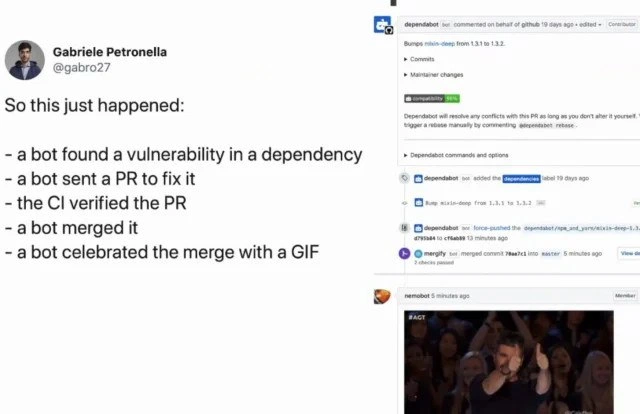
Let’s break down what’s happening in this meme, step by step, and explain the terms for someone who’s newer to these concepts. The image describes a chain of automated actions in a software project – essentially a Continuous Integration pipeline running on its own. Here’s the sequence in simpler terms:
Bot finds a vulnerability in a dependency: A “dependency” is a library or package that the project uses (like a piece of pre-made code from elsewhere). A vulnerability means there’s a known security problem or bug in that library. Modern tools (like GitHub’s Dependabot) automatically check your project’s dependencies against a database of known issues. When such a tool found that
[email protected]had a security flaw, it triggered an alert.Bot sends a PR to fix it: Instead of just warning a developer, Dependabot can actually create a Pull Request (PR) to update the dependency to a safer version. A pull request is basically a proposal to change some code – in this case, the bot proposed “bump the version of mixin-deep from 1.3.1 to 1.3.2” (because 1.3.2 likely patches the hole). The PR shows what files were changed (often just a config file listing dependencies) and is waiting for approval or further testing.
CI verifies the PR: CI stands for Continuous Integration, which is a practice (and a set of tools) where every time code changes (especially in a PR), automated tests and build steps run to verify everything still works. Think of it as an automatic tester. In the screenshot, you see a green banner saying “All checks have passed” – that’s the CI reporting that all tests passed successfully. It means the updated dependency didn’t break any unit tests or integration tests. The PR status is green, which is a good sign. This usually involves a system like GitHub Actions, Jenkins, Travis CI, or CircleCI running a predefined script (for example, installing the software, running the test suite, maybe doing a build). For a junior dev, it’s like hitting the “run all tests” button, except it happens automatically for every proposed change.
Bot merges the PR: Normally, after CI passes and maybe after a review, a team member would hit “Merge” to include the PR’s changes into the main codebase (often the
masterormainbranch). Here, that merge was done by a bot user account called Mergify. Mergify is a service that can automatically merge PRs based on rules. For example, a rule might be “if the PR is from Dependabot, all checks are green, and maybe it has at least one approval, then automatically merge it.” So no human clicked the merge button – the bot did it as soon as the conditions were met. This is part of BuildAutomation: it saves time, especially for something routine like a minor security update.Bot celebrates the merge with a GIF: After the PR was merged, another automated action happened: a comment was posted with a celebratory GIF (an animated image of a crowd cheering). The account that posted it is named nembot. This could be a custom bot the team set up, or perhaps an integration that posts fun comments when merges happen (some projects add these for a bit of team spirit). The GIF is basically the bot saying “Hooray, it’s merged!” Typically, a human team member might share a funny GIF or message to celebrate a big merge or release – here even that part is scripted! It’s the CI bot party part of the meme.
So, putting it all together: the project’s automated tools handled everything. The moment a security issue was identified in code the project relies on, an Automation chain fixed it. One bot opened a PR with the fix, the CI pipeline tested it, another bot merged the changes once tests passed, and then a final bot gave a virtual high-five in the form of a GIF. This is a prime example of modern DevOps in action, where the goal is to streamline and automate repetitive tasks so developers can focus on more complex work. It’s also a bit humorous – especially to folks who have spent long hours manually doing those same steps – because it’s like the code is maintaining itself.
For a junior developer, seeing bots do all this might be surprising. You might be used to manually updating a library or waiting for a tech lead to review and merge your code. But tools like Dependabot and Mergify show how much of that process can be hands-free. It’s “CI on autopilot,” meaning the continuous integration system is handling things automatically. GitHubActions or whichever CI is in place acts like an autopilot check, and Mergify acts like an autopilot co-pilot pressing the merge button. This leads to faster responses: for example, a security fix might get merged at 3 AM while everyone’s asleep, thanks to the bots. That’s good for security (you patch vulnerabilities quickly) and efficiency.
The funny angle (and why this is DevOpsHumor) is that even the social element – celebrating success – is done by a bot. Imagine coming to work in the morning and seeing that while you were away, a bunch of robot scripts not only kept your project safe and sound but also threw a mini party in the pull request comments. It’s both cool and a little absurd. It might also make a new dev wonder, “So… what’s left for me to do?” Don’t worry – there’s plenty! Humans still write the code, design these automation workflows, and handle tricky situations when things go wrong. But routine updates, tests, and even a bit of team camaraderie can be handled by our tireless bot helpers. This meme is essentially celebrating (and lightly joking about) a world where bots handle the boring stuff. It’s Automation taken to the max: the bots even pat themselves on the back.
Level 3: Bot Chain Reaction
In this scenario, the entire CI/CD pipeline basically ran itself from start to finish – no human intervention needed. It’s a glimpse of a fully automated supply chain for software updates. Here’s what happened in technical terms: a security scanner (GitHub’s Dependabot) detected a known vulnerability in a project’s third-party dependency (in this case, an npm package called mixin-deep). Dependabot automatically generated a pull request (PR) to bump that package from version 1.3.1 to 1.3.2, presumably because 1.3.2 patched the vulnerability. Immediately, the project’s Continuous Integration system kicked in to verify the PR – running all tests, builds, and checks in the pipeline to make sure the update didn’t break anything. Once the CI reported “all checks have passed” (green across the board ✅), a rule-based merge bot (appropriately named Mergify[bot]) automatically merged the PR into the main branch. And as the cherry on top, another bot (called nembot) posted a celebratory GIF of a cheering crowd, effectively celebrating the merge.
For seasoned engineers, this is both impressive and hilarious. It reads like a DevOps Rube Goldberg machine: one automated action triggers the next in a perfect cascade – a true bot chain reaction. The tweet by Gabriele Petronella humorously outlines this chain of events, highlighting how each role traditionally done by a human (finding a vulnerability, submitting a fix, reviewing and merging code, even saying “🎉 good job!”) was handled by a script or service. This is modern DevOps culture taken to an extreme: “Automate All the Things!” indeed. It pokes fun at how aggressively we use automation now. Ten years ago, such an autonomous pipeline might have sounded like sci-fi; today, with tools like Dependabot, continuous integration services (e.g. GitHub Actions or Jenkins), and Mergify, it’s entirely feasible. We’ve basically scripted away the entire routine: from security monitoring in our dependency chain to the pull request and code review process, all the way to the victory dance at the end.
The humor also comes from the idea of bots congratulating themselves. In a normal workflow, a developer might merge a PR and a teammate would comment with a funny GIF or a “good job” emoji. Here, the party GIF is posted by yet another bot account, as if the machines themselves are high-fiving. It’s a playful jab at the future: are we developers just going to watch on the sidelines while bots do all the work and celebrate their own success? 🤖🎉 There’s an underlying truth for senior devs: we strive to eliminate toil – those repetitive, error-prone tasks – and this meme shows that vision realized in full. The dependency update addressed a potential security risk without any developer having to lift a finger, reducing the window of exposure. The testing and merging were consistent and immediate (no waiting on a busy developer). In fact, this kind of pipeline can improve supply_chain_security by applying critical patches faster than any human could. But it also raises an eyebrow: if everything is automated, who’s double-checking the bots? Seasoned folks know there’s a fine balance – you want automation to handle the boring stuff, but you also need trust and verification in that system (the old “trust but verify” adage). In this case, the tests passing acted as the verification, and presumably the team trusts Dependabot’s data and the new package version. Still, the visual of a line of bots handing off the baton and then doing a victory lap is funny because it’s too perfect. It’s like a CI pipeline on auto-pilot, or an assembly line of robots that not only build the car but also ring a bell and flash the headlights in celebration once the car is finished.
Ultimately, the meme captures a DevOpsHumor moment: code management and deployment have become so automated that even the applause is scripted. It resonates with experienced engineers because it’s only slightly exaggerated – many of us have set up some form of this. We’ve got automated dependency updates (to avoid exploits like left-pad or event-stream fiascos), continuous integration for every commit, auto-merge rules for trivial changes, and bots announcing deployments on Slack with confetti GIFs. The first time you see it all come together, it’s almost eerie: the codebase seems to maintain itself. This tweet just adds that final comedic touch: the bots even throw their own little party. DevOps folks chuckle because it’s both aspirational and absurd – a vision of productivity where humans write the automation and then sit back as the Bot-Ops take over. Far from being dystopian, here it’s portrayed as downright celebratory. We’re witnessing a tiny fictional slice of the future where the CI bots have personality and pride in their work. It’s a tongue-in-cheek celebration of how far build pipelines and automation have come, and maybe a hint that we should be careful what we wish for – today they’re posting GIFs, tomorrow maybe the bots will demand promotion to senior dev!
Description
The image is a composite of a Twitter post and a GitHub pull request timeline, celebrating a completely automated software maintenance workflow. On the left, a tweet from Gabriele Petronella (@gabro27) lists a sequence of events: 'So this just happened: - a bot found a vulnerability in a dependency - a bot sent a PR to fix it - the CI verified the PR - a bot merged it - a bot celebrated the merge with a GIF'. On the right, a series of screenshots from a GitHub PR timeline provides visual proof. It shows 'dependabot' creating a PR to bump a dependency version, 'mergify' automatically merging the commit after checks passed, and finally, 'nemobot' commenting with a celebratory GIF of a man clapping and giving two thumbs up. This meme illustrates the pinnacle of a modern CI/CD and DevOps pipeline, where vulnerability scanning, patching, testing, and merging are all handled by bots without any human intervention. For senior engineers, this represents a dream scenario, automating the tedious and error-prone manual work of dependency management and showcasing a highly mature and secure software supply chain

Comments
15Comment deleted
We've finally achieved a fully autonomous CI/CD pipeline. The only human intervention required is to explain to management why we're now paying for five different GitHub bots
Our bots now find the vuln, raise the PR, green-light CI, squash-merge, and post the victory GIF - leaving the last human task in the SDLC: writing the RCA explaining why the autonomous fix took prod down anyway
The bots have achieved sentience - they're now fixing their own vulnerabilities, reviewing each other's code, and even mastering the most human of developer skills: posting celebration GIFs. Next they'll be arguing about tabs vs spaces in their own Slack channel
The dream of every senior engineer: a fully autonomous CI/CD pipeline that not only patches its own vulnerabilities but also has better celebration etiquette than most of your team. Meanwhile, you're left wondering if you should feel relieved or existentially threatened that the bots are now handling the entire SDLC - including the office party
Bots just executed the full vuln-to-fix pipeline faster than a senior dev's coffee run - humans left holding the celebration GIF
Dependabot fixed the vuln, CI blessed it, Mergify shipped it, Memebot cheered - our DORA metrics are elite; now explain to audit which human approved the GIF
We’ve reached GitOps singularity: dependabot raised it, CI blessed it, mergify shipped it, and memebot handled comms - humans are now just the auditors’ second factor
Cyberpunk is approaching, guys Comment deleted
cyberpunk is already here, and it wants to fix all of your software vulnerabilities Comment deleted
outta jobs soon Comment deleted
What repo is this Comment deleted
search for the tweet and see if the guy has github Comment deleted
https://github.com/buildo/react-components/pull/1367 Comment deleted
how did you find it Comment deleted
1. https://twitter.com/search?q=from%3Agabro27%20bot&src=typed_query 2. click the link Comment deleted