Skip to content
DevMeme
3887 of 7435
Your Entire Cloud-Native Stack Held Together by a Single Bash Script
DevOps SRE Post #4233, on Feb 20, 2022 in TG

Your Entire Cloud-Native Stack Held Together by a Single Bash Script

Why is this DevOps SRE meme funny?

Level 1: Too Much on Too Little

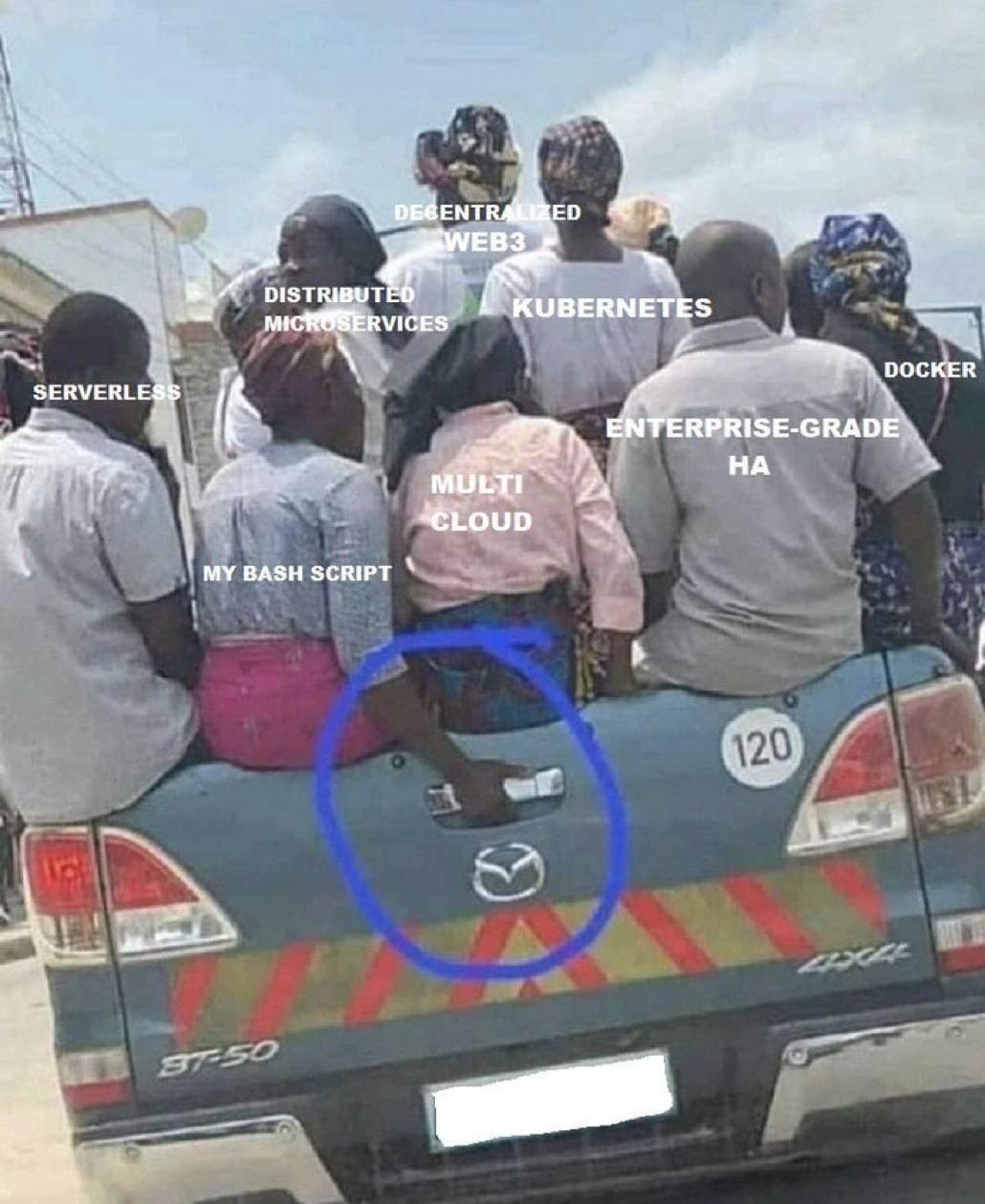
Imagine trying to carry a huge stack of stuff using just one tiny piece of tape to hold it together – that’s the joke here. In the picture, there are a bunch of people (a heavy load) sitting on the back of a truck, and only a small latch with someone’s hand is keeping them from tumbling out. It looks ridiculous and risky, right? It’s funny because you expect something so important (keeping people safely on the truck) to have a strong support, not just one hand on a latch.

Now think of a big complicated project like a giant tower of blocks. Each fancy tech term (like serverless, Kubernetes, Web3) is a big block in the tower, making it taller and seemingly impressive. But if all those blocks are resting on one small block at the bottom (that block is the Bash script), the whole tower is wobbly. It could tip over if that little block slips or breaks. In simpler terms, the meme is saying: “Look how silly it is to have something very important depend on something so small and fragile!”

Even if you don’t know the tech words, you can feel what’s happening: too many things are piled on one weak spot. It’s like balancing an elephant on a stool meant for a cat – sooner or later, crash! The humor comes from that clear imbalance. We usually trust big structures only if their foundations are strong. Here, the foundation is just a flimsy script (or that tiny truck latch). It makes us laugh and cringe because we can see it’s a disaster waiting to happen. It’s a bit like a cartoon where a huge weight is held up by a single small stick – you just know that stick can snap any second.

So, in everyday words: this meme jokes that some high-tech computer systems are just as shaky as an overloaded truck with a loose latch. It’s pointing out the silliness of doing something the hard, fancy way without taking care of the basics. Even a kid can get the core idea: don’t stack a ton of heavy stuff on a teeny tiny support – it’s not safe! And that’s why it’s funny: it’s a common-sense truth shown in a clever, exaggerated way.

Level 2: Buzzword Balancing Act

Let’s break down the components in this over-engineered stack and why the meme labels them as a heavy load on one script. If you’re newer to these terms, here’s what each means and how they relate to real-world setups:

  • Serverless – This doesn’t literally mean “no servers”; it means you use cloud services where the server management is hidden from you. For example, AWS Lambda lets you run functions in the cloud without worrying about the actual machine it runs on. It’s popular because developers can deploy small pieces of code quickly. However, “serverless” still has servers behind the scenes (managed by the cloud provider), and it often lives alongside traditional services. In our stack, maybe they have some serverless functions for certain tasks, but coordinating those with everything else can get tricky.

  • Distributed Microservices – This is an architectural style where an application is split into many small, independent services that communicate over a network. Instead of one big program (a monolith), you have lots of little ones (microservices). Distributed means these services might run on different machines or even different geographic regions. The benefit is supposed to be flexibility and scalability – each microservice can be updated or scaled without affecting the others (in theory). In practice, herding dozens of microservices is complex. You need some way to deploy and manage them all… often done by scripts or orchestration tools. The meme is hinting that despite having distributed microservices, they all depend on one central deployment script (which is a bit ironic, because microservices are meant to reduce central dependencies).

  • Decentralized Web3 – “Web3” is a buzzword that refers to a new iteration of the web based on blockchains and decentralization (like cryptocurrencies, smart contracts, etc.). Decentralized means there’s no single authority; for example, a blockchain is run by many nodes instead of one central server. Companies in 2021-2022 were hyping Web3 a lot. In the meme, they put “Decentralized Web3” as one of the passengers on this crowded truck. It implies the system even has some blockchain or crypto element added – perhaps unnecessarily – just because it’s trendy. It’s funny because Web3 is supposed to remove central points of control, yet here it is sitting on the same tailgate as everything else, ultimately reliant on a very centralized Bash script. For a newcomer: imagine adding a fancy new gadget to your project because everyone says it’s cool, but it complicates things and still relies on your old tools to function.

  • Kubernetes – Often abbreviated as K8s (because there are 8 letters between K and s), Kubernetes is a powerful open-source system for automating deployment, scaling, and management of containerized applications. Think of it as a control plane that manages a bunch of application containers (like a foreman directing many workers). Kubernetes is used to keep microservices running: it restarts them if they crash, moves them if a server dies, and so on. It’s practically become the standard for running large applications. But Kubernetes itself is complex – it has a lot of moving parts (API servers, etcd databases, controllers). In a perfect setup, you describe your system in config files and K8s maintains it. Yet, many teams still use scripts for certain tasks around Kubernetes (like deploying new versions, running maintenance jobs, etc.). The meme’s joke is that even with something as heavyweight and robust as Kubernetes in place, the team is still relying on a little Bash script to keep it all together.

  • Docker – Docker is a technology that allows developers to package their applications into containers. A container includes the app and all its dependencies, so it can run reliably on any machine (this solves the “it works on my machine” problem). Docker and containers are foundational for modern DevOps and microservices, because they make applications portable and isolated. In our meme’s stack, Docker is presumably being used to containerize each microservice. So, you have a bunch of Docker images/containers that Kubernetes is orchestrating. Docker by itself is great for consistency, but you need to manage all those containers somehow – again, often automated by scripts or CI/CD tools. If they’re using a Bash script, it might be doing things like building images (docker build) or pushing them to a registry, or starting containers. Relying solely on a script for that, instead of proper deployment pipelines, is risky – like loading many containers on a truck and trusting one latch to hold them.

  • Enterprise-Grade HA – HA stands for High Availability. “Enterprise-grade” is a fancy way to say it’s supposedly really reliable, fit for large businesses. When something is high availability, it means the system is designed to be up and running almost all the time, often with redundancy and failover mechanisms. For example, if one server goes down, another picks up the work immediately (users might not even notice any issue). Achieving HA often involves clustering (running multiple instances of a service), load balancers, backup systems, and avoiding single points of failure. In the meme’s context, they label one passenger “Enterprise-Grade HA” sarcastically – the system claims to have top-notch availability. But if that depends on one Bash script… well, that script is a single point of failure, which is the opposite of high availability. It’s like advertising a car that has five spare tires and then realizing all those tires are held on by one lug nut. A junior dev should take away that true HA means no one piece can crash everything; clearly, a design that can be toppled by one script isn’t really HA at all.

  • Multi Cloud – This means using multiple cloud providers for your application or infrastructure. For example, running some services on Amazon Web Services, some on Google Cloud Platform, maybe others on Microsoft Azure. Why do this? Possibly to avoid putting all eggs in one basket (if one cloud has an outage, others might still run), or to use specific strengths of each provider, or to avoid vendor lock-in. It’s a complex strategy because each cloud has different APIs and services. Managing a multi-cloud deployment often requires extra tooling or abstraction layers. In reality, few companies do true multi-cloud for the same application stack because of that complexity. But it’s a buzzword executives love – it sounds very robust and flexible. In the meme, “Multi Cloud” is another heavy piece of the stack. One can imagine our Bash script might be something that deploys or orchestrates across two different cloud environments. For instance, it might copy data from AWS to Azure, or start servers on both. If that script fails, your multi-cloud dreams kind of evaporate. For a junior dev: think of multi-cloud like trying to play two different games at once with one controller – you need a pretty clever setup to do it, and if that controller breaks, both games pause.

  • Bash script – Bash is a Unix shell and scripting language. It’s very common on Linux systems for automating tasks. A Bash script is basically a text file with a series of commands that you could type in the terminal, but automated. For example, a script might contain lines to start servers, copy files, or deploy applications. They’re convenient for quick automation because you can string together system commands easily. But Bash scripts are also infamous for being fragile and hard to maintain as they grow. Unlike a proper software program, scripts often lack rigorous error handling, and they rely on the environment being just right. Here, “MY BASH SCRIPT” is depicted as that one hand holding the tailgate closed. It indicates the entire complicated system is ultimately controlled or held together by a single script. For a newcomer: imagine you have a bunch of apps that need to be launched in order – instead of doing it manually, you write a Bash script to run all of them. That’s fine for a few things. But if you end up needing to handle 50 apps across different environments, that script can become hundreds of lines long and very hard to get right. If it breaks, nothing starts correctly.

Now, think about the balance and why it’s a “balancing act.” Each of the buzzwords above is like a person sitting on that truck. They all add weight (complexity). The Bash script is like the latch that’s supposed to hold all that weight in. The more weight you add, the more strain on the latch. In software terms, the more complex your system (more services, more clouds, more fancy tech), the more important the glue or orchestration becomes – and the more catastrophic if that glue fails. A junior developer might not immediately see why a simple script is a risk, so here’s an everyday development example: have you ever written a quick script to set up your development environment or run a build? It’s fine when it’s just you. Now imagine a whole company relying on one script to deploy the entire product to customers. If that script has a bug or someone forgets to update it when things change, it can bring everything to a halt. That’s why this meme hits home for DevOps folks – it’s an exaggerated reminder that even the fanciest tech stack can be brought down by poor underlying tooling or a single neglected piece of code.

In summary, the meme’s text labels each fancy part of the system (serverless, microservices, etc.) to show how many modern technologies are involved, but then it circles the tiny latch labeled “my Bash script” as the one thing keeping it all together. Each term we explained contributes to the complexity and supposed strength of the system, while the Bash script is the unsung, risky hero keeping it from falling apart. The humor (especially for industry insiders) comes from recognizing that disconnect: all that containerization and cloud architecture glory can crumble thanks to one janky script that probably started as a quick fix.

Level 3: One Script to Hold Them All

This level dives into the real-world DevOps humor and painful truth the meme is poking at. You’ve got every trendy architecture element piled on: Serverless computing, a fleet of distributed microservices, some decentralized Web3 component thrown in (because why not add blockchain to our stack?), all orchestrated by Kubernetes running Docker containers. It’s deployed across a Multi-Cloud environment for maximum buzzword compliance, and of course it’s labeled “Enterprise-Grade HA” to assure everyone it never goes down. On paper, this system sounds invincible – all the scalability and resilience money can buy.

But then the meme delivers the punchline: all those big-shot technologies are precariously balanced on “MY BASH SCRIPT”. In the photo, a dozen people (the heavy load of modern tech) sit on a pickup’s open tailgate, but the only thing preventing disaster is one person’s hand gripping the latch – that tiny latch is the Bash script. This is darkly comic to experienced engineers because we’ve all seen something like it. It’s the classic over-engineered stack built on a janky foundation. The whole cloud castle is literally held together by a few lines of Bash that some developer hacked together at 3 AM.

Why is this funny? Because it’s absurd but true. Companies brag about their sophisticated Cloud architectures – “We use Kubernetes, we’re fully serverless, we run across AWS, Azure, and GCP, our system is blockchain-enabled and 100% up all the time!” – yet behind the scenes you find a brittle deploy_all.sh or a cronjob.sh that if it fails, everything stops. The grand irony is that after investing time and money into eliminating single points of failure, they reintroduce a single point of failure in the form of a Bash script. It’s like installing high-tech security systems on all your doors and then leaving a window propped open with a twig.

Tech debt plays a huge role here. That Bash script is a prime example of production held together by scripts: perhaps it started as a quick fix or an automation to glue services together (“just run this script to restart things if the cluster is unhappy”). Over time, that script grew, gained features (update Docker images, redeploy K8s pods, sync databases, trigger serverless functions, etc.), until it became indispensable. But nobody ever refactored it into a more robust solution – maybe because of tight deadlines, or fear of touching it since “it works (mostly)”. This is how quick hacks become permanent fixtures. The meme shows the absurd endgame of that process: a massively overengineered stack resting on a janky Bash script that was never meant to carry this weight.

This scenario is painfully familiar. Perhaps the original devs intended to replace the script with a proper CI/CD pipeline or an orchestrator service, but the project moved on, and the script remained as a fragile backbone. It’s a form of “temporary” solution that became permanent – a hallmark of tech debt. Every seasoned engineer has war stories about critical processes running via some maintenance.sh or a single server that if turned off, everyone panics because “oh, our Kubernetes cluster actually relies on that one node running a Bash watchdog.” The SRE (Site Reliability Engineering) ideal is to eliminate these snowflakes, but in reality, even big enterprises have some cron job or script that must run for things to work.

We also see industry hype cycles at play. Each buzzword on the tailgate represents something that was (or is) hyped: containers, microservices, serverless, blockchain/Web3, multi-cloud. Companies sometimes adopt these not because they need them all, but due to FOMO or resume-driven development. They end up with a patchwork of trendy tech – a frankenstack. But integrating all these can be nightmarish. In a rush to be “state-of-the-art”, folks might skip proper integration. The Bash script becomes the glue – a quick way to make Tech A talk to Tech B. For example, maybe they use a script to deploy code to multiple clouds because the fancy deployment tool didn’t support multi-cloud out of the box. Or a script to orchestrate a “serverless” function deployment alongside a Kubernetes service update, because there isn’t a single standard tool that handles both seamlessly.

Real-world example: Imagine a startup that built a microservices app on Kubernetes, but then needed a couple of AWS Lambda functions (serverless) for some tasks, maybe sprinkled a bit of Ethereum smart contract calls (Web3) for buzz. They brag about their multi-cloud resilience by having some services on AWS and some on Azure. But their deployment process ends up being a Bash script that: builds a Docker image, pushes it, applies K8s manifests, then calls aws lambda update-function, then perhaps triggers something on Azure, and even interacts with a blockchain node. All in one script. That script might look like this:

#!/bin/bash
# Example of a mega-script orchestrating a complex stack (not a best practice!)
echo "Building and deploying the fancy app..."

# Build Docker image
docker build -t fancy_app:latest . &&
docker push registry.example.com/fancy_app:latest

# Deploy to Kubernetes cluster
kubectl apply -f k8s_deployment.yaml

# Update an AWS Lambda function (serverless)
aws lambda update-function-code --function-name FancyFunction \
    --zip-file fileb://function.zip

# Trigger a Web3 smart contract call (just hypothetically)
node invokeContract.js

echo "All components deployed!"

(Above is a contrived snippet, but you get the idea: one script doing everything.)

If any one of those steps fails – e.g., the kubectl apply hangs, or the cloud credentials expire – then boom, the whole deployment is stuck. It’s exactly like that overloaded pickup truck: as long as the latch (script) holds, fine. But if the latch slips, all the passengers (services) tumble out onto the road. And trust me, being on-call when that happens is harrowing. The cynical veteran in me remembers being paged at 2 AM because a one-liner Bash backup script failed and took down an entire data pipeline. These fragile foundations tend to crumble at the worst time.

The meme resonates because** everyone in DevOps/SRE has seen this anti-pattern**: enormous complexity balanced on a tiny, undocumented, often unmonitored piece of code. It’s a mix of schadenfreude and commiseration – we laugh because it’s better than crying about how often this happens. It also subtly mocks the Industry Trends Hype: you can adopt the latest tech fads, but if you don’t invest in solid foundations, you haven’t really improved reliability. As an industry, we know best practices (redundancy, proper orchestration tools, infrastructure as code, etc.), but reality often falls short due to time or budget. That one Bash script is a shortcut that eventually becomes a liability, much like that one bolt or latch holding up an overloaded structure.

In summary, the senior perspective here is: we’ve built a cloud “clown car” – cramming all the flashy tech into one vehicle – and we’re holding the door shut with our bare hands. It’s funny because it’s true, and it’s scary because it’s true. The meme is essentially a cautionary tale: don’t let your shining cloud castle rest on a shell script made of duct tape. Otherwise, all it takes is a small glitch (a missed semicolon, a dropped cron execution, a credentials file not found) and your “enterprise-grade” stack falls flat on its face.

Level 4: Distributed Monolith

At the most architectural level, this meme exposes a paradox of modern distributed systems: we’ve built an elaborate cloud-native stack touted as decoupled and resilient, yet it all hinges on a single, fragile component. In theory, microservice architecture and Multi-Cloud deployments are supposed to eliminate any single point of failure. By spreading load across containers, clusters, and even multiple providers, we aim for Enterprise-Grade HA (High Availability) where no one failure should bring the system down. But here’s the rub: if all those independent services ultimately depend on one Bash script to coordinate or deploy them, you’ve accidentally recreated a distributed monolith. Essentially, you have a complex of microservices that behave like a monolithic app because one central script holds everything together.

From a reliability engineering perspective, the overall system availability is bounded by its weakest link. Mathematically, if each component has a reliability (say Kubernetes cluster at 99.9% uptime, Docker containers at 99.9%, etc.) but the Bash script has, for example, 95% reliability (prone to occasional failures), the entire stack’s reliability caps out around that 95% mark. In formula form, assuming independent components:

R_{\text{total}} = R_{\text{script}} \times R_{\text{K8s}} \times R_{\text{services}} \times \dots

No matter how high the other reliabilities ($R_{\text{K8s}}, R_{\text{services}}$) are, if $R_{\text{script}}$ is the weak link, it drags down $R_{\text{total}}$. In practice, that Bash script becomes a choke point: a single-threaded bottleneck in a world that’s supposed to be massively parallel. It’s the Achilles’ heel of an otherwise distributed system. This is reminiscent of the old saying: a chain is only as strong as its weakest link.

There’s also a hint of the CAP theorem irony here: we brag about decentralization and partition tolerance (like running multi-cloud across regions), yet if one central script coordinates everything (say for deployments or failover), we’ve reintroduced a form of central coordinator. That coordinator (the script) doesn’t tolerate its own failure. In a properly designed distributed system, we’d eliminate or replicate that coordinator to avoid a partition or crash taking down the whole system. But Bash scripts usually don’t run in a consensus cluster or have a backup byzantine-fault-tolerant algorithm—they’re often just sitting in a single VM or CI server.

In essence, the meme highlights a theoretical inconsistency: we assembled the cutting-edge components of a fault-tolerant cloud (serverless functions, container orchestration via Kubernetes, distributed services, even Web3 nodes potentially), but then we glued them with a piece of code that has no fault tolerance at all. That’s like designing a spaceship with redundant engines and life support, then controlling it with a single-string steering mechanism. The high-concept promise of each buzzword (Serverless scaling, Decentralized Web3 trustlessness, etc.) collapses if one unreviewed deploy.sh script fails to execute. In formal terms, we’ve increased system complexity without increasing system robustness equivalently. The mismatch between complexity and reliability is what makes this architecture a precarious house of cards.

Description

This meme depicts a group of people precariously riding in the open bed of an old Mazda pickup truck. Each person or area is labeled with a modern tech buzzword in white text: 'SERVERLESS,' 'DISTRIBUTED MICROSERVICES,' 'DECENTRALIZED WEB3,' 'KUBERNETES,' 'DOCKER,' 'ENTERPRISE-GRADE HA,' and 'MULTI CLOUD.' Amidst this complex stack of technologies sits one person labeled 'MY BASH SCRIPT,' who is highlighted by a large blue circle. This person is desperately clinging to the truck's door handle, implying they are the single point of failure holding the entire unstable assembly together. The humor is aimed at senior developers and architects who understand the irony of building massively complex, supposedly resilient systems that ultimately depend on a fragile, often undocumented, and simple script. It's a cynical commentary on over-engineering and the hidden, unglamorous realities of modern infrastructure, where layers of abstraction can mask a single, critical dependency
Comments

8
Anonymous ★ Top Pick We have a multi-region, self-healing, Kubernetes-orchestrated, microservice architecture that can withstand a meteor strike, but if that one bash script running on a cron job under Steve's desk fails, the whole company goes dark
  1. Anonymous ★ Top Pick

    We have a multi-region, self-healing, Kubernetes-orchestrated, microservice architecture that can withstand a meteor strike, but if that one bash script running on a cron job under Steve's desk fails, the whole company goes dark

  2. Anonymous

    Nothing says “enterprise-grade HA” like a 200-service, multi-cloud mesh whose entire failover strategy is a cron-driven bash script last edited with vi - b in 2014

  3. Anonymous

    After 15 years in tech, you realize every 'cloud-native, microservices-based, enterprise-grade platform' is just three bash scripts in a trench coat, held together by cron jobs and the prayers of the on-call engineer who wrote them in 2009

  4. Anonymous

    Five-nines architecture, fully multi-cloud - availability ultimately governed by a cron-triggered deploy.sh with 'set -e' commented out 'temporarily' in 2019

  5. Anonymous

    After migrating to a fully distributed, cloud-native, multi-region Kubernetes architecture with enterprise-grade HA and blockchain-backed service mesh, the entire platform still depends on a 47-line bash script named 'deploy.sh' that Dave wrote in 2014 and nobody dares to refactor because 'it just works' - proving once again that the most critical infrastructure is always held together by the digital equivalent of duct tape and a prayer, usually committed with the message 'temporary fix, will refactor later.'

  6. Anonymous

    Rated for 120kg, hauling 500kg of microservices - classic enterprise architecture: ignore limits, pray for smooth roads

  7. Anonymous

    Slide deck: “decentralized Web3 on multi‑cloud Kubernetes with enterprise‑grade HA.” Reality: a cron’d Bash script named deploy.sh holding the tailgate shut - SPOF; bus factor = 1

  8. Anonymous

    Nothing says “enterprise‑grade multi‑cloud Kubernetes” like a 700‑line Bash glue job run via cron on the only pet server - the human holding the tailgate

Use J and K for navigation