The Developer Community's Skeptical Reaction to 'Serverless Servers'
Why is this IndustryTrends Hype meme funny?
Level 1: Toyless Toy
Imagine a toy store claiming to sell a “toyless toy.” A salesperson excitedly tells you, “This is the coolest new toy – it has no toy inside!” You would probably stop and think, huh? 🤨 How can a toy have no toy? It sounds silly and confusing, right? You might even just stare at them, not sure if they’re joking. That’s exactly why “serverless servers” is funny. It’s like saying a server that has no server. The people who really know about computers hear that phrase and can’t help but give a blank look, just like you would with the toy example. It’s a silly mix-up of words that promises something magical (a server with no server!) that can’t really exist. The meme makes us laugh because we all know when something sounds too weird to be true, it probably is – and the faces in the last panel show that perfectly.
Level 2: No Servers? Not Exactly
Let’s break down the joke in simpler terms. Serverless architecture means you can run your code on the cloud without managing any physical server or even a virtual machine yourself. For example, with a service like AWS Lambda (Amazon’s serverless platform), you just write a function and upload it. Amazon’s cloud will automatically find a server somewhere to run your code whenever it’s needed. You don’t have to worry about setting up or patching an operating system, and you don’t see or name any servers in this process. This style of computing is often called Function as a Service (FaaS) because you’re deploying individual functions (little pieces of application logic) to the cloud rather than entire servers or applications. It’s a key part of modern cloud native architecture, where apps are built using many managed services in the cloud.
Now, the important thing: “serverless” does not mean there are no servers at all. It just means you don’t have to deal with the servers directly. The cloud provider (like AWS, Google, or Microsoft) is handling them behind the scenes. They have huge data centers full of actual machines (the servers) that will execute your code. So the term “serverless” really means “the servers are invisible to me as a developer.” A popular tongue-in-cheek phrase in tech is: “There is no cloud, it’s just someone else’s computer.” Similarly, when you use serverless services, you’re really using someone else’s servers. You just don’t see them, and you’re not responsible for maintaining them.
Given that, the meme’s phrase “Serverless Servers” sounds totally confusing. It’s like saying “a carless car” or “a toyless toy” – it contradicts itself. The humor here comes from the idea that a marketing person, who might not understand the technology deeply, just mashed two buzzwords together: serverless (hot buzzword!) and servers (everyone loves servers, right?). To a developer, that phrase is nonsensical. The comic shows the marketing person super excited, while the engineers have blank, deadpan looks. They’re thinking, “That doesn’t make any sense… do you even know what serverless means?”
Why would marketing say something like that? In the tech world, marketing buzzwords often get used to make products sound exciting. “Cloud!”, “AI-powered!”, “Blockchain-based!”, and so on – sometimes those terms are applied a bit too liberally. Here, serverless is a buzzword because it’s trendy: it promises simpler scaling and less operational headache. A rebranding hype happens when companies take an existing idea and just rename or spin it to ride the hype wave. If a company had plain old servers to sell, they might suddenly call them “serverless servers” to sound new and cool (even though that’s like saying “hands-free gloves”). It’s done to grab attention, but it usually just confuses people who actually know the tech.
Let’s touch on a few terms and why they matter:
DevOps and SRE: These are the folks who make sure that applications are deployed, monitored, and running reliably. DevOps engineers and Site Reliability Engineers are used to dealing with servers, networks, and on-call alerts. Even in a serverless setup, they have work to do – setting up automation, monitoring performance, and handling things when the cloud services have issues. So they know intimately that “serverless” isn’t truly hands-off magic.
Cost per execution: In serverless platforms like AWS Lambda, pricing is often based on how many times your code runs (and maybe how long it runs, measured in milliseconds). This is different from renting a server by the hour or month. The good side is you can save money if your code only needs to run occasionally, because you’re not paying for idle time. The downside is that if your function suddenly gets called millions of times, the bill can surprise you. Marketing might tout “only pay for what you use” as a benefit – which it is – but seasoned devs also know it means always check the fine print (and set up budgets or alarms!).
Vendor lock-in: This means getting stuck with a particular provider’s technology. If you build your whole application using one cloud’s serverless services (say lots of AWS Lambda functions, plus AWS-specific databases, queues, etc.), it can be very hard to move that application to another cloud or back to your own data center later. The code may rely on that vendor’s unique features. A junior dev might not worry about this at first (because hey, it works great on AWS right now!), but a senior dev will be wary. Marketing isn’t going to bring up “oh, by the way, you’ll be tied to our platform” when selling the cool new solution. The meme hints at this kind of one-sided hype – focusing on the buzz without the caveats.
Cloud native architecture: This is an approach to building software that fully leverages cloud services and scalability. Serverless functions are a big part of cloud-native design. Instead of a single monolithic program running on one big server, you might have dozens of little functions, databases, and services all managed by the cloud. It makes some things easier (like scaling up and down), but it also introduces complexity in understanding how all the pieces fit. In a cloud-native world, something like “serverless servers” as a term would just cause confusion among the people actually piecing these systems together.
For a junior developer or someone new to these concepts, seeing the term “serverless” for the first time can be puzzling. You might think, “Wait, if it’s server-less, where does my code run?” And the answer is: it does run on a server, just one you don’t control. So if someone came along and said, “Check out our serverless servers!”, a newbie might be doubly confused: “Are there servers or aren’t there?” The correct interpretation is that this phrase is just wrong – it’s mixing up terminology. The meme is funny once you understand that basic idea. It’s depicting that exact misunderstanding in a comic form: an excited person who got the jargon wrong, and two tech-savvy people who immediately recognize the mistake and react with stone-faced disbelief.
In essence, the meme’s joke is an explainer by contrast. It highlights what serverless is (a real concept meaning no visible servers to manage) by joking about what it definitely is not (literally having no servers at all). The humor lands because anyone who’s learned about cloud computing knows there’s always a server somewhere. So “serverless servers” comes off as a silly, amusing phrase – the kind of thing you’d chuckle about with colleagues after sitting through a meeting full of buzzwords. It’s a lighthearted way to remember: even in high-tech, not everything that glitters is gold, and not every fancy term makes sense!
Level 3: Schrödinger's Server
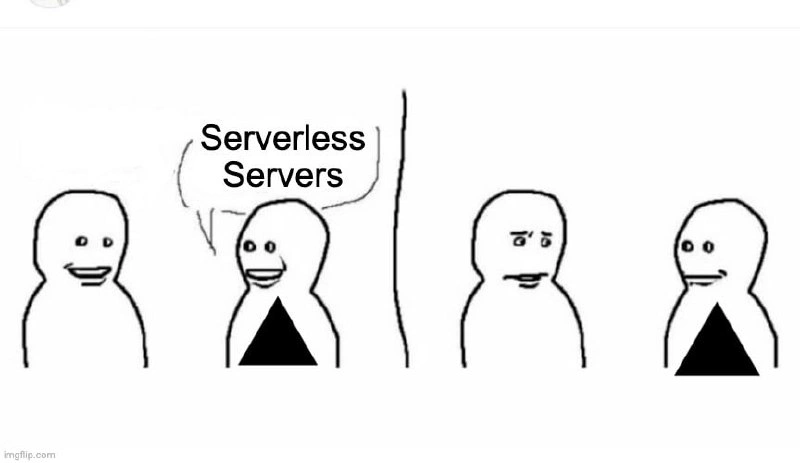
“Serverless servers” is a phrase that could only emerge from a marketing fever dream. It’s a classic cloud-computing oxymoron: call something serverless (implying no servers to worry about), then slap the word server right back into it. In the meme’s first two panels, a smiling stick-figure (representing an overenthusiastic marketing person) excitedly blurts out “Serverless Servers!” in bold text, as if inventing the next big thing. A thin line divides this hype from stark reality: the third panel shows two identical figures (the seasoned engineers) staring forward with blank, disillusioned expressions, each sporting a solid black triangle on their torso. Those black triangles could be caution signs or just the minimalist art style, but either way, the two engineers are clearly unamused. They’ve seen this kind of nonsense before.
For anyone in DevOps or SRE, the humor here is painfully relatable. It’s the CloudHumor of hearing a trendy term get mangled into pure paradox. Serverless architecture is a real tech concept – think deploying code on AWS Lambda or Azure Functions where you don’t manage the underlying machine. The whole point is to abstract away servers. So when a marketing team gloms onto the buzzword and starts talking about “servers” again, it’s like they’ve missed the memo in spectacular fashion. The phrase “serverless servers” sounds as absurd as wireless wires or fat-free fat. The veteran engineers in that last panel have probably spent nights rebooting actual servers at 3 AM, or at least frantically SSH-ing into EC2 instances during an outage. They’ve lived through on-call rotations with real hardware (or VM) failures. Now they’re hearing about serverless* servers* – essentially someone selling the idea of a server that magically has no server. No wonder their faces are blank with you’ve got to be kidding me vibes.
This meme nails an industry pattern: the cycle of marketing buzzwords oversimplifying technical reality. Back in the day, everything became “Cloud-something” as soon as cloud computing got hot (even if it was just the same old data center with a new name). Now we’re in the era of serverless, and sure enough, here comes the rebranding hype: marketing trying to put serverless and server in the same breath to double-dip on buzz. To a senior engineer, it’s eye-roll material. The humor is in the extreme cognitive dissonance – it’s like hearing someone talk about a “zero-calorie cheeseburger.” Technically possible? Maybe in a lab. But in tech, we know serverless doesn’t mean no servers at all; it means “not your servers, not your problem (until it breaks)”.
The term serverless rose to fame in mid-2010s with services like AWS Lambda, which let developers run small pieces of code (functions) on-demand without managing the infrastructure. It’s part of the whole Cloud Native movement: design systems where the cloud provider handles the grunt work of servers and scaling. But crucially, those Lambdas still run on real machines in some data center – you just don’t see them. As experienced devs like to joke, “There is no cloud; it’s just someone else’s computer.” Likewise, serverless is really someone else’s server. So when marketing excitedly discovers the term and starts babbling about “serverless servers,” it’s comically ignorant of that truth. The two blurred-face engineers share a silent understanding: they’re witnessing rebranding hype run amok.
From a senior perspective, this joke also hints at the hidden pain points of serverless tech. Sure, you don’t manage the OS or the hardware, but you also surrender control. Those of us who’ve been burned by cloud promises know that serverless isn’t all sunshine. There are cold starts (functions freezing if unused), opaque performance issues, and the dreaded vendor lock-in — once your whole stack is built on a cloud’s FaaS platform, migrating out is a nightmare. None of that glitzy marketing speak addresses who gets paged when a “serverless” app goes down. (Spoiler: someone still gets paged, often at a very serverful 3 AM.) The blank stares in the meme could very well be two ops engineers remembering how the last “miracle cloud product” still resulted in a war-room call when things failed. In other words, the meme is DevOpsHumor distilled: a witty jab at how business folks try to sell technical concepts they don’t fully grasp, while the engineers silently brace for the inevitable fallout.
In short, “serverless servers” is buzzword fusion at its finest — a term that manages to be internally contradictory and hilariously revealing at the same time. The humor lands because it highlights a truth every experienced cloud engineer knows: no matter what you call it, someone’s got to keep the machines running. The marketing team might think they’ve coined a catchy new phrase, but the devs in the back are just exchanging knowing glances and trying not to facepalm. This is the kind of inside joke that makes the rounds in Slack channels for Cloud architects and SRE teams alike, eliciting a chuckle followed by a sigh. We laugh, because if we didn’t, we might cry every time we hear the next absurd tech buzzword that promises the impossible.
Description
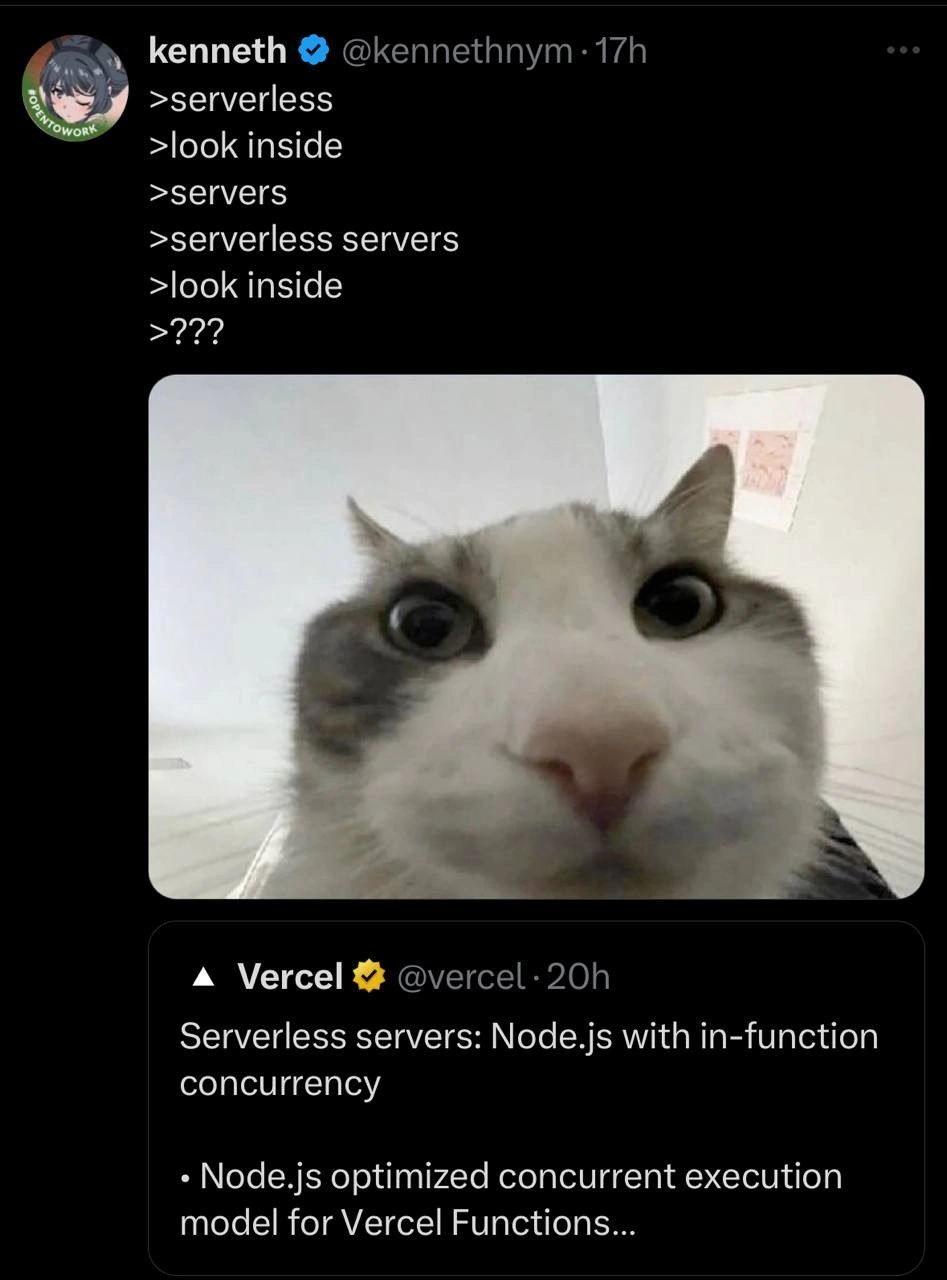
A two-panel comic meme format, often associated with NPC or 'I support the current thing' memes, depicting different reactions to a tech buzzword. On the left, two simple, smiling stick-figure-like characters are shown. One of them, distinguished by a black triangle on its chest (the logo for the company Vercel), is enthusiastically saying 'Serverless Servers' in a speech bubble. On the right panel, separated by a line, two other characters look back at the first pair with expressions of weary concern and skepticism. This meme satirizes the tech industry's penchant for creating confusing, often oxymoronic, marketing terms. 'Serverless Servers' is a real marketing term used by Vercel, and the meme captures the cynical reaction of many experienced developers who see it as nonsensical buzzword inflation. The joke resonates with engineers who are tired of marketing hype obscuring the underlying technology, humorously portraying the Vercel user as a mindless follower of the latest trend
Comments
7Comment deleted
We've gone full circle from 'It's just someone else's computer' to 'It's just someone else's paradoxical marketing campaign'
Sure, it’s serverless - right up until the AWS invoice reminds you exactly whose servers were on the hook at 3 a.m
"Serverless servers" is what happens when marketing discovers that "someone else's computer with autoscaling and cold starts" doesn't fit on a PowerPoint slide
The term 'serverless' is the cloud industry's greatest linguistic achievement: convincing an entire generation of architects that servers don't exist while simultaneously charging them per-millisecond for server time. It's like calling a taxi service 'driverless' because you don't own the driver - technically accurate from a narrow perspective, philosophically absurd from an engineering one, and financially brilliant from a vendor's standpoint
Serverless: trading server wrangling for the subtle joy of paying per millisecond of invisibly managed fleet
We called it “serverless” because “opsless” was false and “vendor-lock-in with per-ms billing” was too honest
Nothing says cloud literacy like 'serverless servers' - ops on someone else’s payroll, latency and IAM errors still on yours