The Existential Crisis of 'Serverless Servers' Marketing
Why is this Cloud meme funny?
Level 1: The Hidden Puppeteer
Imagine you’re at a magic puppet show. The announcer proudly says, “This is a hands-free puppet – it dances all by itself, no puppeteer at all!” Sounds amazing, right? You watch the puppet jiggle around and think it must be magic. But then you get curious. You peek behind the curtain and – oh! – you see a person with strings and controls, secretly making that puppet move. Suddenly it clicks: the puppet wasn’t moving on its own at all; there was always someone behind the curtain, doing the work. You feel a mix of surprise and “ha, I knew it!” humor when you discover the truth.
This meme is just like that. The tech world often says “serverless,” almost like claiming “no hands on the puppet.” It suggests your code runs by itself with no computer (server) behind it. But if you peek behind the scenes, there’s always a real computer humming away. The joke here is that a company went as far as to call something “serverless servers,” which is as silly as “hands-free puppets that are actually operated by hands.” The picture of the wide-eyed cat is basically our face when we realize what’s going on – a funny “gotcha!” moment. It’s the same kind of laugh you get when someone promises something unbelievable, and then you find out the ordinary truth. In the end, the meme is saying: nothing is truly magic, there’s always a helper in the background. And sometimes, discovering that little secret is both enlightening and pretty funny!
Level 2: Someone Else’s Computer
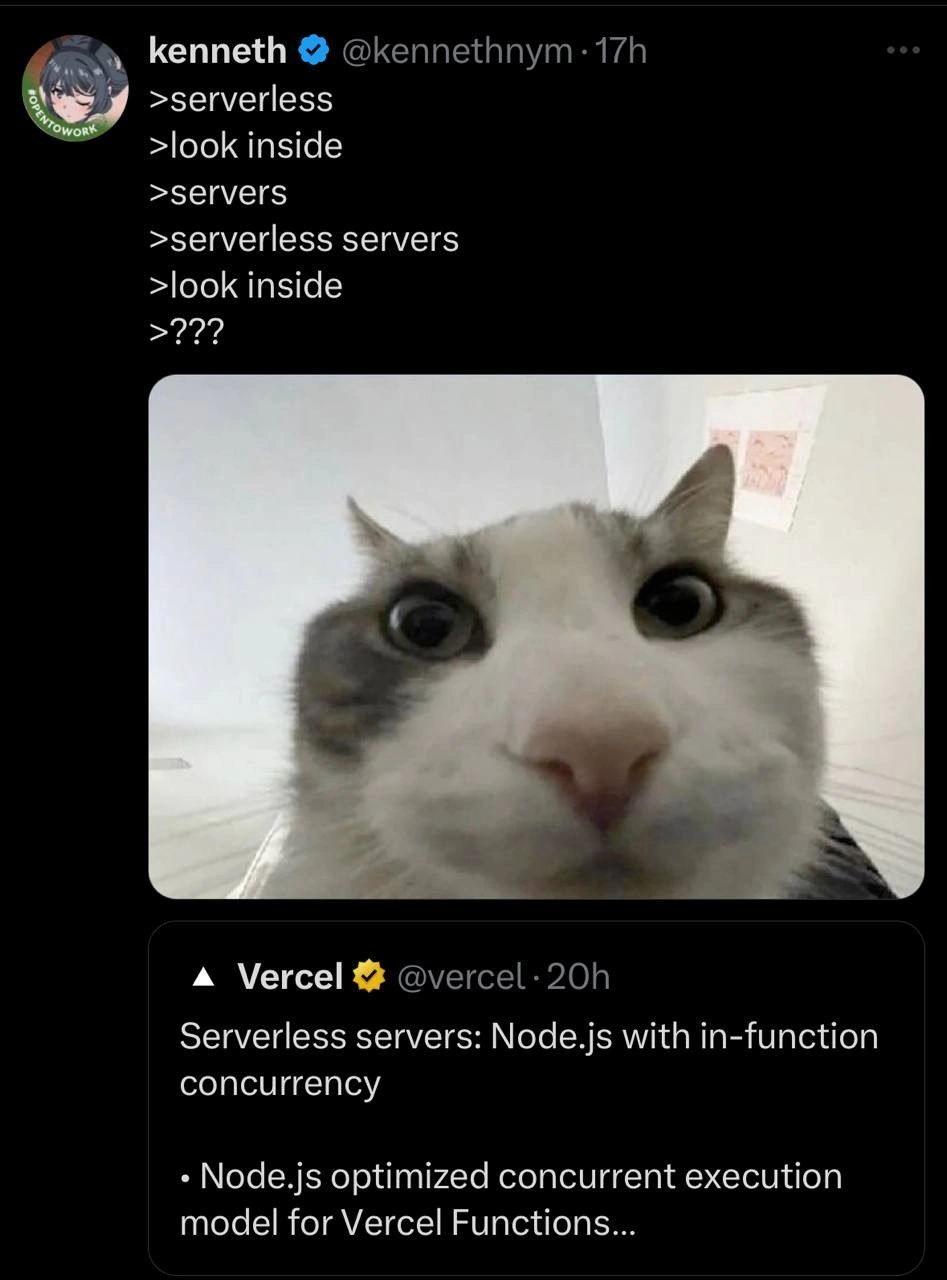
This meme is highlighting a joke about “serverless” technology and how it’s often described. In the Twitter screenshot, the user “kenneth” writes a series of > serverless > look inside > servers > serverless servers > look inside > ??? in a quote-like style. This format is jokingly suggesting a step-by-step revelation: you start with something called serverless, you peek under the hood (“look inside”), you find servers, then someone calls those hidden machines serverless servers, you look again, and you end up utterly confused (the “???”). Beneath this text, there’s a close-up image of a cat looking absolutely baffled into the camera with wide eyes and its nose in your face. Finally, we see a snippet of an official Vercel tweet advertising “Serverless servers: Node.js with in-function concurrency.” The combination is poking fun at the term “serverless servers”, which sounds like a contradiction. It’s as if a sign said “Nothing to see here,” but when you open the door, it’s full of stuff and even the cat is like, “What the heck am I looking at?”
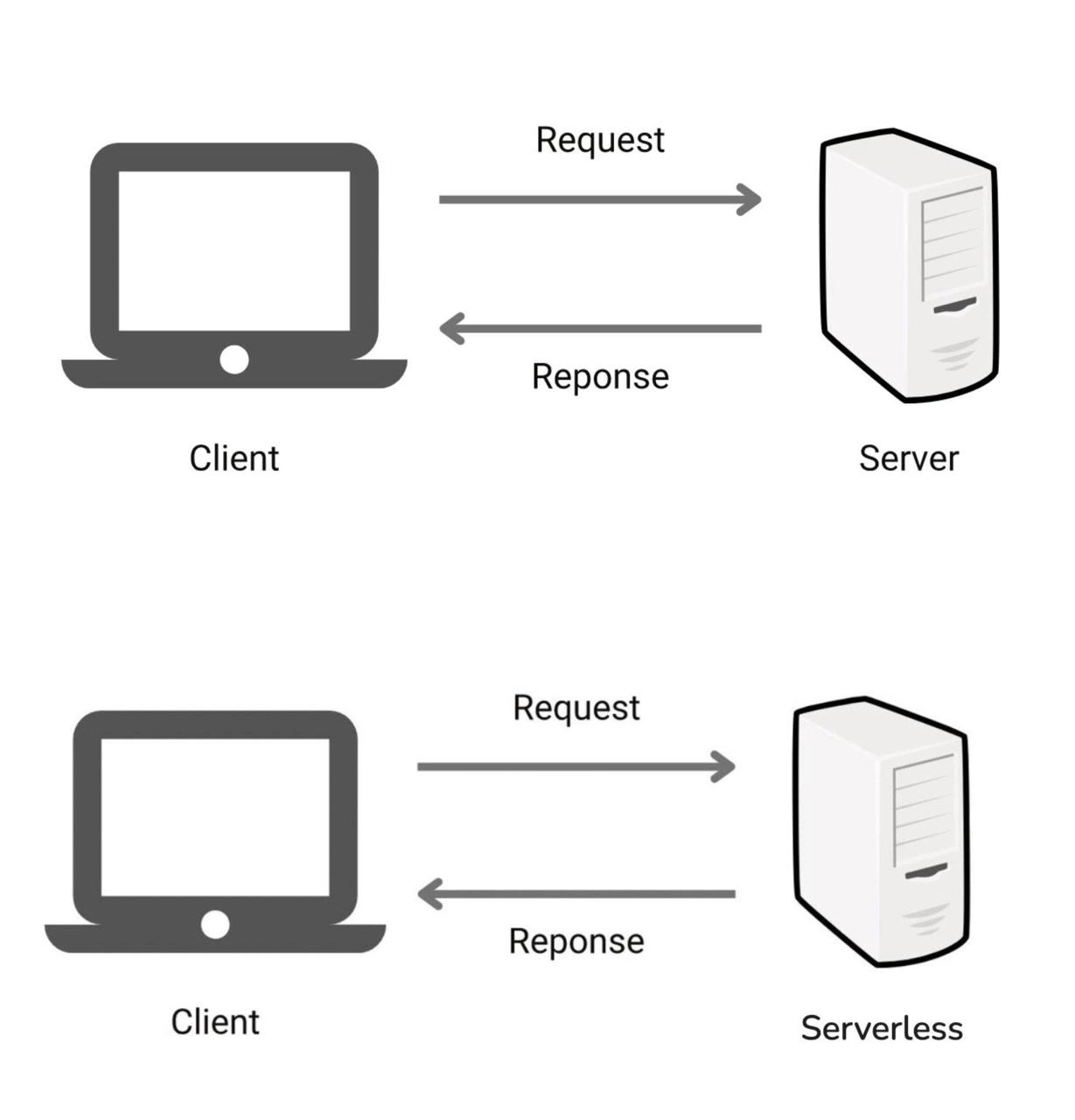
Let’s break down the technical terms in a simpler way. Serverless (or serverless computing) is a cloud service model where you, as a developer, can run your code without managing the underlying servers. You write a function or some backend code, and the cloud provider (like AWS, Google Cloud, or Vercel) runs it on-demand for you. You don’t pick a server, install an OS, or worry about all that – it’s handled behind the scenes. However, “serverless” doesn’t literally mean there are no servers at all – it just means you don’t have to deal with them. The code still runs on real computers (servers) in a data center, but all that infrastructure is invisible to you. People often joke that “serverless is just running on someone else’s servers.” In other words, the cloud company manages the machines, and you just supply the code.
Now, Vercel’s tweet about “Serverless servers” was their marketing way to announce a new feature for Vercel Functions (their serverless platform). They mentioned “Node.js with in-function concurrency.” Node.js is a popular JavaScript runtime for building servers and backends; it’s known for handling many tasks at the same time efficiently (concurrency) using a single running process. Typically, a serverless function handles one request at a time – if two people call it at the same moment, the platform will start two separate instances of your function (this is part of how it auto-scales). But what Vercel is saying is they have optimized this so that one function instance can handle multiple requests concurrently. That’s what “in-function concurrency” means: your Node.js code can multitask inside a single running function, serving multiple users at once (up to some limit), rather than always spawning new instances for each request. This can make things faster and possibly use resources more efficiently (for example, less waiting for new instances to “cold start”).
The ironic humor is in the wording: calling these enhanced behind-the-scenes machines “serverless servers.” To a newcomer, serverless and server sound like opposites – how can you have serverless servers? 😅 It’s a bit like saying “wireless wires” – it just sounds funny and self-contradictory. What they really mean is “servers that power our serverless platform” or “some special servers for your serverless code,” but phrasing it that way became an instant joke in the developer community. Engineers have a habit of poking fun at fancy marketing terms, especially when they seem like TechBuzzwords. The meme writer’s “look inside > servers” gag is basically saying: “We knew it! If you look inside anything called serverless, surprise – there are servers in there.” Then they double down: “serverless servers” – look inside that and you’re like “???”. The confused cat image perfectly captures that feeling of perplexity. The cat’s expression is as if it opened a box expecting emptiness but instead found something that shouldn’t be there.
So in simpler terms: this meme jokes that even in modern cloud computing where things are described as if hardware doesn’t exist (“serverless”), there are always actual servers doing the work. And when a company tries to hype up a new feature with a buzzwordy name that sounds silly (serverless servers!), developers respond with good-natured skepticism and humor. It’s a way of saying, “C’mon, we know there’s a real computer behind this magic. You even called it a server now!” For a junior dev or someone new to cloud tech, the meme is a lighthearted reminder that cloud services aren’t truly magical – they just shift the burden around. And sometimes, the marketing departments invent confusing names that make experienced folks roll their eyes (and reach for the nearest cat meme to respond with). The mention of Node.js and concurrency is the technical part – essentially, Vercel is making their underlying servers a bit smarter in how they handle your code – but the community mostly zeroed in on that funny phrase. It’s CloudHumor 101: when in doubt, tease the buzzwords and enjoy the confused cat vibes.
Level 3: Buzzwords All the Way Down
At first glance, this meme takes a jab at the absurdity of cloud marketing. We see a tweet quoting:
“> serverless > look inside > servers > serverless servers > look inside > ???”
Followed by a wide-eyed confused cat staring into the camera. And finally, an actual embedded Vercel announcement bragging about “Serverless servers: Node.js with in-function concurrency.” It's a layered joke: every time you “look inside” the serverless promise, you just find more servers. It’s like a Russian nesting doll of TechBuzzwords – buzzword inception, if you will – until the last doll isn’t a doll at all, but a startled infra cat caught in the act. The humor comes from that blatant marketing oxymoron: calling something “serverless servers” is as if a magician said, “No tricks here!” while pulling a rabbit out of a hat. Seasoned engineers instantly recognize the Marketing vs Reality gap, and their reaction looks a lot like that cat’s face: Are they serious?
From a senior Cloud and DevOps/SRE perspective, this hits close to home. We’ve been through endless cycles of rebranding the same concepts. First it was physical servers in a rack, then virtual machines, then containers, then ServerlessArchitecture – each layer promising to simplify by abstracting the previous one. Serverless (like AWS Lambda, Azure Functions, or Vercel Functions) was sold as “No servers to manage!” – but of course, it really means “no servers that you have to manage directly.” The actual machines are hidden in someone else’s data center. As the running joke goes: “There is no cloud, it’s just someone else’s computer.” The industry loves to give this illusion of magic, but under the hood it’s always servers all the way down. This meme plays on that truth: peek behind the curtain of any “serverless” platform and you find... a server (surprise!). Peek behind a fancy term like “serverless servers”, and even the cat (representing the infrastructure or maybe the nosy engineer) is stunned by the ridiculous recursion. It’s an infra_peek gone too far, where the abyss of abstraction looks back at you — and it has whiskers.
Let’s talk about that Vercel post: Serverless servers: Node.js with in-function concurrency. For the uninitiated, Vercel is a cloud platform known for hosting modern web apps (Next.js, etc.) and their Vercel Functions are a serverless function service. Normally, a serverless function (for example on AWS Lambda) processes one request at a time per instance – if 100 users hit it, the platform might spin up 100 separate instances in parallel. This avoids one customer’s code interfering with another’s, but it can be inefficient. Vercel’s new feature "in-function concurrency" basically means one Node.js instance can handle multiple requests concurrently before spawning new instances. In plainer terms, they’re letting a single “serverless function” behave more like a Node.js server that juggles many connections on the fly. Node.js is built on an event-loop, which excels at handling lots of concurrent I/O operations in one process. So ironically, Vercel is re-introducing a concept from traditional Backend servers (concurrency) back into the serverless world to improve performance. It’s a clever optimization, yes – it can reduce latency and cold starts – but calling it "serverless servers" is just begging to be memed. A grizzled backend engineer might chuckle: “So you’ve basically reinvented the NodeJS web server, but now it’s a function as a service? Congrats, we’ve come full circle!” The phrase suggests a snake eating its own tail – a cloud Ouroboros. We went from servers 👉 to serverless 👉 and now back to “serverless servers.” It’s the kind of circular innovation that makes old-timers smirk and newbies scratch their heads.
To highlight the comedic contrast between marketing buzzwords and reality, consider this quick reality check table:
| Term | Marketing Hype | Reality Check |
|---|---|---|
| Serverless | “No servers to manage at all!” | Runs on actual servers in a data center (you just don’t see them). Someone else racks and maintains them. |
| Serverless servers | “Even more magical serverless, ultra-fast!” | Wait, so there are servers, after all? It’s essentially a pool of beefy servers behind your functions, now acknowledged in name. Oxymoron much? |
| In-function concurrency | “Optimized parallel execution inside each function” | Basically, a single Node.js process handling multiple requests (like a normal server would). We’ve had event loops since the ‘90s. Not exactly witchcraft, folks. |
The meme perfectly captures this MarketingVsReality tension. On one side, cloud providers coin shiny paradoxical terms to sell ModernTechStacks improvements. On the other side, developers who’ve been around the block are squinting at the announcement like that cat: “Did you really just say serverless servers with a straight face?” The cat’s bewildered, slightly alarmed expression is basically every senior engineer reading that Vercel tweet. There’s also an element of “we knew it!” schadenfreude: those of us who joked all along that “serverless is just servers managed by someone else” now feel validated, albeit amused that the company itself blatantly put the word servers right after serverless. It’s as if the marketing team accidentally let the truth slip out, and now the confused_cat_meme is there to mock them for it.
From the DevOpsHumor perspective, there’s an unwritten law: any time someone says a system is “fully managed” or “you’ll never have to worry about X,” you will eventually have to worry about X (usually at 3 AM during a pager alert). Serverless was supposed to simplify ops – no more provisioning, scaling, or patching servers yourself. And indeed, you offload a lot to the provider. But that doesn’t mean the problems disappeared; they’re just hidden. Cold starts (slower responses when a new function instance spins up) are a classic ColdStart_irony in serverless – you trade operational simplicity for a new performance gotcha. Now to solve that, providers are adding back some form of long-lived server process… which is what we had in the first place with our own servers or containers! It’s a funny IndustryTrends_Hype cycle: remove feature, realize why it existed, add it back, give it a snazzy name. Kind of like how we went from thick clients to thin clients to “cloud terminals” which are basically thin clients again. Or how “NoSQL” databases eventually added SQL-like queries. Or how “microservices” sometimes become so entangled they resemble a monolith again. In this case, “serverless” is creeping back towards “serverful.” Serverless servers is that paradox made explicit – a bit of truth-in-advertising peeking through the hype. It’s marketing trying to have its cake and eat it too: use the buzzword (serverless) but also promise the power of the thing it allegedly replaced (servers). No wonder the meme-maker wrote “> ???” at the end of the green-text chain – even the cat can’t decipher where this loop ends.
And speaking of cats, why a cat? Aside from cats being the unofficial mascots of the internet, the image resonates on a few levels. First, there’s the classic metaphor “curiosity killed the cat.” Here the engineer (or Twitter wit) was curious enough to look inside the “serverless” box, only to find a cat staring back – as if to say, “Buddy, you shouldn’t have looked. Now you see the unglamorous truth.” The cat’s huge, startled eyes and up-close nose create a comical WTF moment – you can almost hear the record scratch. It’s the perfect visual punchline to infra_peek into a supposedly serverless realm and finding the literal embodiment of “I smell something fishy.” The cat might also represent the actual server (or an SRE on call) caught off guard: “Oh hi, yes, I am the ‘server’ making your serverless run… Why are you surprised?” In datacenter lore, sometimes stray cats do wander in attracted by warm server fans – imagine opening a cabinet expecting fancy tech and a real cat jumps out! This meme taps into that absurd imagery. BackendHumor often anthropomorphizes systems (think “this code is being held together by a cat on a wheel”), so an infra cat at the core of a cloud service is just chef’s kiss absurdity.
Ultimately, the meme lands because it’s a wink and an eye-roll from those in the know. It skewers IndustryTrends_Hype by showing how buzzwords can loop back on themselves. A senior dev reading “Node.js optimized concurrent execution model” will nod – that sounds good for performance – but calling it “serverless servers” is just comedy gold. It’s a reminder that under every abstraction, reality remains. ServerlessArchitecture still runs on silicon in racks; abstracting doesn’t eliminate, it only conceals. Peel back enough layers of any high-level service, and you’ll find the foundational bits staring back at you, possibly as disoriented as that cat. As a wise engineer might quip, “Serverless? Sure. It’s running on no servers nothing oh wait…servers.” And now even the vendor has admitted it, albeit in the most self-contradictory way imaginable. The next time some product promises to remove all complexity, remember the infra cat: lurking behind the scenes, ready to pop out and say “gotcha!” when you least expect it.
Description
A screenshot of a tweet from user 'kenneth' reacting to an announcement from Vercel. Kenneth's tweet uses a popular meme format: '>serverless', '>look inside', '>servers', which is a common joke about how serverless computing still uses servers. The tweet then extends this to '>serverless servers', '>look inside', '>???', expressing confusion. Below the text is a close-up, distorted image of a wide-eyed, bewildered-looking cat. Kenneth's tweet is a comment on a Vercel tweet, which is shown below. The Vercel announcement proudly introduces 'Serverless servers: Node.js with in-function concurrency' and mentions an 'optimized concurrent execution model for Vercel Functions...'. The humor is multi-layered for a technical audience. It first plays on the well-worn joke that 'serverless' is a misnomer. It then escalates by mocking Vercel's seemingly paradoxical marketing term 'serverless servers,' which sounds like an oxymoron. Experienced engineers understand that Vercel is describing a real feature (allowing a single function instance to handle concurrent requests), but the branding is so absurd that it becomes a perfect target for ridicule, capturing the often-comical nature of tech marketing buzzwords
Comments
7Comment deleted
First, they told us there were no servers. Then they told us the serverless has servers. Now the serverless servers have concurrent serverless inside? It's abstractions all the way down
“Serverless servers with in-function concurrency” is just a re-branded thread pool - only now the cold-starts bill by the millisecond instead of the rack unit
Serverless is just someone else's servers with a pricing model that makes you nostalgic for the days when you could predict your AWS bill without a PhD in stochastic calculus
After 20 years in the industry, I've learned that 'serverless' is just like 'wireless' - there are definitely servers involved, you just don't want to know where they are or who's paying the bill when your function cold-starts for the 47th time during a demo. The real innovation here is Vercel's ability to nest the word 'server' inside 'serverless' while maintaining a straight face in their marketing materials
Serverless: Node.js concurrency so seamless you forget the servers exist - until cold starts and bills remind you
“Serverless servers” is when marketing renames autoscaled VMs to functions and concurrency to magic, and you spend the postmortem explaining why in‑function Node.js didn’t fix your p95 cold starts
‘In‑function concurrency’ is when you realize your serverless function is just a Node process doing async I/O inside somebody else’s Kubernetes - with billing per 100ms to prove it