The Lead Engineer's Zen-Like Acceptance Before a High-Stakes Demo
Why is this Deployment meme funny?
Level 1: Hope for the Best
Imagine you’ve been working on a big school project that you’re going to show to the whole class and all the teachers. You stayed up late the night before painting it and adding last-minute things because people kept telling you to change stuff. You tried it out and it mostly worked when you tested it alone in your room. Now presentation time arrives. Your friend asks, "Are you sure it’s going to work when you show it?" You just shrug, give a little smile, and say, "I hope so! Whatever happens, happens."
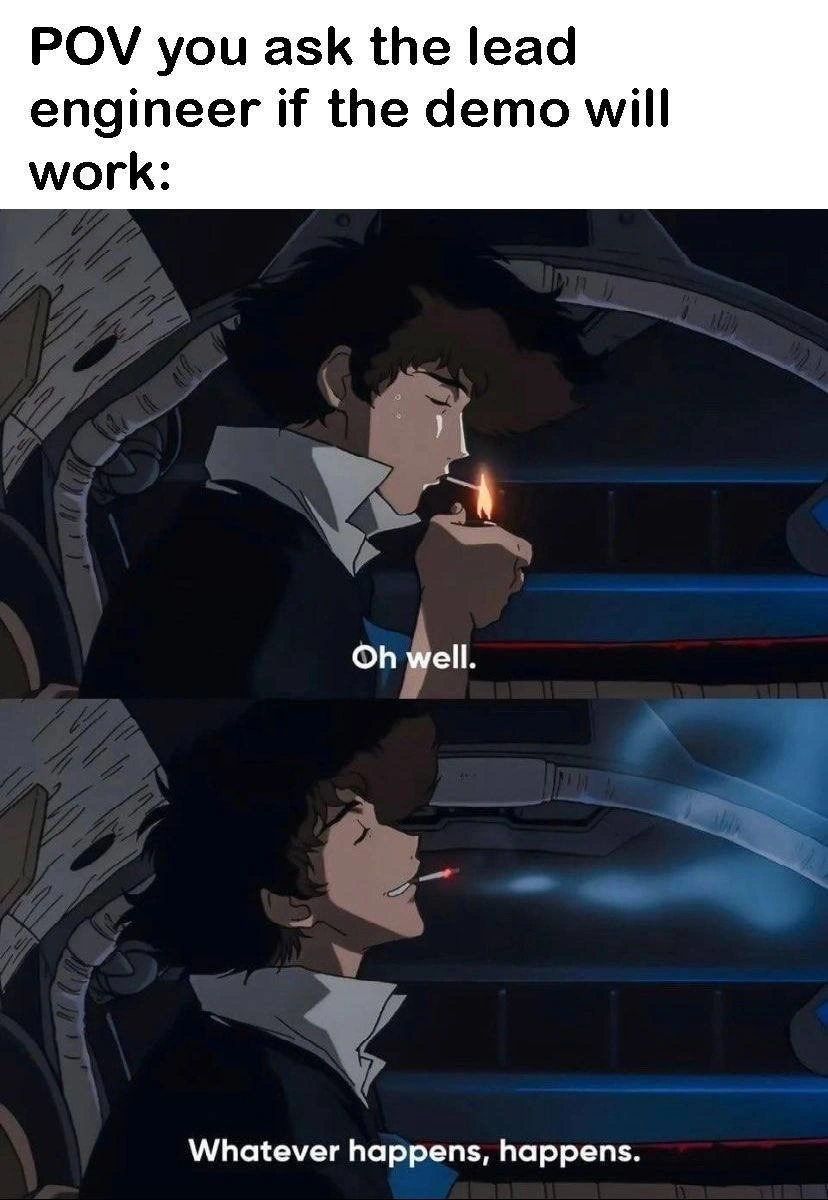
This meme is like that moment. It shows a cartoon guy (Spike) lighting a cigarette and looking surprisingly calm even though he’s about to do something really nerve-racking: show off a project to important people. He’s basically saying, "I’ve done all I can, and now I’ll just take what comes." It’s funny because normally you’d expect someone to be really nervous and say "Oh yes, I think it will work!" or be anxiously double-checking everything. But here, the lead engineer (the person in charge of the project) is acting super chill, almost like a "meh, we’ll see" attitude. It’s the kind of calm that comes when you’re so tired or over it that you just accept whatever outcome.
Think of it like baking a cake for a contest. You rush to finish icing it right before the judges come. Your cake looks okay, but you didn’t get to test how it tastes with all the new decorations. Your friend whispers, "Will the cake taste good?" If you’ve done everything you could but you’re not totally sure, you might just shrug and say, "I hope for the best!" Maybe you’re even a bit amused because it’s out of your hands now — either the cake is great or it isn’t. That’s the feeling this meme captures. It’s poking fun at how a very experienced person might deal with deadline pressure: instead of freaking out, they act extra relaxed, almost in a joking way, to cope with the stress. In simple terms, the meme is funny because the lead engineer is basically treating a serious upcoming demo like a coin toss — he’ll just flip the coin, hope it lands in his favor, and light a cigarette while it’s in the air. Whatever happens... happens.
Level 2: Don't Jinx It
So, what’s actually happening in this meme? We have an anime character (Spike from Cowboy Bebop) standing in for a lead engineer right before a big software demo. The top text sets the scene: “POV you ask the lead engineer if the demo will work.” POV means "point of view," so the meme is pretending you are the one nervously asking, "Hey, is our presentation to the client going to go okay?" And the lead engineer — the experienced dev in charge — responds by shrugging, lighting a cigarette, and basically saying "Oh well... Whatever happens, happens." In other words, he’s not giving a yes or no. He’s acknowledging it might go great or it might go terribly, and he’s oddly at peace with that uncertainty. This reaction is both funny and a little worrying! It’s like asking a pilot if the landing will be smooth and they just chuckle and go, "We’ll find out." 🤷
To unpack the humor, let's clarify some terms and context. A live demo is when you show off a working product (or prototype) in real-time, often to important people like clients, executives, or other stakeholders. It’s "live" because you’re running the actual software on the spot, not a mock-up or a video. Live demos are high pressure: there’s no safety net. If the app crashes or a feature fails, everyone sees it. That’s why developers get demo anxiety – they’re scared something will go wrong in front of the audience. You might hear engineers talk about "the Demo Gods" as a joke. This is a playful way of saying there are mysterious forces that make demos fail for weird, unexpected reasons (like the Murphy’s Law of software demos: if anything can go wrong, it will, especially when all the VPs are watching!). To invoke the Demo Gods usually means doing something that might bring bad luck – for example, confidently saying "Our demo will be perfect" is thought to tempt fate. In contrast, staying humble or noncommittal, like the lead engineer here, is seen as a way to not jinx it. “Jinxing it” means to cause bad luck by talking about something good before it happens. It’s why a lot of devs refuse to say "This will be easy" or "Nothing can go wrong." They’d rather knock on wood and keep quiet, because they’ve seen simple demos implode out of nowhere.
Now, who is this cool-looking character in the images? That’s Spike Spiegel, the main character from an anime called Cowboy Bebop. Spike is known for being ultra-relaxed and sarcastic even in dangerous situations. One of his catchphrases in the show is "Whatever happens, happens," which basically means "I’ll deal with things as they come; I’m not going to worry beforehand." In the meme, Spike represents the lead engineer – basically the most senior developer or tech lead on the project – who should theoretically be confident about the demo. But instead of giving a peppy guarantee like "Yes, it’ll work, trust me!", he channels Spike’s laid-back attitude. In the first panel, Spike (the lead) is sweating a bit while lighting his cigarette and saying "Oh well." That sweat is subtle, but it shows even he isn’t 100% sure about this demo. The shrug and "Oh well" are like him admitting, "We did our best, but who knows?" In the second panel, he’s exhaling smoke and smiling with the caption "Whatever happens, happens." This shows he’s accepted whatever outcome. He’s basically telling his team (and himself) to just roll with it. It’s a very apathy meets wisdom kind of vibe – he might seem apathetic (like he doesn’t care), but really it comes from experience. He’s probably survived enough scary demos and last-minute fixes to know that stressing out at this stage won’t change anything.
Let’s talk about why a lead engineer might respond this way. Big demos often come with DeadlinePressure and StakeholderExpectations that are through the roof. In the run-up to a demo for, say, a client or upper management, a development team often has to scramble to implement changes or new features that stakeholders asked for at the last minute. This is what we call scope creep – when the project’s scope (what’s supposed to be delivered) keeps growing and changing beyond what was originally planned. Scope creep can cause parts of the project to be rushed or half-baked. For example, maybe the client said two days ago, "Can we also have a login feature for the demo?" and the team worked overnight to bolt that on. The result is likely not well-tested. Integration issues are common too: that means all the different pieces of the software (database, backend server, frontend interface, third-party services, etc.) might not have been run together in a real environment until, basically, right before the demo. Imagine building a bunch of Lego sections separately and only clicking them all together at the last second — you might discover some don’t fit perfectly. This leads to live_demo_anxiety: everyone’s nervous that something will break that they didn’t anticipate.
A lead engineer in a scenario like this has two jobs: try to make everything work, and manage the team’s (and management’s) expectations. By the demo day morning, they’ve probably witnessed a bunch of small glitches and done quick fixes for each. They know the system mostly works, but also know weird bugs (heisenbugs) can pop up specifically when you least want them. Perhaps they did a full run-through at 2 AM and everything finally ran correctly on their machine – but now, at showtime, maybe the demo laptop is using a different version of Python, or the Wi-Fi is slow, or a config file path is off. These things happen a lot in real life. That’s why you’ll often hear a phrase, "Well, it worked on my machine..." when a demo goes awry. It’s a tongue-in-cheek excuse developers use meaning, "We did see it working before, honest!"
Given all this, the lead engineer shrugging is a way to quietly say, "We’ve done what we can; now it’s in the hands of fate (or the Demo Gods)." He’s not literally doing a ritual, but culturally, that shrug is like a ward against over-confidence. It’s also a bit of dark humor to ease the tension. If the team sees the leader jokingly taking it easy, it can cut the stress a little. Inside, the lead might be as anxious as everyone else (hence that sweat drop on Spike’s face), but outwardly they’re projecting calm. In corporate culture, especially in front of clients or higher-ups, showing utter panic is not a good look. A seasoned engineer has likely learned to stay calm externally when things get dicey. They might have a Plan B or some quick hacks up their sleeve if something fails. (Example: if the live demo of the software fails, perhaps they have slides or a pre-recorded video of the feature as a backup. Many of us have those ready just in case!) But they won’t promise the demo will be perfect, because they know Murphy’s Law in demos: the moment you claim "nothing can go wrong," something surely will.
In summary, the meme humorously highlights a relatable developer frustration: after crunching under an immovable deadline, dealing with last_minute_fixes and scope_creep_aftermath, the team’s technical leader is basically saying, “I’m not going to claim victory yet. Let’s just do this and see.” It’s funny because it’s true — a lot of times, this is exactly how tech teams feel right before presenting to stakeholders. Instead of the gung-ho movie portrayal of a confident tech guru, the reality is more a tired engineer muttering "oh well" and hoping the live demo gremlins stay asleep. The Cowboy Bebop reference drives it home by using Spike’s ultra-relaxed, accepting posture to mirror that senior developer zen (or total exhaustion, or both). Whatever happens, happens — that phrase in the meme is both a direct quote from the anime and basically the unofficial mantra of engineers on demo day who know that, at this point, worrying won’t prevent a crash, but keeping cool just might save your sanity if one occurs.
Level 3: Schrödinger's Demo
On the surface, this meme captures a lead engineer embodying a paradox every senior developer knows too well: until the moment of truth, a high-stakes live demo both works flawlessly and is broken in unknown ways. It's basically Schrödinger's Demo, where the outcome only collapses to success or failure when the clients are watching. The humor here comes from the lead engineer's response to "Will the demo work?" Instead of boasting or panicking, he just flicks his lighter and shrugs, essentially saying "Oh well... whatever happens, happens." This fatalistic nonchalance is a veteran move — a half-joking ritual to appease the Demo Gods and avoid tempting fate.
Under the hood, there's a lot of technical and cultural subtext. By the time demo day arrives (often an immovable deadline circled on every manager's calendar), the codebase is usually a Frankenstein monster of last-minute fixes and scope creep aftermath. New features were bolted on hours ago, integrations are held together with duct tape (or // TODO: fix later comments), and that “one final change” requested by a stakeholder at 11 PM is still deploying. In theory, we should have a perfectly stable release for the big presentation. In practice, we're often doing a deployment at T-minus 5 minutes and praying nothing crashes. This precarious state is where Murphy’s Law thrives: anything that can go wrong will go wrong — especially during a client demo. Seasoned engineers have been burned by enough ReleaseAnxiety and demo day disasters to know that promising “It’ll work, no problem!” is practically daring the universe (or the demo gods) to smite your app on the spot.
The image of Spike Spiegel from Cowboy Bebop is a perfect avatar for this mindset. Spike’s motto "Whatever happens, happens" fits a lead engineer who's made peace with chaos. Notice in the first frame, he’s sweating a bit while flicking the lighter — despite the outward calm, even a veteran feels the heat of stakeholder expectations. That lighter flick is like the final system test: will the flame catch? Will the app finally compile without errors? Oh well. By the second frame, Spike (the lead) literally lights up and leans back exhaling smoke, mirrorin' a kind of zen acceptance. At that point, the code is deployed, the die is cast, and he’s internally saying, "If the demo breaks, it breaks." This fatalistic calm isn’t about apathy or not caring — it’s dark humor and experience balled together. When you’ve been up against unforgiving Deadlines and unpredictable demo environments enough times, you learn to greet looming disaster with a wry smile and a "Here goes nothing."
The meme’s comedy is amplified by this relatable developer experience. Every engineer who’s done a live demo for demanding Stakeholders/Clients has had this moment: the product worked an hour ago, but now the conference room Wi-Fi is shaky, the API keys might be misconfigured on the demo laptop, and that one bug you could never reproduce decides to show up right in front of the VIPs. This scenario is so common it’s a trope: there are countless war stories of final demos going off the rails, from famous tech conference fails (think Windows 98’s blue-screen-of-death on stage, or a smart car’s windows shattering when they were supposed to demonstrate toughness) to everyday sales presentations where the app freezes in front of the CEO. The corporate culture around these demos can be brutal — you often get one shot to impress, so teams pull crazy hours in a crunch. By demo day, the team is exhausted, the code is a patchwork of rushed changes, and live_demo_anxiety hangs thick in the air. At that point the lead engineer has two choices: have a meltdown, or channel their inner Spike Spiegel and adopt a "whatever happens, happens" philosophy. Most seasoned pros choose the latter (at least externally) as a coping mechanism and as a way to keep the team calm. It’s a tongue-in-cheek form of leadership through chaos: by acting unfazed, the lead engineer signals to everyone, "We’ve done all we can. Stressing now won’t change the outcome."
In a way, shrugging in the face of a possible demo catastrophe is a ritual — a sly nod to the murphys_law_in_demos that every dev dreads. The meme calls it “invoking the Demo Gods” because there really is a near-superstitious element in tech demos. Engineers will say “don’t jinx it” if someone claims the demo will go smoothly, much like sailors avoiding certain words for fear of bad luck. For a live demo, you might:
- Reboot every system 5 minutes before (an offering of uptime).
- Double-check that the StakeholderExpectations are managed (“Remember, this is a prototype, not scaled yet!”).
- Avoid any boastful statements like “What could possibly go wrong?” (surefire way to anger the demo deities).
- Sometimes even prepare a backup video or slides in case the live software gods are unkind.
The lead engineer’s shrug in the meme is basically the final sacrifice: he refuses to predict success, thereby appeasing the Demo Gods with humility. It’s a clever, humorous take on how developer frustration and anxiety get masked by sarcasm and chill vibes. Internally the team might be terrified, but outwardly the leader is saying, "No big deal, if it breaks, it breaks." This mix of resignation and bravado is funny because it’s true — in the absurd world of crunch-time demos, sometimes the healthiest thing you can do is light a (figurative) cigarette, smile at the impending doom, and say "Oh well." Everyone in tech has either been that person or seen them: the grizzled dev who’s basically seen every possible failure and is almost cynically zen about it. They’re not giving up; they’re just acknowledging that at a certain point, you’ve done everything you feasibly can. As Spike Spiegel would say, “Whatever happens, happens.” And ironically, that devil-may-care attitude sometimes is exactly what gets you through the demo — when the team sees the lead staying cool, they might just emulate that calm and make fewer mistakes. In the chaotic cosmos of executive_demo_day, a well-timed shrug and a bit of gallows humor can be the difference between total panic and a half-sane team.
Description
A two-panel meme captioned 'POV you ask the lead engineer if the demo will work:'. The image is from the anime Cowboy Bebop, featuring the character Spike Spiegel in a dimly lit, futuristic cockpit. In the first panel, Spike has a weary expression with a tear on his cheek as he lights a cigarette. The subtitle reads, 'Oh well.' In the second panel, he's exhaling smoke with a resigned, calm smile, and the subtitle says, 'Whatever happens, happens.' This meme captures the feeling of a seasoned lead engineer who has poured all their energy into preparing for a demo and has now reached a state of fatalistic acceptance. The humor lies in the profound relatability of this moment for experienced developers. After countless hours of work, they understand that some element of chaos is always possible during a live presentation (the 'demo effect'). The lead's calm is not apathy, but the hard-earned peace of someone who has done all they can and has surrendered the outcome to the 'demo gods.'
Comments
7Comment deleted
It's not fatalism, it's just accepting that the demo environment is a chaotic neutral entity that feeds on fear
The only thing less deterministic than our distributed consensus algorithm is whether tomorrow’s demo environment will finish ‘docker compose up’ before the VP opens Zoom
After 15 years in the industry, you realize demos follow quantum mechanics: they exist in a superposition of working and broken states until observed by stakeholders, at which point they collapse into whichever state maximizes entropy and your blood pressure medication dosage
After 15 years in production systems, you learn that asking a lead engineer 'will the demo work?' is like asking a distributed systems architect 'will this be consistent?' - the only honest answer involves acknowledging the fundamental uncertainty of the universe, accepting that Murphy's Law has a O(1) runtime complexity for live demos, and understanding that confidence intervals don't apply when stakeholders are watching. The cigarette is just the physical manifestation of having seen one too many 'works perfectly in staging' scenarios become 'catastrophic failure in front of the C-suite' moments
Our demo runs on Schrödinger’s SLA - both green and on fire until screen share
Lead's demo promise: CAP theorem in action - confident consistency or available excuses, but never both when prod partitions hit
Every live demo is a distributed system test: once Zoom starts, DNS, OAuth, and feature flags reach consensus only on when to fail