The Painful Truth About Open-Sourcing Your Code
Why is this OpenSource meme funny?
Level 1: Show and Tell
Imagine you have to show your homework or art to the whole class, not just the teacher. Scary, right? Everyone might see the mistakes or the parts you’re not proud of. You might worry that your classmates will laugh – that’s the “humiliation” part. Now, someone in charge (like a strict but caring teacher) says, “Only a scaredy-cat hides their work. Be brave and show it to everybody!” At first, you feel offended – they basically called you chicken – but you also know they have a point. If you show your work to the class, sure, you might turn red with embarrassment if something’s wrong, but you’ll also get a lot of advice on how to make it better. Maybe one friend knows a cool trick to fix a mistake, and another friend says “I love this part!” Sharing makes you improve faster.
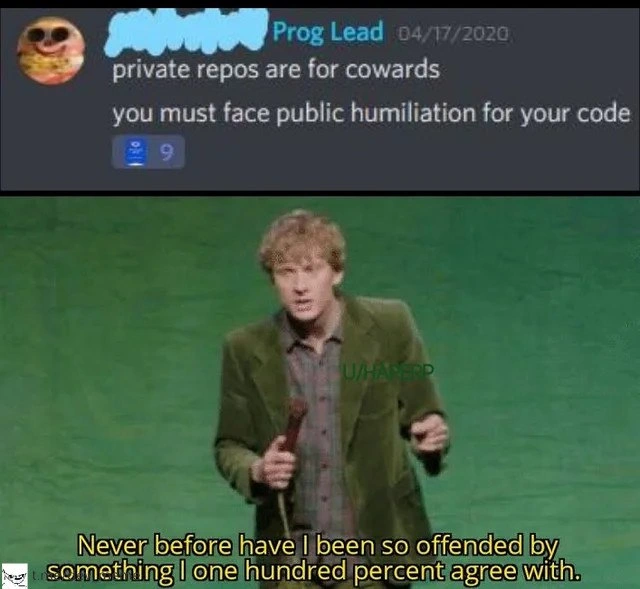
This meme is joking about that exact feeling, but with computer code instead of homework. The first part jokes that keeping your code secret (in a private place) is for the fearful, and real courage is sharing it openly so everyone can see. The second part (the comedian’s reaction) says, “I’m upset you said that, but I totally agree.” It’s funny because it’s true: it hurts a little to be called out, but showing your work to everyone does take courage and can make you better. It’s like a big show and tell for programmers – a bit nerve‑wracking, but ultimately rewarding when you overcome the fear.
Level 2: Open-Source Stage Fright
Let’s break this down in simpler terms. A repository (repo) is like a project folder tracked by a version control system such as Git. On platforms like GitHub, you can make your repo private (only you and invited collaborators can see it) or public (anyone on the internet can view the code). In the meme’s top panel, a team lead boldly says “private repos are for cowards” – basically calling out developers who hide their code. Why “cowards”? Because they think you’re afraid of showing your work to others. Telling someone “face public humiliation for your code” is an exaggerated way of saying, “be brave enough to put your code out in the open, even if you might be embarrassed by mistakes.” This refers to the anxiety of code reviews and feedback in public. CodeReviews are when others examine your code and point out bugs or suggest improvements. Doing that in a private repo feels safer (only your team sees feedback). Doing it in a public repo is like being on stage — anyone (other developers around the world) can witness the discussion, see your code, and comment on it. That can definitely cause stage fright for newer devs!
In developer communities, however, there’s a cultural push toward openness. Many programmers share code on public repos to collaborate, get feedback, or build a reputation. It’s a core idea of OpenSource: the code is visible to everyone, and others can even contribute. The meme humorously acknowledges a common CodeReviewPainPoints scenario: feeling embarrassed when your code isn’t perfect. The bottom panel is a reaction image of a comedian on stage saying, “Never before have I been so offended by something I 100% agree with.” This perfectly captures a young developer’s feelings: being called a “coward” is offensive, yet they secretly agree that sharing code publicly would be beneficial for growth. In other words, the joke punches you in the ego, but you relate to it. After all, most of us have had that relatable developer experience of hesitating to push code to GitHub because “what if people think it’s bad?”
To spell it out, here’s the difference the meme highlights:
| Private Repository (Hidden) | Public Repository (Open) |
|---|---|
| Code is visible only to you and your team. | Code is visible to everyone (the entire world can see it). |
| Mistakes can stay hidden or unnoticed. | Mistakes are out in the open for others to catch. |
| Feedback comes from a small, internal group. | Feedback can come from a huge community (peers, strangers, etc.). |
| Used for proprietary or personal projects. | Used for OpenSource projects or when sharing with community. |
| Feels safer from embarrassment. | Can be scary – you might get publicly critiqued (the “humiliation”). |
The Prog Lead in the meme is using tongue-in-cheek bravado to encourage developers to embrace the DevCommunities ethos: don’t hide your code away. Sure, public_code_exposure means anyone can say “Hey, that function is inefficient,” but that’s also how you get better. It’s like an extreme form of peer review. And honestly, once you survive a tough public code review or two, you realize it’s not fatal – it’s feedback. The meme exaggerates it as “humiliation,” but in reality it’s more about being open to critique. That bottom caption (the stand-up comedian’s line) is exactly how many of us feel when a senior dev jokes about our fearful coding habits: called out, a bit embarrassed, but convinced. This playful shaming is meant to build code_visibility_courage – encouraging developers (especially juniors) to step out of their comfort zone and put their work out there. After all, GitHub is full of code from millions of devs; adding yours to that public mix is how you join the club (and get free tips to improve). In summary, the meme uses humor to say: “Don’t be scared of the public repo, it’s good for you!” – a message that mixes insult and inspiration in equal measure.
Level 3: Shame-Driven Development
In the world of Open Source and distributed VersionControl culture, this meme lands close to home for veteran developers. The project lead’s brazen decree — “private repos are for cowards… you must face public humiliation for your code” — is hyperbolic tough love that seasoned engineers recognize all too well. It satirically champions a mindset of radical transparency: if your code isn’t exposed on a public stage like GitHub, are you really learning to handle the heat? Experienced devs chuckle because they’ve survived those brutal CodeReviews where a maintainer or random contributor basically roasts your commit in front of everyone. It’s a rite of passage in many DevCommunities: you push some code, Linus’s Law kicks in (“with enough eyeballs, all bugs are shallow”), and suddenly a drive-by commenter points out that embarrassing O(n^3) loop you wrote at 2 AM. The humor comes from a place of truth: public_code_exposure does feel like running a gauntlet of opinionated peers. Seasoned contributors joke that this public_humiliation_meme is actually “Shame-Driven Development” – a twisted but effective way to improve. By open-sourcing your project, you invite a thousand nitpicks and the occasional “What the heck is this logic? 😜” remark, but in return you get free QA and learn to harden your skin. We laugh because the Prog Lead isn’t entirely wrong: exposing our code (and ego) to the world can hurt, yet it’s exactly how many of us leveled up our skills. The bottom panel’s reaction (“Never before have I been so offended by something I 100% agree with”) is basically every senior dev’s internal dialogue – offended by the smack-talk, but begrudgingly nodding along, remembering that one time a stranger’s scathing GitHub comment ultimately saved them from a production bug. In short, the meme pokes fun at private_repo_shame and extols code_visibility_courage: enduring a bit of humiliation in the open might just be the price of admission for becoming a better developer.
# Example of commit behavior:
# In a private repo (nobody else watching your commits):
git commit -m "wip: quick hack, hope it works 😅"
# In a public repo (knowing everyone can see this):
git commit -m "fix: improve error handling for empty inputs"
Description
A two-panel meme. The top panel shows a screenshot of a chat message, likely from Discord, from a user named 'Prog Lead' dated 04/17/2020. The message reads, 'private repos are for cowards' and 'you must face public humiliation for your code'. The message has been reacted to with a thumbs-up emoji and a count of 9. The bottom panel features a still image of British comedian James Acaster from a stand-up special, looking perturbed. The caption below him reads, 'Never before have I been so offended by something I one hundred percent agree with.' The meme humorously captures the internal conflict many developers experience regarding open-source development. While the 'Prog Lead's' statement is an aggressive and gatekeeping take, the sentiment that making code public forces a higher standard of quality due to fear of scrutiny is a feeling many senior engineers reluctantly share. It's a joke about imposter syndrome and the harsh-but-true reality that public accountability can be a powerful, albeit terrifying, motivator for writing better code
Comments
7Comment deleted
The difference between a private and a public repo is the commit message history. One is a detailed log of thoughtful development, the other is just 'fix', 'lol', and 'PLEASE WORK'
CI/CD is nice, but the real pipeline is pushing to public GitHub and letting the entire internet run `git blame` on your 2013 “temp_fix” commit - continuous humiliation as a service
The same lead who makes everything public also keeps the database passwords in a private Slack channel because "that's different."
The real reason we keep repos private isn't fear of code theft - it's that our commit history reads like a psychological thriller: 'fix bug', 'actually fix bug', 'revert last 3 commits', 'why did I become a developer', 'IT WORKS DON'T TOUCH IT'. Public repos demand we either squash our existential crises or embrace the performance art of watching senior engineers discover we've been cargo-culting Stack Overflow answers for the past six sprints
ShameOps: keep the repo public, let git blame and Hacker News run QA, and suddenly your 3 a.m. hotfixes read like RFCs
Public repos: where your 'clever' monolith refactor becomes a fork farm of 'just use microservices' PRs from strangers
Flip the repo public and suddenly everyone discovers SemVer, CI, and the magical linter called ‘Hacker News’