The SysAdmin's Rage Against the Machine They Built
Why is this SystemsAdministration meme funny?
Level 1: Because I Said So
Imagine you’re a kid and you want to grab a cookie from the cookie jar, but it’s on a high shelf and Mom has said you need to ask first. You reach for it anyway, and suddenly Mom appears and in her most authoritative voice says, “No, put that back – I’m the only one who decides when you get a cookie.” How do you feel? Probably a bit frustrated and powerless, because even though you really want that cookie, you don’t have the permission to take it. In this situation, your mom is in charge, so you have to listen. In kid terms, the cookie jar (and Mom) “own” that treat until you’re given permission.
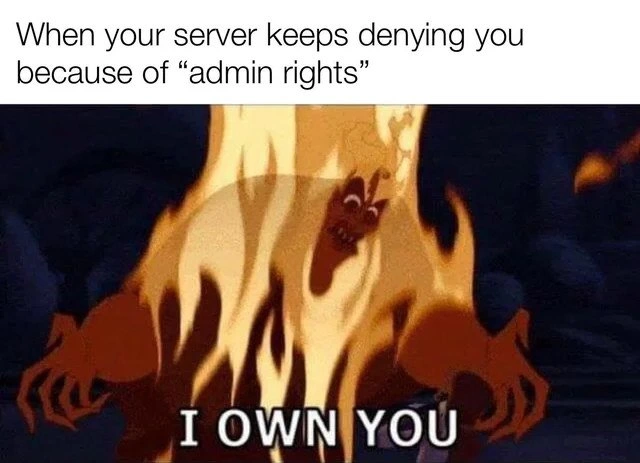
That’s exactly what’s happening in this meme, but with a computer. The developer (like the kid wanting a cookie) is trying to do something on the server (the cookie jar), and the server’s like the strict parent saying, “No, you can’t – I’m in charge here.” The big fire character yelling “I OWN YOU” is a funny way of showing how the computer seems to have all the power. It’s like the computer is a bossy playground bully who owns the only basketball. If you ask to play, the bully holds the ball above your head, laughs, and says, “Haha, I own this ball, so we play by my rules!” You’d feel pretty annoyed, right? The computer in the picture is doing the same kind of thing: the developer has to follow the computer’s rules (the admin rules) or else nothing happens.
In simple words, the meme is funny because we’ve all felt that feeling of being told “no” just because someone else is in charge. Whether it’s a parent, a teacher, or a computer saying it, the reaction is the same: “Ugh, you’re not letting me do what I want!” Here, the computer’s reason is “admin rights” – basically it’s saying, “You’re not the boss of me, I’m the boss of you on this machine.” The fiery cartoon exaggerates this idea, making the computer seem like a loud, stubborn monster. But it’s all in good fun. It helps us laugh at those times we felt small in front of a big authority. After all, even adults (like developers) sometimes feel like little kids when a machine tells them “Because I said so!”
Level 2: Permission Denied 101
So what exactly are “admin rights” and why do they cause so much drama? At a basic level, computers differentiate between regular users and administrators (admins). If you have admin rights, you’re like the king/queen of the system – you can change almost anything. No admin rights? Then you have limits on what you can do. Authorization is the term for these rules about “who can do what.” It’s part of a broader concept called Access Control Mechanisms, which are just systems or methods that decide if a user is allowed to perform a certain action. For example, an access control might say “User Alice can read this file but not edit it” or “User Bob can install software, but only in this one directory.” When you try to do something and the system stops you, that’s authorization in action. And the message you often get is “Permission denied” (or “Access denied” in some systems). It’s the computer’s way of saying, “I know who you are, and I’m sorry Dave, I can’t let you do that.”
In everyday development and system administration, admin_rights usually refer to being part of the admin group or being the root user. On Unix/Linux systems, the top-dog account is called root (literally, the username is “root”). On Windows, it’s typically an “Administrator” user or being in the Administrators group. Being root/Administrator means you have full control: you can modify any file, change any setting, install or remove programs, start or stop services – basically own the system. A regular user account, by contrast, is restricted. For instance, a regular user might not be allowed to write files in system directories like C:\Windows\System32 on Windows or /etc/ on Linux, because those are sensitive areas. If you try, the system will stop you with an access_denied_error. This is usually good! It prevents accidents (imagine accidentally deleting an important system file) and malware from wreaking havoc. But it also means as a developer or user, you sometimes hit a roadblock and need to ask for higher privileges.
One common way to get temporary admin power on Unix/Linux is the sudo command. sudo stands for “superuser do.” It’s basically saying “Hey system, please run this next command with superuser (admin) privileges.” If your user is in the right group (typically the “sudoers” list), the system will ask for your password and then execute the command as if root itself did it. For example, if copying a file to a protected directory fails, you prefix it with sudo and suddenly you have the green light (because you’ve proven you have permission to elevate your role). Here’s what that might look like:
$ cp coolscript.sh /usr/local/bin/coolscript
cp: cannot create regular file '/usr/local/bin/coolscript': Permission denied
$ sudo cp coolscript.sh /usr/local/bin/coolscript
[sudo] password for devuser: ****
# File is copied successfully with admin rights
In the snippet above, the first cp (copy) command fails because /usr/local/bin is a directory owned by root (an admin-only area). The error "cannot create... Permission denied" is essentially the computer saying "Stop! You need to be an administrator to do that." After using sudo, the copy succeeds, because sudo temporarily gave that one command privilege escalation (i.e., it ran with admin-level authority). This demonstrates a legitimate, controlled way to elevate privileges. In contrast, outside of legit tools like sudo, the term PrivilegeEscalation can also refer to malicious techniques hackers use to gain admin rights illicitly. But in our everyday dev context, it usually just means using the proper channels to get the rights you need (like asking a system admin for access or using sudo if you’re allowed).
Now, why does the meme say “I OWN YOU”? It’s playing on the idea of ownership in computing. Every file or resource on the server has an owner (usually the user who created it or an admin account). If you’re not the owner or an admin, you can feel helpless – you have to ask the owner (or the system) for permission to touch it. It’s a bit like trying to edit a Google Doc that you only have read access to – you can see it, but try to type and it just won’t let you. The system is effectively saying “Nope, you don’t have edit rights.” In a server, when it denies you, it can certainly feel like the server itself is bossing you around. The meme exaggerates that feeling by giving the server a menacing voice: “I OWN YOU.” Of course, servers don’t literally talk or laugh at us (thankfully!), but after the tenth “permission denied” in a row, you might start imagining the machine is taunting you. This is common DeveloperFrustration — it’s frustrating not because the task is hard, but because you’re blocked by policy.
To avoid these scenarios, organizations and teams usually set up processes: for example, a dev might have admin rights on their development server (where it’s safe to have full control), but only limited rights on a production server (where mistakes are costly). If you need to do admin-level work on production, you might have to get a senior admin or use a special tool that grants temporary privilege. These practices are part of good Security hygiene. Still, it can be annoying. If you’ve ever tried to install software on a company laptop and got a popup saying “Administrator approval required,” you know the feeling. You either call IT, or sigh and postpone what you were doing. The server saying “I OWN YOU” is just a comical way of expressing that power imbalance: the system holds the keys, and you have to ask nicely (or at least use the right commands) to get through.
In summary, admin rights are like having the master key to a building. Most people (regular users) get a normal key that only opens some doors. When you try to open a door you’re not authorized to, you hit a metaphorical wall (“Access denied!”). The meme shows the wall as a flaming creature telling you it’s in charge. As a newcomer in IT or development, understanding this is crucial: you’ll frequently deal with permission issues. They’re not personal – even though it feels like the computer’s picking on you! – it’s just the way systems maintain order. Over time, you learn the workarounds and proper procedures (like when to use sudo, or how to request access from a Sysadmin). And you’ll join the chorus of chuckling devs who see something like this meme and think, “Ha, been there, fought that fight.” It’s a rite of passage in tech to occasionally be humbled by a machine that politely (or not so politely) refuses your commands.
Level 3: Permission Purgatory
From a seasoned developer or sysadmin’s perspective, this meme hits on a classic SysadminPainPoints scenario: the maddening loop of access_denied_errors when you’re absolutely sure you should be allowed to do something. The top caption sets the scene: "When your server keeps denying you because of 'admin rights'". Every experienced engineer can immediately hear that sarcastic inner voice: “Of course it’s an issue with admin rights... again!” It’s practically a trope in DevOps/SRE life that whenever you’re in a hurry to fix a production issue or deploy a hotfix, you bump into a wall of server_permissions. The meme exaggerates that wall into a roaring blaze of a demon declaring “I OWN YOU”. It’s funny because it’s too real – in those moments, the server truly feels like it has a wicked personality, stubbornly asserting dominance while you scramble to appease it. Welcome to Permission Purgatory: that frustrating state where you’re neither fully blocked nor making progress – you’re just stuck negotiating with the system’s guardians, trying to prove you’re worthy of passage.
Why is this so relatable? Consider a real-world scenario: It’s 3 AM, you’re on-call, and an critical service has stopped. You SSH into the server to restart it, only to find your login doesn’t have permission to do so. You desperately prepend sudo to the restart command... and then realize your account isn’t in the sudoers file (ouch). Now you’re fumbling through documentation or frantically calling a colleague who has the elusive admin rights. The server meanwhile just spits access denied every time you try a command – effectively laughing in your face. That powerlessness is exactly what the meme’s infernal image conveys. The flame demon with outstretched arms is basically the server’s security policy saying: “Bow before me. Without proper authorization, nothing shall be done here!” It’s a mix of DeveloperFrustration and begrudging respect – frustration because you’re blocked at the worst time, respect because, well, the system is doing its job securing the environment (perhaps a little too zealously).
Another common scenario: a developer is trying to deploy a new application or update a config file on a production server. They might encounter an error like “Error: permission denied, unable to write to /opt/app/config.yaml”. The fix is obvious (use elevated privileges or get ops team to do it), but the delay is infuriating. In a hurry, you might even attempt a cheeky workaround like changing the file’s permissions for “just a quick edit”. A seasoned sysadmin, however, hears alarm bells – AccessControlMechanisms exist for a reason, and going rogue on them can lead to even more Security issues. The meme humorously anthropomorphizes the server to express how those mechanisms feel to us humans. It’s as if the server itself snorts: “You think you own this machine? Ha! Think again. I set the rules here.” Many of us have joked that some servers seem almost sentient in how they choose the worst moments to assert dominance with an access_denied_error.
This is also a subtle nod to the dynamic between developers and IT administrators in many organizations. In theory, devs could be granted full rights everywhere, but best practices (and compliance officers) scream otherwise. So companies implement strict roles: developers might have limited rights on staging or prod, requiring sign-off or pairing with ops for anything major. It’s a sensible policy – until you’re the dev who just needs to tweak one thing ASAP. The resulting bureaucratic dance (submitting a ticket or finding an approver while the clock ticks) feels like a form of digital purgatory. The meme captures that emotional drama perfectly with literal flames. It’s SysadminHumor because many sysadmins have been on the other side of this exchange as well – watching a frustrated dev plead for access can be darkly amusing (“Oh, now you want root_access? Let’s see those approvals…”). Of course, a good SRE will empathize, but they also know giving out root too freely is how you get disaster at 3 AM instead of just inconvenience. In other words, “I OWN YOU” is funny because sometimes that’s exactly what a locked-down server feels like: a petty tyrant we’re oddly grateful for (when calmer heads prevail) because it’s saving us from ourselves.
To add insult to injury (or humor to frustration), consider the wording of some permission errors and policies. Unix systems are usually terse: Permission denied – as if that’s all there is to say. Windows might pop up a more polite UAC dialog, but effectively it’s “You must be an administrator to perform this action.” Some corporate systems go further, logging the attempt and warning “This attempt to access a restricted resource has been reported” – which feels like the server saying “Not only do I own you, I’m telling on you too!” 😈. Seasoned devs have learned to recognize these moments immediately. The instant you see that error, you exhale and mutter something like “Right, forgot I’m not God on this box.” The humor of the meme lies in taking that moment – usually accompanied by an eye-roll or a facepalm – and turning it into a literal battle between a developer and a smug fire demon. It’s a battle every engineer has fought, often repeatedly. We laugh because we’ve all been burned by permissions before.
And let’s not forget the time-honored remedy: sudo. There’s an almost mythical reverence for sudo in developer culture – the one command that (if you’re allowed to use it) transforms your authorization level in an instant. It’s the magic word that placates the demon. In fact, jokes abound like “When in doubt, try sudo!” or “With great power (sudo) comes great responsibility.” But the meme’s scenario is one where even that doesn’t work – implying our poor developer doesn’t have sudo privileges either. That’s the ultimate DeveloperFrustration: when you can’t sudo your way out of trouble. Senior folks recognize that if you find yourself constantly needing admin rights to get work done, something is off with the workflow or permissions setup. Ideally, you’d request proper access or adjust the dev process, but in the heat of the moment, it’s just agony. The server firmly crosses its arms (flaming arms, in this case) and refuses to cooperate. Cue the inner monologue dripping with sarcasm: “Wonderful, the server_permissions are literally possessing the machine. Guess I really don’t own the server after all – it owns me.”
In summary, the humor at the senior level comes from recognition. We’ve all danced this dev-ops tango where the server is effectively saying “kneel, mortal” via cryptic permission errors. It’s a shared pain point turned into a visual gag. The demon’s triumphant grin is basically the embodiment of every unassailable root prompt and every Ops policy that ever blocked a curious dev. Seasoned engineers laugh because if we didn’t, we might cry – and because, in retrospect, those battles with admin rights were both frustrating and formative. After enough years, you have war stories of being locked out of your own system, and those become badges of honor (or at least cautionary tales). This meme condenses that war story into a single fiery snapshot. It’s absurd, it’s relatable, and it’s a reminder that sometimes the biggest antagonist in our daily work is not a runtime bug or a logic error – it’s a server permission setting wielding absolute power, cackling in a blaze of “I told you so.”
Level 4: The Principle of Least Privilege
In the operating system underworld, strict access controls are a feature, not a bug. The meme’s fiery demon growling "I OWN YOU" is a dramatization of a core security design known as the Principle of Least Privilege. This principle (articulated in early security research and operating system design papers) dictates that each user or process should have the minimum level of access necessary to perform its duties – no more, no less. In practice, this means your day-to-day account is intentionally not all-powerful; it's kept in check by the system’s access control mechanisms. The upside is safety – limiting privileges reduces the blast radius of mistakes or malware. The downside (as every developer learns) is that whenever you actually need those elevated rights, the system responds with a cold “permission denied”.
Deep down at the OS level, there's a guardian (think of it as a code module with a stern personality) called the kernel. It operates like a bouncer at an exclusive club, checking IDs at the door. Every time you try something sensitive – say modifying system files or starting a service on a protected port – the kernel asks “Is this user allowed to do that?”. Behind the scenes, this check involves user IDs, group IDs, and permission bits. On a Unix-like system, if your user ID isn’t 0 (zero is reserved for the all-powerful root user), you’re just another “guest” in the system’s eyes. The fiery figure in the meme symbolizes the kernel’s zealous enforcement: if you aren't root (or acting with root privileges via a tool like sudo), the system's response is basically “Begone, peasant!” – albeit phrased less dramatically as an EACCES or EPERM error code (which manifest to us humans as “Operation not permitted”).
Historically, this superuser model emerged from multi-user operating systems in the 1970s. Early Unix made a simple, bold decision: user ID 0 would be omnipotent (able to OWN and do anything), and all other users must request privileges or be denied. Over the years, this evolved into more nuanced schemes – Role-Based Access Control (RBAC) in enterprise systems, and mandatory access controls (like SELinux or AppArmor) that introduce even more granular rules. But the fundamental concept remains: there’s always an ultimate root authority, and layers of lesser accounts below. When you lack authorization and try to exceed your role, the OS halts you in your tracks by design. It’s like a law of nature in computing: no privilege, no passage. That law is usually our friend (preventing chaos), but in the moment when you need that forbidden action, it sure feels like a demonic possession of your server – with the access control subsystem grinning, “I own you, and your root_access belongs to me.”
Even the terminology nods to ownership. Consider file systems: every file has an owner and a set of permissions. If you’re not the owner (or in the owner’s group) and not root, the file’s bits and bytes are effectively off-limits. The system will scold you with access_denied_errors because ownership is power. The meme throws this concept back at us by personifying the server as an evil overlord. It’s a tongue-in-cheek reminder that in computing, authority is explicitly granted, never assumed. In academic security terms, the server is upholding integrity and confidentiality. In our emotional terms, it feels like the machine is alive and mocking us. The serious theory (least privilege principle, reference monitors, ACLs) is what creates this exact comedic situation. The server isn’t literally out to get you – it’s just following strict rules – but the devil is in the defaults. And those defaults ensure that unless you invoke the proper rituals (like calling upon sudo or obtaining the correct admin token), you shall not pass.
Description
This meme uses a screencap of the fiery, enraged character Hades from the Disney movie *Hercules*. His body is a column of intense flame, and his face is contorted in a furious expression. A subtitle at the bottom reads, 'I OWN YOU'. Above this image, a caption sets up the scenario: 'When your server keeps denying you because of “admin rights”'. The humor stems from the deeply relatable frustration of a system administrator or developer who, despite having set up, configured, and thus feeling complete ownership over a server, is ironically locked out by the very permission systems they implemented. Hades's impotent rage perfectly mirrors the feeling of yelling at an inanimate object that is just following the rules you wrote, creating a moment of pure, illogical fury against a logical system

Comments
15Comment deleted
The server's response to my 'I OWN YOU' argument was `sudo: user is not in the sudoers file. This incident will be reported.` My own damn incident
Kubernetes RBAC: because nothing humbles a 20-year veteran faster than a mis-indented YAML that locks even cluster-admin out, leaving the daemonset to smugly whisper, “I own you.”
Twenty years in, and I'm still explaining to auditors why I need sudo access to fix the very security policies that are currently preventing me from having sudo access
The irony of modern infrastructure: you're on-call 24/7, responsible for uptime, blamed for every outage, yet somehow 'sudo: permission denied' is your most frequent error message. It's like being a building superintendent who doesn't have keys to the building - except the building is on fire, it's 3 AM, and the security team who has the keys won't answer their phone because they're following 'proper change management procedures.'
Nothing humbles an architect faster than EACCES from a box whose sudoers.d he wrote - turns out “ownership” is a UID, not your title
Admin rights: the original rootkit, ensuring even your own server ghosts you until you escalate
Thinking you have admin? AWS IAM disagrees: Allow is a suggestion, ExplicitDeny is the actual owner of prod
fuck off Comment deleted
This Comment deleted
kick her Comment deleted
There new one each day Comment deleted
Die Comment deleted
some whore got kicked Comment deleted
Geyeeted Comment deleted
No such problem under windows) Comment deleted