Discovering the True Nature of the 'Modern' Codebase
Why is this LegacySystems meme funny?
Level 1: Good Enough for Now
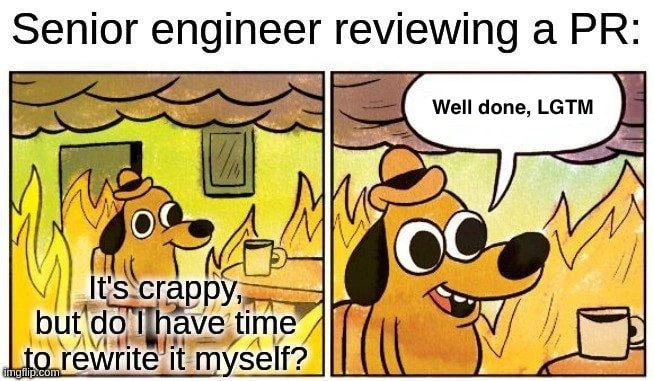
Imagine you have a big school assignment due tomorrow, but you haven’t finished it properly. You spot a bunch of mistakes in it, and you know you could do much better if you had more time. But it’s midnight and you’re out of time. 😟 So instead of fixing everything, you shrug, say “It’s fine,” and turn it in as is. Maybe you even tell yourself, “Great job, all done!” even though you know it’s not your best work. You’re basically pretending everything is okay because you can’t afford to fix it right now. It’s a bit funny and a bit nervous at the same time: you smile on the outside, but inside you’re like, “Uh-oh, I hope this doesn’t end badly.” That’s exactly what’s happening in the meme – the dog (like a person) is calmly saying “Looks good to me!” while everything is on fire around him. In simple terms, it’s about saying something is fine just because you ran out of time to make it better.
Level 2: Quality vs Speed Trade-off
Let’s break down the scene in simpler terms. We have a senior engineer reviewing a teammate’s code change. In software development, code changes are often shared via a Pull Request (PR) – basically a request to merge your code into the main project. A PR goes through code review, where other developers check your work. Here, the senior engineer is the reviewer (the cartoon dog represents them). Now, the issue is the code in this PR is “crappy” (sloppy or subpar). Normally, bad code would get sent back with lots of review comments or requests for improvement (we call that process refactoring when you rewrite code to clean it up). But there’s a problem: a looming deadline. Maybe a release or sprint end is very close, and there’s no time to thoroughly fix things.
In the first panel text, the reviewer thinks: “Do I have time to rewrite it myself?” That’s a key insight. Often a senior engineer will personally take on fixing code if it’s not up to standards, because they know exactly how it should be done. But rewriting someone else’s code properly can be time-consuming. The thought bubble shows the senior weighing, “Is it faster for me to just merge this now and deal with consequences later, or to delay the project by cleaning it up?” Given the flames around the dog (everything is on fire = urgent situation), the choice is leaning towards speed over quality.
In the second panel, the senior dev chooses speed. They say, “Well done, LGTM.” Let’s decode that:
- LGTM stands for “Looks Good To Me.” It’s a quick, positive approval used in code reviews. Typing “LGTM” is like saying “Okay, this change is fine, let’s merge it.” It’s very common on platforms like GitHub when a reviewer is satisfied (or in this case, pretending to be satisfied).
- Saying “Well done” is a bit of polite feedback, possibly to encourage the contributor. It’s ironic here, because the senior doesn’t actually think it’s well done; they’re just being nice or avoiding conflict since time is short.
So effectively, the senior engineer gives the PR a thumbs-up despite misgivings. This is a trade-off between code quality and meeting the deadline. By approving code that isn’t great, they’re creating what developers call technical debt. Think of technical debt like taking a shortcut that you’ll have to pay for later. For example, if you rush your homework and skip some questions, you might save time now but lose points (and have to do extra credit later to make up for it). In coding, pushing through a quick-and-dirty solution saves the day today, but it might cause bugs or slowdowns in the future that require much more work to fix. The “debt” metaphor is used because, just like financial debt, the interest (extra effort) piles up over time if you don’t go back to tidy things. The senior engineer knows this code may cause trouble down the road, but the immediate need (the deadline) outweighs that future cost right now.
The meme format itself – the dog in a burning room saying “This is fine” – is a famous way to joke about ignoring a problem. Here each visual element maps to the software scenario:
- The flames and burning room represent the urgent pressure and the problematic state of the code/project. Everything’s on fire means things are not in order (the codebase might become chaotic if you keep merging bad code).
- The calm dog sipping coffee represents the senior developer outwardly staying calm and acting like nothing is wrong. In reality, they see the “fire” (bad code, risk of future bugs) but they choose to remain composed.
- The dog’s thought “It’s crappy, but do I have time to rewrite it?” is the inner voice of the developer acknowledging the poor quality. This internal question is something many engineers ask themselves when reviewing rushed work.
- The speech bubble “Well done, LGTM.” is what the developer actually says in the code review system. It’s short and sweet. It lets the code through with approval. It’s almost like the developer giving a polite nod while thinking something else entirely.
For a newer developer or someone just learning about this process, here’s why it’s funny: CodeReview culture usually emphasizes quality – you expect your reviewers to catch mistakes and help improve the code. But in this meme, the senior reviewer basically gives up due to time constraints. It’s like a teacher grading an assignment with an A even though they know the work is poor, just because the report cards are due immediately. The phrase “Looks Good To Me” becomes a quick escape hatch. Early in your career, you might be surprised to find out that sometimes even experienced engineers will intentionally let non-perfect code slide. Why? Often because there’s pressure from the business side (e.g., “We must release this feature by Friday!”). If the choice is between missing the deadline or merging a fix that’s 80% okay, many teams choose to merge and deal with the consequences later. You might hear phrases like “we’ll refactor it in the next sprint” or “let’s ship now and fix it later.” These are all hints that the team knows the code isn’t ideal but time is short.
This meme also hits on the emotional aspect for a senior engineer. SeniorEngineerPain is real: once you’ve been around long enough, you’ve seen how messy code can cause outages or all-nighters. So approving something “crappy” is not done lightly. The dog’s somewhat crazed smile in the second panel can be read as the senior dev thinking, “Let’s hope this doesn’t come back to bite us.” It’s a coping smile. Newer developers might find it odd – “Why would a senior say LGTM if it’s bad?” – but often they learn through experience that in a crunch, the practical thing (meeting the deadline) wins over the ideal thing (perfect code). It’s a lesson in real-world software engineering: there is always a balance between quality and speed. Finding that balance is tricky. Approve too much bad code and your project becomes unstable (not fine!). But spend too long chasing perfection and you miss market windows or delay clients (also not fine). Here the meme humorously depicts an extreme case where speed completely wins – to a ridiculous extent (room literally on fire, “This is fine”).
Finally, let’s clarify LGTM in case it’s new: This acronym is commonly dropped in code reviews and stands for “Looks Good To Me.” It means the reviewer didn’t find major issues and believes the code can be merged. It’s almost like stamping “approved” on the change. In many teams, junior devs eagerly wait for an LGTM comment from seniors as the green light. However, as shown in the meme, sometimes LGTM can be a half-hearted approval given under pressure. The senior engineer might actually be thinking “It’s not great, but oh well.” Yet they type LGTM to keep things moving. So, LGTM can sometimes translate to “I’m not going to block this”. In short, the meme is a lighthearted warning: even if someone says your code looks good, it might be that they just don’t have time to make it better. It’s a glimpse into the compromises that happen when time constraints meet code review.
Level 3: Refactor vs Reality
The meme taps into a painfully familiar code review scenario: a senior engineer is staring at a Pull Request full of questionable code (the room on fire) and weighing their options. In the first panel, our seasoned dev (represented by the “This is fine” dog sipping coffee amid flames) thinks, “It's crappy, but do I have time to rewrite it myself?” This single thought bubble captures the classic code review trade-off: code quality versus deadline pressure. The second panel zooms in on the smiling dog cheerfully saying, “Well done, LGTM.” That LGTM – meaning “Looks Good To Me” – is the ultimate rubber stamp. Here it’s used ironically: the senior engineer is effectively saying “sure, whatever, ship it” while everything (possibly the codebase, or their conscience) burns around them. The humor hits home for developers because it’s an exaggeration of real life: we’ve all seen code that’s far from fine, approved with a forced smile to avoid blowing a timeline.
This meme brilliantly juxtaposes calm approval with chaotic reality. The “This is fine” dog is an iconic symbol of denial in disaster, and that’s exactly what’s happening in many rushed code reviews. The reviewer knows the code is subpar – maybe it introduces technical debt or could break in edge cases – yet they act like everything is normal. Why? Because sometimes delivering on time is valued more than doing it right. The phrase “Well done, LGTM” in the cartoon speech bubble is darkly comedic because in context it really means “Well… it’s done. Good enough, let’s move on”. Seasoned devs will smirk at this because LGTM has, in hectic moments, secretly meant “Let’s Get This Merged” rather than a genuine seal of quality. It’s a shared industry joke: deadline-driven development often turns code review into a mere formality.
The meme is poking fun at a common anti-pattern: choosing not to refactor or thoroughly critique a Pull Request when you’re crunched for time. A senior engineer might normally insist on high code quality – pointing out messy logic, suggesting better naming, adding tests – but here they’re overridden by reality. If they requested major changes or decided to rewrite the code themselves (as the thought bubble suggests), the team could miss a delivery date. Perhaps the release is tonight, QA is waiting, and there’s no time to hold up the pipeline. So the senior dev bites their tongue and approves the PR with a generic compliment. It’s a tongue-in-cheek portrayal of SeniorEngineerPain: having to accept less-than-great code to satisfy DeadlinePressure. Everyone watching knows this might come back to haunt them (maybe at 3 AM during a production incident), but in the moment the schedule wins. In essence, the senior is thinking, “I’ll allow this for now – future me will have to deal with the fallout.” This is a textbook creation of technical debt: trading quality for speed, with a promise to pay it back later (a promise often broken).
Why is this so relatable (and cringingly funny) to developers? Because it highlights the gap between our ideals and the reality of software development. In an ideal world, every PR is reviewed with care, and no bad code ever hits main. In reality, teams frequently face time constraint reviews – perhaps it’s Friday evening, or the feature is already late – and the path of least resistance is to approve and deploy. The senior engineer’s inner monologue “Do I have time to rewrite it myself?” is actually a common dilemma. Unspoken team rule: if you, as the reviewer, demand a rewrite and the author can’t handle it fast enough, you might end up pairing or doing it. That’s extra work and overtime the senior might not be able to afford right now. Thus, the safest move is often to say “LGTM” and hope nothing catches fire (even though, as the meme suggests, things are literally on fire). This ironic calm in the face of impending chaos is exactly what the “This is fine” meme format was made for.
Let’s contrast what should happen in code reviews versus what often happens when deadlines loom:
| Code Review Ideal | Code Review Under Deadline |
|---|---|
| Thoroughly scrutinize changes | Skim for only obvious breakage |
| Point out all flaws and pitfalls | Mention maybe one minor nit, skip the rest |
| Suggest refactoring or improvements | Avoid suggestions that delay merge |
| Enforce coding standards | Accept “good enough” code style |
| Ensure no added tech debt | Incidental technical debt accepted as trade-off |
| Refuse to approve bad code | “Well… LGTM, let’s just ship it” |
In a crunch, the priority flips – getting features out takes precedence over polish. The senior dev in the meme chooses the lesser of two evils: merge now and fix it later (which often becomes never, spawning haunted legacy code). The tragedy and comedy here is that everyone in the industry has witnessed this. We joke about it because we’ve lived it, and maybe it’s the only way to stay sane about shipping not-quite-perfect code. Deadline-driven shortcuts are a well-known source of later pain (hello, weekend bug fixes and late-night hotpatches!), but in the moment, saying “This is fine” feels like the only option. As a result, the codebase gradually fills up with shaky sections that all the seniors know about but nobody has time to address – the technical debt grows like a quiet flame in the walls, largely ignored until a major fire (a production issue) forces a reckoning.
Even the language in the meme is spot on. LGTM is such a simple, positive phrase that belies any problems. It’s a classic example of corporate coping: using a cheerful rubber-stamp response to mask the underlying issue (“this code is a bit of a dumpster fire, but oh well”). The senior engineer even says “Well done” – a final pat on the back to the developer who opened the PR, perhaps to avoid hurting feelings or sparking a long debate when there’s no time. It’s an extra layer of irony, because calling a shoddy piece of code “well done” is like congratulating someone for putting out a fire by dumping fuel on it. But in organizations where deadlines trump everything, this kind of polite fiction keeps things moving. The meme shines a light on that unspoken understanding: we both know this isn’t great, but let’s agree to pretend it’s fine so we can move on.
From an architectural standpoint, repeatedly favoring deadlines over quality is how you end up with a house of cards codebase. The senior engineer in this comic has likely seen it happen before – they recognize bad code when they see it. Their resigned expression (before the forced smile) says, “Here we go again…”. For those of us who have been around long enough, this scenario triggers a sort of dark deja vu. We’ve survived past projects where every “temporary” compromise became permanent. We know the technical debt interest will come due eventually (maybe a massive refactor next quarter, or a complete rewrite when the system becomes too unstable). Yet, here we are again, signing off on something we’ll cringe at later. The cycle continues, and that ridiculous calm “This is fine” grin is how we cope with the cognitive dissonance.
To put it in pseudo-code, the senior’s decision logic might look like this:
if (pullRequest.quality < MIN_ACCEPTABLE && project.deadline.isImminent()) {
// The code is messy, but the release date is looming. Gotta ship it.
reviewer.comment("LGTM"); // Approve anyway, time’s up
merge(pullRequest);
// Note: We'll refactor this later... (famous last words)
}
This tongue-in-cheek snippet is essentially what the meme illustrates. The senior engineer’s review algorithm becomes: “If time is almost up and the code isn’t outright catastrophic, just approve it.” It’s both hilarious and a bit horrifying because it’s true. In the back of every experienced developer’s mind is the knowledge that “fix it later” often turns into “live with it forever”, but schedule pressure can override that caution. And so, with a smiling “LGTM”, another dubious commit makes its way into the codebase. The meme resonates because it captures that exact moment of surrender and the thin veneer of positivity (LGTM! 🎉) plastered over the harsh reality (🔥 bad code burning a hole in the repo). In short, the senior engineer isn’t saying “This code is fine.” They’re saying “We know it’s not fine, but this project needs to ship, so… this is fine.”
Description
This meme uses the 'Always Has Been' (or 'Wait, it's all Ohio?') format, which features two astronauts in space. One astronaut, representing a junior developer, is looking at a depiction of the company's software architecture and says, 'Wait, it's all just a series of brittle, undocumented shell scripts?' The second astronaut, a senior developer, is holding a pistol and ominously replies, 'Always has been.' The meme humorously illustrates the moment a newer engineer discovers that the modern, sophisticated application they've been working on is actually built upon a fragile foundation of old, arcane scripts. It's a relatable scenario for anyone who has worked on a long-running project, highlighting the hidden complexities and technical debt that often lie beneath a polished surface
Comments
7Comment deleted
The difference between a junior and a senior dev is that the junior dev wants to rewrite the shell scripts, while the senior dev knows that touching them will summon an ancient demon that runs the entire payroll system
Real senior wisdom: LGTM is just shorthand for “Let’s Generate Tomorrow’s Maintenance” - now hit merge, the OKRs don’t measure regret
The real senior engineer move is leaving a comment that says "Consider refactoring this in the future" knowing full well you're the one who'll inherit it in six months when the author has moved to a different company
The senior engineer's eternal calculus: 'LGTM' doesn't mean 'Looks Good To Me' - it means 'Let's Get This Merged' because refactoring someone else's nested ternaries at 4 PM on Friday would require opening that third monitor, and we both know this code will be rewritten in the next sprint anyway when Product pivots to blockchain AI
LGTM: the concurrency primitive that serializes my calendar over your code quality
LGTM is our code review Raft: fast leader election under roadmap pressure, eventually consistent, and guarantees the tech-debt log only ever appends
LGTM: Prioritizing merge velocity over perfection, because tech debt accrues interest faster than your backlog clears