Skip to content
DevMeme
5854 of 7435
When tenure quietly promotes your personal style guide to policy
CodeQuality Post #6411, on Nov 21, 2024 in TG

When tenure quietly promotes your personal style guide to policy

Why is this CodeQuality meme funny?

Level 1: Oops, I’m Leading

Imagine you’re playing Follow the Leader with your friends, but you didn’t realize the game had started. You’re just walking around doing silly dances, assuming someone else knows the plan. Then you look back and see all your friends are copying your every move! You thought there was another leader, but it turns out you were at the front of the line and everyone was following you the whole time. You’d probably feel surprised and a bit worried, right? Like, “Oh no, I hope the way I was doing it wasn’t too silly!”

That’s exactly the joke here, but with programmers. One programmer stayed at the same company for a very long time and kept coding in his own personal style (like his unique way of writing and formatting code). All the other programmers who joined later just copied him, kind of like younger kids copying the oldest kid, until his way became the team’s unofficial “rules.” In the comic, the goose at the front didn’t know he was leading the flock. When he realizes everyone is following him, he gets wide-eyed and panicky: “Wait, you’re all going where I go?!”

It’s funny in a friendly way. The humor comes from that “oops!” moment when someone accidentally becomes the trend-setter without meaning to. Just like the surprised goose, the long-time programmer might be thinking, “I was just doing my own thing… and now it’s the official way?!” It’s a lighthearted reminder that sometimes, simply by being there the longest, you can become the leader without even noticing.

Level 2: Unwritten Code Rules

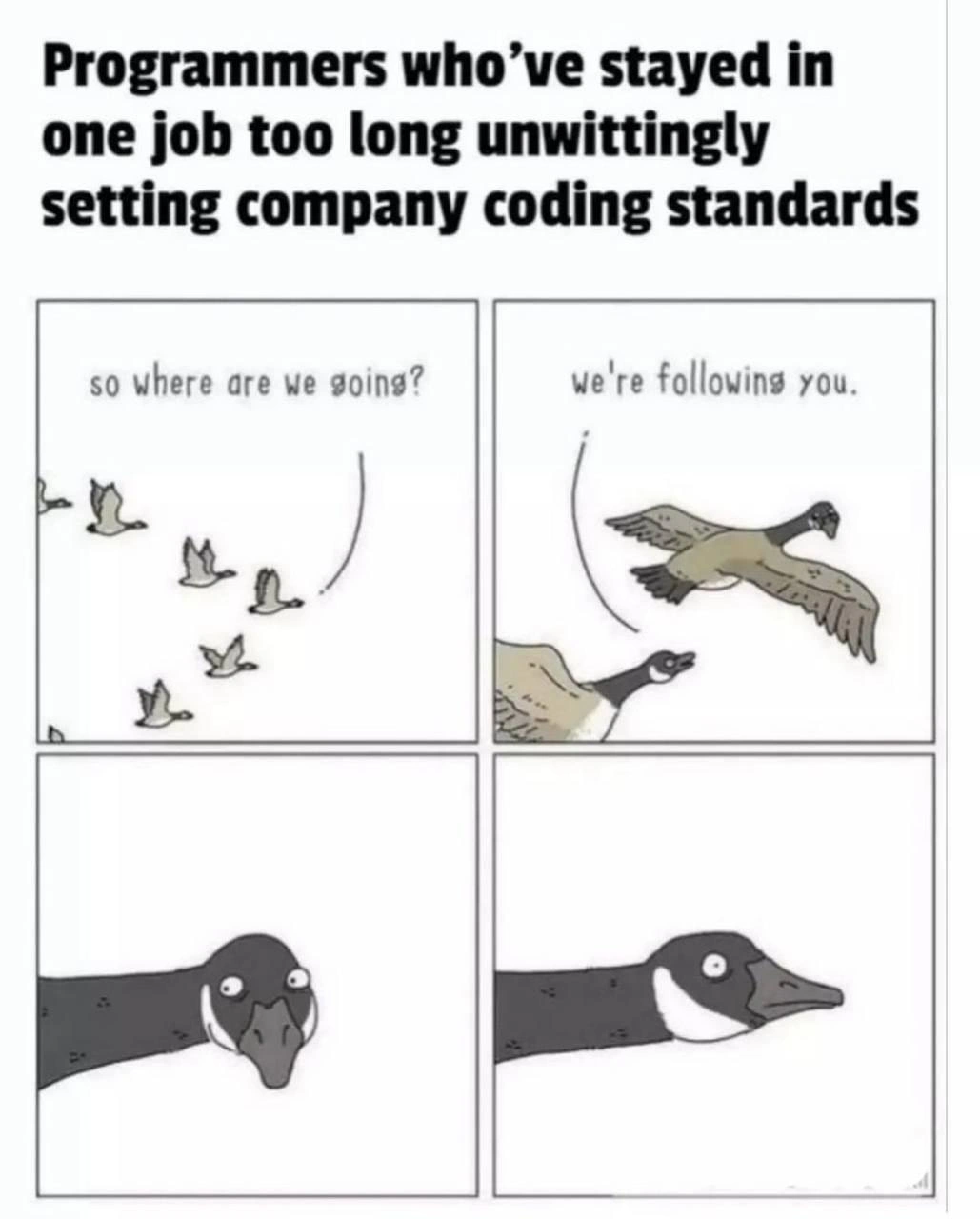
This meme uses a silly scenario (a confused goose leading a flying formation) to explain a real programming inside-joke. The top text says: “Programmers who’ve stayed in one job too long unwittingly setting company coding standards.” In simpler terms, it means if a developer stays at the same company for a very long time, their personal way of writing code might accidentally become the standard way everyone writes code at that company. It’s like everyone quietly copies that one person’s style until it becomes the rule, even though nobody officially said, “this is the rule.”

Let’s break down why that happens. Many teams have something called a code style guide – a document or set of rules about how to format and write code (for example, where to put curly braces {}, how to name variables, whether to use 4 spaces or a tab for indentation, etc.). These guides exist to maintain code quality by keeping the code consistent and easy to read. In big organizations or open-source projects, you often see explicit guidelines or linters (tools that automatically check code style) ensuring everyone writes code in a uniform way. For instance, Google and Microsoft have published style guides for languages like C++ or Python that all their developers follow. This consistency is part of good code quality practices.

However, not every company has a formal style guide. In smaller companies or older teams, sometimes the “style guide” isn’t written down at all. New developers learn by example: they look at the existing code and imitate it. If one programmer has been writing most of that code (because they’ve been there the longest), then that person’s style is the example. This creates an unwritten coding standard – rules that everyone follows but are not officially documented. The meme highlights a funny side of corporate culture: people might say “that’s just how we do things here,” even if nobody remembers who decided it. Often, it was never a conscious decision! It was just one senior dev’s habit that became tradition.

Imagine you’re a junior developer joining a legacy project (legacy code means old code that’s been around a while). You ask, “Hey, do we have a style guide or any coding conventions I should know?” and a teammate responds, “Not really, just try to match the existing code.” If that existing code was 90% written by Alice over the last 8 years, then effectively Alice’s way is the law. Maybe Alice likes to put a space before every semicolon or she writes all her comments with a cheerful “NOTE:” prefix. Without anyone explicitly telling you “Do it like Alice,” you’ll likely start doing those same things just because everything else does it that way. It’s a bit like unwritten workplace etiquette – nobody says you must bring donuts on Fridays, but if the old-timer has always done it, you might feel you should, too.

This scenario is humorous to developers because it happens a lot. It ties into the concept of technical debt as well. Technical debt isn’t about money – it’s a metaphor for the extra work we have to do later because we took a shortcut or made a quick decision earlier. In this case, letting one person’s quirky style become the company standard is a kind of technical debt in code style. Why? Because maybe that style isn’t optimal or modern, and someday people might have to clean it up or re-learn better practices (that cleanup is “paying off” the debt). It’s not a critical bug or anything, but it’s a bit of a LegacyCode burden – like an old fashion that the team is stuck with. Changing it later (for example, reformatting everything to a new style or retraining the team on a new convention) would take effort, so until then everyone limps along with the old way.

The meme uses geese in a V-formation as a clever analogy. In a V-formation, one goose flies at the front and the others naturally follow in that formation. The dialog in the comic goes like this:

  • Panel 1: Some geese in the back ask, “so where are we going?”
  • Panel 2: The front goose says, “we’re following you.”
  • Panel 3 and 4: Close-ups of the front goose’s face looking shocked 😳.

Translating the joke to a dev team:

  • The junior programmers (the geese in the back) might be wondering, “What coding style or direction are we supposed to follow?”
  • They realize the answer is, “We’re following you,” but “you” is actually the senior dev – meaning everyone’s been following that one person all along.
  • The senior dev (front goose) suddenly has the “oh no” face, realizing they have unknowingly been leading the direction of code style (or possibly the project architecture) the whole time.

Why would the senior be surprised or panicked? Because they might not have intended to set any rules; they were just coding in a way that made sense to them. It’s like finding out all your coworkers started using your quirky variable naming just because you did it first. The expression is one of imposter syndrome meets responsibility shock: “Hang on, everyone is copying me? I was just winging it!”

This happens due to tenure inertia – when someone has been in a place for a long time (tenure) and things just keep going in their direction (inertia means staying on the same course unless changed). Nobody bothered to change the style because:

  • The long-time developer’s code worked fine (if it’s not broken, don’t fix it).
  • Out of respect or habit, other team members just followed along.
  • There wasn’t a strong push or a new person with enough influence to introduce a formal guide or different approach.

Additionally, newbies tend to “follow the leader” when they join a team. Early in your career, if you see a weird pattern in code, you might assume it’s there for a good reason. For example, if every function in the code ends with a comment like // EndFunc, you’d likely do it too, thinking it’s required, even if in reality it started because one dev did it out of personal preference. This is related to the idea of cargo cult programming: copying patterns without fully understanding them, just because that’s what the existing code does. The term “cargo cult” in programming is often explained to juniors like this: imagine seeing someone put oranges around a computer every day, and you do the same thinking it’s needed for the computer to work, when in fact it was just that person’s snack. In coding, cargo cult behavior is when we include code or follow practices without understanding, simply because we saw it done before. In a cargo_cult_style_guide situation, the “guide” is really just mimicking the seasoned dev’s style blindly.

Let’s also clarify LegacySystems since it’s mentioned. A legacy system or legacy code is basically old software that is still in use. It often has outdated ways of doing things but nobody has replaced it. The longer a programmer works on the same legacy system, the more their personal patterns might spread throughout it. It’s like an old house where the original builder’s quirky ideas (maybe a secret crawlspace or oddly sized doors) are still there because renovating would be costly, and new occupants just learn to live with them. Likewise, new developers joining a legacy codebase learn to live with and repeat the quirks present there.

In summary, the meme is telling a joke about developer culture. In many dev teams, people have experienced that one senior colleague whose coding style becomes the “way we do things,” not out of official policy but out of long habit. It’s funny because it’s true, and it also serves as a caution: maybe we should actually write down our standards and update them, instead of accidentally following one person. But until that happens, this is a relatable scenario for many programmers – and that’s why they find it humorous. The goose doesn’t know he’s leading, just like some senior devs don’t realize they’ve been effectively writing the rulebook by being the example everyone copies.

Level 3: Cargo Cult Standard

At the highest level, this meme brilliantly captures a software governance anti-pattern: a long-tenured developer’s personal quirks solidifying into the team’s de facto code style guide. The comic’s goose formation is a metaphor for how corporate culture often follows the path of least resistance (or least change), much like geese instinctively fly in a V behind whoever’s in front. Here, the lead goose (the veteran programmer) suddenly realizes the flock (the other devs) has been following his direction all along. In real development teams, a programmer who’s stayed at one job forever can accidentally become the accidental architect of coding conventions—unwittingly setting standards simply because no one else bothered or dared to formalize different ones.

This is humorous because it’s too real: everyone’s looking around asking “so where are we going?” and the one person with the longest tenure hears “we’re following you.” That wide-eyed goose panic is the senior engineer thinking, “Wait… my personal brace style and commit message format have quietly become law?!” 😳 It hits on the shared memory of any dev who’s inherited a project and thought, “Why on Earth do we do it this bizarre way?” only to learn the answer is: because Old-Timer Olga or Bob always did it like that. It’s a gentle roast of tenure inertia: instead of deliberate CodeQuality decisions, the codebase ossified around someone’s idiosyncrasies. The humor has a dark edge for seasoned devs—we’ve all seen how one person’s habit can calcify into unspoken policy, creating a form of legacy code convention that nobody questions until it’s absurd.

From a senior perspective, this scenario touches on cargo cult programming in the context of style guides. Newer developers imitate the senior’s patterns without understanding, much like a cargo cult style guide where rituals are followed because “that’s how it’s always been here.” The “cargo cult” term comes from how South Pacific islanders in WWII mimicked soldiers’ routines hoping to summon cargo; in code teams, it’s blindly copying patterns hoping to achieve success. So if the veteran dev always uses, say, 3-space indents or writes if(condition){ doStuff(); } on one line, the rest of the team might just do the same, assuming it’s the right way. Over years, these habits become institutional memory. No PDF or Confluence page announces it, but violate it and a code reviewer will say “That’s not how we do things here.” The organization has effectively set a policy by precedent.

Why is this funny and painful? Because it highlights a truth: Code standards often emerge by accident. Ideally, teams use explicit CodeStyleGuides or linters (.eslintrc, .clang-format, etc.) to enforce consistency. But many shops—especially older or smaller ones—never get around to that. Instead, the longest-standing code becomes the reference. It’s like an inside joke among engineers that if you stick around long enough, your way becomes “the way.” The meme nails the moment of realization from the veteran’s viewpoint. It’s the senior dev suddenly experiencing imposter syndrome: “I was just tabbing that way because my editor auto-formats it… now it’s company policy?!” The goose’s alarm is our chuckle of recognition.

On a deeper level, this reflects how technical debt in style and architecture accumulates. What starts as one person’s convenience can become a rigid rule that’s hard to change. Consider some common patterns that fossilize by tenure:

  • Indentation & Whitespace: Perhaps the senior dev hates tabs, so all files use 4 spaces. Years later, the whole repo is spaces-only because “that’s how it’s always been”—even if half the team actually prefers tabs.
  • Brace Placement: If that dev was trained on, say, Allman style (braces on a new line) vs K&R style (brace on the same line), the entire codebase follows suit. It’s unwritten law. A newcomer suggesting a different brace style might be looked at like a heretic.
  • Naming Conventions: Maybe the veteran prefixes member variables with m_ or uses Hungarian notation (e.g. strName for strings). No one wrote this down as mandatory, but everyone does it now. It’s become a cargo cult standard: folks emulate the pattern even if modern consensus calls it outdated, simply because that’s what all the legacy code does.
  • Commit Message Etiquette: If the old-timer always writes commits like “Fixed bug” or includes a joke, the team might unconsciously copy that style. Over time, it’s just expected that every commit references a JIRA ID or is written in present tense because the long-time lead does so. It might not even be a conscious rule, just tribal knowledge.

All of this ties into CorporateCulture and a bit of laziness (or pragmatism). Why fight it? If it ain’t broke (and the senior engineer is also the code reviewer), you don’t “fix” the style. Over years, this creates a kind of unwritten coding standard. The phrase that sums it up is:

“We do it this way because we’ve always done it this way.”

That’s the mantra of tenure-driven development. It’s a mix of respect and inertia: respect for the veteran’s experience and inertia to avoid holy wars over style. No one formally codifies the rules, which might start as a personal style guide, but by the time the company grows, these personal preferences get quietly promoted to official policy (with no announcement). The meme’s goose finding out he’s the leader is analogous to a senior dev reading the new-hire onboarding docs (written by someone else) and discovering that their hacky old pattern is listed under “Best Practices.” Cue the startled goose face.

In essence, the company has a single-point-of-failure in its style governance (a bus factor of one for coding style knowledge). If that person leaves, the team might stick to those patterns like a ghost tradition, or worse, flounder about what the real standard is. I’ve seen legacy systems where odd conventions persist like archaeological layers, each stratum traceable via git blame to a particular long-gone engineer. The meme pokes fun at this archaeological LegacySystem effect— “Behold, the Code of Elders, unchanged since the Before Times.” It’s funny because it’s true: real companies have codebases with // TODO: fix in 2010 still there, and everyone just works around it as if part of the landscape.

Finally, there’s a subtle commentary on code quality and governance. Relying on one person’s style can be risky or suboptimal. Perhaps their style isn’t objectively the best, or it’s fine but nobody revisited it as the language evolved. The meme format using geese is apt: in real goose formations, the lead rotates to avoid exhaustion, but in some orgs, one “goose” leads forever. The senior engineer pain here is realizing you inadvertently became that permanent lead. It’s funny to observers, but the veteran might feel a mix of pride and “oh no, what have I done?!”. The remedy, unspoken in the meme, would be to actually discuss and write down a proper style guide—spread out leadership, just like geese do to survive long migrations. But of course, in many companies, that conversation only happens after a new generation of devs come squawking in confusion. Until then, the flock just keeps following the same lead goose. 🙃

Description

The meme is a four-panel, black-outlined comic topped by the caption: “Programmers who’ve stayed in one job too long unwittingly setting company coding standards.” Panel 1 shows a distant V-formation of cartoon geese with the text “so where are we going?” Panel 2 zooms on the lead goose replying “we’re following you.” Panels 3 and 4 are extreme close-ups of that goose’s face, eyes wide and panicked, suddenly realizing the inadvertent responsibility. The humour mirrors how a long-serving developer’s idiosyncratic brace placement, lint rules, or commit etiquette silently ossify into the organisation’s official standard, revealing the intersection of code quality governance and corporate inertia

Comments

6
Anonymous ★ Top Pick It’s all fun and games until your decade-old personal .editorconfig is cited in the SOC-2 audit as “company-wide immutable convention.”
  1. Anonymous ★ Top Pick

    It’s all fun and games until your decade-old personal .editorconfig is cited in the SOC-2 audit as “company-wide immutable convention.”

  2. Anonymous

    The moment you realize your 'temporary workaround' from 2018 has become the cornerstone of the company's architectural patterns, complete with its own internal wiki page titled 'The Smith Pattern' and three junior devs defending it in code reviews as 'how we've always done things here.'

  3. Anonymous

    The terrifying moment when you realize your hastily-written utility function from 2015 - the one with the TODO comment about refactoring - has been cargo-culted into seventeen microservices, spawned three internal libraries, and is now cited in the company's engineering principles documentation as 'the standard approach.' You're not the architect; you're just the goose who happened to be in front when everyone started following

  4. Anonymous

    Most orgs’ “coding standards” are just the ESLint config the longest‑tenured dev copy‑pasted in 2017 and enforced via PR nits - goose-led governance by merge friction

  5. Anonymous

    Veteran dev standards: the one antipattern where blind V-formation beats solo refactoring

  6. Anonymous

    Company 'coding standards' are your 2014 .editorconfig plus three production bugs fossilized into policy - path dependence with unit tests

Use J and K for navigation