Skip to content
DevMeme
5855 of 7435
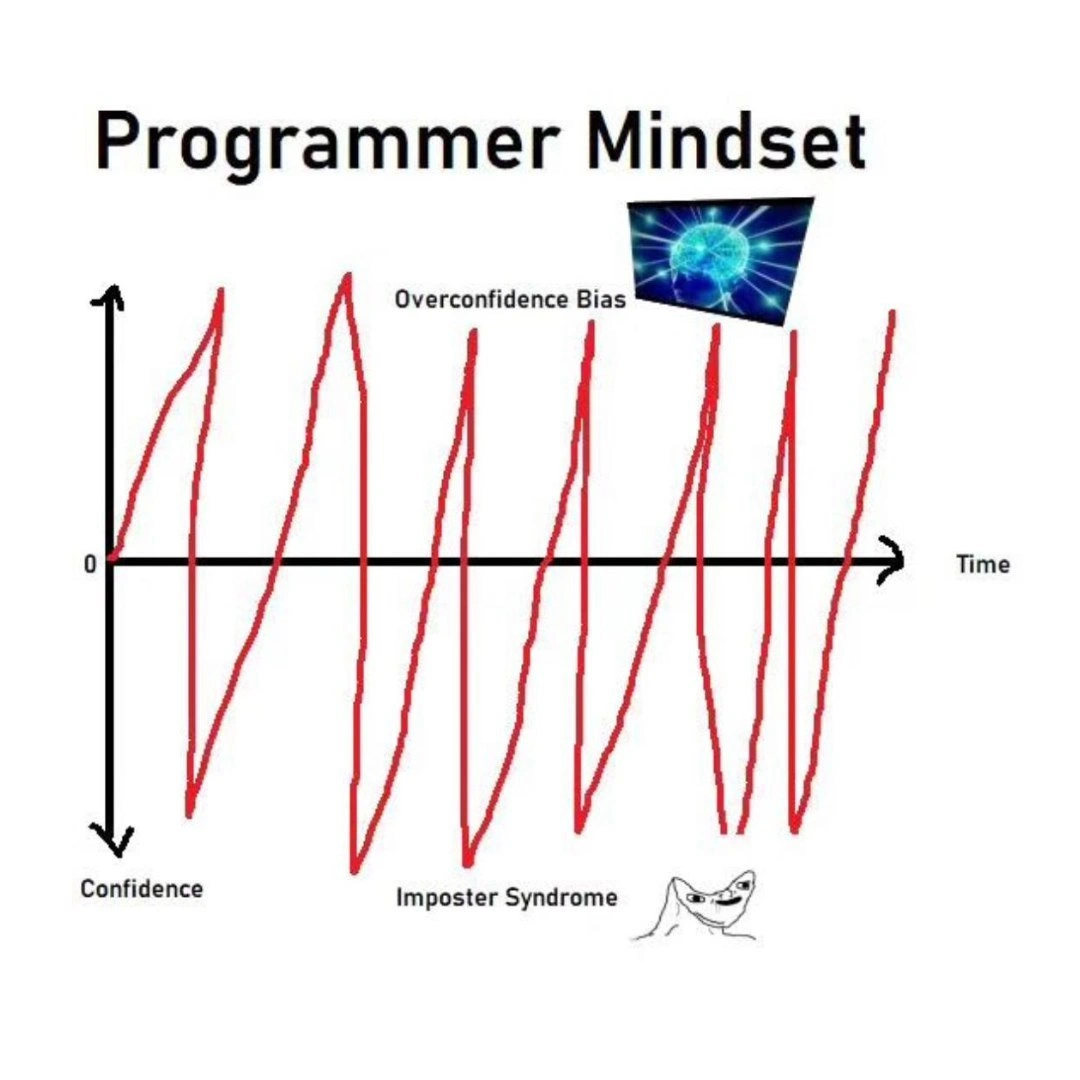
The saw-toothed roller-coaster of senior-dev self-confidence
MentalHealth Post #6412, on Nov 22, 2024 in TG

The saw-toothed roller-coaster of senior-dev self-confidence

Why is this MentalHealth meme funny?

Level 1: Roller Coaster of Emotions

Imagine you’re on a roller coaster that goes up and down, up and down. When it goes up, you feel super proud – like you’re the smartest kid in the world. 🦸 When it goes down, suddenly you feel the opposite – you’re sure you’ve done everything wrong and you’re really not good at all. 😞 Now picture this happening again and again: one minute you’re confident, the next minute you’re full of doubt, then confident again. It’s a big emotional roller coaster!

This meme is showing that being a programmer is kind of like that. One day you might solve a hard puzzle (write some code) and think, “Wow, I’m really good at this!” – that’s the high up. But the next day, you might get stuck on a problem or make a mistake and think, “Oh no, I’m terrible at this, I don’t know anything” – that’s the low down. And then later on, you fix it or learn something new and you’re happy and confident all over again. It’s funny because it’s true: everyone feels like this sometimes, especially when doing something tricky like programming. The meme uses a simple squiggly line going up and down to make us laugh about our own changing feelings. It reminds us of a kid building a tall tower of blocks – feeling like a genius when the tower stands, then feeling upset when it falls down – and then excited to build it again. We laugh at the picture because we recognize that up-and-down feeling in ourselves, and it’s nice to know we’re not the only ones who feel brave one moment and clueless the next.

Level 2: Peaks and Valleys

This meme graph humorously breaks down the wild peaks and valleys of a programmer’s self-confidence over time. Think of the vertical axis labeled “Confidence” as how good a programmer feels about their skills – going up means feeling great (even too great), and going down means feeling awful (even unjustly so). The horizontal axis “Time” just shows the sequence of moments or projects as they happen. The red line zig-zagging sharply up and down illustrates a repeating cycle of emotional highs and lows that many developers experience:

  • Overconfidence Bias (High Peaks): At the top of each spike, the programmer is riding a high of confidence. The meme even places a little “galaxy brain” image there to emphasize those euphoric moments of brilliance. A galaxy brain (from popular internet memes) represents someone having an extremely clever or enlightened idea – in other words, a super smart moment. So at those peak points, the developer thinks they’re a genius. Maybe they just solved a tricky bug or implemented a complex feature and everything clicked. In that moment they might believe “I’ve totally got this coding thing down!” This is what we call overconfidence bias – a tendency to overestimate our own ability or the quality of our solution. In a programming context, it’s like thinking your code is flawless or that you’re the next Linus Torvalds after one good day. The graph shows these high points shooting well above the Confidence = 0 line, meaning confidence is way up – perhaps even unrealistically high.

  • Imposter Syndrome (Low Troughs): Now look at the low points where the red line dives below the 0 line into negative territory. Down there, the meme labels “Imposter Syndrome” and even shows the infamous troll face meme image grinning slyly. The troll-face is a classic meme for getting trolled or mocked – here it represents either the universe or your inner critic laughing at you. Imposter syndrome is the name for that awful feeling many people (especially in tech) get where you believe you’re not actually competent and that you’re a “fraud” fooling everyone. At these troughs, the programmer is filled with self-doubt. Perhaps something went very wrong: that “flawless” code from earlier blew up with a runtime error, or a colleague pointed out a mistake in your logic during code review. In those moments, you swing to the opposite extreme: “I have no idea what I’m doing… How did I ever think I was good at this? I’m not a real programmer, I just got lucky before.” That’s imposter syndrome talking. On the graph, these feelings are so low they’re below zero confidence – meaning you don’t just lack confidence, you have negative confidence (you actively feel like a phony). The troll face down there is like that voice in your head or the cynical part of the internet saying “HA! You thought you were smart, now look at you!” It’s self-deprecating and a bit cruel, which is exactly how imposter syndrome feels internally.

So the red line continuously goes up and down, up and down – it’s a cycle of programmer mood swings. One moment the developer is on top of the world (extremely confident), and the next moment they’re in a pit of despair about their abilities (extremely doubtful). The meme labels it “Programmer Mindset” to suggest this kind of emotional roller coaster is a common mindset among programmers. It’s poking fun at how unstable our confidence can be in this field. In fact, the image caption calls it “The saw-toothed roller-coaster of senior-dev self-confidence”, which is a perfect description: it looks like the teeth of a saw – sharp ups and downs – and it feels like a roller coaster ride for your self-esteem.

Why does this happen in software development? A junior developer might ask, “Do even senior devs really feel like this?” Surprisingly, yes – they do! Programming is complex and full of unknowns. Even a “senior” developer (one with many years of experience) faces new challenges all the time: unfamiliar technologies, unpredictable bugs, changing requirements, etc. It’s very easy to one day feel super capable (when things go right) and the next day feel totally lost (when things go wrong). For example, imagine you spend the morning successfully fixing a nasty bug that was causing a lot of trouble. You feel great – you’re high-fiving yourself because the app works perfectly now. That’s a peak of confidence. But in the afternoon, a user reports a new issue that you had no idea could even happen, or your fix causes a different side-effect. Suddenly you’re struggling for hours and nothing is working. Now you feel miserable and start questioning whether you even understand the code at all. That’s a valley of self-doubt (imposter syndrome).

The meme is relatable humor for developers because it exaggerates a truth: our confidence can swing dramatically in this job. The terms used – Imposter Syndrome and Overconfidence – are actually well-known in tech circles:

  • Imposter Syndrome: a psychological pattern where you doubt your accomplishments and fear being exposed as “not good enough.” It’s extremely common in the tech industry, even among people who are very skilled. You might have imposter feelings when you compare yourself to others or when you hit a problem you can’t solve immediately. (Example: A new programmer might feel like “Everyone here is so much smarter, I don’t really belong” – that’s imposter syndrome talking.)
  • Overconfidence Bias: a cognitive bias where someone’s confidence in their knowledge or abilities is higher than it should be relative to reality. In other words, being too sure of yourself. In programming, this can happen right after you learn something new or finish a project and think “Wow, I’m really on top of this now!” – you might underestimate how many unknown issues or complexities are still out there. (Fun fact: There’s also something known as the Dunning-Kruger effect, which describes how beginners can often be overconfident because they don’t yet know what they don’t know. Here though, even an experienced dev can momentarily act like a beginner in how overconfident they get after a win.)

The inclusion of the “galaxy brain” meme and the “troll face” meme images adds an extra layer of internet culture to the joke:

  • The galaxy brain image at the peak implies the developer’s mind is “expanding” with brilliance – it’s a sarcastic way to say “Look at me, I’m so enlightened right now.” It’s often used humorously to overstate how great or clever someone thinks their idea is.
  • The troll face at the bottom is like a caricature of someone (or fate) saying “Problem?” while grinning maliciously. It’s as if the universe itself is trolling the programmer during their low confidence moments. It represents how ridiculous you feel – like you’ve been pranked by reality.

Even though this is drawn in a funny, cartoonish way, it resonates with developers’ psychology. It’s showing a bit of the mental roller coaster that can come with coding. Every bug fixed or new feature can give a rush of accomplishment (boosting confidence), and every unexpected bug or failure can make you doubt yourself. The reason it focuses on a senior dev is that one might assume a senior developer would be confident all the time – but the joke here is that even the pros aren’t immune to these swings! If anything, seniors know better that overconfidence will be punished by the next weird edge case or production outage. This graph is saying: no matter how experienced you are, programming can always make you feel like a genius one minute and an idiot the next. It’s both comforting and comically tragic to see it drawn so bluntly.

Importantly, many people in tech share this experience, which is why you’ll see terms like DeveloperEmotions, MentalHealthInTech, and DeveloperPsychology alongside the humor. It’s a lighthearted way to acknowledge something real: maintaining confidence in a coding career is hard! The meme gets passed around with a knowing laugh because it’s relatable humor – you recognize yourself in that spiky red line. Developers often use this kind of self-deprecating humor to cope and to remind each other that hey, we all ride this ride – you’re not alone. So if you’re new to the field and find your confidence swinging wildly, remember that even the veterans deal with the same programmer mood swings. Today you might feel like you know nothing, tomorrow you might feel on top of the world, and that’s okay. The key is to try and find a bit of balance (and maybe a little laugh) in this crazy sawtooth ride.

Level 3: Confidence Whiplash

At first glance, this meme’s sawtooth confidence graph looks comically exaggerated – but any seasoned developer will recognize it as painfully accurate. The vertical axis labeled Confidence ranges from smugly sky-high to abysmally low, while the horizontal Time axis ticks along as projects progress. The jagged red line oscillating above and below zero is essentially the life cycle of a senior dev’s ego. One sprint you’re rocketing to a galaxy-brain peak of overconfidence; the next, you’re plunging into a trough of crippling impostor syndrome. It’s a loop of confidence whiplash that senior engineers know all too well: architectural brilliance meets real-world edge cases, and the result is cognitive whiplash.

At the top of each spike, the meme even plants that galaxy-brain image – a tongue-in-cheek nod to those euphoric “Eureka!” moments when you’re convinced your solution is pure genius. This is the overconfidence bias in action: a cognitive bias that tricks you into thinking “I’ve finally cracked it – I’m basically a coding god!” In these peak moments, a dev might merge a PR and strut off like they just invented Kubernetes. It’s the DeveloperHumor version of flying too close to the sun. And indeed, at these heights, you feel invincible: all tests are green, code reviews are glowing (“LGTM – brilliant solution!”), and you start internally riding that galaxy_brain_peak. The code is elegant, the architecture is scalable (in theory), and you’re mentally writing your “10x Engineer” autobiography. This is the high of the overconfidence bias cycle – the part where you’re certain you’ve mastered software development at last.

But then comes the inevitable crash – the red line nose-dives below the zero line into negative territory, straight into the Imposter Syndrome zone. Here the meme has a grinning troll_face_despair lurking, which perfectly personifies that sneering inner voice (or mocking production bug) saying “You have no idea what you’re doing, do you?” This is the brutal flip side: you deploy your “genius” code and a production bug explodes in your face. Maybe an edge case you never considered brings the whole system down at 3 AM, or a junior dev finds a glaring flaw in your “brilliant” algorithm during code review. Suddenly your galaxy brain confidence implodes. You’re staring at a stack trace thinking, “How could I miss this? Any real programmer would have caught it. Maybe I’m just a fraud after all.” That’s impostor syndrome: the pervasive feeling that you’re not as competent as everyone thinks, and that any success was just luck or deception. It’s a familiar devil on the shoulder for many in tech, even those with years of experience. The meme’s troll-face in the trough is basically the universe (or your own mind) trolling you for ever feeling too confident. In this moment, your earlier triumph now feels like a fluke, and you’re convinced you might get “found out” as an impostor javascript incompetent.

What makes this meme hilarious (and a bit haunting) is how it captures the programmer_mood_swing as a never-ending cycle. It’s not a one-time jump from arrogance to self-doubt – it repeats over Time. That red line oscillates like a relentless heartbeat of developer emotions. Every peak of pride contains the seeds of the next fall. In practice, this might look like: one day you confidently refactor a core module and deploy to production without a hitch (overconfidence bias at work), and by evening you discover that your “elegant” change introduced a subtle memory leak that takes down the site (hello, impostor syndrome). As one RelatableHumor t-shirt famously puts it: “##LGTM, (2 hours later) #huh?”.

Even as a veteran, you never fully escape this up-and-down. In fact, senior developers sometimes experience sharper whiplash precisely because they set the bar higher for themselves. You’ve seen enough DeveloperIrony to know that the moment you internally brag “that was easy,” the software gods prepare to humble you. The overconfidence bias peaks might be a little less frequent once you’ve been burned a few times – you grow warier – but they still sneak up on you, especially after a big win. And the impostor syndrome troughs? Those can hit anytime, because the more you know, the more you know you don’t know. It’s the classic tech paradox: a newbie might blissfully think they know it all, whereas a true senior often lies awake nights thinking “How do I still not know it all?”. This meme slyly nods to that dynamic: it’s like a repeated mini Dunning-Kruger effect oscillating within one person over each task – confidence soars with a small triumph then crashes with new insight into complexity.

From an industry perspective, this pattern is practically baked into the DeveloperExperience_DX. Software development is complex and ever-changing, so there’s constant friction between galactic brainwaves and harsh reality checks. We plan grand architectures (microservices! event-sourcing! AI-driven UX!) feeling on top of the world, then reality hits with technical debt, elusive race conditions, or a “one in a million” user input that breaks everything. That cognitive whiplash is a shared secret among developers – we cope with dark SelfDeprecatingHumor like this meme precisely because it’s so common. It also subtly touches on MentalHealthInTech: the graph may be a joke, but riding these highs and lows can be emotionally draining. The fact that this resonates with so many devs speaks to a broader developer psychology conversation: you’re not the only one whose self-esteem graph looks like a volatile startup’s stock price. By laughing at it together, we take some control back – turning that anxiety and arrogance into a cartoonish roller coaster we can point at and say “Yep, that’s me!” Sometimes just knowing that even the most “senior” rockstar engineer feels like an idiot next Tuesday is a relief.

In short, the meme tickles developers because it rings true on multiple levels. It’s absurd and true at the same time: every experienced programmer has been on this roller coaster of emotions, oscillating between “I am GalaxyBrain™” and “I am a total fraud.” And as any cynical, battle-tested engineer will tell you with a smirk: if your confidence isn’t going up and down like that red line, are you even pushing to prod? 😉

Description

White background meme titled “Programmer Mindset.” A black Cartesian graph shows vertical axis labeled “Confidence” and horizontal axis labeled “Time,” with 0 marked at their intersection. A jagged red saw-tooth line oscillates wildly above and below the zero line: peaks soar into a tiny ‘galaxy-brain’ image annotated “Overconfidence Bias,” while troughs dive into the negative region captioned “Imposter Syndrome,” next to a smug troll-face drawing. The visual humorously depicts how a programmer’s confidence swings between euphoric certainty and crushing doubt over successive cycles - much like code review highs followed by production-bug lows. For seasoned engineers, it satirizes the cognitive whiplash experienced when architectural brilliance meets real-world edge cases

Comments

10
Anonymous ★ Top Pick If my Grafana dashboards oscillated like this, SRE would page me - yet somehow it’s perfectly acceptable for my ego’s autoscaling policy
  1. Anonymous ★ Top Pick

    If my Grafana dashboards oscillated like this, SRE would page me - yet somehow it’s perfectly acceptable for my ego’s autoscaling policy

  2. Anonymous

    After 20 years in tech, I've finally achieved stable confidence levels - they're consistently unstable. The only constant is that my confidence in my ability to estimate my confidence is inversely proportional to my actual competence, which follows a non-deterministic finite automaton with quantum superposition between 'I'm a genius' and 'I know nothing'

  3. Anonymous

    This graph perfectly captures the developer experience: you spend Monday morning thinking you've architected the most elegant solution humanity has ever seen, then by Tuesday afternoon you're Googling 'how to exit vim' for the hundredth time while questioning every career decision that led you here. The frequency of this oscillation increases proportionally with proximity to production deployments and inversely with the amount of coffee consumed

  4. Anonymous

    Like a distributed system's eventual consistency, my confidence partitions into genius peaks and fraud-tolerant troughs - CAP theorem for the soul

  5. Anonymous

    My confidence follows eventual consistency: merge three PRs, spike to OverconfidenceBias(); get a 3am PagerDuty, CrashLoopBackOff into ImposterSyndrome() until the next green build

  6. Anonymous

    My confidence is eventually consistent with reality - spiking post-merge, then going negative when PagerDuty enforces strong consistency

  7. @ilia_esmaili 1y

    Why isn't there any value on the time axis? I wanna know how long it takes for me to get out of my Imposter Syndrome phase

    1. @Algoinde 1y

      30 seconds to 5 years

    2. @mira_the_cat 1y

      it is not an exact plot, it is only up to scaling or perhaps any monotonic transform with same zeros

  8. @CorpusDeSage 1y

    oh yeah sin(mind)

Use J and K for navigation